

US launch of a C-UAS Marketplace, designed to make validated counter-drone technologies
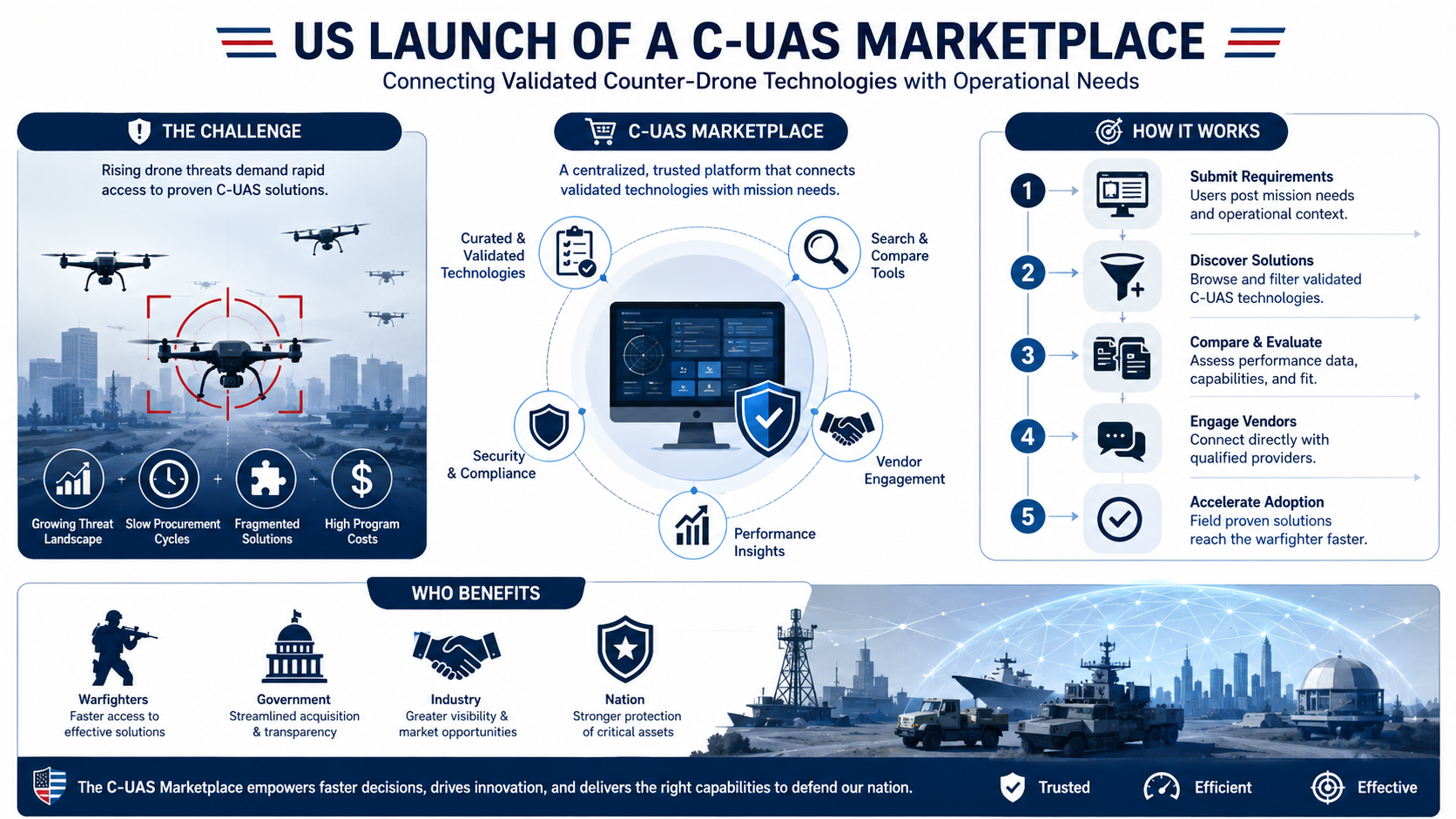
The rapid proliferation of unmanned aircraft systems has created a growing requirement for technologies capable of detecting, tracking, identifying, and responding to unauthorized or hostile drones. Military installations, airports, borders, critical infrastructure, government facilities, and other sensitive locations increasingly require layered counter-unmanned aircraft system (C-UAS) capabilities.
In response to this evolving threat environment, the US government has launched a dedicated C-UAS Marketplace designed to simplify the process of discovering, evaluating, and procuring counter-drone technologies. The official marketplace describes itself as the US government's central marketplace for discovering, evaluating, and procuring counter-drone technology and is operated by JIATF 401.
The initiative represents an important shift in defense technology procurement. Rather than requiring potential users to navigate fragmented sources of information and lengthy discovery processes, the marketplace is intended to provide a more centralized pathway for accessing validated counter-UAS capabilities.
The development comes at a time when military organizations are seeking faster ways to respond to rapidly evolving drone threats. The US Department of Defense launched the marketplace in August 2026, with JIATF 401 responsible for connecting government users with companies developing counter-drone technologies.
Evolution of counter-drone technology procurement
Counter-drone technology has evolved rapidly from individual detection and mitigation products into integrated defense architectures. Early counter-UAS deployments often focused on specific capabilities, such as RF detection, radar surveillance, electronic disruption, or kinetic interception.
Modern C-UAS requirements are considerably broader. Defense and security organizations increasingly need systems that combine multiple sensors, command-and-control capabilities, analytics, and mitigation technologies into a coordinated architecture.
Procurement must therefore consider not only individual products but also their ability to operate within existing defense and security networks.
The emergence of a centralized marketplace reflects this evolution. By providing a dedicated environment for identifying and evaluating counter-drone technologies, the US initiative aims to help users navigate an increasingly diverse technology landscape.
Benefits of the C-UAS Marketplace
The US C-UAS Marketplace can provide several potential advantages to government and defense users:
-
Faster Technology Discovery: A centralized marketplace can make it easier for users to identify relevant counter-drone technologies without relying exclusively on fragmented procurement channels.
-
Validated Technology Access: The marketplace is designed around technologies that have undergone government-oriented evaluation and approval processes, helping users identify capabilities appropriate for operational requirements.
-
Simplified Procurement: A dedicated procurement environment can reduce friction between government organizations and technology providers.
-
Greater Technology Visibility: Vendors can gain a more structured route to present counter-UAS capabilities to potential government customers.
-
Support for Rapid Innovation: Faster exposure to emerging technologies can help government users respond to rapidly changing drone threats.
-
Improved Matching of Capabilities to Requirements: The marketplace's purpose is to help connect appropriate counter-UAS capabilities with users requiring them.
Current market size and growth trends of the Counter-UAS industry
The global Counter-UAS industry is experiencing rapid growth as governments, defense organizations, airports, critical infrastructure operators, and security agencies strengthen protection against unauthorized and hostile drone activity.
According to MarketsandMarkets, the Global Counter-UAS System (C-UAS) Market Size was valued at USD 9.17 billion in 2026 and is projected to reach USD 29.70 billion by 2031, growing at a CAGR of 26.5% from 2026–2031. The market is driven by the rising number of hostile and unauthorized drone activities near military bases, airports, border areas, and critical infrastructure.
This rapid market expansion reflects the increasing importance of low-altitude airspace security and the growing adoption of integrated counter-drone architectures.
Several factors are contributing to this growth, including:
• Increasing hostile and unauthorized drone activity around sensitive locations
• Growing military investment in counter-drone and layered air-defense capabilities
• Increasing adoption of AI-powered drone detection and threat classification
• Greater integration of radar, RF detection, EO/IR sensors, and command-and-control systems
• Rising demand for mobile and vehicle-mounted C-UAS solutions
• Increasing deployment of counter-UAS systems across military, government, homeland security, and critical infrastructure applications
MarketsandMarkets also identifies drone detection, tracking and identification, command and control, and UAS mitigation and neutralization as key solution categories within the market.
Key drivers and factors influencing the future of the C-UAS Marketplace
Several important factors are likely to influence the continued development of the US C-UAS Marketplace and the broader counter-drone ecosystem.
1. Increasing Drone Threats
Drones are becoming increasingly accessible, capable, and autonomous. Their use for surveillance, intelligence gathering, unauthorized access, and other security-sensitive activities has increased demand for counter-UAS capabilities.
As the threat environment changes, government organizations require faster access to technologies capable of addressing different drone types and operating environments.
2. Need for Faster Procurement
Traditional defense procurement processes can take significant time, while drone technology can evolve rapidly.
A centralized marketplace can help reduce the time required to discover and evaluate suitable technologies, potentially improving the speed at which new capabilities reach operational users.
3. Demand for Validated Technologies
Government users need confidence that counter-drone technologies can meet operational requirements. A marketplace centered on validated or approved solutions can help reduce uncertainty during technology selection.
4. Expansion of Layered C-UAS Architectures
Modern counter-UAS strategies increasingly combine detection, tracking, identification, command and control, and mitigation capabilities.
MarketsandMarkets notes that military and government organizations are increasingly investing in layered C-UAS systems that integrate surveillance, command-and-control, and air-defense networks.
5. Rapid Technology Innovation
AI, machine learning, advanced radar, RF sensing, electro-optical/infrared systems, electronic warfare, and autonomous technologies are continuously changing the counter-drone landscape.
A marketplace can provide a mechanism for government users to discover emerging capabilities as these technologies mature.
Emerging trends in the C-UAS Marketplace and counter-drone industry
The future of counter-UAS procurement is likely to be influenced by several major technology and acquisition trends.
1. AI-Enabled Counter-UAS
Artificial intelligence is increasingly being integrated into drone detection, classification, tracking, and threat assessment.
AI can support the identification of aerial objects and help distinguish potential drone threats from other objects operating in the airspace.
2. Multi-Sensor Integration
Next-generation C-UAS architectures are increasingly combining radar, RF detection, EO/IR cameras, acoustic sensors, and other technologies.
The combination of multiple sensor types can provide broader situational awareness than relying on a single detection method.
3. Integrated Command and Control
Command-and-control systems are becoming central to C-UAS architectures because they can coordinate information from multiple sensors and connect detection with appropriate response capabilities.
4. Mobile Counter-UAS Systems
Vehicle-mounted and portable counter-UAS systems are becoming increasingly important for military and security organizations requiring flexible protection.
MarketsandMarkets identifies fixed-site, portable/man-portable, vehicle-mounted, shipborne/maritime, and airborne/drone-mounted configurations as deployment categories in the C-UAS market.
5. Autonomous Threat Detection
The future of C-UAS technology is moving toward increasingly automated detection and classification.
Automation can help operators process large volumes of sensor information and prioritize potential threats.
Opportunities and challenges in the C-UAS Marketplace
The launch of a dedicated US marketplace creates opportunities for both government users and technology developers.
Key opportunities include:
-
Faster Government Access: Counter-UAS developers can gain a more direct channel for presenting validated technologies to government customers.
-
Technology Commercialization: Smaller and emerging companies may have greater visibility among government users seeking innovative counter-drone capabilities.
-
Rapid Capability Deployment: Centralized discovery and procurement can potentially shorten the path from technology evaluation to operational deployment.
-
Integrated Solutions: The marketplace can encourage development of complete counter-UAS architectures rather than isolated technologies.
-
Continuous Innovation: Vendors have incentives to develop increasingly capable AI, sensor, networking, and mitigation technologies.
However, the industry also faces several challenges.
-
Rapid Threat Evolution: Drone technologies continue to evolve, requiring C-UAS technologies to remain adaptable.
-
Interoperability: Counter-UAS systems must increasingly operate alongside existing radar, communications, air-defense, and command-and-control systems.
-
False Positives: Detecting small aerial objects accurately while distinguishing genuine threats from birds, aircraft, and other objects remains an important technical requirement.
-
Procurement Complexity: Even a centralized marketplace must address security, compliance, export-control, operational, and integration requirements.
-
Technology Obsolescence: Rapid innovation can make existing counter-drone capabilities less effective as new drone designs and operating techniques emerge.
Innovations and advancements in counter-UAS technology
The future of the C-UAS market is being shaped by a combination of sensing, artificial intelligence, networking, electronic warfare, and mitigation technologies.
1. Advanced Radar
Modern counter-UAS radars are increasingly designed to detect small, low-altitude, and potentially difficult-to-track aerial objects.
Advanced processing can improve detection and tracking in environments containing significant amounts of background clutter.
2. RF Detection and Analysis
RF systems can identify electromagnetic emissions associated with drones and their control links. These capabilities can complement radar and optical sensors.
3. AI-Based Threat Classification
AI and machine learning can help classify detected objects and prioritize potential threats.
This is particularly important as C-UAS systems process information from multiple sensors simultaneously.
4. Electronic Warfare Integration
Electronic warfare technologies can form part of layered counter-UAS architectures, providing non-kinetic options for addressing certain drone threats.
5. Directed-Energy Technologies
Directed-energy technologies, including high-energy laser systems, are being explored as potential components of future counter-drone architectures. Recent US defense activity illustrates the broader push toward combining kinetic and non-kinetic counter-UAS technologies.
6. Networked C-UAS
Future systems are expected to connect sensors and effectors across distributed networks, enabling organizations to build a broader operational picture of low-altitude airspace.
Future applications and industries that will benefit from the C-UAS Marketplace
The C-UAS Marketplace and broader counter-drone ecosystem have potential applications across multiple sectors.
1. Military and Defense
Military installations require protection against unauthorized or hostile drones. C-UAS technologies can contribute to layered base-defense and airspace-security architectures.
2. Airports and Aviation
Unauthorized drones can create significant operational and safety challenges around airports. Counter-UAS systems can support monitoring and protection of controlled airspace.
3. Border Security
Border agencies can use counter-drone technologies to detect and track unauthorized aerial activity across sensitive border regions.
4. Critical Infrastructure
Power facilities, communications infrastructure, industrial sites, ports, and other high-value facilities may increasingly require counter-drone protection.
5. Government Facilities
Government buildings and sensitive installations can benefit from technologies capable of monitoring low-altitude airspace and identifying unauthorized drone activity.
6. Public Safety
Major public events and high-security environments can require temporary or permanent counter-UAS capabilities to improve airspace awareness.
7. Homeland Security
The growing availability of drones has expanded the potential threat surface for homeland security organizations, creating additional demand for integrated detection and mitigation technologies.
How the C-UAS Marketplace could reshape counter-drone procurement
The launch of the marketplace is significant because it addresses an important challenge facing the rapidly expanding C-UAS industry: how to move validated technology from developers to operational users more efficiently.
The official C-UAS Marketplace is positioned as a centralized platform for discovering, evaluating, and procuring counter-drone technologies.
This model could encourage a more technology-driven procurement environment in which government organizations can compare capabilities and identify solutions based on operational requirements.
It may also help accelerate the adoption of emerging technologies as new counter-UAS capabilities become available.
The broader significance is that counter-drone procurement is moving beyond individual product purchases toward integrated capability development. Future C-UAS requirements are likely to emphasize interoperability, sensor fusion, AI-based analytics, command and control, flexible deployment, and layered mitigation.
The promising future of the US C-UAS Marketplace
The US C-UAS Marketplace arrives at a time when the counter-drone market is expanding rapidly. With the global C-UAS market projected to grow from USD 9.17 billion in 2026 to USD 29.70 billion by 2031 at a CAGR of 26.5%, the need for efficient technology discovery and procurement is becoming increasingly important.
The marketplace can potentially become an important bridge between counter-drone technology developers and government users. By providing a centralized environment for discovering and procuring validated solutions, it can support faster access to emerging capabilities.
Its development also reflects a broader transformation within the defense technology ecosystem. Governments are increasingly seeking acquisition models that can respond to rapidly evolving technologies, particularly in areas such as unmanned systems, artificial intelligence, electronic warfare, autonomous systems, and advanced sensing.
As counter-drone threats continue to evolve, the marketplace model could contribute to a more agile C-UAS acquisition ecosystem.
A new phase for counter-drone technology procurement
The US launch of the C-UAS Marketplace represents an important development in the rapidly expanding counter-drone industry. The platform is designed to make it easier for government organizations to discover, evaluate, and procure counter-drone technologies, creating a more centralized pathway between validated technology providers and operational users.
At the same time, the rapid expansion of the global C-UAS market highlights the urgency behind such initiatives. Rising unauthorized and hostile drone activity around military bases, airports, borders, and critical infrastructure is driving demand for increasingly sophisticated airspace-security solutions.
From AI-powered detection and multi-sensor fusion to advanced radar, RF sensing, electronic warfare, directed energy, and networked command-and-control systems, the next generation of C-UAS technologies will increasingly emphasize integration and adaptability.
The marketplace could therefore become more than a procurement platform. It has the potential to support a broader ecosystem in which innovative counter-drone technologies can be identified, evaluated, and deployed more efficiently.
As drone capabilities continue to advance, the ability to rapidly access validated counter-UAS technologies will become increasingly important for maintaining secure low-altitude airspace across military, government, aviation, and critical infrastructure environments.
Discover the latest market trends, technologies, growth opportunities, competitive landscape, and forecasts shaping the global Counter-UAS System Market.
Download the Sample Research Report for the Counter-UAS System Market: https://www.marketsandmarkets.com/Market-Reports/counter-cuas-systems-market-4197284.html
80% of the Forbes Global 2000 B2B companies rely on MarketsandMarkets to identify growth opportunities in emerging technologies and use cases that will have a positive revenue impact.
- Food Packaging Market Size Set for Strong Growth Through 2030 Amid Rising Demand for Convenience Foods
- Crop Protection Chemical Market Size, Share & Growth Forecast (2025–2030)
- Mulch Films Market: Driving Sustainable Agriculture Through Innovation
- Agricultural Adjuvants Market Analysis, Trends, and Growth Outlook (2026–2031)
- Japan Enterprise Asset Management Market Growth: AI and Smart Infrastructure Drive Demand


