

Why Counter-UAS Is Becoming a Core Defense Investment Priority in 2026
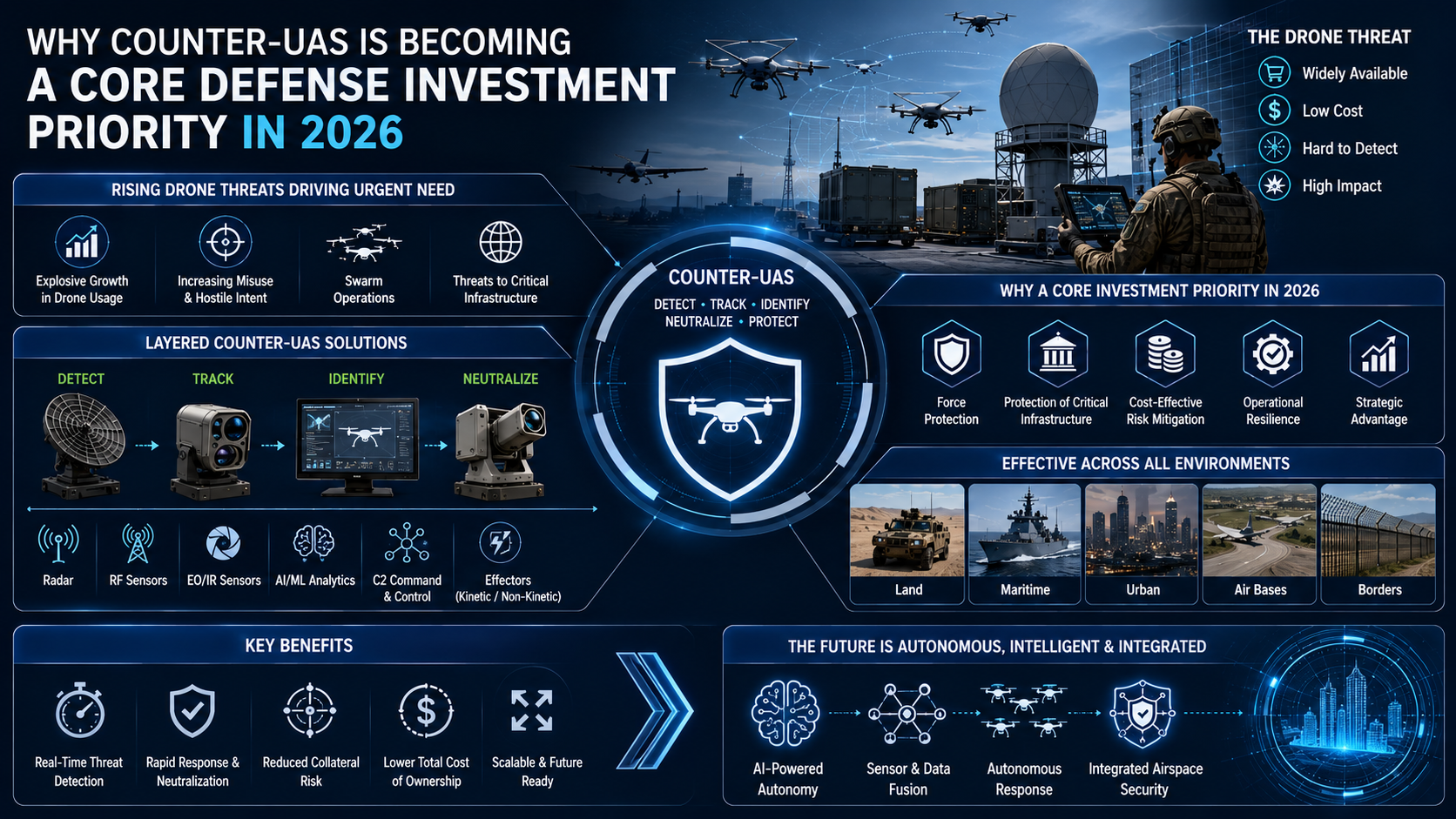
The rapid proliferation of unmanned aerial systems (UAS) is changing the modern security and defense environment. Drones that were once primarily associated with reconnaissance and commercial applications are now being deployed across increasingly complex operational scenarios. As a result, military forces, homeland security organizations, airports, border agencies, and critical infrastructure operators are placing greater emphasis on technologies capable of identifying, tracking, and mitigating unauthorized or potentially hostile drones.
Counter-UAS (C-UAS) systems have emerged as an important layer within modern defense architectures. These systems combine technologies such as radar, radio-frequency (RF) sensing, electro-optical and infrared sensors, artificial intelligence, electronic warfare, and other mitigation technologies to address drone threats.
In 2026, Counter-UAS is increasingly being treated not simply as an individual equipment category, but as a strategic defense capability. The objective is to build layered protection that can identify threats early, assess their behavior, provide decision-makers with actionable information, and deploy an appropriate response.
The growing importance of C-UAS reflects a broader shift in defense procurement toward integrated, networked, and software-enabled systems. As drone threats become more diverse and sophisticated, defense organizations are seeking solutions that can adapt to changing technologies and operational environments.
Evolution of Counter-UAS Systems
Early counter-drone solutions focused primarily on detecting unauthorized UAVs and providing basic methods for disrupting their operations. As drone technology advanced, however, counter-UAS requirements became considerably more complex.
Modern systems increasingly need to distinguish between different types of aerial objects, track multiple targets, operate in congested electromagnetic environments, and integrate information from multiple sensors.
The evolution of C-UAS can therefore be viewed as a transition from standalone detection systems toward layered and networked architectures.
A modern counter-UAS architecture may incorporate:
• Radar-based drone detection
• RF detection and identification
• Electro-optical and infrared surveillance
• Artificial intelligence-enabled classification
• Electronic warfare capabilities
• Command-and-control systems
• Kinetic and non-kinetic mitigation technologies
• Integrated sensor and data fusion
This evolution is making C-UAS an increasingly important component of military force protection and critical infrastructure security.
Benefits of Counter-UAS Systems
Counter-UAS systems offer several advantages for defense and security organizations:
-
Early Threat Detection: Detection technologies can identify potentially unauthorized drones before they reach protected areas, providing additional time for assessment and response.
-
Layered Protection: C-UAS architectures can combine multiple sensing and mitigation technologies to address different types of drone threats.
-
Situational Awareness: Sensor fusion can provide operators with a more comprehensive view of aerial activity around protected locations.
-
Protection of Critical Assets: Counter-UAS systems can help protect military bases, airports, energy facilities, ports, government facilities, and other sensitive locations.
-
Operational Flexibility: Modern systems can be deployed across fixed sites, mobile platforms, vehicles, and temporary security environments.
-
Network Integration: C-UAS systems can increasingly connect with broader command-and-control and surveillance networks.
-
Adaptability: Software-defined architectures and AI-based processing can support upgrades as drone technologies and threat patterns evolve.
Current Market Size and Growth Trends of the Counter-UAS Industry
The global Counter-UAS market is experiencing rapid expansion as defense forces and security organizations respond to the increasing use of drones in contested and sensitive environments.
According to MarketsandMarkets, the Global Counter-UAS System (C-UAS) Market Size was valued at USD 9.17 billion in 2026 and is projected to reach USD 29.70 billion by 2031, growing at a CAGR of 26.5% from 2026 to 2031. The market is driven by the rising number of hostile and unauthorized drone activities near military bases, airports, border areas, and critical infrastructure.
The strong market expansion reflects the increasing recognition that conventional air-defense systems may not always provide an economical or operationally suitable response to smaller unmanned aircraft. This is encouraging defense organizations to develop specialized counter-UAS capabilities.
The market's growth is supported by several factors, including:
• Increasing deployment of drones for reconnaissance, surveillance, and other military missions
• Rising use of unauthorized drones around airports and sensitive facilities
• Growing defense spending on force protection and low-altitude air defense
• Increasing demand for radar and RF-based drone detection
• Rapid adoption of AI-enabled detection and classification
• Development of electronic warfare-based mitigation technologies
• Increasing deployment of integrated command-and-control systems
• Growing requirements for protection of critical infrastructure
Key Drivers and Factors Influencing Counter-UAS Investment in 2026
Several factors are making Counter-UAS a strategic investment priority for defense organizations in 2026.
Rising Drone Threats
One of the strongest drivers is the increasing availability and operational use of drones.
Small UAVs can provide surveillance capabilities and can potentially be used to disrupt operations around military installations, airports, borders, energy facilities, and public venues.
The diversity of available drone platforms means that defense organizations need detection and response architectures capable of addressing different sizes, operating profiles, and levels of sophistication.
Military Force Protection
Military bases are particularly important applications for C-UAS technology.
Modern military installations contain aircraft, ammunition, command centers, communications infrastructure, personnel, and other high-value assets.
Counter-UAS systems can provide an additional protective layer by monitoring low-altitude airspace and identifying potentially unauthorized UAV activity.
Critical Infrastructure Protection
Energy facilities, power plants, ports, communications sites, and transportation infrastructure are increasingly considering counter-drone technologies.
A drone entering a restricted area can create operational, safety, and security concerns even when malicious intent has not been established.
Consequently, organizations are investing in detection and monitoring capabilities that can provide greater awareness of nearby drone activity.
Airport Security
Airports are another major application area.
Unauthorized drone activity can disrupt flight operations and create significant safety concerns. C-UAS technologies can help security organizations detect and track drones operating near airport airspace.
This creates demand for systems capable of operating effectively in complex environments where false alarms and electromagnetic interference must be carefully managed.
Defense Modernization
Counter-UAS capabilities are increasingly being incorporated into broader defense modernization programs.
Rather than operating as isolated systems, future C-UAS technologies are expected to become integrated with air-defense networks, surveillance systems, battlefield management systems, and command-and-control architectures.
Emerging Trends in Counter-UAS Technology
The future of Counter-UAS is being shaped by several important technology trends.
1. AI-Powered Drone Detection
Artificial intelligence is becoming an important component of modern counter-UAS systems.
AI algorithms can assist in analyzing sensor data, identifying patterns, classifying objects, and reducing false alarms.
By processing information from radar, RF sensors, cameras, and other sources, AI can help operators differentiate potential drone threats from birds, aircraft, and other objects.
2. Multi-Sensor Fusion
Future C-UAS systems will increasingly combine multiple sensing technologies.
Radar can provide range and tracking information, RF sensors can identify relevant emissions, while electro-optical and infrared systems can provide visual confirmation.
Combining these sources can create a more comprehensive threat picture.
3. Electronic Warfare Integration
Electronic warfare is becoming increasingly important within counter-UAS architectures.
Electronic methods can provide non-kinetic options for responding to certain drone threats, depending on the operational environment and applicable regulations.
This makes electronic warfare an important component of layered counter-drone defense.
4. Autonomous Threat Assessment
Automation is expected to play a larger role in future C-UAS operations.
Systems may increasingly automate parts of the detection, classification, tracking, and alerting process, allowing operators to focus on higher-level decisions.
The objective is not simply to automate every response but to reduce operator workload and improve reaction times.
5. Distributed Counter-UAS Networks
Instead of relying on one sensor or one mitigation system, future architectures are likely to use distributed networks of sensors.
Multiple systems can provide overlapping coverage, enabling operators to maintain awareness even when individual sensors have limitations.
Opportunities and Challenges in the Counter-UAS Market
The rapid expansion of the C-UAS market creates significant opportunities for defense contractors, sensor manufacturers, electronics companies, software developers, and system integrators.
Opportunities
-
Integrated C-UAS Platforms: Demand is increasing for complete systems combining detection, tracking, command and control, and mitigation capabilities.
-
AI-Based Detection: Companies developing AI algorithms for object classification, sensor fusion, and threat assessment can benefit from increasing automation requirements.
-
Compact Radar: Smaller radar systems can support mobile and distributed counter-UAS deployments.
-
Electronic Warfare: Advanced electronic warfare technologies provide opportunities for non-kinetic counter-drone capabilities.
-
Critical Infrastructure Security: Airports, energy facilities, ports, and other infrastructure operators represent expanding commercial and government markets.
-
Networked Defense: Integration with existing air-defense and command-and-control networks creates opportunities for software and interoperability solutions.
-
Mobile C-UAS: Militaries increasingly require systems that can accompany deployed forces and protect temporary operating locations.
However, the Counter-UAS market also faces several challenges.
Counter-drone systems must operate in complex electromagnetic environments and distinguish genuine threats from harmless objects. False positives can create unnecessary operational responses, while false negatives can allow threats to go undetected.
Regulatory requirements are another consideration, particularly for systems that operate around civilian airspace and critical infrastructure. Organizations must also consider interoperability with existing defense networks.
Cost remains an additional challenge. Customers increasingly require effective solutions without creating excessive procurement, deployment, training, and maintenance burdens.
Innovations and Advancements in Counter-UAS Technology
The future of C-UAS will be shaped by innovations across sensing, software, artificial intelligence, electronic warfare, and command-and-control technologies.
Advanced Counter-Drone Radar
Radar remains a foundational technology for detecting and tracking UAVs.
Next-generation radar systems are expected to become more compact while improving detection, tracking, and classification capabilities.
Advanced signal processing can help systems identify small targets in environments containing significant background clutter.
AI-Enabled Sensor Processing
AI can enable faster interpretation of data from multiple sensors.
Instead of requiring operators to manually analyze every detection, automated systems can prioritize potential threats and present relevant information to security personnel.
This can improve operational efficiency when multiple drones are present simultaneously.
High-Speed Data Fusion
Modern C-UAS systems increasingly depend on the rapid exchange of information.
Data fusion technologies can combine radar tracks, RF information, electro-optical imagery, and other intelligence into a common operating picture.
This provides operators with a more complete understanding of the aerial environment.
Directed-Energy Technologies
Directed-energy technologies are being explored as potential components of future counter-UAS architectures.
Their development reflects the broader defense requirement for scalable and potentially cost-efficient methods of addressing certain drone threats.
Software-Defined C-UAS
Software-defined architectures can make C-UAS systems more adaptable.
Software updates can potentially introduce new detection algorithms, threat libraries, classification models, and operational functions without requiring complete replacement of hardware.
This approach can help defense organizations maintain capability as drone technologies evolve.
Future Applications and Industries That Will Benefit From Counter-UAS
1. Military and Defense
Military applications will remain central to the Counter-UAS market.
Systems can support base protection, battlefield force protection, airspace monitoring, and protection of deployed personnel and equipment.
C-UAS is also increasingly becoming part of layered low-altitude air-defense architectures.
2. Airports
Airports require reliable awareness of unauthorized UAV activity because drones can interfere with aviation operations.
Counter-UAS solutions can provide security teams with detection and tracking capabilities around sensitive airspace.
3. Energy Infrastructure
Power plants, substations, oil and gas facilities, and renewable energy installations can represent attractive applications for counter-drone systems.
Protecting these assets can help reduce risks associated with unauthorized aerial activity.
4. Border Security
Border agencies can use C-UAS systems to detect unauthorized UAVs operating near sensitive areas.
Integration with broader surveillance networks can provide additional information for security teams.
5. Ports and Maritime Facilities
Ports contain high-value infrastructure and operate in complex environments.
Counter-UAS systems can help security teams monitor aerial activity around ports, naval facilities, and other maritime infrastructure.
6. Smart Cities and Public Venues
Large public venues, government facilities, stadiums, and major events can require temporary or permanent aerial security.
Mobile and rapidly deployable C-UAS solutions can provide additional protection during high-profile events.
7. Commercial and Industrial Facilities
As drones become more widely used for commercial purposes, industrial organizations may increasingly require technologies to monitor restricted airspace around their facilities.
Why Counter-UAS Is Becoming a Core Defense Investment Priority in 2026
Counter-UAS is increasingly moving from a specialized defense requirement to a core component of modern security architecture.
The reason is straightforward: the drone threat is evolving faster than conventional security models can adapt.
Modern defense organizations must prepare for scenarios involving individual drones, multiple simultaneous UAVs, autonomous platforms, and increasingly sophisticated drone operations. This creates a requirement for layered systems capable of detecting, classifying, tracking, and responding to different threats.
Investment priorities are consequently shifting toward integrated architectures rather than isolated equipment.
A modern C-UAS investment strategy increasingly emphasizes:
• Detection: Identifying potential UAV activity at an early stage.
• Classification: Determining whether detected objects represent genuine threats.
• Tracking: Maintaining awareness of the location and movement of potential targets.
• Identification: Combining sensor information to improve confidence in threat assessment.
• Command and Control: Giving operators a common operating picture and coordinated decision-support capability.
• Mitigation: Providing appropriate response options based on the operational situation.
• Integration: Connecting C-UAS capabilities with broader defense and security networks.
This layered approach is particularly important because no single technology is expected to address every drone scenario effectively.
Future Outlook for the Counter-UAS Market
The Counter-UAS market is expected to remain one of the fastest-growing areas within defense technology.
According to MarketsandMarkets, the market is projected to expand from USD 9.17 billion in 2026 to USD 29.70 billion by 2031, representing a 26.5% CAGR.
Future development will increasingly center on AI-enabled sensing, multi-sensor fusion, autonomous threat assessment, advanced radar, electronic warfare, distributed sensor networks, and integrated command-and-control architectures.
The convergence of these technologies will enable C-UAS systems to move toward faster and more intelligent threat assessment.
AI may help operators manage larger numbers of simultaneous detections, while advanced radar and RF sensing can improve detection capabilities. Software-defined architectures can provide the flexibility required to adapt to evolving UAV technologies.
At the same time, C-UAS is likely to become increasingly integrated with broader air-defense and security ecosystems.
The Strategic Future of Counter-UAS
The growing importance of Counter-UAS technology reflects a fundamental change in the modern defense environment. Drones are becoming more accessible, more capable, and more diverse, creating new security requirements for military forces and civilian infrastructure operators.
According to MarketsandMarkets, the Global Counter-UAS System (C-UAS) Market Size was valued at USD 9.17 billion in 2026 and is projected to reach USD 29.70 billion by 2031, growing at a CAGR of 26.5% from 2026 to 2031.
The market's rapid growth is being supported by increasing drone activity around military bases, airports, border areas, critical infrastructure, and other sensitive locations.
The future of C-UAS will extend beyond simple drone detection. AI, advanced radar, RF sensing, sensor fusion, electronic warfare, software-defined systems, and integrated command-and-control technologies will increasingly work together to create layered counter-drone architectures.
For defense organizations, investment in Counter-UAS is therefore becoming a strategic requirement rather than an optional capability. The ability to detect emerging threats, understand their behavior, coordinate responses, and integrate counter-drone systems into wider defense networks will become increasingly important.
As drone technology continues to evolve, Counter-UAS technology will also need to evolve continuously. Organizations that prioritize adaptable, scalable, networked, and AI-enabled architectures will be better positioned to address the changing low-altitude security environment.
The future of defense against emerging drone threats will depend not on a single countermeasure, but on intelligent, integrated, and continuously evolving Counter-UAS ecosystems.
Discover the latest Counter-UAS market trends, technologies, growth opportunities, and competitive insights from MarketsandMarkets
https://www.marketsandmarkets.com/Market-Reports/counter-cuas-systems-market-4197284.html
80% of the Forbes Global 2000 B2B companies rely on MarketsandMarkets to identify growth opportunities in emerging technologies and use cases that will have a positive revenue impact.
- Food Packaging Market Size Set for Strong Growth Through 2030 Amid Rising Demand for Convenience Foods
- Crop Protection Chemical Market Size, Share & Growth Forecast (2025–2030)
- Mulch Films Market: Driving Sustainable Agriculture Through Innovation
- Agricultural Adjuvants Market Analysis, Trends, and Growth Outlook (2026–2031)
- Japan Enterprise Asset Management Market Growth: AI and Smart Infrastructure Drive Demand


