

Latest Trends in the Counter UAS Market: AI Analytics, Multi-Sensor Integration, and Secure Airspace Technologies
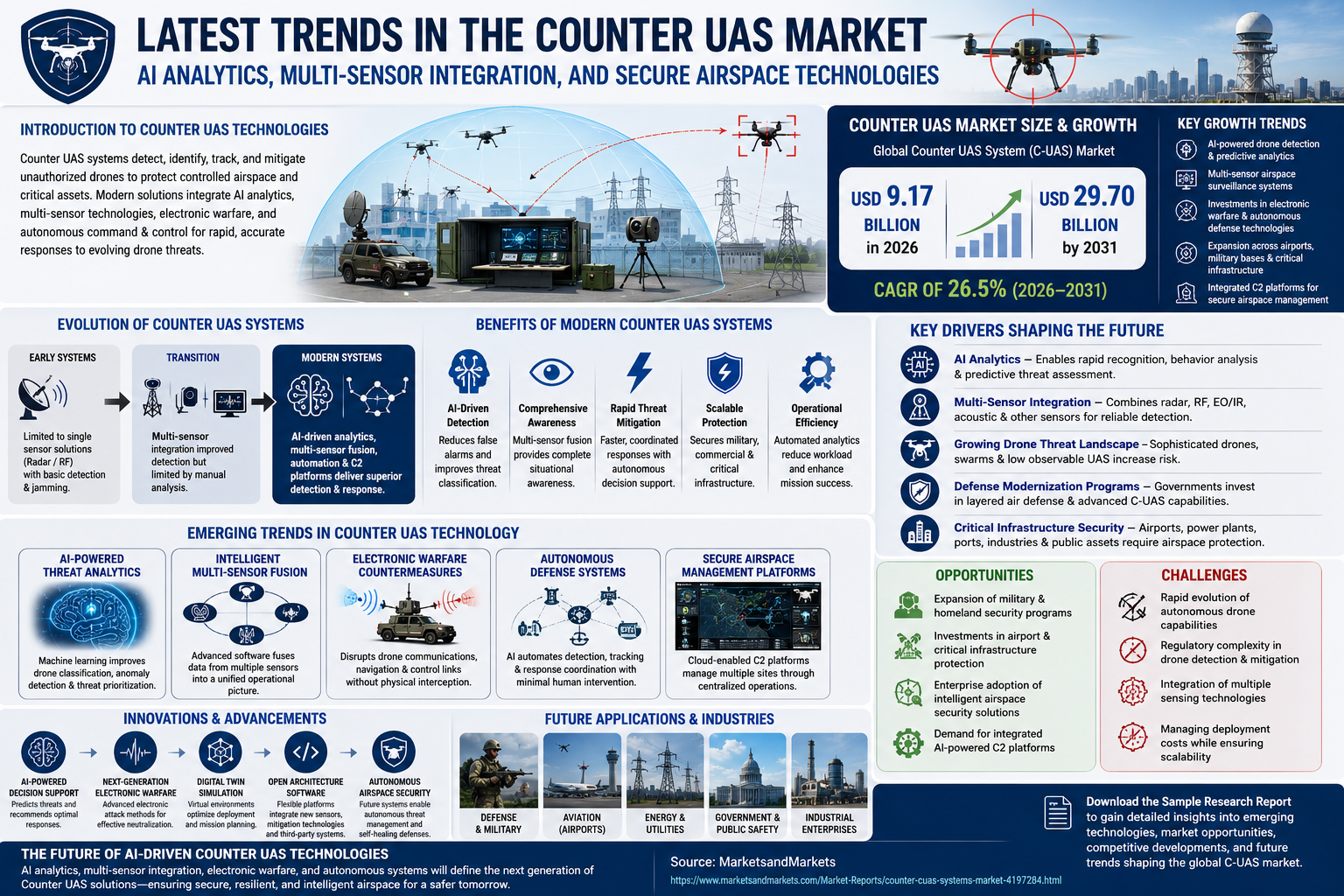
Introduction to Counter UAS Technologies
As unmanned aerial systems become increasingly sophisticated and widely deployed, protecting controlled airspace has become a strategic priority for defense organizations, government agencies, airports, energy providers, and operators of critical infrastructure. Unauthorized drones can be used for surveillance, espionage, smuggling, cyber enabled attacks, or direct physical threats, making traditional perimeter security insufficient for modern operational environments. Counter Unmanned Aircraft Systems (Counter UAS) have therefore evolved into intelligent, integrated airspace security platforms capable of detecting, identifying, tracking, and mitigating drone threats before they disrupt operations.
The latest generation of Counter UAS solutions combines artificial intelligence analytics, multi sensor integration, electronic warfare, cyber protection, electro optical imaging, radar, radio frequency detection, and autonomous command and control systems. These technologies deliver comprehensive situational awareness while enabling organizations to respond rapidly to increasingly complex drone threats across military installations, airports, industrial facilities, transportation networks, and critical national infrastructure.
Evolution of Counter UAS Systems
Counter UAS technology has advanced rapidly in response to the growing capabilities of commercial and military drones. Early systems primarily relied on radar or radio frequency jamming to detect and disrupt drone activity. While effective against basic platforms, these approaches often struggled to identify autonomous drones, low altitude aircraft, or multiple simultaneous threats.
Modern Counter UAS architectures integrate multiple sensing technologies with artificial intelligence driven analytics, allowing operators to fuse information from radar, electro optical cameras, infrared sensors, acoustic detectors, and radio frequency monitoring into a unified operational picture. This evolution has significantly improved detection accuracy, response speed, and overall airspace security.
Benefits of Modern Counter UAS Systems
Advanced Counter UAS technologies deliver several important advantages for defense organizations and enterprise operators.
- Artificial Intelligence Driven Detection: AI rapidly identifies, classifies, and prioritizes drone threats while minimizing false alarms.
- Comprehensive Situational Awareness: Multi sensor integration provides continuous monitoring across complex operational environments.
- Rapid Threat Mitigation: Autonomous decision support enables faster and more coordinated responses to airborne threats.
- Scalable Airspace Protection: Modern platforms protect military bases, airports, energy facilities, industrial sites, and public infrastructure.
- Improved Operational Efficiency: Automated analytics reduce operator workload while enhancing mission effectiveness.
Current Market Size and Growth Trends of the Counter UAS Industry
The Counter UAS industry is experiencing exceptional global growth as governments and commercial organizations increase investments in intelligent airspace protection technologies. The rising use of drones for surveillance, intelligence gathering, logistics, and offensive operations has accelerated demand for integrated Counter UAS solutions capable of securing both military and civilian environments.
According to MarketsandMarkets, the global Counter UAS System (C UAS) Market was valued at USD 9.17 billion in 2026 and is projected to reach USD 29.70 billion by 2031, growing at a CAGR of 26.5% during the forecast period.
Several important trends are contributing to this rapid market expansion:
- Rising adoption of AI powered drone detection and predictive threat analytics
- Increasing deployment of multi sensor airspace surveillance systems
- Growing investments in electronic warfare and autonomous defense technologies
- Expansion of Counter UAS deployments across airports, military bases, and critical infrastructure
- Continuous development of integrated command and control platforms for secure airspace management
Key Drivers Influencing the Future of the Counter UAS Market
Several strategic developments continue driving innovation throughout the industry.
Artificial Intelligence Analytics
Artificial intelligence enables rapid target recognition, behavior analysis, predictive threat assessment, and automated decision support for Counter UAS operations.
Multi Sensor Integration
Combining radar, radio frequency monitoring, electro optical imaging, infrared cameras, and acoustic sensors significantly improves detection reliability and operational awareness.
Growing Drone Threat Landscape
The increasing sophistication of autonomous drones, drone swarms, and low observable unmanned aircraft continues accelerating demand for advanced Counter UAS capabilities.
Defense Modernization Programs
Governments worldwide continue investing in layered air defense systems capable of protecting military forces and strategic infrastructure from evolving aerial threats.
Critical Infrastructure Security
Airports, power plants, ports, transportation networks, government facilities, and industrial operations require comprehensive airspace protection against unauthorized drone activity.
Emerging Trends in Counter UAS Technology
Several innovations are shaping the future of secure airspace technologies.
AI Powered Threat Analytics
Machine learning algorithms continuously improve drone classification, anomaly detection, and threat prioritization.
Intelligent Multi Sensor Fusion
Advanced software integrates data from multiple sensors into a unified operational picture for greater situational awareness.
Electronic Warfare Countermeasures
Modern electronic warfare systems disrupt drone communications, navigation, and mission execution without requiring physical interception.
Autonomous Defense Systems
Artificial intelligence automates target detection, tracking, and response coordination while reducing human intervention.
Secure Airspace Management Platforms
Cloud enabled command and control systems allow organizations to manage multiple protected facilities through centralized security operations.
Opportunities and Challenges in the Counter UAS Market
The Counter UAS market presents significant growth opportunities.
Opportunities
- Expansion of military modernization and homeland security programs
- Increasing investments in airport and critical infrastructure protection
- Growing enterprise adoption of intelligent airspace security solutions
- Rising demand for integrated AI powered command and control platforms
The industry also faces several challenges.
Challenges
- Rapid technological evolution of autonomous drone capabilities
- Regulatory complexity governing drone detection and mitigation
- Integration of multiple sensing technologies into existing security environments
- Managing deployment costs while maintaining scalable protection
Innovations and Advancements in Counter UAS Technology
Continuous innovation is transforming modern airspace security.
Artificial Intelligence Powered Decision Support
Advanced analytics improve operational efficiency through predictive threat identification and automated response recommendations.
Next Generation Electronic Warfare
Modern electronic attack capabilities provide highly effective non kinetic drone neutralization.
Digital Twin Simulation
Virtual operational environments help optimize Counter UAS deployment and mission planning before implementation.
Open Architecture Software
Flexible software platforms support integration of new sensors, mitigation technologies, and third party security systems.
Autonomous Airspace Security
Future Counter UAS systems will increasingly rely on autonomous threat management with minimal operator involvement.
Future Applications and Industries Benefiting from Counter UAS Systems
Counter UAS technologies continue expanding across multiple sectors.
Defense and Military
Military installations, tactical operations, command centers, and strategic defense infrastructure.
Aviation
Commercial airports, air traffic management, and aviation security.
Energy and Utilities
Power generation facilities, oil and gas infrastructure, renewable energy installations, and utility networks.
Government and Public Safety
Government facilities, border security, transportation infrastructure, and major public events.
Industrial Enterprises
Manufacturing facilities, logistics centers, data centers, and high value commercial infrastructure.
The Future of AI Driven Counter UAS Technologies
The future of the Counter UAS market will be shaped by artificial intelligence analytics, intelligent multi sensor integration, autonomous defense systems, electronic warfare, and secure airspace management platforms. As drone technology continues evolving, organizations responsible for protecting critical assets will increasingly depend on intelligent Counter UAS ecosystems capable of delivering rapid detection, accurate threat assessment, and coordinated response.
Companies developing integrated solutions that combine AI powered analytics, multi sensor awareness, and autonomous defense capabilities will play a leading role in the next generation of global airspace security.
According to MarketsandMarkets, the global Counter UAS System (C UAS) Market is projected to grow from USD 9.17 billion in 2026 to USD 29.70 billion by 2031, at a CAGR of 26.5%, reflecting accelerating investments in advanced Counter UAS technologies across defense, homeland security, aviation, and critical infrastructure sectors.
To explore comprehensive market forecasts, technology trends, competitive intelligence, and regional opportunities, visit:
https://www.marketsandmarkets.com/Market-Reports/counter-cuas-systems-market-4197284.html
Download the Sample Research Report to gain detailed insights into emerging technologies, market opportunities, competitive developments, and future trends shaping the global Counter UAS System Market.
80% of the Forbes Global 2000 B2B companies rely on MarketsandMarkets to identify growth opportunities in emerging technologies and use cases that will have a positive revenue impact.
- Food Packaging Market Size Set for Strong Growth Through 2030 Amid Rising Demand for Convenience Foods
- Mulch Films Market: Driving Sustainable Agriculture Through Innovation
- Agricultural Adjuvants Market Analysis, Trends, and Growth Outlook (2026–2031)
- Crop Protection Chemical Market Size, Share & Growth Forecast (2025–2030)
- Japan Enterprise Asset Management Market Growth: AI and Smart Infrastructure Drive Demand


