

Small Satellites Reshape the Global Satellite Manufacturing Industry
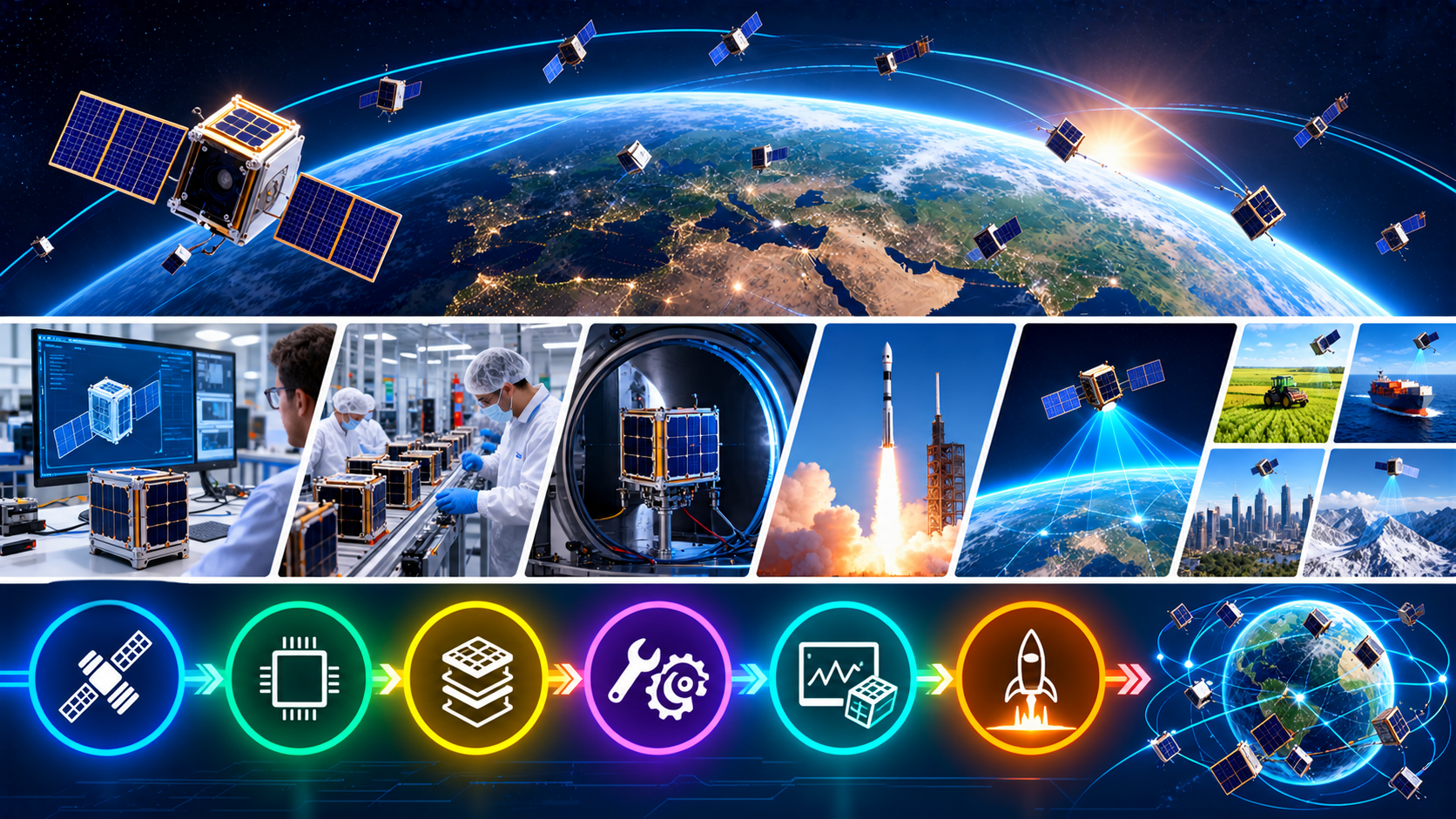
The global satellite industry is entering a new phase of transformation as organizations increasingly adopt smaller, more flexible, digitally enabled, and cost efficient satellite platforms. Expanding satellite networks, rising demand for communication and Earth observation services, growing commercial participation, and continued government and defense investment are reshaping the way satellites are designed, manufactured, deployed, and operated. This transformation is creating new opportunities across the satellite manufacturing ecosystem while accelerating the shift toward more scalable and technology driven production models.
The Global Satellites Market is evolving beyond conventional satellite manufacturing approaches centered on large and highly customized spacecraft. Modern satellite programs increasingly emphasize smaller platforms, modular architectures, advanced payloads, digital processing, autonomous operations, improved connectivity, and efficient manufacturing workflows. Small satellites can support broader deployment strategies by enabling organizations to build satellite networks with greater flexibility and scalability.
According to MarketsandMarkets, the Global Satellites Market was valued at USD 23.28 billion in 2026 and is projected to reach USD 58.37 billion by 2032, growing at a CAGR of 16.6% from 2026 to 2032. In terms of volume, the market is expected to reach 7,748 units by 2032 from 4,383 units in 2026. Market growth is supported by expanding satellite networks, increasing demand for communication and Earth observation services, rising commercial involvement, and ongoing government and defense investments in space infrastructure.
Small Satellites Enter an Investment Driven Growth Phase
Small satellites are increasingly attracting investment because organizations are seeking scalable approaches to expanding space based capabilities. Conventional satellite programs can require significant development resources, long manufacturing cycles, and complex integration processes. Smaller spacecraft can support more flexible deployment strategies and create opportunities for organizations seeking to expand communication, Earth observation, scientific, navigation, and other space based capabilities.
The growing adoption of satellite networks is creating opportunities across the complete satellite manufacturing ecosystem. Satellite manufacturers, component suppliers, payload developers, sensor companies, propulsion providers, communication technology companies, software developers, launch service providers, ground infrastructure companies, and data analytics providers are increasingly becoming part of the expanding satellite ecosystem.
The opportunity is not limited to the spacecraft itself. A complete small satellite solution can include the satellite bus, power system, thermal management system, attitude determination and control system, propulsion system, communication subsystem, payload, onboard computing, software, ground infrastructure, and data processing capabilities.
The increasing number of satellites being deployed is also creating demand for more efficient manufacturing processes. Manufacturers are increasingly focused on standardized components, modular designs, repeatable production workflows, and scalable integration processes. These approaches can support the development of multiple spacecraft while maintaining the flexibility required for different missions.
The expected increase in satellite volume from 4,383 units in 2026 to 7,748 units by 2032 highlights the importance of scalable manufacturing capabilities. The expansion of satellite networks is consequently creating opportunities not only for spacecraft manufacturers but also for companies supplying the technologies and infrastructure required to produce and operate larger satellite fleets.
AI Is Transforming Satellite Manufacturing and Operations
Artificial intelligence is becoming an important technology shaping the evolution of satellite systems. Earlier satellite architectures relied heavily on ground based processing and operator intervention. Modern systems increasingly incorporate intelligent software, automated operations, onboard processing, computer vision, predictive analytics, and autonomous decision support.
AI can support satellite manufacturers and operators across different stages of the spacecraft lifecycle. During manufacturing, intelligent systems can support inspection, quality control, production planning, and analysis of manufacturing data. During operations, AI can support satellite monitoring, anomaly detection, mission planning, image analysis, and resource management.
The integration of AI with satellite payloads is also changing the value of satellite data. Earth observation satellites can generate substantial quantities of imagery and sensor information. Processing this information closer to the point of collection can help organizations extract useful insights more efficiently.
AI can also support autonomous satellite operations. Intelligent systems can analyze spacecraft information and assist with operational decisions while reducing the amount of manual intervention required from ground teams.
The convergence of satellite hardware, AI, onboard computing, advanced sensors, and software is consequently creating new opportunities across the Global Satellites Market. As satellite networks expand, intelligent technologies are becoming increasingly important for managing larger and more complex spacecraft fleets.
Advanced Components Are Expanding Small Satellite Capabilities
Component technology represents one of the most important areas of innovation within satellite manufacturing. The capabilities of a satellite depend on the performance and integration of its power systems, communication systems, sensors, processors, navigation technologies, thermal systems, propulsion systems, and payloads.
Small satellite architectures are creating demand for compact and efficient components that can provide high performance within constrained physical and power requirements. Manufacturers and component suppliers are therefore focusing on improving the efficiency, reliability, and integration of satellite subsystems.
Communication components remain important because satellites increasingly support connectivity applications. Advanced communication systems can help spacecraft connect with ground infrastructure and other elements of increasingly integrated satellite networks.
Sensors are also becoming increasingly important as Earth observation and scientific missions expand. Advanced imaging and sensing technologies can enable satellites to collect detailed information about the Earth and its environment.
The growing availability of advanced components is expanding the potential applications of small satellite platforms. Instead of relying on one standardized satellite configuration, organizations can increasingly select spacecraft architectures and payload combinations according to specific mission requirements.
This modular approach is creating opportunities for both satellite manufacturers and specialized component developers.
Modular Manufacturing Is Changing Satellite Production
One of the most important developments in satellite manufacturing is the movement toward modular and scalable production. Traditional spacecraft development often involved highly customized engineering programs in which individual satellites were designed around specific missions.
The growing use of smaller satellites is encouraging manufacturers to consider more standardized architectures. Common spacecraft structures and subsystem designs can potentially support multiple missions while allowing payloads and mission specific technologies to be adapted according to requirements.
Modular manufacturing can also create opportunities for more repeatable production processes. Instead of treating every spacecraft as an entirely independent manufacturing project, companies can develop production systems capable of supporting multiple satellite configurations.
This approach becomes increasingly relevant as satellite volumes rise. The expected increase from 4,383 units in 2026 to 7,748 units by 2032 indicates the potential importance of manufacturing scalability across the industry.
Manufacturing automation, digital engineering, component standardization, and improved integration processes can support this transition.
The result is a satellite manufacturing environment increasingly influenced by production efficiency, software, automation, and supply chain management.
Digital Engineering Is Increasing Manufacturing Efficiency
Digital engineering is becoming increasingly important within the satellite manufacturing ecosystem. Satellite programs involve complex interactions between spacecraft structures, components, payloads, software, power systems, communication systems, and operational requirements.
Digital engineering tools can support the development and management of these systems by enabling manufacturers to model spacecraft architectures and evaluate system interactions before physical production.
Digital workflows can also support collaboration among spacecraft manufacturers, component suppliers, payload developers, software companies, and mission operators.
The use of digital models can improve the relationship between satellite design and manufacturing. Engineers can evaluate system configurations, identify potential issues, and manage design information throughout the spacecraft lifecycle.
As satellite production becomes more scalable, digital engineering can become increasingly important for maintaining consistency across multiple spacecraft.
The combination of digital engineering and modular manufacturing is therefore creating a foundation for more efficient satellite production.
Earth Observation Is Expanding Demand for Small Satellites
Earth observation represents an important opportunity for small satellite manufacturers because organizations increasingly require space based information about the Earth's surface and environment.
Satellites can collect imagery and sensor data across large geographic areas. This information can support applications associated with environmental monitoring, resource management, infrastructure observation, agriculture, disaster monitoring, and other activities.
The expansion of Earth observation services is supporting demand for satellite platforms equipped with increasingly capable payloads and sensors.
Small satellites can contribute to these applications by supporting larger satellite networks and distributed observation architectures. Multiple spacecraft can provide broader coverage and create opportunities for more frequent data collection.
The growing demand for Earth observation services identified in the supplied market information is consequently supporting opportunities across spacecraft manufacturing, payload development, sensors, onboard computing, communication systems, and data processing.
This trend is also increasing the importance of software and analytics because the value of Earth observation extends beyond the collection of imagery. Satellite data must be processed, analyzed, and converted into information that organizations can use.
Communication Satellites Are Expanding Small Satellite Opportunities
Communication services are another major driver of satellite industry expansion. Increasing demand for connectivity is encouraging organizations to develop and expand satellite networks capable of supporting communication requirements across different geographic areas.
Small satellites can contribute to these networks by enabling distributed spacecraft architectures. A larger number of spacecraft can create opportunities for network expansion and broader service coverage.
Communication satellites also increasingly require advanced onboard systems capable of managing data and supporting connectivity workflows.
The expansion of satellite communication networks is creating opportunities across satellite buses, communication payloads, antennas, processors, power systems, software, ground infrastructure, and network management technologies.
The commercial sector is becoming increasingly important within this ecosystem. Rising commercial involvement is supporting the development of satellite networks designed around communication services and other applications.
As commercial organizations continue to participate in the space sector, satellite manufacturing is becoming increasingly connected to broader digital communication markets.
Payload Innovation Is Increasing Satellite Value
Payloads represent one of the most important elements of satellite architecture because they determine many of the mission specific capabilities of a spacecraft.
Communication payloads can support connectivity services, while imaging and sensing payloads can support Earth observation. Scientific payloads can support research missions, while specialized technologies can support other applications.
The growing use of small satellites is creating demand for payloads that can deliver strong capabilities within compact spacecraft architectures.
This is encouraging innovation in sensors, processors, communication technologies, and payload integration.
The ability to configure satellite platforms around different payload requirements can also increase manufacturing flexibility. A standardized spacecraft platform can potentially support multiple mission types when combined with different payload architectures.
This relationship between standardized spacecraft platforms and specialized payloads is becoming increasingly important as the satellite industry moves toward larger and more diverse fleets.
Onboard Processing Is Increasing Satellite Intelligence
Onboard processing is becoming increasingly important as satellites collect larger quantities of data. Conventional satellite architectures often rely extensively on transmitting collected information to ground stations for processing.
Modern satellite systems can increasingly process information onboard the spacecraft before transmitting selected information to the ground.
This can improve the efficiency of satellite operations by allowing spacecraft to identify, process, organize, or prioritize information closer to the point of collection.
For Earth observation missions, onboard processing can support the analysis of imagery and sensor data. For communication satellites, onboard computing can support network management and data handling.
The integration of onboard processing with artificial intelligence is also creating opportunities for more autonomous satellite operations.
As satellite networks grow, onboard intelligence can become increasingly valuable because operators may need to manage larger numbers of spacecraft. Intelligent processing can support more efficient use of spacecraft resources and reduce dependence on continuous ground intervention.
This development is increasing the importance of processors, software, artificial intelligence technologies, and digital architectures within the satellite manufacturing ecosystem.
Satellite Networks Are Increasing the Importance of Fleet Management
The growth of satellite networks is changing the way organizations approach spacecraft operations. Instead of managing individual satellites as isolated assets, operators increasingly need to manage groups of interconnected spacecraft.
Fleet management requires technologies capable of monitoring spacecraft health, managing communications, coordinating missions, processing data, and supporting operational decision making.
Small satellite constellations can increase the number of spacecraft that need to be monitored and controlled. This creates demand for automated fleet management systems and software platforms.
AI can contribute to this transition by supporting anomaly detection, predictive analysis, mission planning, and operational optimization.
The expansion of satellite networks is therefore increasing the importance of software alongside physical satellite manufacturing.
For manufacturers, this creates an opportunity to provide integrated solutions that combine spacecraft hardware with software and operational capabilities.
Ground Infrastructure Is Becoming More Important
Although satellite technology is becoming increasingly sophisticated, ground infrastructure remains a critical part of the satellite ecosystem.
Satellites must communicate with ground stations to exchange information, receive operational commands, and deliver collected data.
As satellite fleets expand, ground infrastructure must support larger numbers of spacecraft and increasingly complex communication workflows.
Ground systems can include communication infrastructure, antennas, data processing systems, mission control platforms, storage technologies, and network management capabilities.
The growing integration between satellites and ground systems is creating opportunities for companies operating across both segments.
Cloud platforms can further expand this integration by allowing satellite data to be processed, stored, and accessed through digital infrastructure.
The satellite industry is consequently moving toward an integrated architecture in which spacecraft, ground systems, cloud platforms, and data analytics operate as interconnected components.
Cloud Platforms Are Transforming Satellite Data Management
Satellite missions can generate large quantities of data, particularly in Earth observation applications. Managing this information requires storage, processing, visualization, analytics, and collaboration capabilities.
Cloud platforms can provide infrastructure for storing and processing satellite datasets while allowing authorized users to access information from different locations.
Cloud based workflows can also support collaboration between satellite operators, government organizations, commercial companies, researchers, analysts, and customers.
The integration of satellites with cloud computing is creating a broader digital ecosystem around spacecraft.
This development is also changing the competitive landscape. Companies can participate in the satellite industry through data platforms, analytics services, software, and cloud infrastructure without necessarily manufacturing spacecraft themselves.
The result is an increasingly interconnected market in which satellite manufacturing represents one part of a broader space technology ecosystem.
Software Is Becoming a Major Competitive Factor
One of the most significant changes in the satellite industry is the growing importance of software.
The physical spacecraft provides the infrastructure required to collect, transmit, and process information, but software increasingly determines how efficiently these capabilities are used.
Modern satellite software can support mission planning, spacecraft monitoring, data processing, autonomous operations, fleet management, analytics, network management, and ground system integration.
This expansion is broadening competition beyond traditional satellite manufacturers.
Companies that combine reliable spacecraft hardware with advanced software, onboard computing, data processing, and analytics capabilities can provide more integrated solutions.
Software is also becoming important because satellite fleets are growing in size. Larger fleets require more efficient approaches to spacecraft management and operational control.
As satellite networks continue expanding, software capabilities are likely to become increasingly important in determining the efficiency and value of satellite systems.
Improved Power Systems Are Supporting Small Satellite Growth
Power systems remain a fundamental part of satellite design. Every spacecraft depends on reliable power generation, storage, and distribution to operate its payloads, communication systems, processors, sensors, and other subsystems.
Small satellites operate within constrained physical architectures, making power efficiency particularly important.
Manufacturers therefore need to balance spacecraft capabilities with available power resources.
Improved power technologies can enable satellites to support more capable payloads and processors while maintaining efficient operations.
As satellite architectures become more sophisticated, power management is becoming closely connected to onboard processing, communication systems, sensors, and payload requirements.
The relationship between power efficiency and satellite capability is consequently becoming increasingly important for small satellite manufacturers.
Connectivity Is Enabling More Integrated Satellite Operations
Modern satellites increasingly depend on connectivity for communication between spacecraft, ground infrastructure, operators, and digital platforms.
Reliable communication systems enable spacecraft to transmit mission data, receive commands, and participate in broader satellite networks.
Connectivity can also support the integration of satellite systems with cloud platforms, analytics environments, and other digital infrastructure.
This is creating a shift from isolated satellite operations toward connected space based data ecosystems.
For small satellites, connectivity is particularly important because distributed spacecraft architectures depend on reliable communication between different components of the network.
The expansion of satellite networks is consequently creating opportunities for communication technology providers, satellite manufacturers, ground infrastructure companies, software developers, and cloud service providers.
Satellite Manufacturing Is Becoming More Scalable
The expected increase in satellite volume is creating pressure for manufacturers to develop scalable production capabilities. The global market is projected to reach 7,748 satellite units by 2032 compared with 4,383 units in 2026.
This increase can encourage manufacturers to adopt production methods that improve repeatability and efficiency.
Standardized spacecraft platforms, modular components, automated testing, digital engineering, and streamlined integration processes can support higher production volumes.
Scalable manufacturing can also help reduce the complexity associated with producing multiple spacecraft for expanding satellite networks.
This trend is changing the competitive landscape because manufacturers increasingly need to demonstrate not only spacecraft engineering expertise but also production efficiency and supply chain capabilities.
Companies that can scale manufacturing while maintaining reliability and mission performance can gain opportunities as satellite network deployments expand.
Commercial Involvement Is Expanding the Satellite Ecosystem
Commercial participation is becoming an increasingly important part of satellite industry development.
The supplied market information identifies rising commercial involvement as one of the factors supporting Global Satellites Market growth.
Commercial organizations are contributing to satellite manufacturing, communication services, Earth observation, software, data analytics, ground infrastructure, and other areas of the space ecosystem.
This participation is encouraging new approaches to satellite development and deployment.
Commercial companies can also create demand for flexible satellite architectures capable of supporting different business models and service requirements.
The expansion of commercial involvement is therefore broadening the satellite industry beyond traditional government and defense driven programs.
Government and Defense Investment Supports Market Expansion
Government and defense organizations remain important participants in the satellite ecosystem.
The supplied market information identifies ongoing government and defense investment in space infrastructure as another factor supporting market growth.
Government programs can support satellite communication, Earth observation, scientific missions, navigation capabilities, and other space based requirements.
Defense organizations can also require secure and resilient satellite capabilities to support communication, observation, and operational requirements.
The continued role of government and defense investment provides an important foundation for satellite manufacturing and technology development.
It also encourages innovation across spacecraft platforms, payloads, sensors, communication technologies, onboard processing, software, and ground infrastructure.
Challenges Could Slow Small Satellite Adoption
Despite strong growth prospects, several challenges remain within the satellite manufacturing ecosystem.
Satellite development requires high levels of engineering expertise, testing, integration, and quality assurance. Even smaller spacecraft must meet demanding requirements for operation in the space environment.
Supply chain complexity can also influence manufacturing timelines. Satellite systems depend on numerous specialized components and technologies, meaning disruptions affecting individual components can influence broader production schedules.
Manufacturing scalability presents another challenge. Increasing satellite production volumes requires manufacturers to maintain consistency and reliability while increasing output.
Spacecraft testing and integration can also become more complex as manufacturers move toward larger satellite fleets.
Data management and cybersecurity represent additional considerations as satellites become increasingly connected to ground infrastructure and cloud platforms.
Addressing these challenges will be essential for converting the expansion of satellite networks into sustainable manufacturing growth.
Investment and Innovation Are Expanding Across the Satellite Ecosystem
The Global Satellites Industry is entering a strong expansion phase. According to the supplied MarketsandMarkets information, the market is projected to increase from USD 23.28 billion in 2026 to USD 58.37 billion by 2032, representing a CAGR of 16.6%.
The projected increase in satellite volume from 4,383 units in 2026 to 7,748 units by 2032 further highlights the expansion of spacecraft deployment.
This growth creates opportunities across satellite platforms, payloads, sensors, communication systems, power technologies, processors, software, ground infrastructure, cloud platforms, and analytics.
The competitive environment is consequently becoming broader and more technology driven.
Manufacturers are increasingly competing not only on spacecraft design but also on manufacturing scalability, system integration, digital capabilities, software, operational efficiency, and the ability to support expanding satellite networks.
Future Outlook for the Global Satellite Manufacturing Industry
The future of the Global Satellites Market is expected to move toward increasingly scalable, intelligent, digitally integrated, and networked satellite systems.
Small satellites are likely to remain an important part of this transformation because their architecture can support distributed satellite networks and flexible mission configurations.
The next generation of spacecraft is expected to combine advanced sensors, digital payloads, onboard processing, artificial intelligence, autonomous operations, efficient power systems, communication technologies, cloud platforms, and data analytics.
Rather than operating as isolated spacecraft, satellites are increasingly becoming components of broader digital infrastructure.
Communication providers can use satellite networks to expand connectivity. Earth observation organizations can use spacecraft to collect detailed information about the planet. Government and defense organizations can use satellites as part of broader space infrastructure. Commercial companies can develop services based on satellite data, communication capabilities, and digital platforms.
The broader Global Satellites Market provides an important foundation for this transformation. The market is projected to reach USD 58.37 billion by 2032, while satellite volume is expected to reach 7,748 units during the same period.
Small Satellites Are Becoming Intelligent Manufacturing Platforms
The Global Satellites Market is moving into a new phase defined by smaller spacecraft, scalable manufacturing, advanced components, artificial intelligence, onboard processing, digital engineering, cloud computing, and connected satellite networks.
The expansion of the satellite industry is creating a strong foundation for manufacturers to develop more flexible and efficient spacecraft production models. Increasing satellite volumes are encouraging manufacturers to improve standardization, modularity, automation, and production scalability.
The most important opportunity may extend beyond the growth of individual satellite platforms. The convergence of spacecraft hardware with sensors, payloads, processors, software, AI, communication infrastructure, cloud platforms, and analytics is creating an integrated satellite ecosystem.
For satellite manufacturers, this transformation creates opportunities across
80% of the Forbes Global 2000 B2B companies rely on MarketsandMarkets to identify growth opportunities in emerging technologies and use cases that will have a positive revenue impact.
- Food Packaging Market Size Set for Strong Growth Through 2030 Amid Rising Demand for Convenience Foods
- Crop Protection Chemical Market Size, Share & Growth Forecast (2025–2030)
- Mulch Films Market: Driving Sustainable Agriculture Through Innovation
- Agricultural Adjuvants Market Analysis, Trends, and Growth Outlook (2026–2031)
- Japan Enterprise Asset Management Market Growth: AI and Smart Infrastructure Drive Demand


