

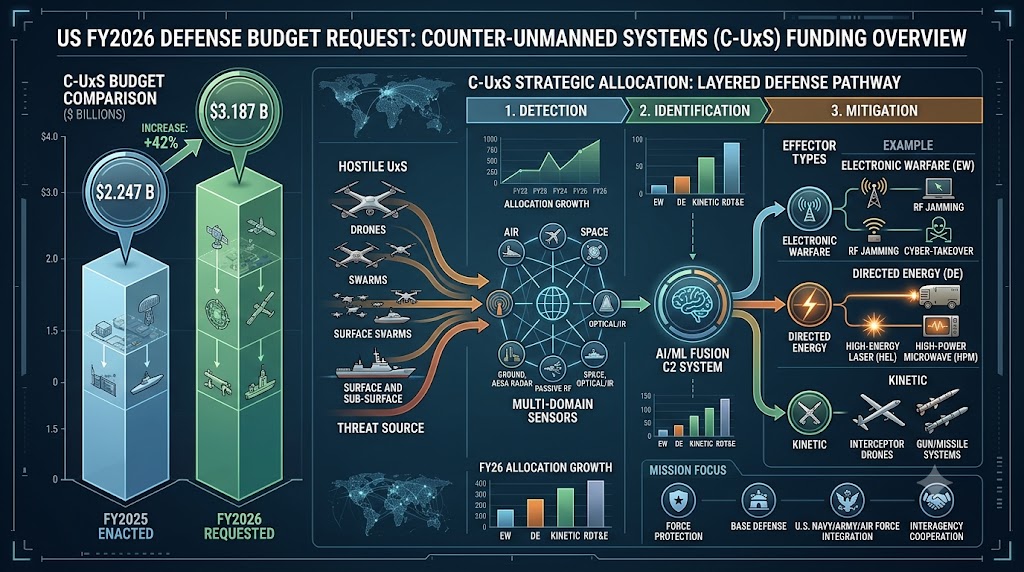
US FY2026 defense budget requested $3.187 billion for Counter-Unmanned Systems, compared with $2.247 billion enacted for FY2025.
The rapid proliferation of unmanned aerial systems has fundamentally changed the modern security and defense environment. Drones that were once primarily associated with surveillance, commercial photography, agriculture, and industrial inspection are increasingly being used for intelligence, reconnaissance, border infiltration, battlefield surveillance, electronic warfare, and attack missions. This transformation has created an urgent requirement for technologies capable of detecting, identifying, tracking, and neutralizing unauthorized or hostile unmanned systems.
The United States is responding to this changing threat environment with increased investment in Counter Unmanned Systems, commonly referred to as C UXS or Counter UAS. The FY2026 US defense budget request provides a strong indication of the growing strategic importance of counter drone capabilities. The Department of Defense requested $3.187 billion for Counter Unmanned Systems in FY2026, compared with $2.247 billion enacted for FY2025. This represents an increase of approximately $940 million, or 41.8%, over the FY2025 enacted level. The Department has identified countering unmanned systems as a high priority and is seeking to accelerate capabilities that can provide layered protection against increasingly sophisticated unmanned threats.
This increased investment comes at a time when the global Counter UAS market is experiencing rapid expansion. According to MarketsandMarkets, the Global Counter UAS System Market Size was valued at USD 9.17 billion in 2026 and is projected to reach USD 29.70 billion by 2031, growing at a CAGR of 26.5% from 2026 to 2031. The market is being driven by the rising number of hostile and unauthorized drone activities near military bases, airports, border areas, and critical infrastructure.
The convergence of higher defense spending, accelerating drone proliferation, artificial intelligence, sensor fusion, electronic warfare, directed energy, autonomous systems, and increasingly sophisticated drone tactics is positioning Counter UAS technology as a core component of future defense architectures.
History and Evolution of Counter UAS Technology
The development of Counter UAS technology has evolved alongside the expansion of unmanned aircraft. Early counter drone approaches were relatively simple and frequently relied on conventional surveillance equipment or existing air defense capabilities. As small drones became more accessible and their operational applications expanded, security organizations recognized that conventional air defense systems were often unsuitable for detecting and responding to small, low altitude, and inexpensive aerial targets.
The first generation of dedicated Counter UAS systems focused primarily on drone detection. Radar, radio frequency sensing, electro optical cameras, infrared sensors, and acoustic systems were deployed to identify objects operating within protected airspace. These technologies provided security personnel with improved awareness of unauthorized drone activity.
The next stage involved integrating detection with tracking and identification. Instead of simply detecting an object, C UAS systems began creating a more comprehensive picture of the potential threat. Command and control systems enabled operators to combine information from multiple sensors and determine whether an airborne object represented a legitimate aircraft, a commercial drone, a bird, or a potential hostile platform.
As drone threats became more sophisticated, the industry expanded into mitigation and neutralization technologies. Electronic countermeasures, radio frequency disruption, navigation interference, physical interceptors, and other approaches became increasingly important. More recently, directed energy and autonomous interception technologies have entered the C UAS development landscape.
Modern Counter UAS systems are therefore moving from standalone detection equipment toward integrated architectures. MarketsandMarkets identifies the growing integration of radar, RF detection, electro optical and infrared sensors, command and control, artificial intelligence, and multiple countermeasure technologies as a major development in the market.
The evolution of Counter UAS technology can broadly be understood as a transition from detection to tracking, identification, decision support, mitigation, and increasingly automated response.
Benefits of Counter UAS Technology
Counter UAS technology provides several advantages for military organizations, government agencies, airports, critical infrastructure operators, and other security stakeholders:
-
Enhanced Airspace Security: C UAS systems provide continuous monitoring of low altitude airspace and help security organizations identify unauthorized drones before they reach sensitive areas.
-
Protection of Critical Assets: Military installations, airports, power plants, government facilities, energy infrastructure, and other strategic sites can use Counter UAS systems to reduce exposure to drone based surveillance and attacks.
-
Improved Threat Detection: The integration of radar, RF sensors, EO and IR cameras, acoustic sensors, and artificial intelligence can improve the ability to detect and classify small aerial targets.
-
Faster Response: Integrated command and control systems allow operators to combine sensor information and respond to drone threats more rapidly.
-
Layered Defense: Multiple detection and mitigation technologies can be combined to provide protection against different types of drones and operating scenarios.
-
Reduced Operational Disruption: Counter drone capabilities can help airports, public venues, industrial facilities, and other sensitive locations manage unauthorized drone activity while minimizing disruption to normal operations.
-
Adaptability to Emerging Threats: Software based systems and AI enabled architectures can be updated as drone designs, communications methods, tactics, and threat patterns evolve.
Current Market Size and Growth Trends of the Counter UAS Industry
The global Counter UAS market is entering a period of accelerated expansion as governments and commercial organizations respond to the increasing frequency and sophistication of drone threats.
According to MarketsandMarkets, the Global Counter UAS System Market was valued at USD 9.17 billion in 2026 and is projected to reach USD 29.70 billion by 2031, registering a CAGR of 26.5% between 2026 and 2031. The rapid expansion is linked to increasing hostile and unauthorized drone activity around military bases, airports, borders, critical infrastructure, and other sensitive locations.
The US defense budget provides an important example of how this security requirement is translating into government investment. The FY2026 defense budget request allocated $3.187 billion to Counter Unmanned Systems compared with $2.247 billion enacted for FY2025, representing a $940 million increase. The Department of Defense has stated that its priority is to accelerate capabilities that provide layered defenses against unmanned threats and improve the ability of warfighters to counter these systems.
This rapid growth can be attributed to several factors, including:
• Increasing use of drones for surveillance, reconnaissance, smuggling, attacks, and battlefield operations
• Rising defense expenditure on protection against small unmanned aircraft systems
• Increasing deployment of integrated radar, RF, EO and IR, acoustic, and AI based detection technologies
• Growing adoption of layered Counter UAS architectures combining detection, tracking, identification, command and control, and mitigation
• Increasing demand for mobile and vehicle mounted C UAS systems
• Expansion of Counter UAS applications beyond military facilities into airports, energy infrastructure, public venues, government facilities, and industrial sites
• Increasing development of AI enabled threat classification and autonomous response capabilities
MarketsandMarkets projects North America to be the fastest growing regional market, with a CAGR of 27.4% during the forecast period. The vehicle mounted segment is also expected to register a strong 29.9% CAGR between 2026 and 2031, while UAS mitigation and neutralization is expected to remain the largest solution segment during the forecast period.
Key Drivers and Factors Influencing the Future of Counter UAS
Several major factors are shaping the future direction of the Counter UAS industry.
1. Rising Drone Threats
The most important driver is the rapid increase in drone deployment across military and civilian environments. Commercially available drones can be modified for surveillance, reconnaissance, payload delivery, and other missions. Military organizations are also increasingly confronting low cost unmanned systems and coordinated drone attacks.
The increasing availability of FPV drones, autonomous platforms, and other small unmanned systems is creating a requirement for faster and more flexible defensive architectures.
2. Increasing US Defense Investment
The US FY2026 Counter Unmanned Systems request demonstrates the growing importance of counter drone capabilities in national defense planning. The $3.187 billion request is substantially higher than the $2.247 billion enacted in FY2025, highlighting the priority being placed on accelerating C UXS capabilities.
The US Department of Defense has also emphasized the need for rapid fielding, improved production capacity, technology innovation, open systems architecture, system integration, and force structure as part of its Counter Unmanned Systems strategy.
3. Drone Heavy Warfare
Recent conflicts have demonstrated how inexpensive unmanned systems can influence battlefield operations. Drones can provide persistent surveillance, identify targets, support artillery operations, deliver payloads, and create threats to personnel and equipment.
This has made C UAS capabilities increasingly important for protecting troops, command posts, logistics hubs, airfields, and other military assets.
4. Artificial Intelligence and Machine Learning
AI is becoming an important component of modern Counter UAS systems. Machine learning algorithms can analyze data from multiple sensors, classify potential threats, reduce false alarms, identify unusual flight behavior, and prioritize targets.
MarketsandMarkets highlights AI enabled multi sensor detection, data fusion, autonomous threat classification, and counter drone swarm capabilities as important trends influencing the industry.
5. Requirement for Layered Defense
No single Counter UAS technology can reliably address every drone threat. Small drones can operate at low altitude, fly slowly, maneuver unpredictably, use autonomous navigation, or operate in groups.
As a result, defense organizations are increasingly looking toward layered architectures that combine several detection and mitigation technologies. The Congressional Budget Office similarly notes that a wide range of counter small UAS technologies is available and that layered defenses provide the most comprehensive protection.
Emerging Trends in Counter UAS Technology
The future of Counter UAS technology is being shaped by several significant trends.
1. AI Enabled Autonomous Counter UAS
Artificial intelligence is increasingly being integrated into detection, classification, tracking, and response workflows. AI can process large quantities of sensor data and identify potential threats faster than manual analysis alone.
Future systems are expected to use AI to continuously evaluate airspace activity, classify threats, identify behavioral patterns, and recommend appropriate responses.
2. Multi Sensor Data Fusion
Modern C UAS architectures are increasingly combining radar, RF detection, EO and IR, acoustic sensing, and other technologies.
Sensor fusion creates a more comprehensive operational picture and can improve confidence in drone identification. MarketsandMarkets identifies sensor fusion and AI enabled detection as major trends in the Counter UAS market.
3. Counter Drone Swarm Technologies
Drone swarms create a particularly difficult challenge because multiple inexpensive platforms can approach a protected asset from different directions.
Future C UAS systems will increasingly require technologies capable of identifying, tracking, prioritizing, and responding to multiple simultaneous threats.
4. Mobile and Vehicle Mounted C UAS
Military forces require systems that can move with deployed units. Vehicle mounted Counter UAS systems can provide protection for mobile formations, logistics convoys, command centers, and temporary operating locations.
MarketsandMarkets expects the vehicle mounted segment to record a 29.9% CAGR between 2026 and 2031.
5. Open Architecture Systems
Open systems architectures are becoming increasingly important because defense organizations need to integrate sensors, software, communications systems, and countermeasures from multiple suppliers.
Open architectures can improve upgradeability and allow military users to incorporate new technologies without replacing an entire Counter UAS system.
6. Integration of Counter UAS and Electronic Warfare
Electronic warfare is becoming increasingly relevant to Counter UAS operations because many drones depend on radio communications, navigation signals, and wireless data links.
The integration of electronic warfare with radar, RF sensing, command and control, and other countermeasures can provide a more comprehensive response to unmanned threats.
Opportunities and Challenges in the Counter UAS Market
The rapid growth of the Counter UAS industry creates substantial opportunities for technology companies, defense contractors, sensor manufacturers, software developers, and system integrators.
Opportunities
-
Expansion of Defense Procurement: Rising government investment in Counter Unmanned Systems creates opportunities for manufacturers of detection, tracking, command and control, and mitigation technologies.
-
Layered C UAS Architectures: Defense organizations are increasingly seeking complete solutions rather than standalone sensors. Companies capable of integrating multiple technologies can benefit from this transition.
-
AI Based Threat Detection: Artificial intelligence provides opportunities to improve drone identification, behavioral analysis, threat prioritization, and automated decision support.
-
Non Military Applications: Airports, critical infrastructure, energy facilities, correctional facilities, government buildings, stadiums, and public events represent important growth opportunities for C UAS technologies. MarketsandMarkets notes increasing adoption across airports, energy facilities, government infrastructure, and public event security.
-
Mobile and Tactical Systems: Increasing demand for vehicle mounted, portable, and rapidly deployable systems creates opportunities for companies developing compact and modular C UAS solutions.
Challenges
-
Rapid Evolution of Drone Technology: Drone platforms are continuously improving in autonomy, speed, communications, radar signature management, and swarm capabilities. C UAS systems must continuously evolve to remain effective.
-
Regulatory Restrictions: The use of radio frequency interference, interception, and other mitigation technologies can be subject to significant regulatory and legal restrictions.
-
High System Complexity: Effective C UAS systems require the integration of sensors, software, communications, command and control, and mitigation technologies.
-
False Alarms: Small drones can be difficult to distinguish from birds and other airborne objects, creating a requirement for highly accurate identification technologies.
-
Cost Effectiveness: Many hostile drones can be inexpensive compared with traditional air defense systems. C UAS architectures therefore need to achieve a sustainable cost relationship between detection and defeat mechanisms.
-
Complex Operating Environments: Urban areas, mountainous regions, electromagnetic interference, weather, clutter, and other environmental conditions can affect sensor performance.
Innovations and Advancements in Counter UAS Technology
The Counter UAS market is becoming an important area for defense technology innovation.
1. AI Based Drone Identification
AI algorithms are being developed to distinguish drones from birds, aircraft, and other objects. Machine learning can evaluate characteristics such as movement, size, speed, flight behavior, and sensor signatures.
These capabilities can reduce false alarms and help operators focus on genuine threats.
2. Advanced Radar for Small Drone Detection
Specialized radar systems are being developed to detect small, low altitude targets with relatively low radar signatures. Advanced signal processing can help identify drones operating in environments with significant background clutter.
3. RF Detection and Direction Finding
RF sensors can detect communications signals associated with drones and provide information about their location and operating characteristics. Direction finding can also support the identification and localization of drone operators in applicable environments.
4. Electro Optical and Infrared Systems
EO and IR sensors provide visual confirmation of potential threats. When integrated with radar and RF detection, these sensors can strengthen the identification process and improve situational awareness.
5. Directed Energy Countermeasures
Directed energy technologies are emerging as another component of the Counter UAS ecosystem. These systems can provide a potentially scalable response mechanism against certain drone threats while complementing kinetic and electronic countermeasures.
6. Autonomous Interceptor Systems
Interceptor drones and other autonomous systems are being developed to engage hostile unmanned aircraft. These systems could become increasingly important against threats that are difficult to address using traditional electronic countermeasures.
7. Integrated Command and Control
Advanced C UAS command and control platforms are bringing multiple sensors and mitigation systems together through unified interfaces. This enables operators to develop a common operational picture and coordinate responses more efficiently.
Future Applications and Industries That Will Benefit from Counter UAS
The future Counter UAS market will extend well beyond traditional military applications.
1. Military and Defense
Military organizations will remain the largest and most important users of C UAS systems. Applications include protecting military bases, forward operating locations, airfields, command centers, logistics hubs, ships, vehicles, and deployed personnel.
As unmanned systems become increasingly integrated into modern warfare, Counter UAS capabilities will become an essential element of layered force protection.
2. Airports and Aviation
Airports are particularly vulnerable to unauthorized drone activity because even a small drone can cause significant operational disruption.
Integrated C UAS systems can provide airport operators with improved awareness of low altitude airspace and support faster responses to unauthorized drone activity.
3. Critical Infrastructure
Power plants, energy facilities, oil and gas infrastructure, telecommunications facilities, water treatment plants, and transportation infrastructure can benefit from Counter UAS systems.
Protecting these facilities against surveillance, disruption, and potential attacks will become increasingly important as drone availability increases.
4. Border Security
Drones can be used for surveillance, smuggling, border reconnaissance, and unauthorized crossings. Border security agencies can use C UAS technologies to monitor low altitude airspace and identify suspicious drone activity.
5. Government Facilities
Government buildings and strategic facilities represent another important application area. Portable and fixed site systems can provide protection against unauthorized drone operations.
6. Public Safety and Law Enforcement
Police departments and other security agencies can use Counter UAS technologies during major public events, high profile gatherings, and sensitive security operations.
C UAS systems can provide situational awareness while helping authorized organizations manage unauthorized drone activity.
7. Maritime and Naval Applications
Counter Unmanned Systems are increasingly relevant to maritime environments. Ships, naval bases, ports, and offshore facilities can use integrated systems to detect and respond to drones approaching from different directions.
8. Commercial and Industrial Facilities
Industrial plants, warehouses, energy facilities, and other commercial sites can use C UAS technologies to protect sensitive operations and reduce the risk of unauthorized aerial surveillance or disruption.
The Promising Future of Counter UAS Technology
The rapid development of unmanned systems is transforming the global defense and security environment. As drones become more capable, affordable, autonomous, and widely available, organizations will require increasingly sophisticated technologies to protect personnel, infrastructure, military assets, and controlled airspace.
The US FY2026 defense budget request illustrates the growing strategic importance of this capability. The Department of Defense requested $3.187 billion for Counter Unmanned Systems in FY2026, compared with $2.247 billion enacted in FY2025, representing a $940 million increase. The Department has emphasized accelerating capabilities, improving production capacity, supporting technology innovation, and developing layered defenses against unmanned threats.
At the global level, the Counter UAS market is projected to expand from USD 9.17 billion in 2026 to USD 29.70 billion by 2031 at a CAGR of 26.5%, demonstrating the strong commercial and defense opportunity associated with the technology.
The future of Counter UAS will increasingly depend on the integration of artificial intelligence, radar, RF detection, EO and IR sensing, electronic warfare, command and control, autonomous systems, directed energy, and other mitigation technologies. Rather than relying on a single countermeasure, defense organizations are moving toward layered architectures capable of addressing different drone types and threat scenarios.
The evolution toward AI enabled detection, multi sensor fusion, autonomous threat classification, counter drone swarm capabilities, mobile systems, and open architectures will create significant opportunities for defense companies and technology providers.
At the same time, the industry must overcome challenges involving regulatory restrictions, false alarms, complex operating environments, rapidly evolving drone tactics, system integration, and the cost effectiveness of countering inexpensive unmanned platforms.
As governments continue to increase investment in Counter Unmanned Systems and military organizations adapt to drone intensive warfare, C UAS technology is expected to become an increasingly important component of modern airspace security and force protection.
The combination of rising drone threats, increased defense spending, artificial intelligence, sensor fusion, electronic warfare, and advanced mitigation technologies creates a strong foundation for continued growth in the Counter UAS industry. The US FY2026 investment request represents an important indicator of this broader transformation, demonstrating that countering unmanned systems is increasingly being treated as a core defense investment priority rather than a niche security capability.
Discover the latest advancements, technologies, market opportunities, and competitive developments shaping the Counter UAS industry by exploring the latest research from MarketsandMarkets. Stay informed about emerging C UAS technologies and the evolving global demand for counter drone solutions.
Download Sample Research Report for Counter UAS Market Future: https://www.marketsandmarkets.com/Market-Reports/counter-cuas-systems-market-4197284.html
80% of the Forbes Global 2000 B2B companies rely on MarketsandMarkets to identify growth opportunities in emerging technologies and use cases that will have a positive revenue impact.
- Food Packaging Market Size Set for Strong Growth Through 2030 Amid Rising Demand for Convenience Foods
- Crop Protection Chemical Market Size, Share & Growth Forecast (2025–2030)
- Mulch Films Market: Driving Sustainable Agriculture Through Innovation
- Agricultural Adjuvants Market Analysis, Trends, and Growth Outlook (2026–2031)
- Japan Enterprise Asset Management Market Growth: AI and Smart Infrastructure Drive Demand


