

Inside the EV Industry: Why the Electric Vehicle Industry Is Moving Beyond the Car
EV Industry: Ecosystem, Manufacturing, Battery, Charging Infrastructure and Global Market
The EV industry is evolving from a vehicle electrification opportunity into a broader automotive technology and energy ecosystem. Automakers are no longer competing only on vehicle design and performance. Battery efficiency, charging speed, power electronics, software, manufacturing automation, and supply-chain resilience are increasingly influencing competitiveness across the electric vehicle industry.
The scale of this transformation is reflected in the growth of the global market. According to MarketsandMarkets, the global Electric Vehicle Market is projected to grow from USD 1,145.51 billion in 2025 to USD 1,857.34 billion by 2035, registering a CAGR of 5.0% during the forecast period. The expansion of charging infrastructure, government support, emission regulations, technological advancements, and increasing investments in electric mobility are supporting this growth.
At the manufacturing level, the opportunity is also expanding. The EV assembly market is projected to grow from USD 190.11 billion in 2026 to USD 291.39 billion by 2035, reflecting a 4.9% CAGR over the period.
Source: MarketsandMarkets, EV Assembly Market
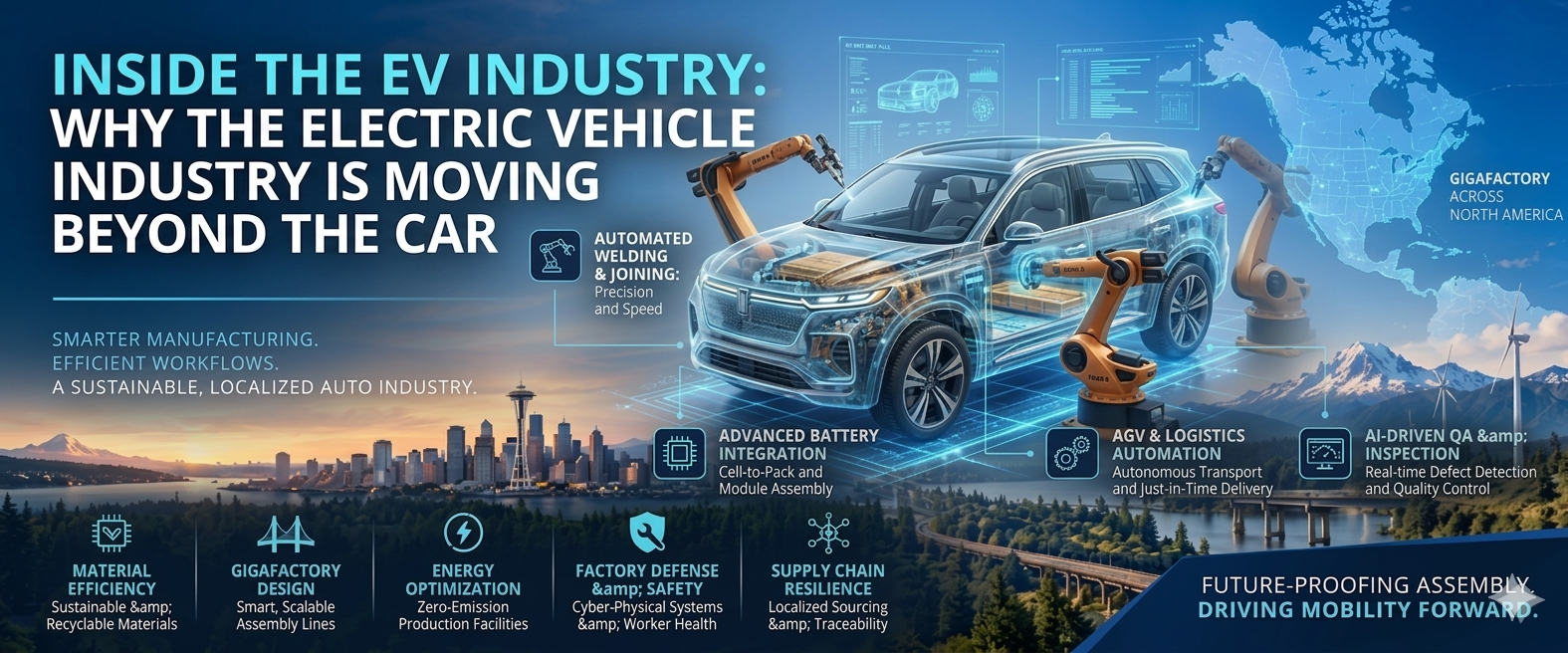
These developments are creating opportunities across the EV value chain, from battery cells and electric motors to inverters, charging infrastructure, software, semiconductors, and advanced manufacturing technologies.
EV Industry Ecosystem and Value Chain
The EV industry ecosystem has become increasingly interconnected as vehicle electrification brings together the automotive, energy, electronics, semiconductor, software, and manufacturing sectors.
At the upstream level, the ecosystem includes raw-material suppliers and manufacturers of battery cells, power electronics, semiconductors, electric motors, and other critical components. At the vehicle level, automakers and Tier 1 suppliers integrate these technologies into electric cars, buses, trucks, two-wheelers, and other electric mobility platforms.
The downstream ecosystem includes charging network operators, electricity providers, fleet operators, software companies, maintenance providers, and battery recycling businesses.
This expanding value chain is changing where value is created within the electric vehicle industry. Battery technology and power electronics have become strategically important, while software and connectivity are creating new opportunities for recurring services and vehicle functionality.
The shift toward dedicated EV platforms is also changing vehicle architecture. Unlike traditional platforms adapted for electrification, dedicated EV architectures can be designed around battery placement, electric powertrains, optimized vehicle packaging, and advanced electrical and electronic systems.
EV Manufacturing and Assembly
EV manufacturing is undergoing a fundamental transformation as automakers redesign production processes around electric powertrains and high-voltage battery systems.
An EV production line typically involves body manufacturing, battery and powertrain integration, electrical and electronic system installation, software integration, testing, and final assembly. However, the transition to EVs is also changing how these processes are organized.
Automakers are increasingly investing in dedicated EV production lines, flexible manufacturing systems, robotics, automated inspection, digital production monitoring, and smart factory technologies. These technologies can help manufacturers improve throughput, quality, flexibility, and production scalability.
Another important development is the increasing adoption of gigacasting, in which large structural components can be manufactured as single castings instead of assembling multiple smaller parts. This can reduce component counts and simplify certain manufacturing processes.
Battery manufacturing and battery-pack integration are also becoming increasingly important within the EV assembly process. Automakers are evaluating different approaches to battery integration, including modular battery packs and structural battery concepts, depending on vehicle architecture and manufacturing strategy.
For detailed insights into EV manufacturing and assembly technologies, market size, regional developments, and competitive strategies, see the MarketsandMarkets EV Assembly Market report.
Download the EV Assembly Market PDF
EV Technology Components: Battery, Motor and Inverter
The development of the EV industry is closely linked to advances in its core technology components. Battery packs, electric motors, inverters, battery management systems, and other power electronics determine many of the performance and efficiency characteristics of an electric vehicle.
EV Battery
The EV battery is one of the most important components of an electric vehicle because it stores the electrical energy used by the powertrain.
Battery characteristics such as energy density, capacity, charging speed, thermal performance, safety, lifecycle, and cost directly affect vehicle range, performance, and ownership economics.
Battery technology is therefore a major area of investment across the electric vehicle industry. Automakers and battery manufacturers are working on improving cell chemistry, pack design, thermal management, manufacturing efficiency, and battery management systems.
Battery localization is another important trend. Companies are increasingly seeking regional battery supply chains to reduce logistics risks, improve supply security, and comply with local manufacturing and sourcing requirements.
EV motor
The EV motor converts electrical energy into mechanical energy to propel the vehicle. Motor selection can influence acceleration, efficiency, weight, cost, driving range, and thermal performance.
Permanent magnet synchronous motors, induction motors, and switched reluctance motors are among the technologies used across different electric vehicle applications.
As manufacturers look to improve vehicle efficiency, motor design is increasingly being optimized alongside battery and inverter technologies rather than treated as an independent component.
EV inverter
The EV inverter is a critical power electronics component that converts DC electricity from the battery into the AC electricity required by many electric motors.
Inverters also control motor speed and torque, making them essential to electric powertrain performance. Advances in semiconductor technologies and power electronics are enabling more efficient and compact inverter systems.
The shift toward higher-voltage architectures, including 800V systems, is also influencing inverter and powertrain design. Higher-voltage systems can support faster charging and help improve efficiency in suitable vehicle applications.
For a broader view of EV components, technologies, market segments, and regional opportunities, the MarketsandMarkets Electric Vehicle Market report provides detailed market analysis.
Download the Electric Vehicle Market PDF
EV Charging Infrastructure
The expansion of EV charging infrastructure is essential for supporting the continued growth of electric mobility. As EV adoption increases, charging networks need to accommodate residential users, commercial fleets, workplace charging, public transportation, and long-distance travel.
Charging infrastructure can broadly be categorized into AC and DC charging. AC charging is widely used for home and workplace applications where vehicles can remain connected for longer periods. DC fast charging is particularly important for highways, public charging networks, commercial vehicles, and applications where minimizing charging time is a priority.
The charging ecosystem is also becoming more technologically sophisticated. Smart charging can help manage electricity demand, while connected charging networks can enable remote monitoring, payment management, charger utilization analysis, and fleet optimization.
Emerging technologies such as ultra-fast charging, wireless charging, bidirectional charging, and vehicle-to-grid applications could further expand the role of charging infrastructure within the broader energy ecosystem.
However, charging deployment continues to face challenges, including infrastructure investment requirements, charging time, grid capacity, location constraints, and interoperability between charging systems.
Global Electric Vehicle Market
The global electric vehicle market is being shaped by a combination of regulatory, technological, economic, and consumer factors.
Government policies and emissions regulations continue to encourage vehicle electrification in major automotive markets. At the same time, automakers are expanding their EV portfolios across passenger cars, commercial vehicles, buses, and other applications.
Battery improvements and increasing model availability are also influencing consumer adoption. For commercial fleets, factors such as operating costs, energy efficiency, route predictability, and total cost of ownership are important considerations.
Asia Pacific is expected to remain a leading region in the global electric vehicle market. The region benefits from a strong automotive manufacturing base, significant battery production capabilities, established component supply chains, and growing EV adoption.
China has emerged as a major center for EV manufacturing and battery production, while Japan and South Korea also have significant automotive and technology capabilities. Europe and North America remain important markets, supported by investments in local EV production, charging infrastructure, battery manufacturing, and regulatory initiatives.
The geographic expansion of the electric vehicle industry is also creating opportunities in emerging markets as governments and businesses develop charging networks and local manufacturing capabilities.
Key Trends Shaping the EV Industry
Several trends are expected to influence the next phase of growth in the EV industry.
Dedicated EV platforms: Automakers are increasingly developing platforms specifically engineered for electric powertrains, enabling optimized battery packaging, vehicle architecture, and manufacturing.
800V vehicle architectures: Higher-voltage electrical systems can support faster charging and improved efficiency and are gaining attention in premium and performance-oriented EV applications.
Smart EV factories: Robotics, automation, artificial intelligence, digital twins, and connected manufacturing systems are changing EV production environments.
Gigacasting: Large structural castings can reduce the number of individual components and potentially simplify certain assembly processes.
Battery localization: Automakers are investing in regional battery manufacturing and supply chains to improve supply security and reduce dependence on distant suppliers.
Software-defined vehicles: Software, connectivity, centralized computing, and over-the-air updates are becoming increasingly important to EV product strategies.
Battery recycling and second-life applications: As the installed base of EV batteries grows, recycling, material recovery, and second-life applications are expected to become increasingly important parts of the EV ecosystem.
Future Growth Opportunities in the Electric Vehicle Industry
The future of the electric vehicle industry will depend on more than increasing EV sales. The next phase of industry development is likely to focus on integrating the vehicle with a broader technology and energy ecosystem.
Battery performance, charging speed, manufacturing efficiency, power electronics, software, connectivity, and energy management will increasingly interact to determine the competitiveness of EV products.
For automakers, opportunities will exist in developing cost-efficient EV platforms and scalable manufacturing systems. Component suppliers can benefit from growing demand for batteries, motors, inverters, semiconductors, thermal management systems, and other electrification technologies. Charging providers can expand through public, commercial, residential, and fleet charging networks.
The EV industry is therefore moving toward a more integrated model in which vehicle manufacturers, technology suppliers, energy companies, infrastructure providers, and software businesses increasingly operate within the same ecosystem.
Frequently Asked Questions About the EV Industry
What is the EV industry?
The EV industry encompasses the vehicle manufacturers, component suppliers, technology companies, battery manufacturers, charging infrastructure providers, software companies, and other businesses supporting electric mobility.
What are the main components of an electric vehicle?
Key components include the battery pack, electric motor, inverter, battery management system, on-board charger, DC-DC converter, thermal management system, and other electrical and electronic systems.
What is driving growth in the electric vehicle industry?
Government policies, emission regulations, battery technology improvements, expanding charging infrastructure, increasing EV model availability, and investments in manufacturing are among the major factors supporting industry growth.
What is the future of the EV industry?
The future of the EV industry is expected to be shaped by battery innovation, faster charging, dedicated EV platforms, smart manufacturing, software-defined vehicles, advanced power electronics, and battery recycling.
Where can I find detailed EV market data?
MarketsandMarkets provides detailed analysis of the global Electric Vehicle Market, including market size, forecasts, segmentation, regional analysis, competitive landscape, and industry trends.
Explore the Electric Vehicle Market Report
Source: MarketsandMarkets, Electric Vehicle Market and EV Assembly Market.
80% of the Forbes Global 2000 B2B companies rely on MarketsandMarkets to identify growth opportunities in emerging technologies and use cases that will have a positive revenue impact.
- Food Packaging Market Size Set for Strong Growth Through 2030 Amid Rising Demand for Convenience Foods
- Mulch Films Market: Driving Sustainable Agriculture Through Innovation
- Agricultural Adjuvants Market Analysis, Trends, and Growth Outlook (2026–2031)
- Crop Protection Chemical Market Size, Share & Growth Forecast (2025–2030)
- Japan Enterprise Asset Management Market Growth: AI and Smart Infrastructure Drive Demand

