

China’s EV Price War: BYD’s Strategy and the Battle for Profitability
China's EV price war is exposing the limits of volume-driven growth, forcing automakers to balance aggressive pricing and international expansion with sustainable profitability.
China's automotive industry has built substantial advantages in battery production, supply chain integration, manufacturing scale, and product development. These strengths have enabled manufacturers to introduce new electric vehicle (EV) models rapidly and compete aggressively on price. However, intensifying domestic competition has put pressure on profitability, raising questions about whether sales growth can translate into sustainable financial performance.
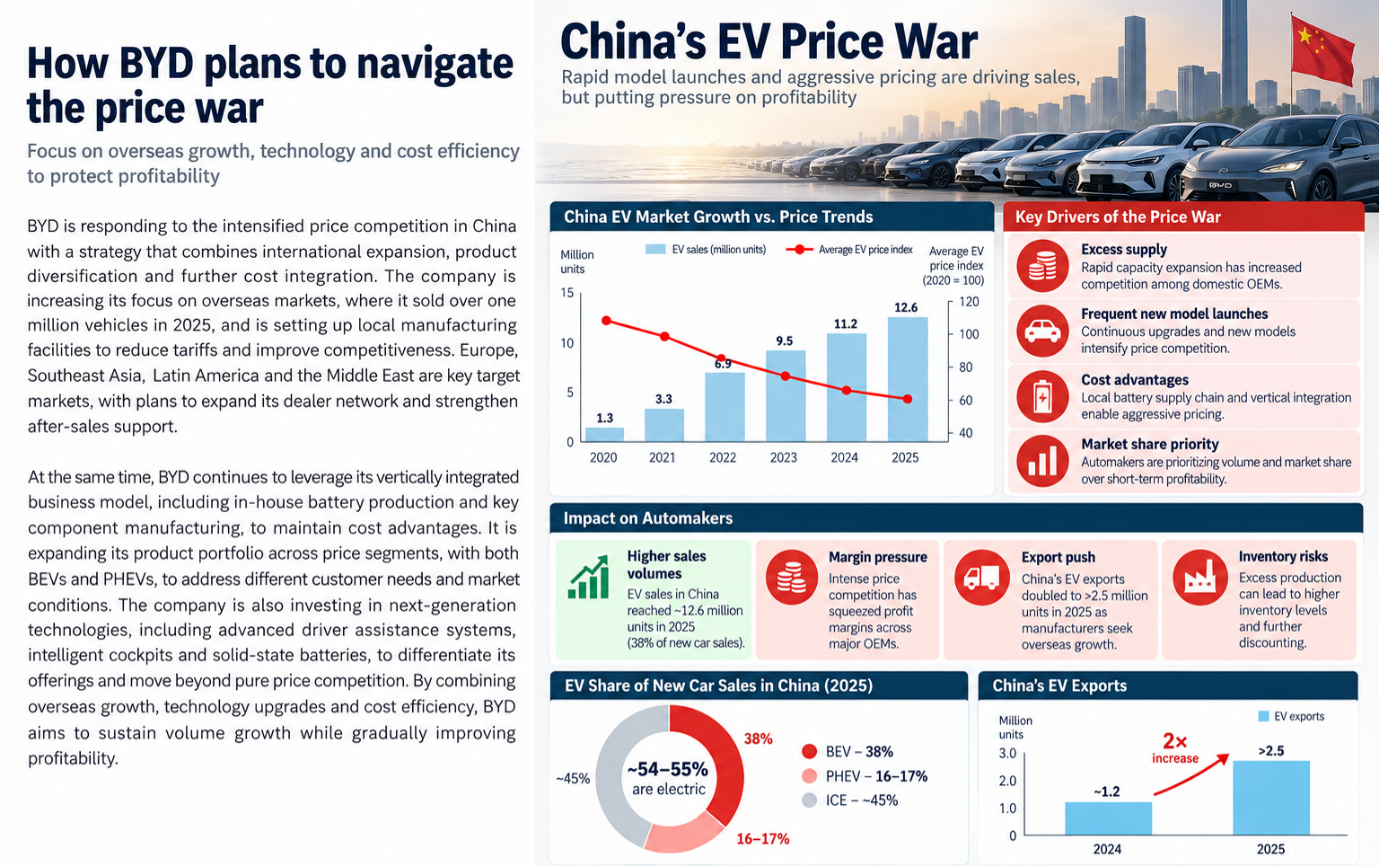
According to the IEA's Global EV Outlook 2026, intense domestic competition in China has squeezed automaker margins and encouraged manufacturers to seek growth overseas. China's electric car exports doubled in 2025 to more than 2.5 million units, while domestic sales growth slowed. Although exports provide access to new customers and help utilize manufacturing capacity, tariffs, logistics costs, local production requirements, distribution expenses, and warranty obligations can reduce returns in overseas markets.
The central challenge for Chinese automakers is whether they can convert production scale into sustainable earnings rather than relying on continuous price reductions to maintain market share.
Why China's EV Price War Is Putting Pressure on Profitability
China's EV market has become increasingly competitive as automakers use price reductions, promotional offers, and frequent product launches to attract customers. Although these strategies can support vehicle sales, they can also reduce revenue per vehicle and place pressure on manufacturers' profit margins.
The challenge extends beyond pricing. Manufacturers must manage production costs, maintain factory utilization, invest in new technologies, and expand into international markets while protecting their financial performance.
For companies with high fixed manufacturing costs, maintaining production volumes is important. However, if production consistently exceeds genuine retail demand, excess inventory and discounting can intensify pressure on profitability.
Download PDF Brochure @ https://www.marketsandmarkets.com/pdfdownloadNew.asp?id=209371461
BYD Illustrates the Gap Between Sales Growth and Profitability
BYD is one of the strongest examples of the distinction between vehicle sales growth and financial performance. Its scale, battery manufacturing capabilities, and international reach provide competitive advantages, but its 2025 financial results highlight the pressure that an aggressive pricing environment can create.
Table 1: BYD 2025 Financial Performance
| Metric | 2025 Figure | Year-on-Year Change |
|---|---|---|
| Revenue | RMB 804 billion | +3.5% |
| Net Profit | RMB 32.6 billion | -19.0% |
| Gross Margin | 17.74% | -1.7% |
| New Energy Vehicles Sold | 4.60 million units | +7.7% |
Source: BYD Annual Report 2025
Several factors explain why these figures matter for the wider EV industry:
- Lower revenue per vehicle: Price reductions can support unit sales while reducing the contribution earned on each vehicle.
- Higher costs of defending market share: Frequent promotions, product launches, and dealer support can increase the cost of maintaining sales volumes.
- Greater dependence on overseas markets: Exports create growth opportunities, but tariffs, logistics costs, and local production requirements can limit the margin benefit.
- Pressure to maintain factory utilization: High fixed manufacturing costs encourage production, but excess supply can increase inventory and discounting pressures.
BYD's financial results do not indicate that the company is close to financial failure. Rather, they demonstrate that continued volume growth cannot automatically be assumed to generate stronger profitability. The wider Chinese EV industry faces a more difficult challenge, particularly for manufacturers with weaker brands, limited access to capital, or less efficient production.
As competition intensifies, some manufacturers may reduce production, pursue partnerships, restructure operations, or exit unprofitable segments. The next phase of competition will increasingly distinguish companies that can lower costs while preserving product value from those that depend on discounts to sustain sales.
Zero-Kilometer Used Car Exports Raise Questions About Reported Sales
Another concern in China is the practice commonly described as zero-kilometer used car exports. Under this arrangement, a newly manufactured vehicle may be registered and subsequently transferred into the used vehicle channel despite having travelled little or no distance. The vehicle can then be sold domestically or exported as a used car.
A Reuters investigation published in 2025 described how Chinese exporters and traders used this channel to register newly manufactured vehicles, classify them as used cars, and export them to markets including Russia, Central Asia, and the Middle East.
The practice raises questions about the relationship between reported sales and genuine end-customer demand. A vehicle supplied to a dealer or intermediary may be counted as a sale even when the final customer has not purchased it for normal use. Subsequent resale at a discount can create additional pressure on vehicle prices and residual values.
There are four important implications for the automotive industry:
- Reported sales may overstate retail demand: Factory shipments, dealer purchases, registrations, and end-customer sales represent different stages of the distribution process and should not be treated as interchangeable.
- Inventory can accumulate within the distribution chain: When dealers and intermediaries acquire vehicles faster than they can resell them, excess stock can lead to further discounting.
- Residual values can weaken: Nearly unused vehicles offered at lower prices can reduce the value of comparable new and used cars, affecting leasing, financing, and trade-in economics.
- Brand positioning can suffer: Customers may become reluctant to pay full price if they expect substantial discounts or believe similar vehicles will soon be available at lower prices.
The Reuters investigation also described registration and insurance arrangements used by certain manufacturers to record sales before vehicles reached genuine customers. It identified Neta and Zeekr in relation to specific practices. These findings should not be generalized to every Chinese automaker.
The available evidence presented here does not establish that BYD's entire reported sales volume is inflated by zero-kilometer resale activity. The broader lesson is that industry performance should be assessed using retail demand, inventory, pricing, and cash generation alongside reported vehicle shipments.
For BYD and its competitors, the important questions are whether domestic customers can absorb production at sustainable prices, whether exports generate attractive margins, and whether distribution networks maintain healthy inventory levels.
How BYD Plans to Navigate the Price War
BYD is responding to China's intensifying EV price war through overseas expansion, vertical integration, product diversification, and continued investment in technology. Having sold more than one million vehicles overseas in 2025, the company is seeking to reduce its dependence on the domestic market by expanding across Europe, Southeast Asia, Latin America, and the Middle East.
Figure 1: How BYD Is Responding to China's EV Price War to Remain Profitable
Source: MarketsandMarkets Analysis
These strategies can help BYD diversify its revenue sources and strengthen its competitive position. However, overseas expansion does not guarantee higher profitability. Tariffs, local manufacturing investments, logistics expenses, and competition in destination markets can affect the financial returns generated by international sales.
Vertical integration and continued technology investment can support cost efficiency and product differentiation. Their long-term value will depend on whether these advantages allow BYD to compete effectively without relying on continuous price reductions.
What the EV Price War Means for China's Wider Automotive Industry
China's EV market is entering a phase in which cost efficiency, profitability, and international competitiveness are becoming increasingly important alongside sales volumes. Overseas markets offer an outlet for production capacity as domestic growth slows, but exports alone will not resolve margin pressure.
A prolonged price war could place smaller manufacturers with weaker finances and less efficient operations under greater pressure, potentially accelerating partnerships, restructuring, and market consolidation. At the same time, excess inventory and zero-kilometer used car exports highlight the importance of distinguishing reported shipments from genuine end-customer demand.
The manufacturers most likely to sustain their positions will be those that combine competitive production costs with strong retail demand, disciplined inventory management, and the ability to generate profits without relying on continuous price reductions.
The Road Ahead: Profitability Will Define the Next Phase of EV Competition
China's EV price war highlights a fundamental challenge for automotive manufacturers: increasing production and sales does not necessarily translate into stronger financial performance. BYD's 2025 results illustrate the importance of evaluating revenue, profitability, pricing discipline, and international expansion together.
The growing use of zero-kilometer used car exports also reinforces the need to distinguish vehicle shipments and registrations from genuine retail demand. Inventory levels, residual values, and the financial health of distribution networks will remain important indicators of market conditions.
As competition evolves, sustainable success will depend on more than manufacturing scale. Automakers will need to manage costs, protect margins, strengthen international operations, and align production with genuine customer demand.
Sources: International Energy Agency (IEA), Global EV Outlook 2026; BYD Annual Report 2025; Reuters investigation published in 2025; MarketsandMarkets Analysis.
80% of the Forbes Global 2000 B2B companies rely on MarketsandMarkets to identify growth opportunities in emerging technologies and use cases that will have a positive revenue impact.
- Food Packaging Market Size Set for Strong Growth Through 2030 Amid Rising Demand for Convenience Foods
- Crop Protection Chemical Market Size, Share & Growth Forecast (2025–2030)
- Mulch Films Market: Driving Sustainable Agriculture Through Innovation
- Agricultural Adjuvants Market Analysis, Trends, and Growth Outlook (2026–2031)
- Japan Enterprise Asset Management Market Growth: AI and Smart Infrastructure Drive Demand

