

INDIA: THE WORLD’S NEXT GLOBAL CAPABILITY POWERHOUSE?
Global Companies. AI Infrastructure. Engineering Excellence. A New Centre of Global Decision Making.
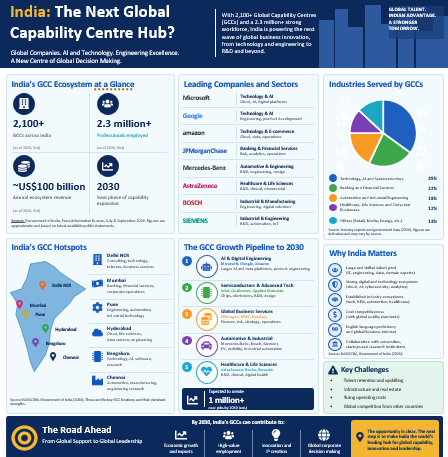
India is moving beyond traditional outsourcing to become a strategic base for global technology development, engineering, research, and business leadership.
According to MarketsandMarkets research:
- USD 98.4 billion — Estimated India GCC ecosystem revenue in FY2026
- USD 105.1 billion — Projected market size by 2030
- 1.6% CAGR — Forecast growth from 2026 to 2030
THE GLOBAL CAPABILITY POWERHOUSE
India’s GCC ecosystem spans technology, financial services, automotive, industrial engineering, healthcare, and consumer businesses.
Technology, AI and Semiconductors
Microsoft, Google, Amazon, Marvell
Banking and Financial Services
JPMorgan Chase, Goldman Sachs, HSBC
Automotive and Industrial Engineering
Mercedes Benz, Bosch, Siemens
Healthcare, Life Sciences and Consumer Businesses
AstraZeneca, Roche, Nestlé
These companies represent different parts of the wider ecosystem. Not every company investment or Indian operation listed here is a GCC specific commitment.
THE BIG INVESTMENT SIGNALS
1. Google: US$15 billion
Visakhapatnam, Andhra Pradesh
Google announced a five year investment for 2026 to 2030 to build an AI hub combining data centre capacity, computing infrastructure, energy, and international connectivity. Construction began in April 2026.
2. Amazon: US$48 billion
India, including cloud infrastructure in Mumbai and Hyderabad
Amazon announced total planned investment of US$48 billion through 2030, including an additional US$13 billion for AI and cloud infrastructure.
3. Microsoft: US$3 billion
India wide cloud and AI expansion
Microsoft announced a US$3 billion investment over two years in January 2025 for cloud and AI infrastructure, alongside plans to train 10 million people in AI skills by 2030.
4. Marvell: US$250 million
Bengaluru and Hyderabad
In July 2026, Marvell announced plans to invest US$250 million in India over three years, expand engineering capabilities, and double its headcount.
The bigger signal: Global investment is moving towards AI compute, advanced engineering, semiconductor capabilities, and digital infrastructure. These investments can strengthen the GCC ecosystem, but they should not be presented as GCC specific budgets.
THE GCC GROWTH PIPELINE TO 2030
The Government of India projects the GCC sector to reach approximately US$105 billion, with nearly 2,400 centres employing more than 2.8 million professionals by 2030.
The next phase of growth will be driven by:
1 AI and Generative AI: AI platforms, enterprise automation, model development, and AI operations.
2 Engineering and R&D: Automotive systems, semiconductor design, industrial technology, and product development.
3 Cloud and Cybersecurity: Data platforms, cloud architecture, digital resilience, and secure enterprise systems.
4 Global Business Leadership: Product strategy, finance, risk management, analytics, and global decision making.
5 New GCC Formation: In July 2026, Nestlé Business Solutions announced Hyderabad as the location for its new Indian Global Capability Centre, with Genpact as its partner.
6 Advanced Technology Talent: Marvell’s engineering expansion illustrates the wider demand for specialised semiconductor and AI infrastructure skills.
INDIA’S GCC HOTSPOTS
Bengaluru: AI, software engineering, semiconductor design, and technology R&D.
Hyderabad: Cloud, data science, life sciences, engineering, and enterprise technology.
Pune: Automotive engineering, industrial technology, financial services, software, and product development.
Chennai: Automotive, manufacturing technology, engineering, and research.
Mumbai: Banking, financial services, enterprise operations, and data centre infrastructure.
Delhi NCR: Consulting, telecom, corporate functions, and technology services.
Visakhapatnam: An emerging AI infrastructure hub, supported by Google’s announced investment.
Each city offers a different combination of talent, industry expertise, infrastructure, and operating costs. The next opportunity is to expand specialised capabilities beyond the largest established centres.
WHY INDIA MATTERS
Talent depth: A large pool of technology, engineering, finance, and domain specialists.
Innovation capability: Growing expertise in AI, analytics, product development, and advanced engineering.
Established ecosystems: Strong networks across banking, automotive, manufacturing, healthcare, and technology.
Global delivery experience: Mature capabilities in managing international operations and complex enterprise programmes.
Infrastructure investment: Expanding cloud, AI, data centre, and digital connectivity capacity.
Leadership potential: GCCs increasingly support global product ownership, research, strategic planning, and decision making.
THE OPPORTUNITY THROUGH 2030
India’s next phase of GCC growth will depend on the ability to attract higher value mandates, build specialised talent, improve infrastructure, and move more global leadership roles into Indian centres.
The opportunity extends beyond employment and service delivery. GCCs can help strengthen technology exports, intellectual property creation, advanced engineering, and global corporate decision making.
The big question is:
Can India evolve from the world’s leading GCC destination into one of its most important centres for global innovation, product ownership, and business leadership by 2030?
Click here to review the sample report to purchase the full Report:
Explore the India GCC Market
80% of the Forbes Global 2000 B2B companies rely on MarketsandMarkets to identify growth opportunities in emerging technologies and use cases that will have a positive revenue impact.
- Food Packaging Market Size Set for Strong Growth Through 2030 Amid Rising Demand for Convenience Foods
- Crop Protection Chemical Market Size, Share & Growth Forecast (2025–2030)
- Mulch Films Market: Driving Sustainable Agriculture Through Innovation
- Agricultural Adjuvants Market Analysis, Trends, and Growth Outlook (2026–2031)
- Japan Enterprise Asset Management Market Growth: AI and Smart Infrastructure Drive Demand

