
Europe Crop Protection Chemicals Market Size, Growth Trends & Forecast 2030
MarketsandMarkets™, 03 Mar 2026
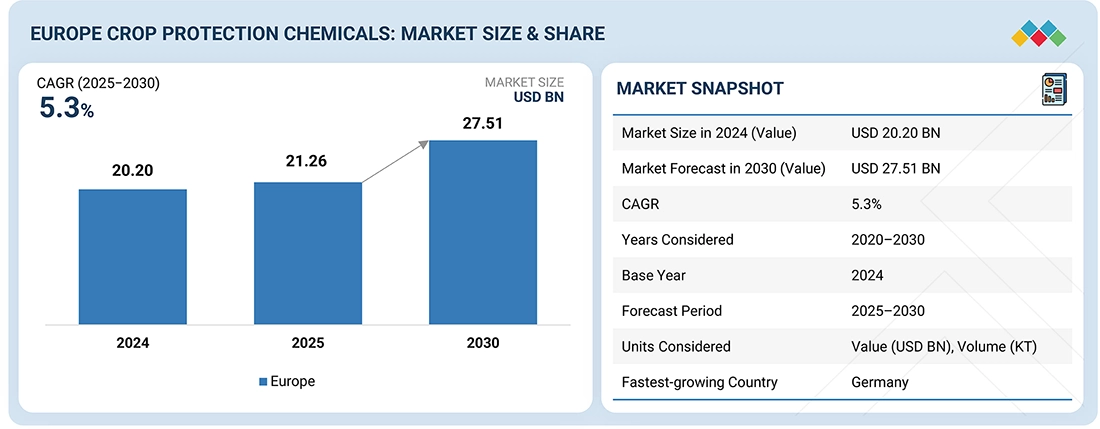
The Europe crop protection chemicals market is estimated at USD 21.26 billion in 2025 and is projected to reach USD 27.51 billion by 2030, expanding at a CAGR of 5.3% during the forecast period. Market growth is being driven by rapid technological innovation, rising demand for high-quality agricultural produce, and the increasing adoption of sustainable farming practices across the region.
The growing integration of Integrated Pest Management (IPM) programs and the development of bio-based crop protection formulations align strongly with the sustainability objectives of the European Union Green Deal, emphasizing environmentally responsible crop productivity. Europe remains one of the largest global markets for crop protection chemicals and is expected to maintain its leadership position throughout the forecast period.
The region’s dominance is underpinned by the strong presence of globally operating crop-protection manufacturers and the implementation of stringent regulatory frameworks. These regulations have accelerated the adoption of natural and biological crop protection solutions, driving innovation and market diversification across Europe.
Market Size and Growth Forecast
- Market Size in 2024 (Value): USD 20.20 Billion
- Market Forecast in 2030 (Value): USD 27.51 Billion
- Growth Rate: CAGR of 5.3% from 2025-2030
- Years Considered: 2020-2030
- Base Year: 2024
- Forecast Period: 2025-2030
- Units Considered: Value (USD Million/Billion), Volume (KT)
- Report Coverage: Revenue forecast, company ranking, competitive landscape, growth factors, and trends
Download PDF Brochure: https://www.marketsandmarkets.com/pdfdownloadNew.asp?id=190542011
Europe Crop Protection Chemicals Market by Type
The type segment includes:
- Herbicides
- Insecticides
- Fungicides & bactericides
- Others
Fungicides & bactericides hold the largest market share, driven by Europe’s strong focus on high-value crops and strict quality standards. These products are essential for managing a wide range of fungal and bacterial diseases that threaten the yield and quality of fruits, vegetables, cereals, and horticultural crops.
The widespread prevalence of diseases such as powdery mildew, rust, blight, and bacterial spot has intensified demand for effective disease-control solutions in key agricultural countries, including France, Spain, Italy, and Germany, positioning fungicides and bactericides as critical inputs in European agriculture.
Europe Crop Protection Chemicals Market by Mode of Application
The mode of application segment includes:
- Foliar spray
- Soil treatment
- Seed treatment
- Other application modes
Foliar spray dominates this segment due to its simplicity, cost-efficiency, and rapid action against pests and diseases on plant surfaces. It is the preferred application method for high-value crops such as fruits, vegetables, grapes, and greenhouse produce, where fast protection and precision treatment are critical for maintaining crop quality and yield.
Europe Crop Protection Chemicals Market by Crop Type
The crop type segment includes:
- Cereals & grains
- Fruits & vegetables
- Oilseeds & pulses
- Other crop types
Cereals & grains account for the largest market share due to their extensive cultivation and strategic importance in food security. Crops such as wheat, rice, barley, and corn require large-scale cultivation and are highly vulnerable to weeds, insects, and fungal diseases throughout their growth cycle.
These crops are often produced under intensive farming systems that prioritize yield maximization and crop uniformity, resulting in higher chemical input requirements. Their high economic value encourages farmers to invest heavily in advanced and effective crop protection programs to minimize yield losses and protect productivity.
Request Sample pages: https://www.marketsandmarkets.com/requestsampleNew.asp?id=190542011
Germany: Fastest-Growing Country in the Europe Crop Protection Chemicals Market
Germany is projected to be the fastest-growing market in Europe during the forecast period. Growth is driven by the large-scale cultivation of cereals, oilseeds, and sugar beets, combined with a strong national commitment to sustainable agriculture.
German farmers are increasingly adopting:
- Integrated Pest Management (IPM) systems
- Digital monitoring platforms
- Precision agriculture technologies
- Bio-based crop protection formulations
This transition supports environmental protection, regulatory compliance, and productivity optimization. The focus on eco-efficient farming systems and compliance with EU environmental standards is accelerating the adoption of next-generation, environmentally sustainable crop protection solutions across Germany.
- BASF SE (Germany)
- Bayer AG (Germany)
- Syngenta (Switzerland)
- FMC Corporation (US)
- Novonesis Group (Denmark)
- Koppert (Netherlands)
- BioFirst Group (Belgium)
- UPL (India)
- Nufarm (Australia)
- Corteva (US)
- American Vanguard Corporation (US)
- Kumiai Chemical Industry Co., Ltd (Japan)
- PI Industries (India)
- Gowan Company (US)
- Albaugh LLC (US)
Strategic Market Outlook
The Europe crop protection chemicals market is evolving toward a technology-driven, sustainability-focused agricultural ecosystem. The convergence of:
- Regulatory enforcement
- Sustainable farming policies
- Digital agriculture tools
- Bio-based innovations
- IPM adoption
is reshaping market dynamics and creating long-term growth opportunities. Companies that align product portfolios with sustainability goals, regulatory compliance, and precision agriculture trends are expected to gain strong competitive advantages in the European market landscape.
Frequently Asked Questions (FAQ):
Q1. What is the size of the Europe crop protection chemicals market?
The Europe crop protection chemicals market is estimated at USD 21.26 billion in 2025 and is projected to reach USD 27.51 billion by 2030, growing at a CAGR of 5.3% during the forecast period.
Q2. What factors are driving the growth of the Europe crop protection chemicals market?
Market growth is driven by technological innovation, rising demand for high-quality agricultural produce, increasing adoption of sustainable farming practices, expansion of integrated pest management (IPM) programs, and strong regulatory support for bio-based crop protection solutions.
Q3. What is Integrated Pest Management (IPM) and why is it important in Europe?
Integrated Pest Management (IPM) is a sustainable agricultural approach that combines biological, cultural, mechanical, and chemical tools to control pests while minimizing environmental impact. It is important in Europe due to strict environmental regulations and the European Union’s focus on sustainable agriculture and ecological conservation.
Q4. Which product type dominates the Europe crop protection chemicals market?
Fungicides and bactericides dominate the market due to Europe’s strong focus on high-value crops, strict quality standards, and the widespread presence of fungal and bacterial diseases affecting fruits, vegetables, cereals, and horticultural crops.
Q5. Which mode of application holds the largest market share in Europe?
Foliar spray holds the largest share due to its cost-effectiveness, ease of application, and rapid action against pests and diseases, especially for high-value crops such as fruits, vegetables, grapes, and greenhouse produce.
Q6. Which crop type segment dominates the Europe crop protection chemicals market?
Cereals and grains dominate the market due to their large-scale cultivation, importance in food security, vulnerability to pests and diseases, and intensive farming practices that require effective crop protection solutions.
Q7. Why is Germany the fastest-growing market in Europe?
Germany is the fastest-growing market due to its large-scale cultivation of cereals, oilseeds, and sugar beets, strong commitment to sustainable agriculture, rapid adoption of IPM systems, digital farming technologies, and increasing use of bio-based crop protection products.
Q8. How do EU regulations impact the crop protection chemicals market?
EU regulations promote environmental safety, reduce chemical residues, and encourage the adoption of natural and bio-based formulations, driving innovation and increasing demand for sustainable crop protection solutions across Europe.
Q9. What role do bio-based crop protection chemicals play in market growth?
Bio-based crop protection chemicals support sustainable agriculture by reducing environmental impact, improving soil health, and aligning with EU sustainability policies, making them a major growth driver in the European market.
Q10. What is the future outlook of the Europe crop protection chemicals market?
The market outlook is positive, supported by sustainable agriculture initiatives, technological innovation, digital farming adoption, regulatory support for eco-friendly products, and increasing investment in agricultural research and development.
About
80% of the Forbes Global 2000 B2B companies rely on MarketsandMarkets to identify growth opportunities in emerging technologies and use cases that will have a positive revenue impact.
RECENT POST
- Food Packaging Market Size Set for Strong Growth Through 2030 Amid Rising Demand for Convenience Foods
- Mulch Films Market: Driving Sustainable Agriculture Through Innovation
- Agricultural Adjuvants Market Analysis, Trends, and Growth Outlook (2026–2031)
- Crop Protection Chemical Market Size, Share & Growth Forecast (2025–2030)
- Japan Enterprise Asset Management Market Growth: AI and Smart Infrastructure Drive Demand

Emerging Trends and Growth Opportunities in the Europe Crop Protection Chemicals Market
For In-depth Analysis on Europe Crop Protection Chemicals Market
