The Future of the Hearing Aids: Market Innovations, Growth, and Trends
Hearing impairment affects millions of individuals across the globe, impacting daily communication, social interaction, and overall quality of life. As auditory healthcare continues to progress toward personalized care and advanced technical integration, hearing aids have evolved from simple sound amplification devices into highly sophisticated electronic tools. Modern hearing solutions incorporate digital signal processing, ergonomic designs, and wireless connectivity to assist individuals with varying degrees of hearing impairment. Driven by demographic shifts, expanding healthcare infrastructure, and heightened public health awareness worldwide, the global hearing healthcare industry is undergoing continuous innovation across device manufacturing, clinical diagnostic methodologies, and patient management pathways.
Current Industry Overview
The global auditory healthcare sector is experiencing sustained financial expansion, supported by increasing clinical demand and technological breakthroughs. Valued at USD 9.74 billion in 2024, the global hearing aids market is projected to reach USD 10.35 billion in 2025 and expand further to USD 14.42 billion by 2030. This growth path reflects a steady compound annual growth rate (CAGR) of 6.8% between 2025 and 2030.
The marketplace encompasses two primary product categories: hearing aid devices and hearing implants. Non-invasive devices—such as Receiver-in-the-Ear (RITE), Behind-the-Ear (BTE), In-the-Canal (ITC), and In-the-Ear (ITE) models—command the predominant revenue share due to their widespread suitability for mild to moderate hearing loss. Conversely, surgical solutions, including cochlear implants and bone-anchored hearing systems, address severe to profound auditory conditions.
Segmentation by impairment type demonstrates a clear dominance of sensorineural hearing loss over conductive conditions. Because age-related deterioration and hair cell damage within the inner ear represent the vast majority of clinical cases, sensorineural solutions account for the primary share of device distribution. In terms of patient demographics, the adult segment held 88.5% of the total market share in 2024. This concentration stems directly from the widespread incidence of presbycusis among populations over the age of 50.
From a technological perspective, digital hearing devices have almost entirely supplanted legacy analog technology. Digital solutions utilize adaptive signal processing, multi-channel sound management, and automatic environmental recognition, leaving analog units relegated to niche, highly price-sensitive environments. Distribution pathways remain centered on specialized audiology practices, ear, nose, and throat (ENT) clinics, and medical centers, though retail pharmacy networks and direct online sales channels are steadily expanding their market presence.
Key Market Drivers
Demographic aging stands as the single most powerful factor propelling industry expansion. Biologically, natural auditory degeneration accelerates past the age of 50, creating a continuously growing global patient population. In 2024, approximately 1.5 billion people worldwide lived with some degree of hearing impairment, including 430 million individuals requiring clinical intervention for disabling hearing loss. Demographic projections suggest that by 2050, nearly 2.5 billion individuals will experience hearing impairments, necessitating sustained investments in diagnostic and corrective technologies.
In addition to demographic aging, elevated exposure to environmental and recreational noise has increased the incidence of noise-induced hearing loss among younger adult demographics. Prolonged audio consumption via personal earwear and urban noise exposure have heightened public awareness regarding early auditory screening.
Concurrently, supportive insurance frameworks and expanding reimbursement mechanisms in several developed nations are improving patient access. Where third-party payers reduce out-of-pocket financial strain, device uptake increases significantly. The growing societal recognition that untreated auditory impairment leads to broader health issues—including accelerated cognitive decline, clinical depression, social isolation, and an elevated risk of accidental falls—has motivated health management organizations to facilitate earlier device adoption.
Emerging Technologies
Technological innovation is reshaping the user experience through artificial intelligence, deep neural networks, and advanced semiconductor architecture. Modern hearing instruments no longer operate merely as acoustic amplifiers; they function as intelligent processing units capable of isolating human speech from complex ambient background noise in real time.
Microchip engineering has achieved major breakthroughs in miniaturization and processing capacity. Recent releases highlight this shift, such as next-generation hardware platforms powered by dedicated deep neural network chips that analyze ambient environments instantaneously. Modern devices automatically adjust directional microphones to focus on active conversational partners based on the listener's directional attention. Furthermore, advances in chip efficiency allow manufacturers to deliver subminiaturized form factors that reduce physical volume by up to 25% while extending operational battery life to nearly 38 hours on a single charge.
Connectivity integration represents another critical technological frontier. The industry is rapidly adopting Bluetooth LE Audio standards, Google Fast Pair capabilities, and Auracast broadcast technologies. Auracast enables hearing aid wearers to stream audio directly from public address systems, venue displays, and personal devices with minimal power consumption and negligible latency.
In tandem with hardware improvements, cloud-based fitting software allows clinicians to perform real-time parameter adjustments remotely. Patients can receive fine-tuned acoustic recalibrations through mobile applications without visiting a clinic in person, establishing a flexible model for long-term patient support.
Future Trends
The boundary between prescription medical hardware and premium consumer audio products is growing increasingly fluid. The industry is witnessing a convergence where discreet aesthetic design, seamless wireless streaming, and biometric tracking feature prominently alongside medical-grade sound processing. Custom rechargeable in-the-ear units now combine invisible fitting profiles with universal smartphone connectivity, satisfying consumer demand for cosmetic discretion and everyday convenience.
Another pivotal trend involves the expansion of holistic health monitoring within auditory hardware. Future devices are poised to incorporate multi-sensor arrays capable of tracking physical activity, monitoring cardiovascular metrics, and detecting sudden falls in elderly users. By transforming hearing aids into multi-functional health tracking hubs, manufacturers are improving health outcomes and encouraging higher continuous wear compliance.
Regulatory evolution is also influencing distribution channels. The rollout of over-the-counter (OTC) sales frameworks for mild-to-moderate hearing impairments in key regions allows consumers to acquire self-fitting devices through traditional retail and e-commerce platforms. While prescription devices remain essential for complex auditory conditions, OTC options lower access barriers for early-stage users.
Opportunities
Emerging economies across the Asia Pacific, Latin American, and Middle Eastern regions represent exceptional expansion opportunities for device manufacturers and care providers. Historically underserved markets are experiencing rapid growth in healthcare expenditure, expanding hospital infrastructure, and rising disposable incomes. Countries such as India, South Korea, China, and Vietnam possess large populations with underdiagnosed hearing conditions, offering an extensive growth runway for affordable, digital hearing technologies.
Furthermore, medical tourism hubs in Southeast Asian nations, including Thailand and Malaysia, are drawing international patients seeking high-quality audiological evaluations and implant surgeries at competitive price points. Manufacturers that establish localized distribution partnerships, offer tailored pricing structures, and support clinician training programs in these high-growth geographies are well-positioned to capture long-term market share.
The integration of tele-audiology platforms offers another major growth vector. As digital literacy increases among older adults, remote diagnostic consultations, home-delivery device fittings, and continuous cloud-based acoustic updates allow service providers to reach patients in geographically remote or rural areas where specialized clinical services remain sparse.
Challenges
Despite positive growth prospects, the market faces structural challenges related to high cost barriers. Prescription hearing aids generally range between USD 1,000 and USD 6,000 per pair, presenting a substantial financial hurdle where insurance coverage or public healthcare subsidies are lacking. For individuals requiring surgical interventions, such as cochlear implantation, device expenses can exceed USD 34,000, excluding the substantial costs associated with surgery, hospital stay, and long-term speech rehabilitation therapy. These high costs severely restrict adoption among lower-income demographics and in developing countries.
A critical shortage of qualified healthcare professionals presents another persistent bottleneck. The global supply of specialized otolaryngologists, clinical audiologists, and skilled ENT surgeons remains insufficient to meet rising clinical demand. This talent deficit is particularly acute in rural and non-metropolitan regions, leading to prolonged wait times for diagnostic testing, inaccurate device fittings, and delayed post-operative care. Addressable demand cannot be fully realized without expanding educational and vocational pipelines for audiology professionals globally.
Regional Outlook
North America and Europe currently represent mature, revenue-dominant regional markets. These territories benefit from well-funded healthcare infrastructure, high consumer awareness, comprehensive clinical guidelines, and favorable reimbursement structures. Advanced digital devices, custom rechargeable models, and early-stage AI integrations find rapid commercial acceptance across these developed markets.
The Asia Pacific region is projected to experience the fastest compound annual growth rate during the forecast period. Expansion in Asia Pacific is propelled by rapid population aging, growing public awareness regarding hearing preservation, and massive public and private investments in clinical infrastructure. Developed economies within the region, such as South Korea, Taiwan, and Singapore, are witnessing elevated adoption of high-end smart devices, while developing nations like China and India present expanding volume demand driven by expanding healthcare access.
Latin America, alongside the Middle East and Africa, exhibits steady long-term growth potential. Infrastructure modernization, expanding healthcare coverage, and government-led hearing screening initiatives across primary schools and eldercare facilities are gradually opening up these emerging regional markets.
Competitive Landscape
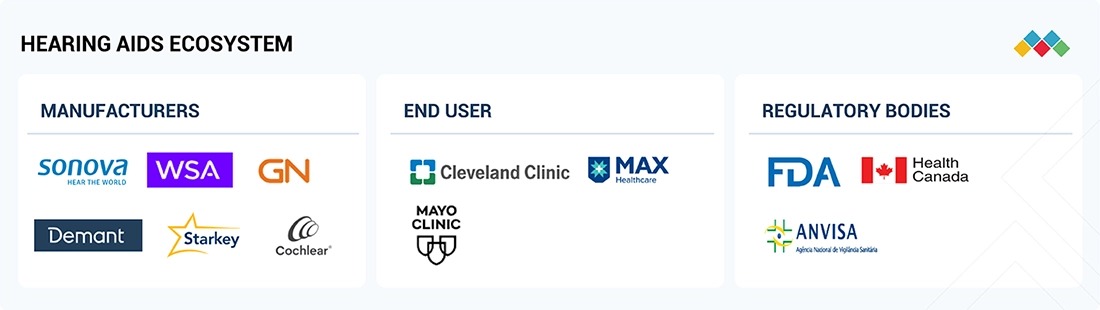
The competitive environment in the hearing aids sector is highly concentrated among established global medical technology leaders. Key market participants include Sonova (Switzerland), WS Audiology (Denmark), Demant A/S (Denmark), Cochlear Ltd. (Australia), GN Store Nord A/S (Denmark), Starkey Laboratories, Inc. (US), MED-EL Medical Electronics (Austria), Eargo Inc. (US), Rion Co., Ltd. (Japan), and Zhejiang Nurotron Biotechnology Co., Ltd. (China).
These market leaders maintain their competitive positioning through strategic research and development investments, frequent product upgrades, and targeted corporate acquisitions. Recent strategic moves showcase this innovation focus:
-
Sonova introduced the Phonak EON platform built on the HYPERSONIC microchip, incorporating Spheric Speech Clarity 3.0 and AutoSense OS AI 8.0, offering a form factor 25% smaller and 20% lighter than prior generations with up to 38 hours of operational runtime. Additionally, Sonova expanded its custom line with the Phonak Virto R Infinio, a compact, rechargeable custom in-the-ear device featuring universal Bluetooth connectivity.
-
Demant launched Oticon Zeal, an in-the-ear rechargeable device featuring AI-driven sound management, Bluetooth LE Audio integration, Google Fast Pair, and Auracast compatibility.
-
WS Audiology unveiled the Widex Allure platform built around the proprietary W1 chip and Precision Hearing Technology, paired with the cloud-based Widex Compass Cloud fitting ecosystem.
-
GN Store Nord launched ReSound Vivia, an AI-powered device utilizing a dedicated deep-neural-network chip with Intelligent Focus technology, accompanied by the ReSound Savi accessibility line bringing Bluetooth LE Audio to broader consumer segments.
-
Cochlear Ltd. and MED-EL remain dominant in the specialized hearing implant segment, advancing internal implant technology, speech processor miniaturization, and post-surgical rehabilitation support.
What the Future Looks Like
Looking toward 2030, the hearing aids industry will complete its transition from reactive sound amplification to proactive, continuous auditory healthcare management. Devices will operate with total autonomy, continually analyzing the listener's surrounding environment, predicting acoustic intent, and adjusting frequency response parameters using on-board artificial intelligence.
The universal rollout of Auracast and next-generation wireless protocols will make public audio accessible across transit hubs, theaters, places of worship, and educational facilities. As form factors shrink and battery life extends, physical stigma surrounding device usage will diminish further, encouraging earlier adoption among working-age populations. Ultimately, integrating auditory care into broader health ecosystems will reduce long-term cognitive and social complications, establishing hearing devices as indispensable tools for healthy aging.
80% of the Forbes Global 2000 B2B companies rely on MarketsandMarkets to identify growth opportunities in emerging technologies and use cases that will have a positive revenue impact.
- Food Packaging Market Size Set for Strong Growth Through 2030 Amid Rising Demand for Convenience Foods
- Crop Protection Chemical Market Size, Share & Growth Forecast (2025–2030)
- Mulch Films Market: Driving Sustainable Agriculture Through Innovation
- Agricultural Adjuvants Market Analysis, Trends, and Growth Outlook (2026–2031)
- Japan Enterprise Asset Management Market Growth: AI and Smart Infrastructure Drive Demand

The global hearing aids market stands at the intersection of medical necessity and technological evolution. Driven by an aging global population, rising noise-induced hearing loss, and a growing recognition of the connection between auditory clarity and cognitive longevity, demand for advanced hearing solutions will continue its upward trajectory. While high device costs and specialist shortages remain key operational obstacles, ongoing innovations in artificial intelligence, chip miniaturization, wireless streaming, and tele-audiology are breaking down historical barriers to care. As key industry players expand their product portfolios and emerging regions accelerate infrastructure investments, the future of hearing healthcare promises greater accessibility, superior acoustic fidelity, and improved quality of life for millions worldwide.