The Future of Orthopedic Devices: Global Market Trends, Technological Innovations, and Growth Forecast (2026–2030)
Modern healthcare is undergoing a profound transformation as demographic shifts and technological advancements converge to redefine surgical interventions. The field of musculoskeletal care stands at the forefront of this evolution, where medical engineering continually bridges the gap between patient mobility and clinical efficiency. As joint degeneration, traumatic injuries, and chronic bone conditions become increasingly prevalent across diverse age demographics, advanced medical interventions have shifted from elective options to critical healthcare requirements. Through continuous innovation in biological materials, precision engineering, and digital connectivity, modern clinical infrastructure is reshaping how surgeons approach joint restoration and bone reconstruction to ensure long-term mobility and better quality of life worldwide.
Current Industry Overview
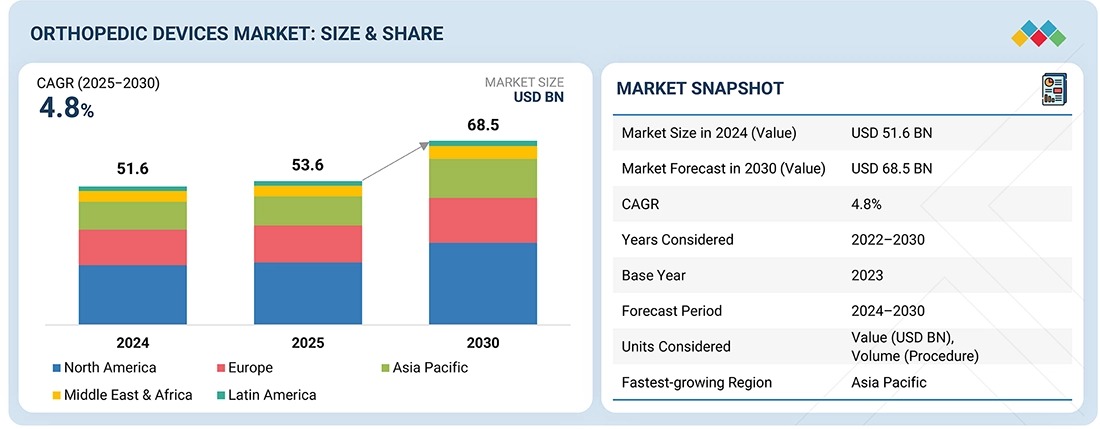
The global landscape for bone and joint interventions is experiencing steady expansion, reflecting an escalating worldwide requirement for specialized surgical hardware and regenerative tools. Financial valuations indicate that the orthopedic devices market expanded to USD 51.6 billion in 2024 and is projected to reach USD 68.5 billion by 2030. This structural growth represents a compound annual growth rate (CAGR) of 4.8% across the forecast period.
Product and Site Dynamics
Within product categories, joint reconstruction devices represent the primary revenue driver of the sector. Replacement systems are expected to exhibit the fastest trajectory among device categories, advancing at a CAGR of 5.9%. Geographically, North America held the dominant share in 2024, capturing 43.1% of overall global revenue.
When evaluating procedural sites, interventions targeted at the foot and ankle segment are projected to register the fastest growth rate between 2025 and 2030. Outpatient surgical environments, including ambulatory care facilities and trauma units, are rapidly emerging as the fastest-expanding end-user care delivery channels.
Key Market Drivers
Demographic aging across major global economies acts as a primary catalyst propelling clinical intervention demand. Age-related structural degeneration, particularly osteoporosis and progressive joint wear, leads to higher rates of bone fragility and functional impairment. Global demographic data indicates that the population aged 65 and older stood at 727 million in 2020 and is projected to reach 1.5 billion by 2050.
In the United States, the population segment over age 65 will double between 2005 and 2030, contributing to over 300,000 annual hospitalizations for hip fractures among elderly individuals. Similarly, demographic models in Japan indicate that seniors will account for nearly 40% of the national population by 2060.
Beyond age-related factors, changing active lifestyles, increased participation in sports, and vehicular accidents generate a persistent need for trauma fixation hardware and joint reconstruction. The growing prevalence of chronic conditions like osteoarthritis provides a consistent baseline for elective joint procedures. Concurrently, the expanding adoption of telemedicine platforms and remote diagnostic tools accelerates patient evaluations, facilitating timely surgical consultations and broadening overall procedural access.
Emerging Technologies
Material science and digital engineering are fundamental drivers reshaping modern implant performance. A structural transition is underway from conventional metallic hardware toward bio-interactive materials. Advanced bioresorbable implants, porous titanium surfaces, and hybrid polymer-ceramic systems are increasingly deployed to enhance osseointegration, encouraging natural bone bonding and reducing revision rates.
Additive Manufacturing and Smart Hardware
Three-dimensional printing and additive manufacturing are revolutionizing custom implant production. Surgeons can now utilize patient-specific devices contoured precisely to match unique patient anatomy, optimizing weight distribution and biomechanical alignment. In spinal care, porous polyetheretherketone (PEEK) implants and nano-textured titanium cages blend structural durability with radiolucency, allowing physicians to clearly evaluate post-operative fusion progress through standard medical imaging.
Digital hardware capabilities are further enhanced through smart implants embedded with IoT-enabled micro-sensors. These integrated devices provide real-time monitoring of post-operative joint pressure, range of motion, and localized inflammation, streaming biomechanical data to clinicians for proactive recovery management. When combined with artificial intelligence and machine learning software, surgical teams can simulate complex procedures and optimize pre-operative plans prior to making an incision.
Future Trends
The procedural model for joint restoration is undergoing a permanent shift toward minimally invasive procedures and ambulatory care. Outpatient surgical centers offer accelerated patient rehabilitation, reduced risk of hospital-acquired complications, and noticeable cost efficiencies. Computer-guided navigation systems and compact arthroscopy instruments enable medical teams to execute intricate reconstructive procedures safely in outpatient settings.
At the same time, environmental sustainability and value-based healthcare models are shaping strategic decisions across original equipment manufacturers. Top medical device creators are implementing recyclable material packaging, energy-efficient manufacturing workflows, and modular instrument designs to curb clinical waste. Concurrently, healthcare payors are shifting procurement toward outcome-based frameworks, favoring devices that demonstrate long-term durability and lower rates of post-surgical complications.
Opportunities
Substantial commercial and clinical potential lies in combining orthobiologics, advanced robotics, and additive manufacturing. Orthobiologic solutions, such as demineralized bone matrix (DBM) and synthetic bone graft substitutes, stimulate natural biological bone regeneration. These biological solutions enhance fusion rates in spinal surgeries and complex fracture repair, providing effective alternatives to traditional autografts.
Robotic-assisted surgery represents another primary driver of clinical progress. Robot-guided joint replacements deliver high procedural success rates near 95%, primarily due to precise implant positioning and reduced surrounding tissue disruption. Institutional adoption continues to accelerate globally; for example, KIMS Hospital in the United Kingdom integrated Stryker's Mako Smart Robotics system to enhance precision during total knee replacements. Such investments highlight a growing institutional commitment to robotic accuracy and predictable clinical outcomes.
Challenges
Despite strong market momentum, the industry faces notable structural obstacles. The financial burden associated with sophisticated joint replacement therapies remains a major barrier to widespread adoption. In developing markets, traditional total knee arthroplasty costs between $5,500 and $11,500 in India, posing a challenge for patients without comprehensive medical insurance. In high-income regions, robotic-assisted total knee surgeries carry an approximate 10% cost premium over standard manual techniques, prompting cost-containment scrutiny from healthcare payors.
Workforce constraints also present a significant bottleneck. A widespread shortage of trained orthopedic specialists limits surgical availability and contributes to extended waiting times for elective procedures. This labor shortfall restricts the immediate scaling of advanced robotic platforms. Furthermore, medical technology manufacturers face intense commercial competition, downward pricing pressure from hospital purchasing alliances, and rigorous regulatory clearance pathways across major markets.
Regional Outlook
North America continues to hold the largest revenue share in the global landscape. This dominance is supported by sophisticated healthcare infrastructure, high adoption rates of premium technologies like robotic navigation, and established insurance reimbursement frameworks. Leading medical device developers maintain a dominant presence across North American health systems, driving consistent volume in hip, knee, and trauma procedures.
The Asia-Pacific region is poised to achieve the highest growth rate during the forecast period through 2030. Rapid economic development, expanding middle-class populations, and expanding medical tourism networks in countries such as India, China, and South Korea are accelerating regional demand. Governments across the region are actively investing in healthcare facilities and promoting local manufacturing initiatives to improve treatment affordability and broaden patient access.
Competitive Landscape
The competitive landscape exhibits significant consolidation among established global medical technology leaders. Prominent companies driving market trends include Stryker Corporation, Johnson & Johnson MedTech (DePuy Synthes), Zimmer Biomet Holdings, Smith+Nephew, B. Braun, Medtronic, and NuVasive. These industry leaders continually invest in digital surgery integration, robotic capabilities, and strategic corporate realignments.
Strategic Corporate Portfolio Actions
Major industry participants actively refine their product portfolios through targeted divestitures, regulatory milestones, and strategic partnerships:
-
In January 2025, Stryker finalized an agreement to sell its spinal implant business segment to Viscogliosi Brothers, leading to the creation of a dedicated entity named VB Spine, LLC.
-
In December 2024, Zimmer Biomet secured FDA 510(k) clearance for its OsseoFit Stemless Shoulder System, expanding its total shoulder arthroplasty portfolio.
-
In July 2024, Smith+Nephew established a strategic collaboration with Healthcare Outcomes Performance Company (HOPCo) to integrate digital analytics tools across outpatient ambulatory surgical centers.
Mid-tier competitors and specialized startups are successfully differentiating themselves by developing niche solutions, including bioresorbable fixation pins, custom 3D-printed constructs, and low-cost arthroscopy instruments.
What the Future Looks Like
The future of joint and bone intervention will seamlessly merge biological healing, precision engineering, and data analytics. Implants will shift from static mechanical devices to dynamic systems capable of reporting continuous biomechanical feedback and encouraging rapid bone integration. AI-driven predictive algorithms will automatically convert patient radiological scans into custom 3D-printed devices while planning optimal robotic trajectories for surgeons. Outpatient care settings will handle the majority of routine joint procedures, supported by standardized recovery protocols and connected remote patient monitoring. Consequently, surgical interventions will achieve higher repeatability, shorter hospital stays, and lower revision rates.
80% of the Forbes Global 2000 B2B companies rely on MarketsandMarkets to identify growth opportunities in emerging technologies and use cases that will have a positive revenue impact.
- Food Packaging Market Size Set for Strong Growth Through 2030 Amid Rising Demand for Convenience Foods
- Mulch Films Market: Driving Sustainable Agriculture Through Innovation
- Agricultural Adjuvants Market Analysis, Trends, and Growth Outlook (2026–2031)
- Crop Protection Chemical Market Size, Share & Growth Forecast (2025–2030)
- Japan Enterprise Asset Management Market Growth: AI and Smart Infrastructure Drive Demand

Conclusion
The trajectory of the musculoskeletal care industry is defined by rapid technological evolution, expanding biological applications, and patient-centric care models. Supported by an aging global population, growing outpatient care infrastructure, and innovations in bioresorbable materials, 3D printing, and surgical robotics, the sector is positioned for steady long-term expansion. Although high treatment costs and specialist shortages remain key operational challenges, the transition toward value-based care and connected digital platforms provides a clear path forward. As medical technology continues to improve implant longevity and surgical predictability, patients worldwide stand to gain enhanced mobility and improved long-term quality of life.