25 Leading Cell Culture Companies Shaping Innovation and Market Growth to 2031
Discover the top 25 companies driving innovation in the cell culture market. This in-depth analysis explores competitive advantages, transformative trends, and key players poised to influence biopharmaceutical manufacturing, vaccine development, drug discovery, and cell and gene therapy through 2031.
Spotlights on the Industry's Top Cell Culture Companies
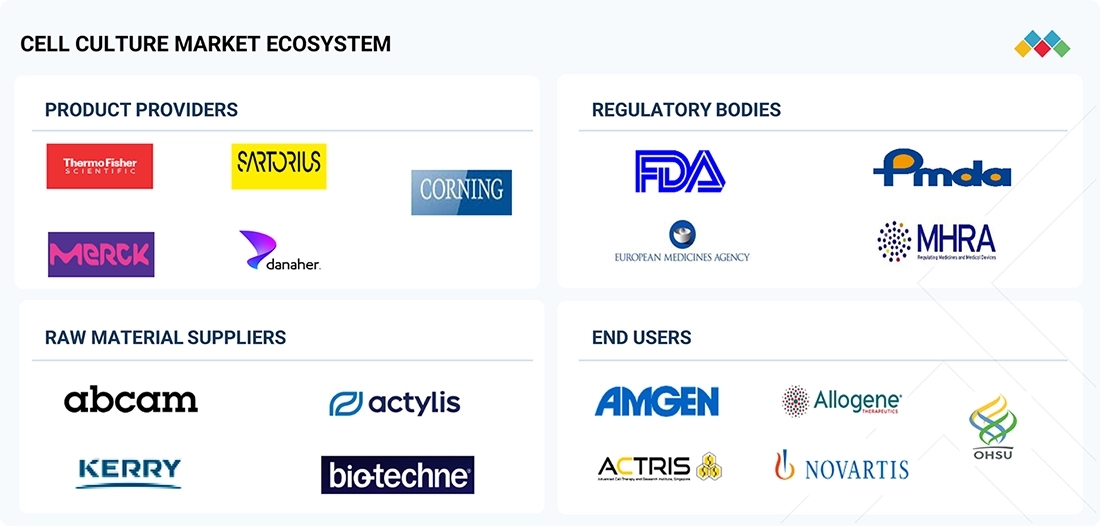
The global cell culture market is evolving as pharmaceutical and biotechnology companies increase investments in biologics, biosimilars, vaccines, and advanced therapies. Demand for reliable culture media, sera, reagents, vessels, and bioprocessing equipment is increasing across research and commercial manufacturing. Technologies such as serum-free and chemically defined media, single-use bioreactors, automated cell culture systems, closed processing, three-dimensional culture, and organoids are reshaping the industry. Companies are strengthening their portfolios through product innovation, manufacturing expansion, and specialized solutions that support scalability, reproducibility, contamination control, and consistent cell growth. According to MarketsandMarkets, the market is projected to grow from USD 33.07 billion in 2026 to USD 58.42 billion by 2031, at a CAGR of 12.1%.
1. THERMO FISHER SCIENTIFIC INC.
Thermo Fisher Scientific is a major supplier of cell culture products through its Gibco portfolio, which includes basal media, specialty media, sera, supplements, reagents, and cell culture systems. Its offerings support research, drug discovery, vaccine development, biologics production, and cell therapy manufacturing. The company combines consumables with laboratory equipment, bioprocessing technologies, and technical services to serve customers across research and commercial production. Its global distribution network and broad product portfolio position it as a significant participant in the cell culture market.
2. DANAHER CORPORATION
Danaher participates in the cell culture market primarily through its Cytiva and Pall businesses, which supply bioprocessing technologies, filtration systems, and solutions used in biologics manufacturing. Its portfolio supports cell culture process development, media preparation, contamination control, and downstream processing. Through integrated equipment and consumables, the company serves manufacturers producing monoclonal antibodies, vaccines, and other biological products. Danaher's capabilities in process technologies and biomanufacturing workflows help customers improve operational consistency, scale production, and manage complex manufacturing requirements.
3. MERCK KGAA
Merck KGaA provides cell culture and bioprocessing solutions through its Life Science business, including the Millipore portfolio. Its offerings encompass cell culture media, supplements, reagents, filtration products, and technologies supporting biopharmaceutical production. The company serves research laboratories and manufacturers working with monoclonal antibodies, vaccines, and advanced therapies. Its expertise in media development, process optimization, quality systems, and manufacturing support makes it an important supplier to organizations seeking consistent culture performance and scalable production processes.
4. SARTORIUS AG
Sartorius supplies cell culture and bioprocessing technologies for pharmaceutical development and biological manufacturing. Its portfolio includes bioreactors, single-use systems, filtration products, laboratory instruments, and solutions supporting upstream processing. The company serves biopharmaceutical manufacturers developing monoclonal antibodies, vaccines, and cell and gene therapies. Its emphasis on scalable equipment, process monitoring, and integrated workflows addresses the need for reproducibility and operational efficiency. Sartorius is positioned to benefit from the growing adoption of flexible manufacturing systems and advanced bioprocessing technologies.
5. CORNING INCORPORATED
Corning Incorporated is a prominent supplier of cell culture vessels and laboratory consumables, including flasks, dishes, plates, tubes, and specialized culture surfaces. Its products support adherent cell growth, routine laboratory research, drug discovery, and biopharmaceutical development. The company also offers advanced cell culture platforms designed to support more complex biological models and scalable workflows. Corning's expertise in materials science and surface treatment technologies helps researchers address cell attachment, consistency, and reproducibility requirements across conventional two-dimensional culture and selected three-dimensional applications.
6. FUJIFILM HOLDINGS CORPORATION
FUJIFILM Holdings participates in the cell culture market through specialized life science products and biomanufacturing capabilities. Its FUJIFILM Irvine Scientific business provides cell culture media and related solutions for biopharmaceutical production, cell therapy, and assisted reproductive technology applications. These products support the cultivation and maintenance of cells under controlled conditions. The broader group also has contract development and manufacturing capabilities through its biopharmaceutical businesses. Its combination of media expertise and manufacturing services supports customers developing and commercializing biological therapies.
7. BD
BD, or Becton, Dickinson and Company, supports cell culture workflows through laboratory products, research tools, and technologies used in cell analysis and sample handling. Its portfolio includes laboratory consumables and systems relevant to cell preparation, flow cytometry, and biological research. These capabilities complement cell culture activities by helping laboratories assess cell populations, characterize samples, and monitor experimental outcomes. BD serves research, clinical, and pharmaceutical customers, with particular relevance to workflows requiring reliable sample processing and cellular analysis alongside cultivation.
8. EPPENDORF SE
Eppendorf supplies laboratory equipment and consumables used in cell culture research and bioprocess development. Its portfolio includes cell culture flasks and vessels, centrifuges, incubators, pipettes, mixers, and bioreactor systems. These products support routine cell maintenance, sample preparation, process development, and small-scale cultivation. The company serves academic institutions, biotechnology firms, pharmaceutical laboratories, and industrial research facilities. Its focus on laboratory precision, equipment reliability, and workflow compatibility makes Eppendorf a relevant provider for organizations seeking reproducible cell culture processes.
9. LONZA
Lonza is an important supplier of cell culture products and services for pharmaceutical research and biopharmaceutical manufacturing. Its capabilities include cell culture media, specialized cell systems, bioprocess development, and contract development and manufacturing services. The company supports production involving biologics and advanced therapies, including cell and gene therapy applications. By combining scientific expertise with manufacturing infrastructure, Lonza helps customers develop and scale biological processes. Its role spans research support and commercial production, making it relevant to the expanding demand for reliable cell-based manufacturing solutions.
10. GETINGE
Getinge contributes to cell culture and biopharmaceutical manufacturing through equipment and systems designed for controlled production environments. Its relevant technologies include sterilization equipment, contamination-control solutions, and products supporting cleanroom and aseptic processing operations. These systems help pharmaceutical manufacturers maintain hygienic conditions around sensitive biological processes. Although Getinge is not primarily a cell culture media supplier, its equipment supports the infrastructure required for safe and consistent biomanufacturing. Its relevance is strongest in facilities where sterilization, process integrity, and contamination prevention are essential.
11. AGILENT TECHNOLOGIES, INC.
Agilent Technologies supports cell culture research through analytical instruments, laboratory consumables, and solutions for measuring biological and chemical processes. Its technologies are used in cell-based research, metabolite analysis, media characterization, and quality assessment associated with biological production. Analytical capabilities can help researchers investigate culture conditions and evaluate product quality during process development. Agilent's relevance is therefore strongest in analytical testing and laboratory workflows surrounding cell cultivation rather than as a broad supplier of cell culture vessels or complete bioreactor platforms.
12. HIMEDIA LABORATORIES
HiMedia Laboratories supplies microbiology and life science products, including cell culture media, sera, reagents, and laboratory consumables. Its product portfolio serves research laboratories, educational institutions, diagnostic facilities, and biotechnology applications. The company offers products for maintaining and cultivating cells under defined laboratory conditions, supporting routine research and specialized experimental workflows. Its presence in laboratory supplies and biological media gives it relevance across research and industrial users seeking accessible culture materials. Product selection depends on the specific cell type, application, and required quality specifications.
13. BIO-TECHNE
Bio-Techne provides life science reagents, proteins, antibodies, cell culture products, and technologies supporting cell-based research. Through brands such as R&D Systems and Tocris, it supplies growth factors, cytokines, and specialized reagents used to study cell signaling, differentiation, and biological responses. These materials support stem cell research, disease modeling, drug discovery, and advanced cellular applications. The company's expertise in biologically active proteins and research reagents makes it particularly relevant to specialized cell culture workflows that require precise control over cellular behavior.
14. MILTENYI BIOTEC
Miltenyi Biotec develops technologies for cell separation, cell analysis, cell culture, and cell therapy manufacturing. Its portfolio includes cell processing instruments, reagents, media, and integrated solutions used in cellular research and therapeutic development. These technologies help researchers isolate, maintain, and process specific cell populations while supporting workflows for immunology, stem cell research, and advanced therapies. The company's expertise in cellular processing and clinical-scale manufacturing solutions makes it relevant to the increasing adoption of cell-based treatments and more controlled cell production systems.
15. STEMCELL TECHNOLOGIES
STEMCELL Technologies specializes in cell culture media, reagents, and tools for stem cell research, immunology, cancer research, and regenerative medicine. Its offerings include specialized media and supplements for the maintenance, expansion, and differentiation of human and animal cells. The company also provides cell separation products and research tools that support defined experimental workflows. Its focus on specialized cell types and reproducible culture conditions helps researchers address complex biological questions and develop cell-based models for disease research, drug discovery, and therapeutic development.
16. SOLIDA BIOTECH GMBH
Solida Biotech GmbH focuses on bioprocess equipment and cultivation technologies used in biotechnology and life science applications. Its relevant capabilities include bioreactor systems and solutions for controlled cultivation, process development, and scale-up. Such systems allow users to regulate important operating parameters and investigate culture performance under defined conditions. The company is relevant to laboratories and industrial biotechnology organizations seeking flexible cultivation equipment for development and production workflows. Its contribution is primarily equipment-based rather than centered on broad portfolios of media and cell culture reagents.
17. CAISSON LABS
Caisson Labs supplies cell culture media, sera, buffers, and related reagents for research and biotechnology applications. Its products support the maintenance and growth of cells across laboratory and specialized research workflows. The company offers culture materials designed for different experimental requirements, including applications where media composition and consistency are important. Its focused product portfolio positions it as a specialized supplier within a market that includes multinational life science companies and niche manufacturers. Caisson Labs is particularly relevant to customers seeking dedicated media and reagent options.
18. PROMOCELL GMBH
PromoCell GmbH specializes in human primary cells, cell culture media, supplements, and related research products. Its portfolio supports the cultivation of human cell types used in biomedical research, disease modeling, and drug discovery. The company provides cell-specific culture systems designed to help researchers maintain appropriate growth and functional characteristics. Its focus on primary human cells and specialized media differentiates it from suppliers primarily concentrated on large-scale bioprocess equipment. PromoCell is relevant to laboratories seeking reliable cellular models for investigating human biology and evaluating experimental treatments.
19. INVIVOGEN
InvivoGen develops research reagents and biological tools used in immunology, inflammation, infectious disease research, and cellular signaling studies. Its products include cell culture-related reagents, media, and specialized tools for investigating innate immunity and immune responses. These solutions can support experiments involving cultured cells, including studies of cellular activation and responses to biological stimuli. InvivoGen's role in the cell culture ecosystem is specialized, focusing on research reagents and experimental applications rather than large-scale culture vessels or commercial bioreactor systems.
20. PAN-BIOTECH
PAN-Biotech supplies cell culture media, sera, supplements, buffers, and other laboratory reagents for research and biotechnology applications. Its products support the cultivation of mammalian cells and other biological systems across laboratory workflows. The company serves customers who require culture formulations and related materials for routine research, process development, and specialized cell-based applications. Its focused portfolio and experience in cell culture materials position it as a relevant supplier for laboratories seeking alternatives across media and reagent categories, subject to application-specific performance and quality requirements.
21. CELLEXUS
Cellexus specializes in bioreactor technology designed for cell culture and microbial cultivation applications. Its airlift-based systems provide an alternative to conventional stirred-tank approaches for selected bioprocesses. The technology is relevant to research and process development activities where controlled cultivation, mixing, and oxygen transfer are important. Cellexus serves biotechnology and life science users seeking equipment for developing and scaling biological processes. Its specialized bioreactor focus distinguishes it from broader suppliers whose portfolios span media, sera, cultureware, analytical instruments, and filtration products.
22. MEISSNER FILTRATION PRODUCTS, INC.
Meissner Filtration Products provides filtration technologies and single-use systems for pharmaceutical and biopharmaceutical manufacturing. Its offerings include filters, filtration assemblies, and fluid management solutions used in process preparation and product purification. These technologies support cell culture operations by helping manufacturers manage process fluids and protect product quality throughout bioprocessing workflows. The company's strongest relevance lies in filtration and contamination-control infrastructure rather than in the direct supply of cell culture media. Its solutions address the stringent quality requirements of biological manufacturing environments.
23. ADOLF KÜHNER AG
Adolf Kühner AG develops and manufactures laboratory shakers and bioreactor systems used in biotechnology, cell culture, and microbial research. Its equipment supports controlled cultivation by enabling users to manage agitation and other process conditions appropriate to their applications. Shaking systems are widely used for cell expansion, screening, and early-stage process development, while bioreactors support more controlled cultivation studies. Kühner's focus on cultivation equipment makes it relevant to research institutions and biopharmaceutical developers seeking reproducible experimental conditions and scalable process-development workflows.
24. ADVANCION CORPORATION
Advancion Corporation supplies specialty ingredients and performance materials used across industrial and life science applications. Its relevance to cell culture is associated with selected chemical ingredients and formulation components that may support laboratory and bioprocess workflows, depending on the product and application. It is not primarily positioned as a comprehensive cell culture systems provider comparable with major suppliers of media, vessels, and bioreactors. Its role should therefore be assessed at the product level, with attention to verified cell culture applications and suitability for the intended manufacturing process.
25. BIOSPHERIX LLC
BioSpherix LLC develops environmental control systems and specialized equipment for cell culture and cell-based research. Its technologies include controlled-atmosphere workstations and systems designed to regulate oxygen and other environmental conditions around cultured cells. These capabilities are relevant to research involving sensitive cell types, hypoxia, stem cells, and other applications where conventional incubator conditions may not be sufficient. By enabling tighter control of the cellular environment, BioSpherix supports researchers seeking to improve experimental consistency and investigate cell behavior under specific physiological conditions.
80% of the Forbes Global 2000 B2B companies rely on MarketsandMarkets to identify growth opportunities in emerging technologies and use cases that will have a positive revenue impact.
- Food Packaging Market Size Set for Strong Growth Through 2030 Amid Rising Demand for Convenience Foods
- Crop Protection Chemical Market Size, Share & Growth Forecast (2025–2030)
- Mulch Films Market: Driving Sustainable Agriculture Through Innovation
- Agricultural Adjuvants Market Analysis, Trends, and Growth Outlook (2026–2031)
- Japan Enterprise Asset Management Market Growth: AI and Smart Infrastructure Drive Demand

The cell culture market is positioned for continued expansion as demand for biologics, biosimilars, vaccines, and cell and gene therapies increases. Advances in chemically defined media, single-use bioreactors, automated cultivation, filtration, and specialized cell models are creating opportunities for established suppliers and niche technology providers. At the same time, manufacturers must address quality requirements, contamination control, process consistency, scalability, and applicable regulatory expectations. Companies that strengthen product performance, manufacturing capacity, and application-specific solutions will be better positioned to serve evolving research and biomanufacturing needs.