

Artificial intelligence (AI) is transforming the 3D motion capture industry across North America
AI in 3D Motion Capture Systems: Pioneering Innovations in North America
Artificial intelligence (AI) is transforming the 3D motion capture industry across North America, enabling faster, more accurate, and increasingly accessible human-motion tracking. Traditionally, motion capture required specialized cameras, reflective markers, sensors, and controlled studio environments. Today, AI-powered software, computer vision, deep learning, and sensor fusion are reducing these limitations and opening new applications across entertainment, healthcare, sports, robotics, and industrial environments.
Get More Details PDF Brochure:
https://www.marketsandmarkets.com/pdfdownloadNew.asp?id=193435109
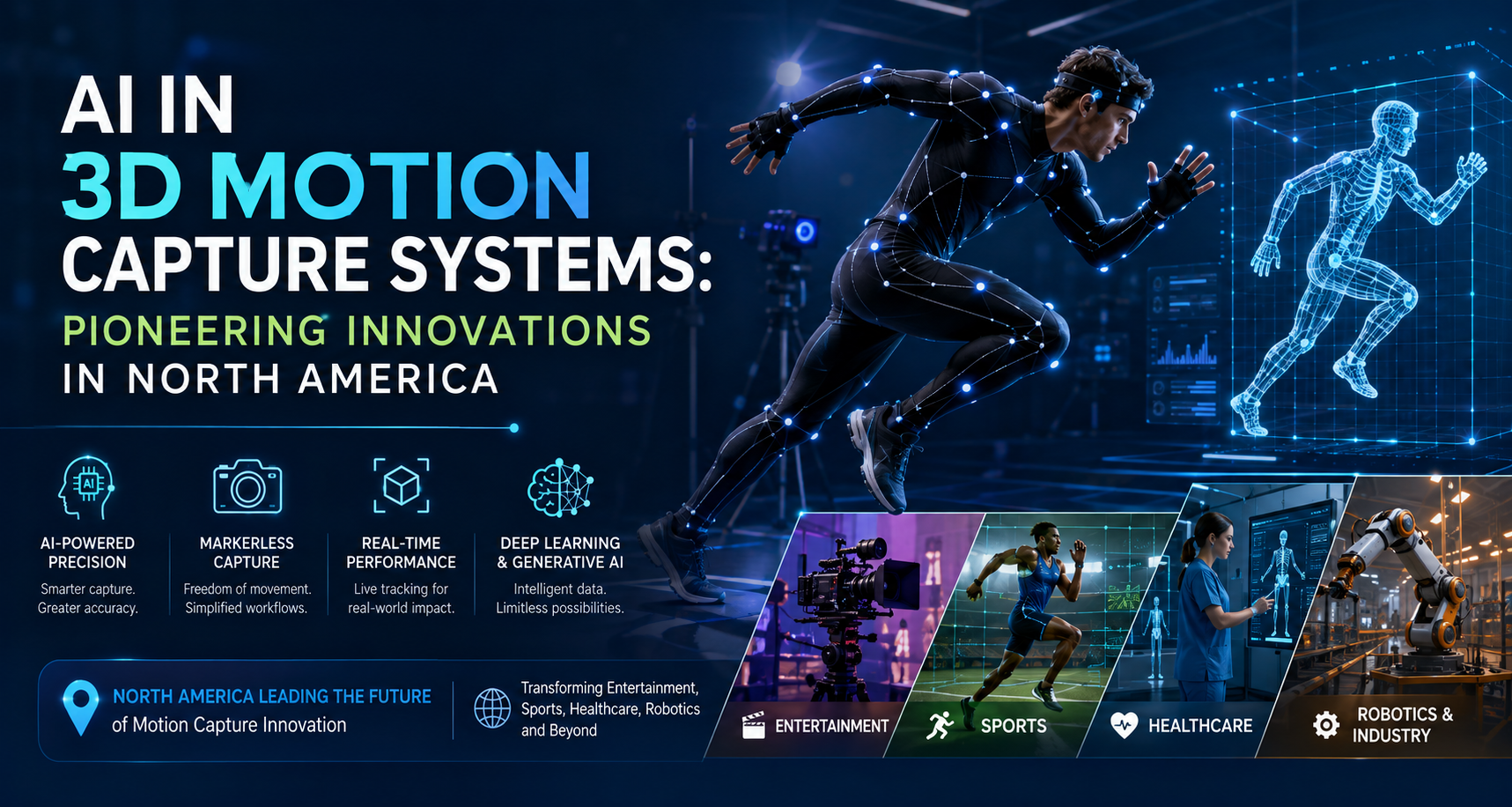
The Evolution of AI-Powered 3D Motion Capture
Conventional 3D motion capture systems depend heavily on physical markers attached to an actor or subject. Although these systems can provide highly precise data, they can be expensive and time-consuming to set up. AI is changing this model through markerless motion capture.
AI-based computer vision algorithms can analyze video streams and identify human body landmarks, joints, posture, and movement patterns. Deep-learning models can then reconstruct these movements as 3D skeletal data. This allows motion to be captured using fewer physical sensors and, in some applications, ordinary cameras.
North American technology companies, research institutions, entertainment studios, and sports organizations are investing heavily in these capabilities, making the region an important hub for motion-capture innovation.
AI and Markerless Motion Capture
One of the most significant innovations is AI-driven markerless motion capture. Instead of requiring users to wear a specialized suit, AI algorithms estimate body position directly from camera footage.
Modern systems can recognize complex movements such as walking, running, jumping, dancing, and athletic gestures. Multi-camera systems can further improve accuracy by combining information from different viewpoints.
This technology is particularly valuable for film, animation, gaming, and virtual production. Production teams can capture performances more quickly while reducing the logistical requirements associated with traditional motion-capture studios.
Applications Across North America
The entertainment industry is one of the largest adopters of AI-enabled 3D motion capture. Film and television producers use motion data to create digital characters, visual effects, and immersive virtual environments. Game developers can use captured movements to produce more realistic character animations.
Sports is another rapidly expanding application. AI-powered motion analysis can help coaches and athletes evaluate biomechanics, movement efficiency, and performance. Motion data can also support virtual training environments and digital athlete simulations.
In healthcare, 3D motion capture combined with AI can support gait analysis, rehabilitation, physical therapy, and movement assessment. AI models can identify movement abnormalities and provide quantitative information that may complement conventional clinical assessments.
The technology is also gaining attention in robotics and industrial automation. Human-motion datasets can help robots understand gestures, movement patterns, and human-machine interactions. In manufacturing environments, motion analysis can potentially help organizations evaluate ergonomics and improve workplace safety.
Role of Generative AI and Deep Learning
The next phase of innovation involves combining motion capture with generative AI. Deep-learning models can learn from large datasets of human movements and generate realistic motion sequences.
For example, AI can potentially transform a simple movement instruction into a complete animation sequence. This can accelerate the development of digital characters and virtual experiences.
Generative AI can also help clean noisy motion data, fill gaps, predict missing movements, and create variations of captured performances. As these models become more sophisticated, motion capture may evolve from simply recording movement to intelligently interpreting and generating it.
Challenges and Opportunities
Despite rapid progress, AI-based 3D motion capture still faces challenges. Occlusion, lighting conditions, complex movements, multiple people in the same scene, and unusual body positions can reduce tracking accuracy. Real-time processing also requires significant computing capabilities for high-quality applications.
Data privacy is another important consideration, particularly in healthcare, workplaces, and consumer applications. Companies must establish responsible approaches to collecting, storing, and processing biometric and movement-related data.
Nevertheless, the opportunities are substantial. AI can reduce equipment requirements, accelerate production workflows, and make sophisticated motion capture available to a wider range of users.
Future Outlook
North America is positioned to remain a major center for AI-driven 3D motion capture innovation. Continued advances in computer vision, edge computing, generative AI, spatial computing, and sensor technologies are expected to improve accuracy and real-time performance.
The convergence of AI and 3D motion capture could ultimately create more natural digital humans, immersive gaming experiences, intelligent robots, personalized rehabilitation tools, and advanced industrial systems.
As AI moves from simply recognizing motion to understanding its context and intent, 3D motion capture is evolving into a powerful foundation for the next generation of digital and physical experiences.
80% of the Forbes Global 2000 B2B companies rely on MarketsandMarkets to identify growth opportunities in emerging technologies and use cases that will have a positive revenue impact.
- Food Packaging Market Size Set for Strong Growth Through 2030 Amid Rising Demand for Convenience Foods
- Mulch Films Market: Driving Sustainable Agriculture Through Innovation
- Agricultural Adjuvants Market Analysis, Trends, and Growth Outlook (2026–2031)
- Crop Protection Chemical Market Size, Share & Growth Forecast (2025–2030)
- Japan Enterprise Asset Management Market Growth: AI and Smart Infrastructure Drive Demand


