

Commercial Humidification in 2026: Emerging Trends in Indoor Humidity Control
Indoor air quality has become an increasingly important consideration for commercial buildings in 2026. Offices, healthcare facilities, hotels, educational institutions, retail spaces, data centers, and other commercial environments are paying closer attention to temperature, ventilation, air filtration, and humidity levels. Within this broader indoor climate management landscape, commercial humidification is emerging as an important solution for maintaining comfortable and controlled indoor environments.
Commercial humidification systems add moisture to indoor air when humidity levels fall below desired levels. Maintaining appropriate humidity is important for occupant comfort, building materials, equipment performance, and certain industrial or commercial processes. As buildings become more energy efficient and HVAC systems become increasingly automated, the need for accurate and responsive humidity control is also growing.
The commercial humidification market is expected to be valued at USD 0.98 billion in 2026 and USD 1.58 billion by 2032, growing at a CAGR of 8.3% during the forecast period.
Download PDF Brochure:
https://www.marketsandmarkets.com/pdfdownloadNew.asp?id=167029597
Why Commercial Humidification Is Becoming More Important in 2026
Low indoor humidity can create several challenges, particularly during colder months or in buildings located in dry climates. Excessively dry air can contribute to discomfort, dry skin and eyes, static electricity, and irritation of the respiratory system. It can also affect wood, paper, furniture, and other humidity-sensitive materials.
Commercial facilities are therefore increasingly incorporating humidification into broader HVAC and indoor environmental management strategies. Instead of treating humidification as an isolated function, building operators are integrating it with heating, ventilation, air conditioning, building management systems, and indoor air quality monitoring.
The growing emphasis on occupant wellbeing is another factor supporting adoption. Businesses are recognizing that indoor environmental conditions can influence employee comfort, productivity, and the overall experience of people using a facility.
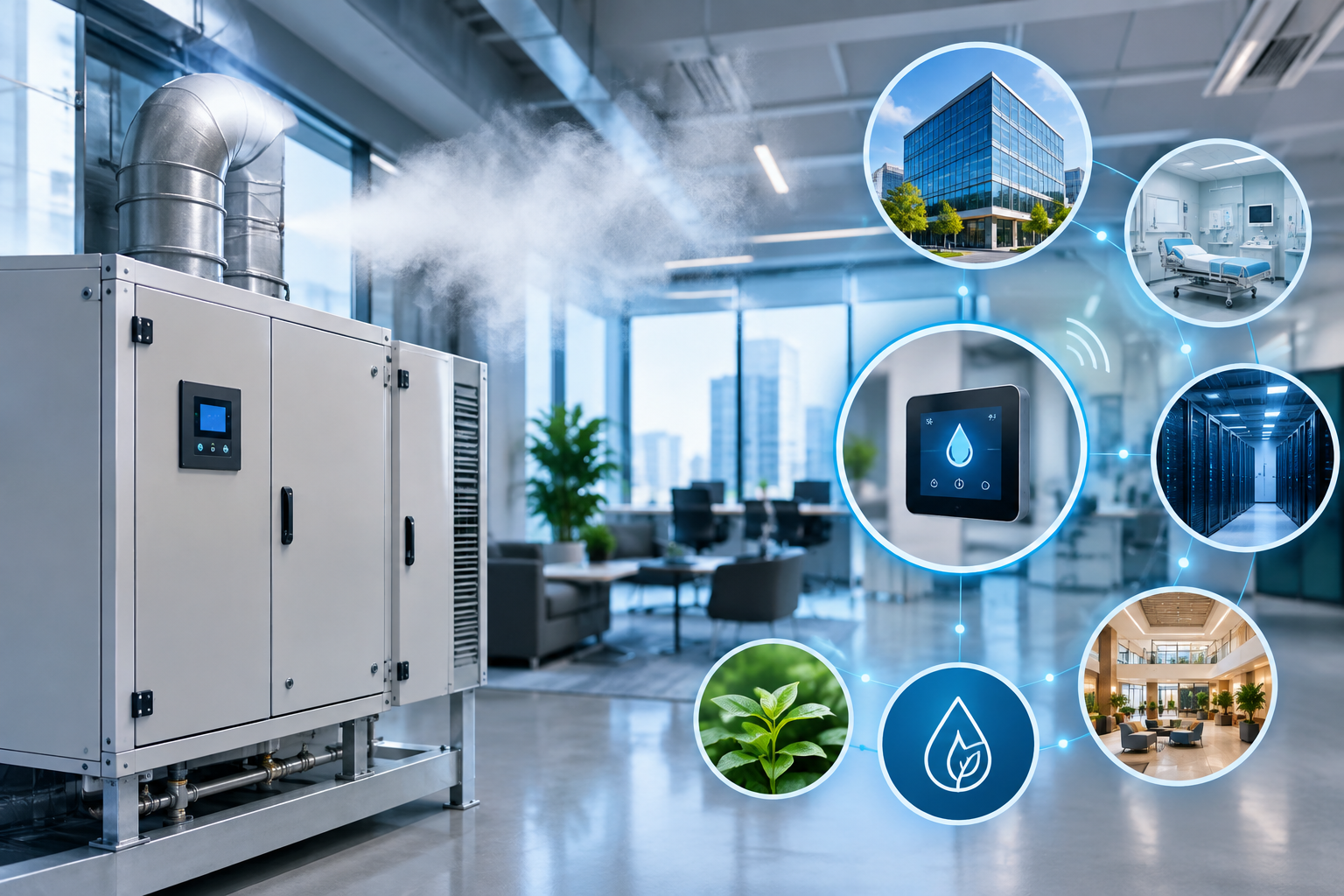
Smart Humidity Control Is Shaping the Market
One of the most significant trends in commercial humidification in 2026 is the adoption of smart control technologies. Modern humidification systems can work with sensors and automated building management platforms to monitor humidity continuously and adjust operation based on real-time conditions.
Connected sensors can measure relative humidity and provide data to centralized control systems. This allows facility managers to identify fluctuations and maintain humidity within predefined ranges. More advanced systems can use automated controls to respond to changes in occupancy, outdoor weather conditions, HVAC operation, or indoor environmental requirements.
The integration of Internet of Things (IoT) technologies is further improving visibility into system performance. Facility managers can monitor equipment remotely, receive alerts, and identify potential maintenance requirements before they result in significant operational problems.
Energy Efficiency Becomes a Key Priority
Energy efficiency remains a major consideration for commercial building operators. HVAC systems are among the largest energy-consuming systems in many buildings, creating pressure to improve performance without compromising indoor comfort.
Humidification manufacturers are responding with systems designed to provide precise moisture control while minimizing energy and water consumption. Efficient steam generation, improved controls, optimized water usage, and better integration with HVAC equipment are becoming increasingly important.
Demand for energy-efficient humidification is also connected to broader building sustainability objectives. Commercial property owners are looking for technologies that can contribute to efficient building operations and support environmental targets while maintaining suitable indoor conditions.
Healthcare and Critical Environments Drive Demand
Healthcare facilities represent an important application area for commercial humidification. Hospitals, clinics, laboratories, and pharmaceutical environments often require carefully controlled indoor conditions because humidity can affect both occupant comfort and sensitive processes.
Maintaining suitable humidity levels can support controlled environments in operating rooms, patient areas, laboratories, pharmaceutical production spaces, and storage facilities. Humidity control can also help manage static electricity and protect sensitive equipment and materials.
Beyond healthcare, humidity management is relevant to museums, archives, libraries, printing facilities, manufacturing environments, and other locations where products or materials can be affected by fluctuations in moisture levels.
Data Centers and Technology Facilities Need Precise Humidity Management
The rapid expansion of digital infrastructure is creating another area of opportunity for commercial humidification. Data centers contain large quantities of electronic equipment that operate continuously and generate substantial heat.
Maintaining suitable environmental conditions is essential for reliable equipment operation. Extremely low humidity can increase the risk of static electricity, while excessive humidity can create other operational and equipment-related concerns. As data centers become larger and computing workloads increase, operators are paying greater attention to precise environmental monitoring.
The growth of artificial intelligence, cloud computing, high-performance computing, and digital services is contributing to the development of increasingly sophisticated data center infrastructure. Humidity control can therefore become part of a broader strategy for managing thermal and environmental conditions in these facilities.
Humidification and Indoor Air Quality
Indoor air quality is becoming a central component of commercial building management. Although humidification alone does not solve all indoor air quality challenges, maintaining an appropriate humidity range can complement ventilation, filtration, and air-cleaning strategies.
In 2026, building owners are increasingly taking a holistic approach to indoor environmental quality. Instead of managing individual parameters separately, HVAC and building management systems are being designed to coordinate temperature, humidity, ventilation, and air quality.
This integrated approach can help facilities respond more effectively to changing indoor conditions while improving operational visibility.
Greater Demand for Automated and Low-Maintenance Systems
Commercial building operators are also looking for equipment that is easier to operate and maintain. Manual monitoring and frequent adjustments can increase operational complexity, particularly in large buildings with multiple zones.
Automated humidification systems can reduce the need for constant manual intervention. Features such as automatic controls, remote monitoring, fault alerts, and predictive maintenance capabilities are becoming increasingly valuable.
System reliability is particularly important in facilities where environmental conditions need to remain stable around the clock. Improved automation can help facility teams detect abnormal operating conditions and address maintenance requirements more efficiently.
Regional and Building-Level Considerations
The demand for commercial humidification varies according to climate, building type, HVAC practices, and local environmental conditions. Cold and dry regions can experience greater requirements for indoor moisture control during heating seasons, while other regions may require more sophisticated systems capable of balancing humidification and dehumidification.
Commercial construction and modernization are also influencing adoption. As new buildings incorporate advanced HVAC and building automation systems, humidification can increasingly be integrated during the initial design stage rather than added later.
Ask for Sample Report:
https://www.marketsandmarkets.com/requestsampleNew.asp?id=167029597
What to Expect from Commercial Humidification in 2026 and Beyond
Commercial humidification is moving toward smarter, more connected, and more energy-conscious operation. The convergence of HVAC automation, IoT sensors, building management systems, and data-driven facility management is creating new opportunities for more precise humidity control.
At the same time, growing awareness of indoor environmental quality is encouraging businesses to look beyond basic temperature control. Offices, healthcare facilities, hospitality spaces, data centers, and other commercial environments increasingly require indoor conditions that support comfort, equipment reliability, and operational efficiency.
As highlighted in the MarketsandMarkets commercial humidification market research, technological development and increasing attention to controlled indoor environments are important factors shaping the market. Going forward, solutions that combine precise control, energy efficiency, connectivity, and simplified maintenance are likely to remain central to the evolution of commercial humidification.
For building owners and facility managers, the focus is shifting from simply adding moisture to the air toward creating intelligent indoor climate systems that continuously monitor and respond to changing environmental conditions. This shift is expected to make commercial humidification an increasingly integrated part of modern building infrastructure.
Explore the emerging trends shaping Commercial Humidification in 2026: https://www.marketsandmarkets.com/Market-Reports/commercial-humidification-market-167029597.html
80% of the Forbes Global 2000 B2B companies rely on MarketsandMarkets to identify growth opportunities in emerging technologies and use cases that will have a positive revenue impact.
- Food Packaging Market Size Set for Strong Growth Through 2030 Amid Rising Demand for Convenience Foods
- Crop Protection Chemical Market Size, Share & Growth Forecast (2025–2030)
- Mulch Films Market: Driving Sustainable Agriculture Through Innovation
- Agricultural Adjuvants Market Analysis, Trends, and Growth Outlook (2026–2031)
- Japan Enterprise Asset Management Market Growth: AI and Smart Infrastructure Drive Demand

