

Data Center Elevator Technology Innovation: Key Trends, Growth Drivers and Opportunities
Introduction to Data Center Elevator Technology
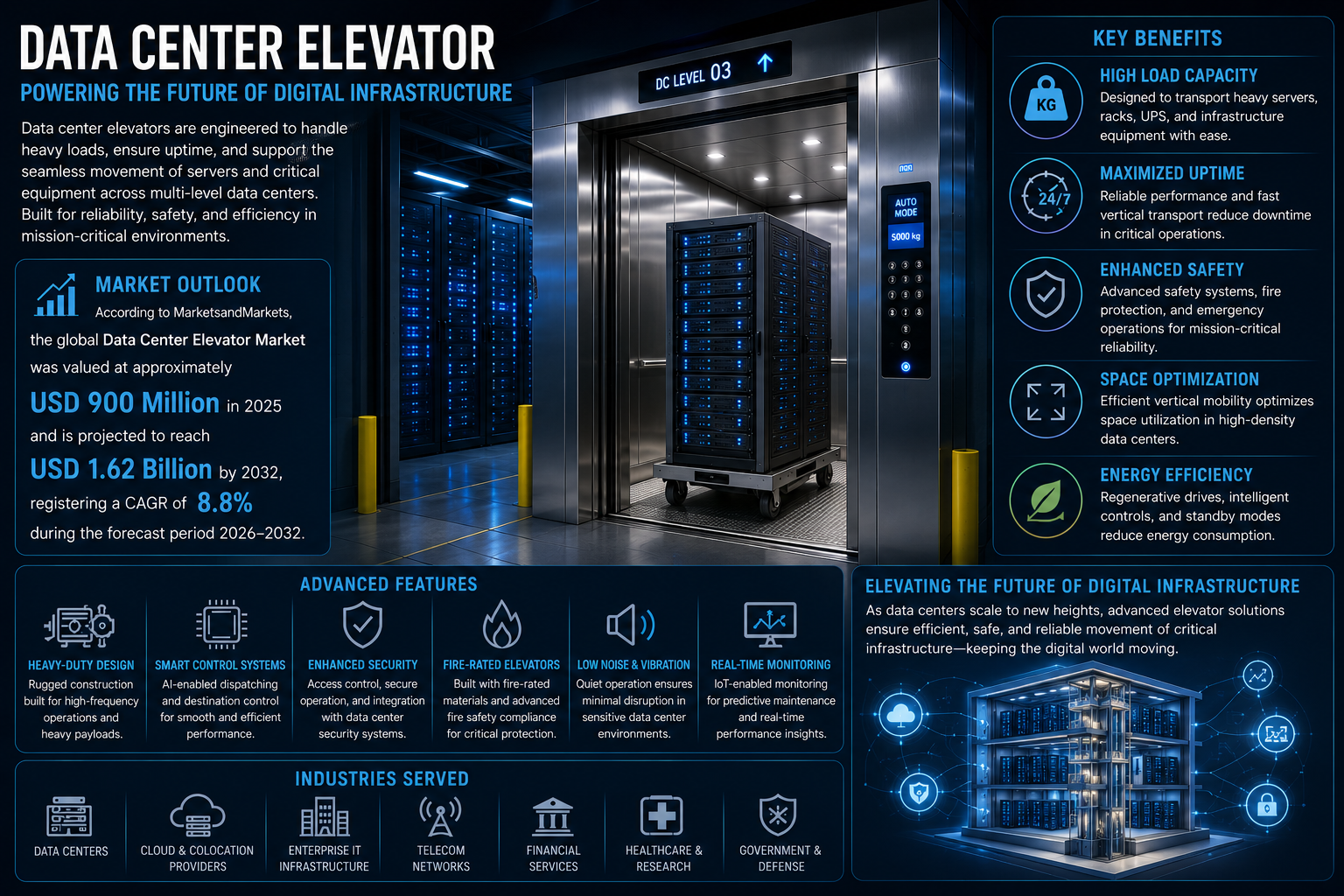
Data center elevator technology is becoming an essential component of modern digital infrastructure by enabling the safe, efficient, and reliable movement of servers, networking equipment, cooling systems, batteries, and maintenance personnel within hyperscale and enterprise data centers. As facilities become larger, taller, and more automated, elevators designed specifically for mission-critical environments are helping improve operational efficiency, equipment handling, and maintenance workflows. The growing adoption of cloud computing, artificial intelligence (AI), edge computing, and hyperscale data centers is driving demand for advanced elevator solutions that offer higher load capacities, enhanced reliability, intelligent monitoring, and seamless integration with smart building management systems.
History of Data Center Elevator Technology
Traditional commercial elevators were initially used to transport IT equipment within early data centers. However, the rapid expansion of hyperscale facilities and high-density computing environments created the need for elevators specifically engineered to handle heavy server racks, precision equipment, and continuous maintenance operations. Over the years, advancements in load-bearing capacity, predictive maintenance, IoT connectivity, and energy-efficient drive systems have transformed data center elevators into intelligent vertical transportation solutions that improve operational reliability while supporting the evolving needs of modern digital infrastructure.
Benefits of Data Center Elevator Technology
Data center elevators improve operational efficiency by enabling the secure transportation of mission-critical equipment while minimizing downtime and manual handling risks. Modern elevator systems are designed to support continuous operations, enhance worker safety, and integrate with intelligent facility management platforms, making them a valuable asset for next-generation data centers.
Key Benefits Include:
- Safe transportation of heavy servers, racks, batteries, and cooling equipment.
- Improved operational efficiency during installation, upgrades, and maintenance.
- Reduced equipment handling risks and workplace injuries.
- High load capacity designed for mission-critical infrastructure.
- Integration with Building Management Systems (BMS) and IoT platforms.
- Predictive maintenance capabilities that minimize unexpected downtime.
- Energy-efficient drive systems that reduce operating costs.
- Enhanced reliability for hyperscale and colocation data center operations.
Current Market Size and Growth Trends of the Data Center Elevator Market
The data center elevator market is witnessing steady growth as organizations continue investing in hyperscale data centers, cloud infrastructure, AI computing facilities, and edge data centers worldwide. Increasing demand for reliable vertical transportation systems capable of handling heavy IT equipment is driving the adoption of specialized elevator solutions. At the same time, innovations in intelligent monitoring, predictive maintenance, energy-efficient technologies, and smart building integration are improving elevator performance and supporting long-term market expansion.
According to MarketsandMarkets, the global data center elevator market was valued at approximately USD 900 million in 2025 and is projected to reach USD 1.62 billion by 2032, registering a CAGR of 8.8% during the forecast period (2026–2032).
Download PDF Brochure: https://www.marketsandmarkets.com/pdfdownloadNew.asp?id=267395404
Key Market Growth Drivers
- Rapid expansion of hyperscale and colocation data centers.
- Increasing investments in AI infrastructure and cloud computing facilities.
- Growing deployment of edge data centers worldwide.
- Rising demand for efficient transportation of high-value IT equipment.
- Increasing adoption of smart building technologies and IoT-enabled elevators.
- Growing focus on predictive maintenance and operational efficiency.
- Rising investments in sustainable and energy-efficient data center infrastructure.
Key Drivers and Factors Influencing the Future of Data Center Elevator Technology
The future of data center elevator technology is being driven by the rapid expansion of hyperscale data centers, AI infrastructure, cloud computing, and edge computing facilities. As modern data centers become larger and more complex, operators require reliable vertical transportation systems capable of moving heavy IT equipment safely and efficiently. Growing investments in smart buildings, automation, and predictive maintenance technologies are further accelerating the adoption of intelligent elevator systems that improve operational efficiency while minimizing downtime.
Key Growth Drivers
- Rapid growth of hyperscale, enterprise, and colocation data centers.
- Increasing investments in AI infrastructure and high-density computing facilities.
- Expansion of cloud computing and digital transformation initiatives.
- Rising deployment of edge data centers to support low-latency applications.
- Growing demand for safe handling of heavy server racks, batteries, and cooling equipment.
- Adoption of IoT-enabled predictive maintenance and smart building management systems.
- Increasing focus on operational efficiency, equipment safety, and business continuity.
Emerging Trends in Data Center Elevator Technology
Data center elevator technology is evolving with advancements in automation, intelligent monitoring, and energy-efficient engineering. Manufacturers are introducing smart elevators equipped with IoT sensors, remote diagnostics, and AI-powered predictive maintenance capabilities to enhance reliability and reduce service interruptions. At the same time, innovations in machine-room-less (MRL) designs, destination control systems, and touchless operation are improving space utilization, energy efficiency, and user experience within modern data centers.
Key Emerging Trends
- Integration of IoT sensors for real-time performance monitoring.
- Adoption of AI-powered predictive maintenance to reduce unplanned downtime.
- Growing deployment of machine-room-less (MRL) elevator systems.
- Implementation of destination dispatch systems for optimized elevator traffic management.
- Increasing use of touchless controls and biometric access for enhanced security.
- Development of energy-efficient motors and regenerative drive technologies.
- Integration with Building Management Systems (BMS) and Digital Twin platforms.
Opportunities and Challenges in the Data Center Elevator Market
The data center elevator market offers significant opportunities as organizations continue expanding digital infrastructure to support cloud services, artificial intelligence, and high-performance computing. Demand for specialized elevator systems capable of transporting mission-critical equipment is increasing across hyperscale facilities, enterprise data centers, and edge computing environments. However, manufacturers must address challenges related to installation costs, system customization, maintenance requirements, and compliance with strict operational standards.
Key Opportunities
- Expansion of hyperscale data centers across global markets.
- Growing investments in AI, cloud computing, and edge infrastructure.
- Increasing demand for high-capacity freight elevators for IT equipment.
- Rising adoption of smart building automation and connected facility management.
- Opportunities in retrofitting existing data centers with intelligent elevator solutions.
Key Challenges
- High installation and infrastructure investment costs.
- Complex integration with existing building layouts and legacy systems.
- Need for continuous maintenance in mission-critical environments.
- Compliance with stringent safety and operational standards.
- Limited downtime availability during modernization and equipment upgrades.
Innovations and Advancements in Data Center Elevator Technology
Continuous innovation is improving the safety, intelligence, and operational performance of data center elevator systems. Manufacturers are incorporating advanced sensors, AI-driven diagnostics, cloud-based monitoring, and energy-efficient drive technologies to enhance equipment reliability and reduce maintenance costs. These innovations enable facility operators to optimize elevator performance while supporting the increasing demands of next-generation digital infrastructure.
Recent Innovations
- AI-enabled predictive maintenance for proactive fault detection.
- Cloud-connected elevator monitoring and remote diagnostics.
- Regenerative drive systems that recover and reuse braking energy.
- Smart load monitoring for safe transportation of sensitive IT equipment.
- Advanced cybersecurity features for connected elevator systems.
- Digital Twin integration for real-time performance analysis and lifecycle management.
- High-speed, high-capacity elevators designed specifically for hyperscale data centers.
Future Applications and Industries That Will Benefit from Data Center Elevator Technology
Data center elevator technology is expected to play an increasingly important role in supporting the next generation of digital infrastructure. As hyperscale facilities, AI data centers, and edge computing environments continue to expand, specialized elevator systems will become essential for transporting servers, cooling equipment, batteries, and maintenance personnel safely and efficiently. Future innovations in automation, AI, IoT, and smart building integration will further enhance elevator performance, improve operational reliability, and support sustainable data center operations across multiple industries.
Key Future Applications
- Hyperscale Data Centers: Facilitate the safe movement of high-density server racks, cooling systems, and power equipment while improving operational efficiency.
- Cloud Computing Facilities: Support continuous infrastructure expansion, equipment upgrades, and maintenance activities with minimal disruption.
- AI & High-Performance Computing (HPC): Handle increasingly heavy AI servers, GPU clusters, liquid cooling equipment, and power distribution systems.
- Edge Data Centers: Enable efficient vertical transportation in compact urban facilities supporting low-latency applications and real-time processing.
- Colocation Data Centers: Improve tenant operations by providing reliable movement of customer-owned IT equipment and infrastructure.
- Smart Buildings: Integrate with Building Management Systems (BMS), Digital Twin platforms, and IoT-enabled facility management for intelligent operations.
- Telecommunications Infrastructure: Support data centers that manage 5G networks, fiber-optic communication systems, and network operations centers.
- Disaster Recovery & Mission-Critical Facilities: Ensure reliable equipment transportation during emergency maintenance, system upgrades, and business continuity operations.
As digital infrastructure continues to evolve, intelligent elevator systems will become a critical component of future-ready data centers by improving safety, efficiency, sustainability, and operational resilience.
Conclusion: The Promising Future of Data Center Elevator Technology
Data center elevator technology is evolving beyond conventional vertical transportation to become an integral part of intelligent, automated, and highly efficient digital infrastructure. As organizations invest in hyperscale data centers, AI computing, cloud services, and edge infrastructure, specialized elevator systems are playing an increasingly important role in ensuring the safe movement of mission-critical equipment while minimizing operational risks and downtime.
80% of the Forbes Global 2000 B2B companies rely on MarketsandMarkets to identify growth opportunities in emerging technologies and use cases that will have a positive revenue impact.
- Food Packaging Market Size Set for Strong Growth Through 2030 Amid Rising Demand for Convenience Foods
- Crop Protection Chemical Market Size, Share & Growth Forecast (2025–2030)
- Mulch Films Market: Driving Sustainable Agriculture Through Innovation
- Agricultural Adjuvants Market Analysis, Trends, and Growth Outlook (2026–2031)
- Japan Enterprise Asset Management Market Growth: AI and Smart Infrastructure Drive Demand

