

Digital Video Recorder Market: Trends, Growth Drivers, Opportunities, and Future Outlook
The digital video recorder market is evolving rapidly as organizations and consumers increasingly adopt advanced video surveillance technologies for security, monitoring, and operational intelligence. Digital video recorders (DVRs) capture, process, store, and manage video footage generated by surveillance cameras, enabling users to review recorded events and monitor activities in real time. Although network video recorders (NVRs) and cloud-based surveillance solutions are gaining popularity, DVR systems continue to play an important role in analog and hybrid surveillance environments. Growing security concerns, modernization of surveillance infrastructure, and increasing adoption of high-definition cameras are expected to create opportunities for the digital video recorder market.
According Marketsandmarkets,the video surveillance market is projected to reach USD 88.06 billion by 2031 from USD 56.11 billion in 2025, at a CAGR of 7.8% from 2025 to 2031. Advancements in cloud-based surveillance and edge computing are accelerating market growth.
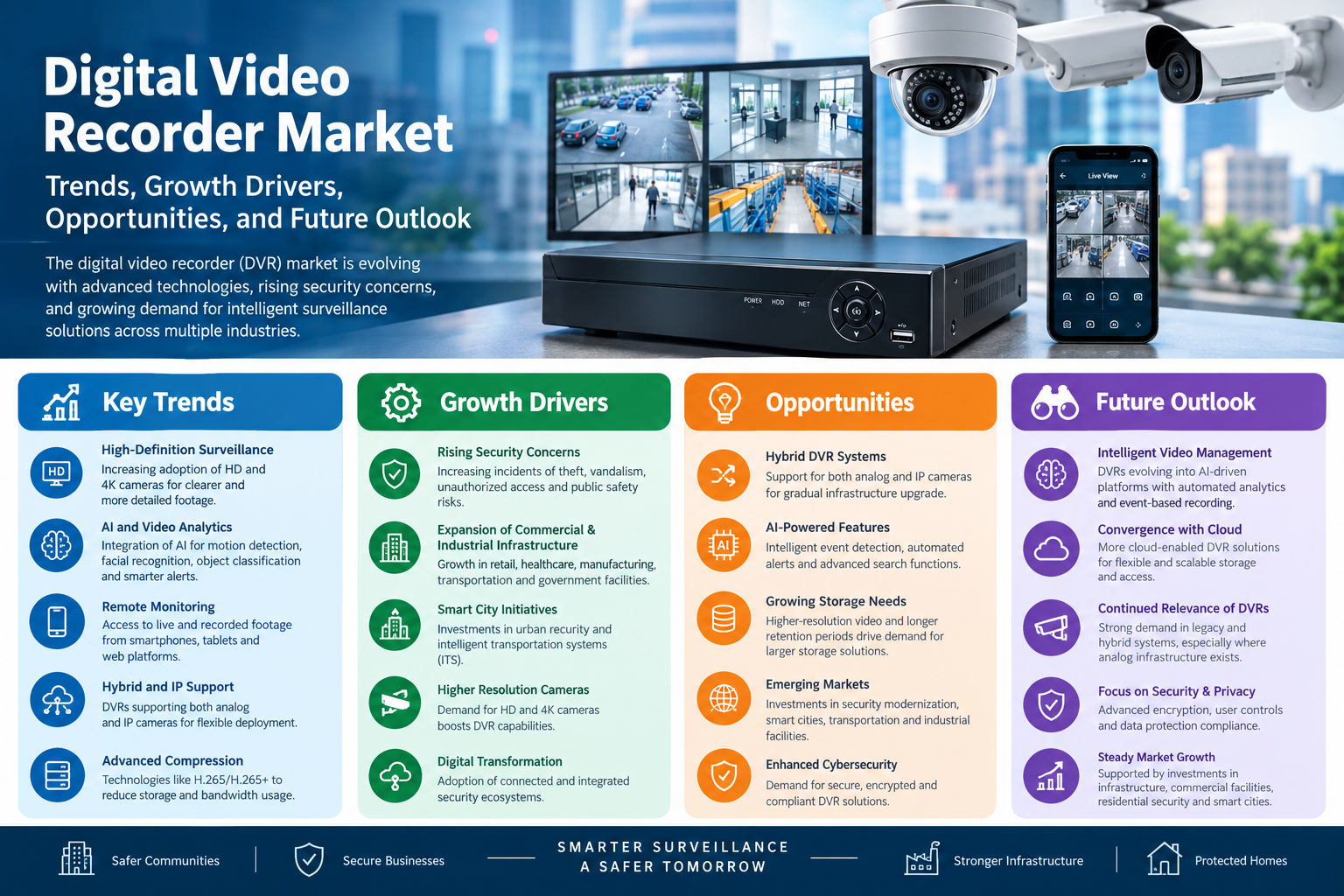
Growing Demand for Video Surveillance Solutions
Increasing concerns related to theft, vandalism, unauthorized access, and public safety are encouraging businesses, government organizations, residential users, and infrastructure operators to invest in video surveillance systems. DVRs remain an important component of many surveillance installations because they provide centralized video recording and storage.
Retail stores, banks, manufacturing facilities, warehouses, educational institutions, hospitals, transportation facilities, and residential properties use DVR-based surveillance systems to monitor premises and investigate security incidents. The ability to continuously record video and retrieve footage from specific time periods makes DVRs valuable for security management and incident investigation.
Transition Toward High-Definition Surveillance
The transition from traditional analog cameras to high-definition surveillance cameras is influencing the development of the digital video recorder market. Modern DVR systems increasingly support technologies such as HD analog video, higher-resolution cameras, improved compression, remote access, and intelligent video functions.
High-definition DVRs enable users to obtain clearer footage, helping security personnel identify people, vehicles, objects, and activities more effectively. Technologies such as H.265 and H.265+ video compression can also reduce storage requirements and bandwidth consumption while maintaining video quality.
Integration of AI and Video Analytics
Artificial intelligence is becoming an important technology trend in the surveillance industry. Advanced DVR platforms can increasingly work with AI-enabled cameras and video analytics software to identify specific events and generate alerts.
Functions such as motion detection, intrusion detection, line-crossing detection, people counting, vehicle detection, and object classification can improve the effectiveness of surveillance systems. Instead of relying entirely on personnel to continuously monitor multiple camera feeds, intelligent analytics can identify potentially significant events and notify security teams.
The integration of AI capabilities is expected to create new opportunities for DVR manufacturers as customers seek surveillance systems that provide not only video recording but also actionable security intelligence.
Remote Monitoring and Connectivity
Remote monitoring is another important factor shaping the digital video recorder market. Businesses and property owners increasingly want to access surveillance footage from smartphones, tablets, computers, and centralized security platforms.
Modern DVRs can connect to networks and support remote viewing, playback, configuration, and alerts. Mobile applications and web-based interfaces allow users to monitor multiple locations without being physically present at the surveillance site.
This capability is particularly valuable for businesses operating multiple retail stores, warehouses, offices, and other distributed facilities. Centralized remote monitoring can help organizations improve operational visibility while reducing the need for continuous on-site supervision.
Adoption Across Commercial and Industrial Applications
The commercial sector represents an important application area for DVR systems. Retailers use surveillance cameras and DVRs to monitor stores, reduce theft, investigate customer incidents, and improve employee safety. Banks and financial institutions deploy video surveillance to strengthen physical security and support investigations.
In manufacturing and industrial environments, surveillance systems can help monitor production areas, restricted zones, warehouses, and equipment. DVR-based systems can also provide recorded evidence following accidents, security incidents, or unauthorized access.
The transportation sector is another important application area. Airports, railway stations, bus terminals, parking facilities, and logistics centers use video surveillance to monitor large and complex environments.
Residential Security Applications
Residential security is also contributing to demand for digital video recording technologies. Homeowners increasingly install surveillance cameras around entrances, driveways, parking areas, and other vulnerable locations.
DVR-based systems can provide continuous recording and allow users to review previous events. Integration with mobile applications enables homeowners to remotely monitor their properties and receive alerts when motion or other predefined events are detected.
However, residential users are increasingly considering cloud-connected cameras and standalone smart cameras, creating competition for traditional DVR-based solutions. DVR manufacturers therefore need to focus on ease of installation, remote access, cybersecurity, storage capacity, and integration with smart-home ecosystems.
Competition From NVR and Cloud-Based Solutions
The digital video recorder market faces increasing competition from network video recorders and cloud-based video surveillance solutions. NVRs are designed primarily for IP camera systems and can offer high-resolution video management, network connectivity, and integration with advanced analytics.
Cloud-based surveillance provides another alternative by allowing video footage to be stored and managed remotely. These systems can reduce the need for local storage infrastructure and provide flexible access to surveillance data.
Despite these trends, DVRs continue to have advantages in environments where existing coaxial cabling and analog surveillance cameras are already installed. Organizations can upgrade camera resolution and recording capabilities without completely replacing their existing infrastructure.
Cybersecurity and Data Protection
As DVR systems become increasingly connected to networks and the internet, cybersecurity is becoming an important consideration. Unauthorized access, weak passwords, outdated firmware, and unsecured network connections can expose surveillance systems to cyber threats.
Manufacturers are therefore focusing on security features such as encrypted communications, secure authentication, firmware updates, user-access controls, and network protection. Compliance with data protection and privacy requirements is also becoming increasingly important, particularly for organizations operating surveillance systems in public and commercial environments.
Key Opportunities in the Digital Video Recorder Market
The market presents opportunities across several areas. One major opportunity is the development of hybrid DVR systems that support both analog and IP cameras. These systems can help organizations gradually transition from traditional surveillance infrastructure to network-based solutions.
Another opportunity is the integration of AI-powered analytics. DVRs capable of supporting intelligent event detection, automated alerts, and advanced search functions can provide greater value to end users.
Demand for higher storage capacity is also expected to increase as surveillance cameras generate higher-resolution video. Advanced compression technologies and intelligent recording capabilities can help organizations manage growing volumes of video data efficiently.
Emerging markets also offer opportunities because governments, businesses, and infrastructure operators are investing in security modernization, smart-city projects, transportation infrastructure, and industrial facilities.
FAQ
| Question | Answer |
|---|---|
| 1. What is the size of the global video surveillance market? | The global video surveillance market is projected to reach USD 88.06 billion by 2031, increasing from USD 56.11 billion in 2025. The market is expected to grow at a CAGR of 7.8% from 2025 to 2031, supported by increasing security requirements, AI adoption, cloud-based surveillance, edge computing, and smart-city investments. |
| 2. What is the CAGR of the video surveillance market? | The global video surveillance market is expected to register a CAGR of 7.8% from 2025 to 2031. Increasing adoption of IP-based systems, AI-powered video analytics, cloud platforms, high-resolution cameras, and intelligent monitoring solutions is supporting market expansion. |
| 3. Which region is expected to grow fastest in the video surveillance market? | Asia Pacific is expected to register the fastest growth, with a CAGR of 9.1% during 2025–2031. The regional market is projected to increase from USD 30.89 billion in 2025 to USD 52.00 billion by 2031, driven by urbanization, smart-city projects, infrastructure investments, and adoption of AI-powered security technologies. |
| 4. Which companies are the key players in the video surveillance market? | Key companies operating in the video surveillance market include Hangzhou Hikvision Digital Technology Co., Ltd., Dahua Technology Co., Ltd., Hanwha Vision Co., Ltd., Honeywell International Inc., and Motorola Solutions, Inc. These companies offer surveillance cameras, video management technologies, analytics, storage, and integrated security solutions. |
| 5. What is driving the growth of the video surveillance market? | Major growth drivers include the increasing adoption of edge AI, smart-city initiatives, AI and machine-learning-based video analytics, cloud surveillance, high-resolution cameras, and connected security systems. Demand from commercial, infrastructure, transportation, residential, industrial, and public-sector applications is also contributing to market growth. |
| 6. What is the outlook for the Video Surveillance as a Service market? | The Video Surveillance as a Service (VSaaS) market is benefiting from increasing adoption of cloud-based video monitoring, remote surveillance, AI-powered analytics, and scalable security solutions. VSaaS enables organizations to access surveillance footage remotely while reducing dependence on extensive on-premises infrastructure. The broader video surveillance market is projected to reach USD 88.06 billion by 2031 at a 7.8% CAGR from 2025 to 2031, reflecting the industry's shift toward connected and cloud-enabled solutions. |
| 7. What is driving the surveillance camera system market? | The surveillance camera system market is being driven by increasing demand for IP cameras, networked video systems, high-resolution imaging, and intelligent video analytics. Integrated surveillance camera systems are increasingly deployed across enterprises, government facilities, transportation infrastructure, and residential environments to improve security and situational awareness. |
| 8. What factors are supporting the security cameras market? | The security cameras market is supported by rising security concerns, smart-city initiatives, and increasing adoption of AI-enabled cameras. Modern security cameras can incorporate capabilities such as motion detection, object detection, facial recognition, video analytics, and automated alerts. Connected and cloud-enabled cameras are also expanding across commercial, residential, industrial, and public applications. |
| 9. Which segment is expected to grow significantly in the video surveillance market? | By system type, IP video surveillance systems are expected to register the highest CAGR of 9.3% during the forecast period. By offering, hardware accounted for 61.8% of the market in 2024, while the software segment is projected to record the fastest CAGR, supported by demand for AI-powered analytics, video management systems, and cloud-based platforms. |
| 10. What are the major trends shaping the future of the video surveillance market? | Major trends include AI-powered video analytics, edge computing, cloud-based surveillance, smart-city deployments, connected cameras, high-resolution imaging, and intelligent video management. The integration of AI and ML is enabling automated video analysis and threat detection, while cloud and edge technologies are improving scalability, remote access, privacy, and operational efficiency. |
Future Outlook
The future of the digital video recorder market will be shaped by the convergence of video surveillance, artificial intelligence, connectivity, and data analytics. Traditional recording functionality is gradually evolving into intelligent video management, where DVRs can support automated detection, remote monitoring, event-based recording, and integration with broader security platforms.
While NVRs and cloud-based systems are expected to gain further adoption, DVR technology is likely to remain relevant in legacy and hybrid surveillance installations. Manufacturers that combine high-definition recording, AI analytics, cybersecurity, remote accessibility, efficient storage, and flexible camera compatibility will be positioned to address changing customer requirements.
Overall, the digital video recorder market is transitioning from conventional video storage toward intelligent and connected surveillance infrastructure. Continued investments in physical security, infrastructure modernization, smart cities, commercial facilities, and residential security are expected to support demand for advanced recording technologies over the coming years.
80% of the Forbes Global 2000 B2B companies rely on MarketsandMarkets to identify growth opportunities in emerging technologies and use cases that will have a positive revenue impact.
- Food Packaging Market Size Set for Strong Growth Through 2030 Amid Rising Demand for Convenience Foods
- Crop Protection Chemical Market Size, Share & Growth Forecast (2025–2030)
- Mulch Films Market: Driving Sustainable Agriculture Through Innovation
- Agricultural Adjuvants Market Analysis, Trends, and Growth Outlook (2026–2031)
- Japan Enterprise Asset Management Market Growth: AI and Smart Infrastructure Drive Demand

