

Future of Wireless Charging Technology: Trends, Applications, and Market Outlook 2026
The future of wireless charging technology is moving beyond the simple replacement of charging cables. Advances in power transfer, intelligent energy management, electric vehicles (EVs), connected devices, and smart infrastructure are creating new possibilities for how electronic devices and transportation systems receive power. Wireless charging enables devices to receive energy without a physical connector, offering greater convenience and supporting increasingly connected digital environments.
According to MarketsandMarkets, the global wireless charging market was valued at USD 7.36 billion in 2025 and is projected to reach USD 16.0 billion by 2029, growing at a CAGR of 20.3% during 2024–2029. Increasing adoption of smart and portable devices, growing EV sales, demand for multi-device charging, and integration of wireless charging into furniture, infrastructure, smart homes, and IoT devices are among the factors supporting market growth.
Download PDF Brochure:
https://www.marketsandmarkets.com/pdfdownloadNew.asp?id=640
Key Takeaways
- Wireless charging is expanding beyond smartphones, with applications emerging across electric vehicles, healthcare, industrial automation, IoT, and smart infrastructure.
- Inductive charging, magnetic resonance, and RF charging are among the key technologies shaping the development of wireless power transfer.
- Electric vehicles represent a major opportunity for wireless charging, particularly for parking facilities, commercial locations, fleets, and future dynamic charging infrastructure.
- Multi-device and intelligent charging solutions are expected to improve convenience by allowing multiple connected devices to receive power from a single charging environment.
- Smart homes and IoT ecosystems could increasingly integrate wireless charging into furniture, appliances, workspaces, and public infrastructure.
- Charging efficiency, speed, interoperability, range, safety, and infrastructure costs remain important challenges for widespread adoption.
- Advancements in AI, power management, sensors, and connected technologies are expected to make wireless charging systems more intelligent and adaptable.
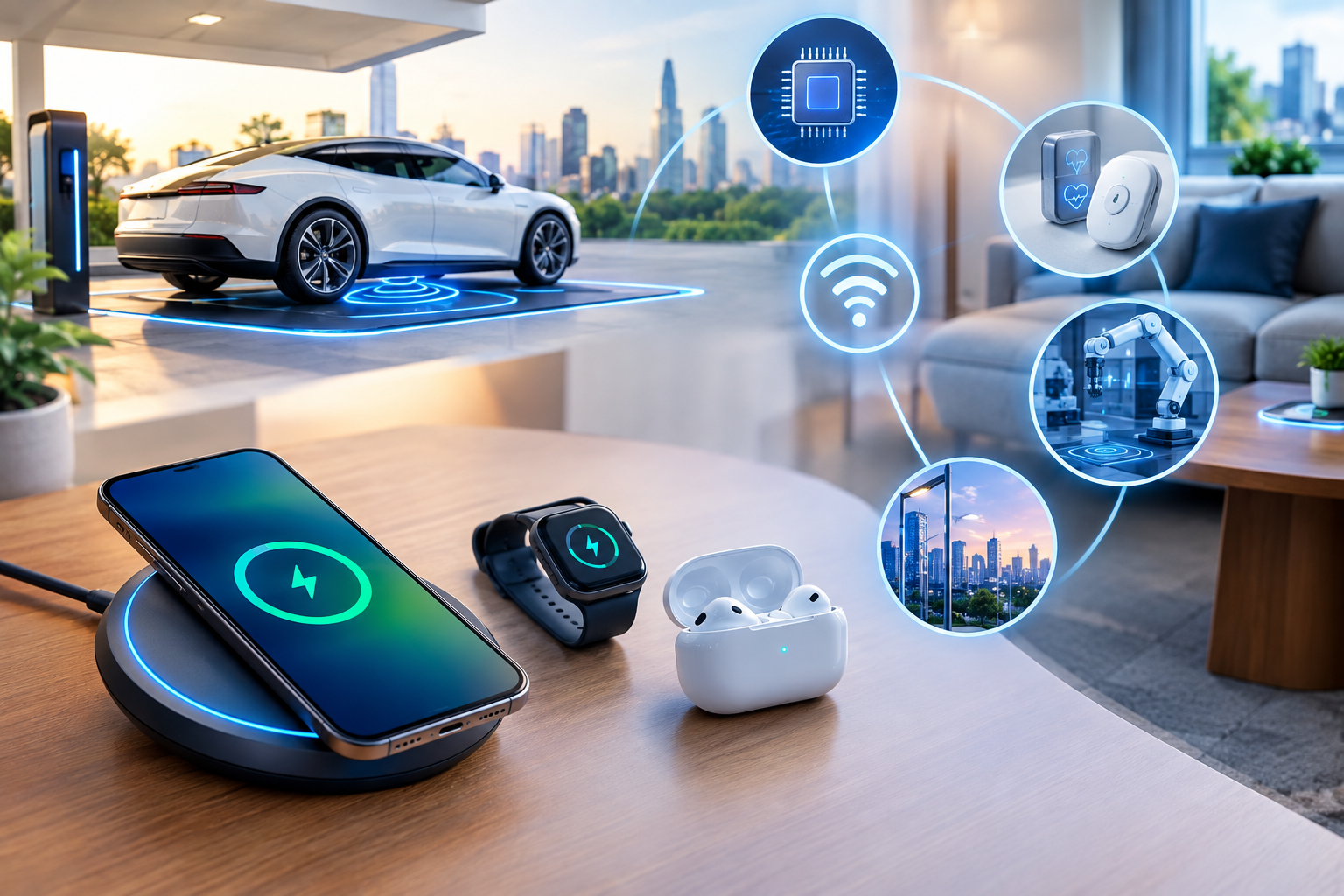
Evolution of Wireless Charging Technology
Wireless charging has developed significantly from basic charging pads designed primarily for smartphones and wearable devices. Technologies such as inductive charging, magnetic resonance, and radio frequency (RF) charging are enabling different approaches to wireless power transfer. Inductive technology currently represents an important part of the market because of its widespread use in smartphones, smartwatches, and earbuds, while magnetic resonance and RF technologies offer opportunities for applications requiring greater flexibility or charging range. ?
The evolution of wireless charging is also closely connected with standardization and interoperability. Standards such as Qi are helping create greater compatibility between devices and charging systems, while continued industry development is expected to improve the overall user experience.
Key Trends Shaping the Future of Wireless Charging
- Long-range wireless charging: Future systems are expected to extend charging beyond direct contact with a charging pad, creating opportunities for more flexible power delivery.
- Multi-device charging: Charging stations capable of powering several devices simultaneously can address the growing number of smartphones, earbuds, smartwatches, and other connected products used by consumers.
- Wireless EV charging: Electric vehicles represent an important growth opportunity, with wireless charging potentially enabling convenient charging in parking areas, commercial locations, fleets, and other environments.
- Smart infrastructure integration: Wireless charging technology is increasingly being integrated into furniture, buildings, public spaces, and transportation infrastructure, making charging more accessible.
- Bi-directional wireless charging: Future solutions may support two-way energy transfer, allowing compatible systems to both receive and supply power as part of broader energy-management applications.
- Intelligent power management: Advanced systems can optimize power distribution based on the number of connected devices, charging requirements, and available energy.
Wireless Charging in Electric Vehicles
One of the most significant areas for the future of wireless charging is electric mobility. Wireless EV charging can reduce the need for physical charging connectors and provide a more convenient experience for drivers. Stationary wireless charging can be incorporated into parking spaces, garages, and fleet facilities, while emerging concepts such as dynamic wireless charging could eventually support power transfer while vehicles are in motion.
MarketsandMarkets identifies increasing demand for wireless charging in EVs as a key market driver. The development of faster and more efficient systems, combined with broader EV adoption, is expected to create additional opportunities for wireless power technologies. ?
Applications Beyond Consumer Electronics
Consumer electronics will remain an important application area, but wireless charging is expanding into healthcare, automotive, industrial, and IoT environments. In healthcare, wireless power transfer can support certain implantable and monitoring devices. In industrial applications, wireless charging can be used for robots, autonomous systems, and warehouse equipment, potentially reducing downtime associated with manual battery replacement.
Smart homes and IoT ecosystems are another promising area. As the number of connected devices increases, embedding wireless charging into desks, furniture, appliances, and other surfaces could create charging environments that require less user intervention. MarketsandMarkets also highlights opportunities associated with wireless charging infrastructure in public spaces and the integration of charging capabilities into everyday environments. ?
Challenges to Overcome
Despite its growth potential, wireless charging technology faces challenges related to power efficiency, charging speed, compatibility, range, infrastructure costs, and safety. Wireless systems must deliver competitive charging performance while managing heat and energy losses. Standardization and interoperability will also remain important as different devices and applications adopt wireless power solutions.
Large-scale EV wireless charging infrastructure may require substantial investment, while consumers and businesses may continue to use conventional wired charging where it is more practical or cost-effective. Addressing these challenges through research, improved standards, and technology development will be essential for wider adoption.
What Is the Future of Wireless Charging Technology?
The future of wireless charging technology is likely to be defined by greater range, faster power transfer, intelligent charging, multi-device capabilities, and integration into everyday environments. Instead of relying exclusively on standalone charging accessories, users could increasingly interact with charging surfaces and infrastructure embedded into vehicles, furniture, buildings, and public spaces.
As wireless power technologies mature, collaboration among technology providers, device manufacturers, automotive companies, infrastructure developers, and standards organizations will be important. Continued innovation in inductive, magnetic resonance, RF, and other wireless power technologies can help expand the number of applications while improving efficiency and usability.
Request Free Sample Report:
https://www.marketsandmarkets.com/requestsampleNew.asp?id=640
Conclusion
The future of wireless charging technology extends well beyond smartphones and wearables. From electric vehicles and smart homes to healthcare, industrial automation, and IoT ecosystems, wireless power transfer has the potential to become an integral part of connected environments. With the global wireless charging market projected to reach USD 16.0 billion by 2029, continued advancements in charging efficiency, range, interoperability, and infrastructure are expected to shape the next phase of this technology.
Frequently Asked Questions (FAQs)
1. What is the future of wireless charging technology?
The future of wireless charging technology is expected to focus on faster charging, greater power-transfer range, multi-device charging, intelligent power management, and integration into vehicles, furniture, buildings, and public infrastructure.
2. How will wireless charging impact electric vehicles?
Wireless charging can make EV charging more convenient by enabling vehicles to receive power without manually connecting a charging cable. Potential applications include residential parking, commercial facilities, fleet operations, and future dynamic charging systems.
3. What technologies are used in wireless charging?
Key wireless charging technologies include inductive charging, magnetic resonance, and radio frequency (RF) power transfer. Each technology offers different capabilities in terms of charging distance, power level, efficiency, and application suitability.
4. What are the major applications of wireless charging technology?
Wireless charging is used in smartphones, smartwatches, earbuds, electric vehicles, healthcare devices, industrial equipment, robots, IoT devices, and smart infrastructure. Its applications are expected to expand as charging efficiency and interoperability improve.
5. What challenges could affect the adoption of wireless charging?
Key challenges include charging efficiency, power-transfer losses, charging speed, interoperability, safety, operating range, infrastructure costs, and the need for widely accepted standards across devices and applications.
Download Sample Research Report for Wireless Charging Market Future @ https://www.marketsandmarkets.com/Market-Reports/wireless-charging-market-640.html
80% of the Forbes Global 2000 B2B companies rely on MarketsandMarkets to identify growth opportunities in emerging technologies and use cases that will have a positive revenue impact.
- Food Packaging Market Size Set for Strong Growth Through 2030 Amid Rising Demand for Convenience Foods
- Crop Protection Chemical Market Size, Share & Growth Forecast (2025–2030)
- Mulch Films Market: Driving Sustainable Agriculture Through Innovation
- Agricultural Adjuvants Market Analysis, Trends, and Growth Outlook (2026–2031)
- Japan Enterprise Asset Management Market Growth: AI and Smart Infrastructure Drive Demand


