
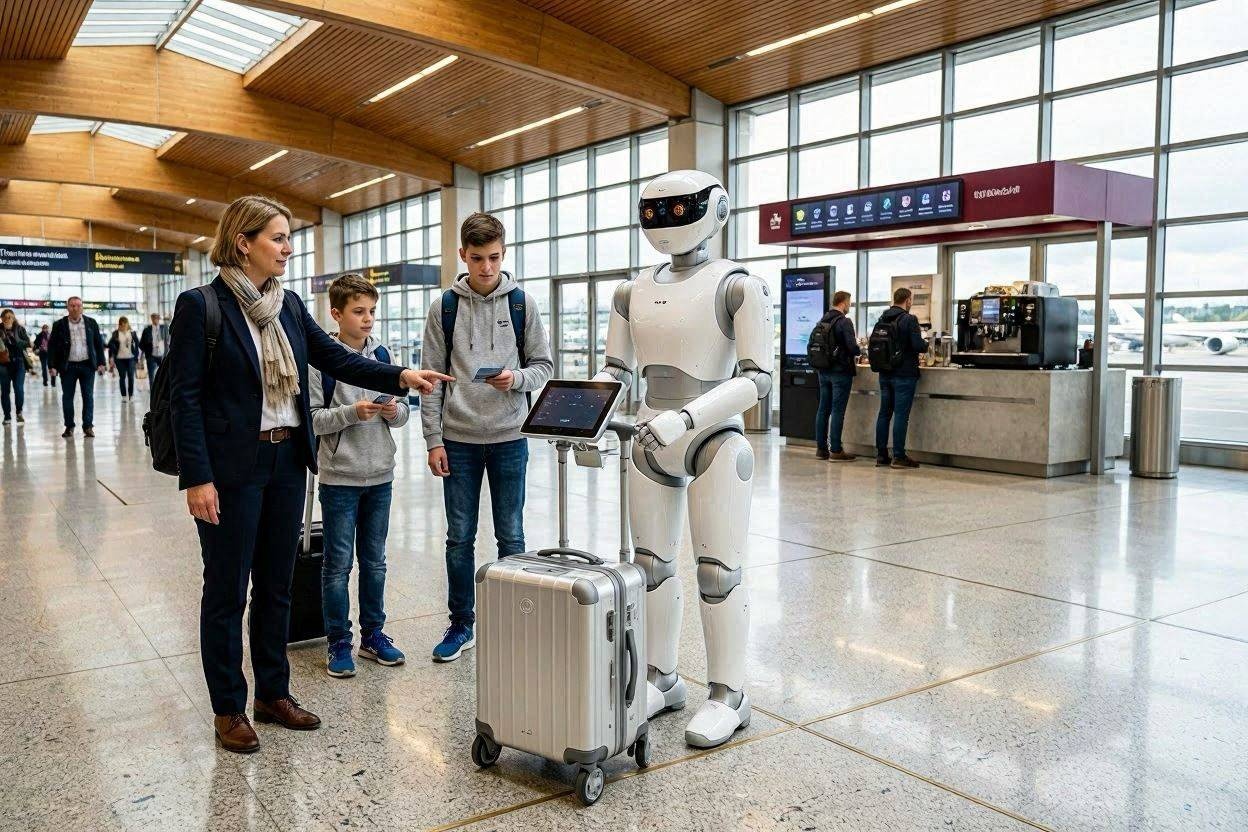
Service Robotics Innovation: Key Trends, Growth Drivers and Opportunities
Service robotics innovation is fundamentally reshaping industries by deploying autonomous and semi-autonomous machines that perform tasks for the well-being of humans and equipment. Unlike traditional industrial robots confined to cages, service robots operate alongside people in dynamic environments such as hospitals, warehouses, hotels, farms, and even homes. This burgeoning field integrates cutting-edge technologies including Artificial Intelligence (AI), the Internet of Things (IoT), advanced sensors, and cloud computing to enable robots to navigate, perceive, and interact with the world around them. The driving force behind this innovation is the need to augment the human workforce, improve operational efficiency, and enhance safety in an increasingly complex and labor-constrained world. As a result, service robots are rapidly evolving from simple, single-task machines into sophisticated, multi-functional platforms capable of adapting to a wide range of scenarios.
History of Service Robotics
The journey of service robotics began with early, rudimentary automated systems like the autonomous guided vehicles (AGVs) used in factories and the first robotic vacuum cleaners for consumer homes. These initial systems relied on basic sensors and simple programming. The real acceleration began with significant advancements in computing power, sensor miniaturization, and wireless communication technologies. The introduction of robust operating systems like ROS (Robot Operating System) and the rise of AI, particularly in machine learning and computer vision, were pivotal. These developments enabled robots to perceive their environment, make decisions, and learn from their actions. Today, the field is characterized by increasingly autonomous mobile robots (AMRs), sophisticated surgical systems, and the emergence of humanoid robots, all powered by cloud-based analytics and AI-driven insights, representing a leap from simple automation to intelligent, adaptable assistance.
Benefits of Service Robotics
- Service robotics delivers transformative value across a multitude of sectors by offering solutions to persistent operational and societal challenges. Key benefits include:
- Enhanced Productivity and Efficiency: Automating repetitive, time-consuming tasks allows human workers to focus on higher-value activities, significantly boosting overall output.
- Reduced Operational Costs: Robots can operate continuously without fatigue, reducing labor costs associated with shift work, benefits, and training. RaaS models further lower the barrier to entry by eliminating large upfront capital expenditures.
- Improved Safety and Ergonomics: Robots can be deployed in hazardous environments—such as for bomb disposal, firefighting, or inspecting nuclear facilities—and can take over physically demanding tasks that lead to workplace injuries.
- Enhanced Quality and Precision: In fields like surgery and laboratory automation, robots offer unparalleled precision, leading to better patient outcomes and more reliable experimental results.
- Addressing Labor Shortages: With a growing global shortage of skilled workers in healthcare, logistics, and manufacturing, robots provide a critical solution for filling operational gaps.
Current Market Size and Growth Trends
The service robotics market is experiencing explosive growth. According to MarketsandMarkets, the service robotics market is projected to grow from USD 47.10 billion in 2024 to USD 98.65 billion by 2029, at a robust compound annual growth rate (CAGR) of 15.9%. This growth is underpinned by the increasing adoption of automation across healthcare, logistics, and agriculture. The market's expansion is further fueled by the rise of Robotics-as-a-Service (RaaS) models, which make automation accessible to a wider range of businesses by offering subscription-based solutions rather than requiring expensive outright purchases. Logistics and cleaning robots currently represent the largest market segments, but significant growth is also anticipated in emerging areas like agricultural, search and rescue, and construction robots.
Download PDF Brochure @ https://www.marketsandmarkets.com/pdfdownloadNew.asp?id=681
Key Drivers
Rising adoption to achieve high returns on investment: Companies are deploying robots to streamline processes, enhance productivity, and improve workplace safety, leading to a significant reduction in operational costs.
Growing deployment of IoT and AI: The integration of AI and IoT enables cost-effective predictive maintenance, real-time data analytics for operational optimization, and more intelligent, autonomous robots.
Increasing labor shortages: A global shortage of skilled workers in sectors such as healthcare, logistics, and hospitality is a primary driver, as robots fill essential roles and maintain business continuity.
Government initiatives and funding: Substantial government investments in intelligent technologies and robotics research are accelerating innovation and adoption.
Emerging Trends
Robotics-as-a-Service (RaaS): This business model is democratizing access to robotics, allowing companies to rent robots on a subscription basis, which lowers upfront costs and provides flexibility.
Humanoid Robots: Massive investments are being directed toward developing multi-purpose humanoid robots, although practical, scaled deployments are still nascent. The core technologies developed for humanoids are benefitting the broader robotics ecosystem.
AI-Enabled Autonomy: Advancements in generative AI and vision-language-action models are making robots more intuitive to operate and better at adapting to unstructured environments.
Cloud Robotics and Edge Computing: Robots are leveraging cloud platforms for data analytics, fleet management, and complex processing, while edge computing enables real-time decision-making at the robot level.
Opportunities and Challenges
Service robotics presents immense opportunities in modernizing healthcare with surgical and assistive robots, optimizing logistics and warehouse operations, and automating agriculture to address food production needs. However, the market faces significant challenges. The high initial capital expenditure (CAPEX) for purchasing and deploying robots can be prohibitive for small and medium-sized enterprises, though RaaS is mitigating this issue. Technical complexities, such as ensuring reliability and interoperability in dynamic environments, remain hurdles. Furthermore, data privacy and cybersecurity risks, especially in sensitive sectors like healthcare, and a lack of standardization are significant restraints that the industry must overcome.
Innovations and Advancements
Current innovations are focused on creating more intelligent and versatile robots. This includes the development of advanced perception systems using sophisticated camera and LIDAR technology for better navigation and object manipulation. AI algorithms are enabling robots to learn from their environments and adapt to new tasks. In the hardware space, we are seeing improvements in battery life, energy efficiency, and the use of more durable materials to increase robot endurance and capability. Edge AI is being integrated to allow for faster, more responsive decision-making in time-sensitive applications like autonomous vehicles and delivery drones.
Future Application
The future will see service robots becoming even more integrated into our daily lives. They will be central to the development of smart cities, performing roles in infrastructure inspection, security, and public services. In healthcare, robots will go beyond surgery to provide more personalized care and companionship for an aging population. Agricultural drones and field robots will become crucial for precision farming, helping to increase crop yields and manage resources sustainably. Furthermore, the integration of service robots with renewable energy systems, EV charging, and building automation will create a highly interconnected and intelligent ecosystem that enhances value across the board.
Service robotics innovation is at a pivotal moment, poised to become a foundational technology for 21st-century society. By addressing critical challenges such as labor scarcity, operational inefficiency, and workplace safety, intelligent robotic systems are unlocking significant value across every major industry. With strong investment in digital infrastructure, declining hardware costs, and the accelerating capabilities of AI, the industry is on a trajectory for sustained and robust growth. As robots move from simple tools to intelligent, collaborative partners, their impact on the global economy and human life will only deepen.
Download Sample Research Report for Service Robotics Market Future: : https://www.marketsandmarkets.com/Market-Reports/service-robotics-market-681.html
80% of the Forbes Global 2000 B2B companies rely on MarketsandMarkets to identify growth opportunities in emerging technologies and use cases that will have a positive revenue impact.
- Food Packaging Market Size Set for Strong Growth Through 2030 Amid Rising Demand for Convenience Foods
- Crop Protection Chemical Market Size, Share & Growth Forecast (2025–2030)
- Mulch Films Market: Driving Sustainable Agriculture Through Innovation
- Agricultural Adjuvants Market Analysis, Trends, and Growth Outlook (2026–2031)
- Japan Enterprise Asset Management Market Growth: AI and Smart Infrastructure Drive Demand


