

Video Surveillance Market: Investment Trends, Funding Opportunities, and Growth Outlook
Video Surveillance Market: Investment Trends, Funding Opportunities, and Growth Outlook
The Video Surveillance Market is undergoing a major transformation as traditional security cameras evolve into intelligent platforms capable of analyzing video, identifying objects, detecting unusual behavior, and generating real-time alerts. Increasing concerns about public safety, rising security requirements, smart city development, industrial automation, and the expansion of connected infrastructure are creating new investment opportunities across the surveillance ecosystem.
Modern video surveillance is no longer limited to recording footage for investigation after an incident. Artificial intelligence (AI), machine learning, computer vision, edge computing, cloud platforms, Internet of Things (IoT) connectivity, and advanced video analytics are enabling cameras to become intelligent sensors that can support security as well as operational decision-making.
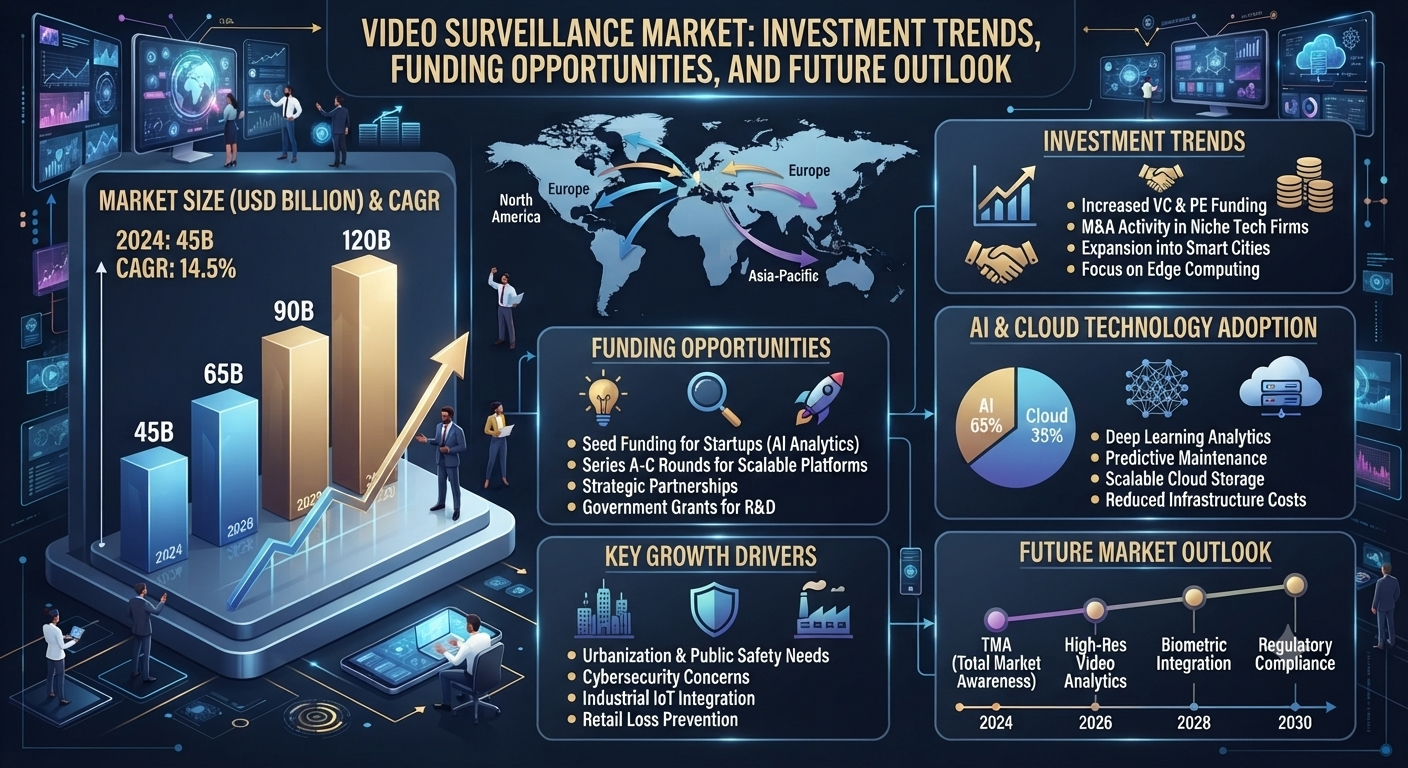
The market is expected to maintain strong growth as governments, enterprises, transportation operators, retailers, industrial facilities, and residential users invest in intelligent monitoring solutions. The strongest opportunities are increasingly shifting from conventional cameras toward AI-enabled systems, video management software, analytics platforms, cloud surveillance, and integrated security ecosystems.
Download PDF Brochure:
https://www.marketsandmarkets.com/pdfdownloadNew.asp?id=645
Video Surveillance Market Investment Trends
Investment in video surveillance is increasingly focused on intelligent and connected technologies. Organizations are moving away from isolated camera installations and adopting integrated systems that connect cameras with access control, alarms, sensors, analytics software, command centers, and cloud platforms.
One of the most important investment trends is the transition from conventional CCTV to IP-based video surveillance. IP cameras provide higher resolution, remote access, network connectivity, and compatibility with software-based analytics.
The adoption of high-resolution cameras is also increasing. 4K and advanced imaging technologies are improving the ability to identify people, vehicles, products, and other objects in challenging environments.
Another important investment theme is AI-powered video analytics. Instead of requiring security personnel to continuously monitor hundreds or thousands of camera feeds, AI systems can automatically identify events that require attention.
AI can detect:
-
Unauthorized entry
-
Abandoned objects
-
Crowd formation
-
Suspicious movement
-
Vehicle activity
-
Perimeter intrusion
-
Workplace safety violations
-
Fire and smoke
-
Traffic incidents
-
Equipment or process abnormalities
This shift from video recording to video intelligence is creating a much larger opportunity for software companies and AI technology providers.
Funding Opportunities in the Video Surveillance Market
The funding landscape is expanding beyond traditional security hardware manufacturers. Venture capital, private equity, corporate investors, and technology companies are increasingly interested in startups developing AI-powered surveillance, computer vision, cloud security platforms, edge computing, and specialized analytics.
One of the strongest funding opportunities is AI video analytics. Startups that can provide accurate object detection, behavioral analysis, anomaly detection, and automated alerting can address a wide range of commercial and public-sector applications.
Another opportunity is cloud-based video surveillance. Cloud platforms allow customers to manage cameras remotely, store video footage, scale systems more easily, and integrate surveillance with other enterprise applications.
Funding opportunities are also emerging in:
-
AI-powered security cameras
-
Computer vision software
-
Edge AI processors
-
Cloud video management systems
-
License plate recognition
-
Facial recognition technologies
-
Thermal imaging
-
Drone-based surveillance
-
Industrial video analytics
-
Smart city surveillance platforms
-
Cybersecurity for connected cameras
-
Privacy-enhancing surveillance technologies
The growing importance of cybersecurity is particularly significant because connected cameras can become potential entry points into corporate networks. This creates demand for secure cameras, encrypted communications, authentication systems, and continuous device monitoring.
AI and Computer Vision Transforming Video Surveillance
Artificial intelligence is becoming one of the most important growth drivers for the video surveillance industry.
Traditional surveillance systems depend heavily on human operators. AI-enabled systems can automatically process large volumes of video and identify specific events.
Computer vision algorithms can recognize people, vehicles, objects, movement patterns, and environmental conditions. Machine learning models can also improve detection accuracy over time.
One major development is edge AI. Instead of sending all video footage to a centralized cloud server, cameras can process information locally. This can reduce bandwidth requirements, improve response times, and support privacy-sensitive applications.
AI-powered cameras can also generate structured data from video. For example, a retail camera can identify customer movement patterns, while an industrial camera can identify unsafe worker behavior or production abnormalities.
The combination of AI and video surveillance therefore expands the market from security into business intelligence.
Cloud Video Surveillance Investment
Cloud-based video surveillance is becoming increasingly attractive because it provides scalability and centralized management.
Businesses with multiple stores, warehouses, offices, or manufacturing facilities can manage surveillance systems from a central platform.
Cloud surveillance can also simplify software updates, system monitoring, storage management, and analytics deployment.
The emergence of subscription-based models is creating opportunities for Security-as-a-Service and Video Surveillance-as-a-Service.
Instead of purchasing cameras and software as a large upfront investment, customers can increasingly pay recurring fees based on cameras, storage, users, analytics capabilities, or usage.
This business model can create predictable recurring revenue for surveillance technology providers.
Video Surveillance Applications
Smart Cities
Smart city development is one of the largest long-term opportunities for video surveillance.
Governments are deploying cameras across roads, intersections, public areas, transportation facilities, and critical infrastructure.
AI analytics can help identify traffic congestion, accidents, suspicious activities, overcrowding, and other events.
The integration of cameras with traffic management systems can also support intelligent transportation and emergency response.
Retail
Retailers are increasingly using video surveillance for more than theft prevention.
AI-powered cameras can analyze customer movement, identify crowded areas, monitor queues, improve store layouts, and support inventory-related processes.
This creates an opportunity to combine security data with operational intelligence.
Manufacturing
Manufacturing facilities are adopting video analytics for security, worker safety, quality monitoring, and production optimization.
AI cameras can detect whether workers are wearing required protective equipment, identify unsafe movement around machinery, and monitor restricted areas.
Video analytics can therefore contribute to both security and productivity.
Transportation
Airports, railway stations, ports, highways, and public transportation networks require continuous monitoring.
AI surveillance can support passenger monitoring, vehicle identification, traffic management, incident detection, and perimeter security.
The increasing development of intelligent transportation infrastructure is expected to support demand for advanced surveillance systems.
Banking and Financial Services
Banks and financial institutions continue to invest in surveillance for branch security, ATM monitoring, fraud prevention, and incident investigation.
AI can enhance the ability to identify unusual activity while reducing the burden on security personnel.
Residential Security
Smart home security is another rapidly developing opportunity.
Consumers are adopting connected cameras, video doorbells, indoor cameras, outdoor cameras, and smart monitoring platforms.
The integration of cameras with mobile applications, smart locks, alarms, and voice assistants is creating a broader connected-home security ecosystem.
Regional Investment Outlook
North America remains an important market because of strong adoption of advanced security technologies, smart buildings, enterprise security systems, and AI-based analytics.
The United States is also seeing growing investment in intelligent public safety infrastructure and connected surveillance systems.
Asia Pacific represents one of the strongest long-term opportunities. Rapid urbanization, smart city projects, industrial development, transportation infrastructure, and increasing security requirements are driving demand.
China, India, Japan, and South Korea are among the important markets for video surveillance technology.
India represents an especially interesting opportunity because of rapid urban development, smart city programs, transportation modernization, industrial expansion, retail growth, and increasing adoption of AI.
Europe is focusing on intelligent security, critical infrastructure protection, transportation monitoring, and privacy-conscious surveillance solutions.
The European market also creates opportunities for technologies that provide advanced analytics while supporting strong data-protection requirements.
Key Companies and Competitive Landscape
The video surveillance ecosystem includes camera manufacturers, video management software providers, AI companies, cybersecurity companies, cloud providers, system integrators, and analytics specialists.
Major companies operating across the broader market include Hikvision, Dahua Technology, Axis Communications, Bosch Security Systems, Hanwha Vision, Motorola Solutions, Honeywell, Johnson Controls, Avigilon, Genetec, Verkada, and Cisco.
Competition is increasingly moving beyond camera specifications.
Companies are differentiating themselves through AI capabilities, cybersecurity, cloud platforms, analytics, ease of deployment, interoperability, and total cost of ownership.
The future competitive advantage will increasingly come from the ability to turn video footage into actionable intelligence.
Investment Opportunities
The investment outlook for video surveillance is broader than the traditional camera market.
The most attractive opportunities are likely to emerge in AI-powered cameras, video analytics, cloud platforms, edge computing, cybersecurity, smart city systems, and industry-specific solutions.
Investors may also find opportunities in companies developing specialized surveillance technologies for sectors such as healthcare, logistics, manufacturing, retail, transportation, and critical infrastructure.
Another opportunity is the modernization of legacy surveillance systems.
Many organizations still operate older analog or partially connected camera systems. Upgrading these environments with IP cameras, network infrastructure, AI analytics, and cloud management can create a large replacement and modernization market.
Recent Developments in the Video Surveillance Market
The market is experiencing several important developments that are changing the competitive landscape.
-
AI-enabled cameras are becoming mainstream, with cameras increasingly capable of object detection, behavioral analysis, anomaly detection, and automated alerts.
-
Edge AI is expanding, allowing cameras to analyze video locally and reduce dependence on centralized processing.
-
Cloud-based video surveillance is gaining momentum, particularly among businesses seeking centralized management and scalable security infrastructure.
-
Video surveillance is expanding beyond security, with retailers, manufacturers, transportation operators, and smart cities using video analytics for operational intelligence.
-
Privacy and cybersecurity are becoming strategic priorities, increasing demand for encrypted systems, secure device management, privacy controls, and responsible AI deployment.
Future Growth Outlook
The future of the Video Surveillance Market will be defined by the convergence of cameras, AI, cloud computing, edge computing, IoT, and cybersecurity.
Traditional surveillance cameras will increasingly become intelligent sensors capable of understanding their surroundings.
Instead of simply recording an event, future systems will be able to identify what happened, determine whether the event is important, and automatically notify the appropriate person or system.
AI-powered surveillance platforms could also integrate with access control, building management, emergency response, traffic systems, robotics, and industrial automation.
This will create a broader visual intelligence ecosystem.
Another major trend will be the shift toward privacy-aware AI. As governments and consumers become more concerned about surveillance and data protection, technology providers will need to balance security benefits with responsible data management.
Local processing, anonymization, encrypted storage, controlled access, and transparent governance are likely to become increasingly important.
Conclusion
The Video Surveillance Market is moving into a new phase of growth driven by AI, computer vision, cloud computing, edge analytics, smart cities, connected infrastructure, and rising security requirements.
Investment opportunities are expanding beyond cameras into software, AI analytics, cybersecurity, cloud platforms, and specialized vertical applications.
The strongest companies will increasingly be those capable of transforming massive amounts of video data into useful and actionable intelligence.
For investors, technology companies, security providers, and system integrators, the convergence of AI and video surveillance represents one of the most important opportunities in the broader physical security and intelligent infrastructure ecosystem.
As organizations continue to modernize legacy systems and deploy connected infrastructure, demand for intelligent video surveillance is expected to remain strong through the coming decade.
FAQs
What is the Video Surveillance Market?
The Video Surveillance Market includes cameras, video management systems, analytics software, storage solutions, networking technologies, and services used to monitor and analyze physical environments.
What is driving the growth of video surveillance?
Major growth drivers include public safety requirements, smart city development, industrial automation, retail security, transportation infrastructure, rising crime concerns, and the increasing adoption of AI-based video analytics.
How is AI changing video surveillance?
AI enables surveillance systems to automatically detect objects, people, vehicles, unusual behavior, intrusions, accidents, and other events without requiring humans to continuously monitor every camera feed.
What are the major investment opportunities?
Key opportunities include AI cameras, video analytics, cloud surveillance, edge computing, cybersecurity, smart city platforms, computer vision, thermal imaging, and industry-specific surveillance solutions.
What is edge AI in video surveillance?
Edge AI allows cameras or nearby devices to process video locally instead of sending all footage to a centralized cloud platform. This can improve response time, reduce bandwidth requirements, and support privacy.
Which industries use video surveillance?
Major users include government, smart cities, retail, manufacturing, banking, transportation, healthcare, logistics, education, hospitality, critical infrastructure, and residential security.
What is the future of video surveillance?
The future is moving toward intelligent visual platforms that combine AI, computer vision, IoT, cloud computing, edge processing, and cybersecurity to provide real-time security and operational intelligence.
Is cloud surveillance becoming important?
Yes. Cloud surveillance allows organizations to manage distributed camera networks, analytics, storage, and system updates through centralized platforms. Subscription-based models are also creating new recurring-revenue opportunities.
What are the major challenges facing the market?
Privacy concerns, cybersecurity risks, regulatory requirements, high-quality data requirements, integration with legacy systems, storage costs, and the need for skilled professionals are among the major challenges.
Why is AI surveillance attracting investors?
AI surveillance creates opportunities to convert video from passive recordings into actionable data. This enables applications beyond security, including traffic management, retail analytics, industrial safety, operational monitoring, and smart infrastructure.
80% of the Forbes Global 2000 B2B companies rely on MarketsandMarkets to identify growth opportunities in emerging technologies and use cases that will have a positive revenue impact.
- Food Packaging Market Size Set for Strong Growth Through 2030 Amid Rising Demand for Convenience Foods
- Mulch Films Market: Driving Sustainable Agriculture Through Innovation
- Agricultural Adjuvants Market Analysis, Trends, and Growth Outlook (2026–2031)
- Crop Protection Chemical Market Size, Share & Growth Forecast (2025–2030)
- Japan Enterprise Asset Management Market Growth: AI and Smart Infrastructure Drive Demand

