

AI Impact Analysis on Armored Vehicle Market
The Global Armored Vehicles Market is undergoing a significant transformation as defense forces modernize their land platforms to address changing operational requirements, evolving security threats, and the growing complexity of military environments. Armored vehicles remain essential assets for land forces, supporting troop transportation, reconnaissance, command and control, logistics, protected mobility, and combat operations. However, the capabilities expected from these platforms are expanding beyond traditional armor protection, engine performance, and weapon integration. Modern military vehicles increasingly rely on advanced sensors, digital communication systems, onboard computing, electronic architectures, and data-driven decision-support technologies.
Artificial intelligence (AI) is becoming an important enabler of this transformation. Its integration into armored vehicles can improve how platforms collect and process information, monitor mechanical health, support crews, manage fleets, and interact with other military systems. Machine learning, computer vision, predictive analytics, digital twins, and intelligent automation are creating opportunities across the armored vehicle lifecycle, from initial design and manufacturing to deployment, maintenance, and modernization.
The growing complexity of land operations is one of the main reasons for this shift. Armored vehicle crews may need to interpret information from cameras, thermal imaging systems, radar, navigation equipment, communication networks, and vehicle sensors. Processing these inputs manually can increase workload and make it difficult to maintain a comprehensive understanding of changing conditions. AI-enabled systems can help organize information, identify patterns, highlight equipment anomalies, and present relevant data to personnel. The objective is to improve situational awareness and operational efficiency while preserving human oversight over consequential decisions.
AI is also influencing the development of autonomous and optionally crewed ground platforms. These systems may support logistics, reconnaissance, engineering, surveillance, and other missions in which reducing personnel exposure or extending operational reach is important. At the same time, AI-powered maintenance systems can analyze vehicle telemetry to forecast component degradation and support more effective maintenance planning. In manufacturing, computer vision and predictive analytics can improve quality inspection, production planning, and engineering validation.
The impact of AI on the armored vehicles market therefore extends across multiple technology categories and customer requirements. It is influencing the design of next-generation main battle tanks, infantry fighting vehicles, armored personnel carriers, reconnaissance vehicles, and specialized support platforms. It is also creating new opportunities for defense original equipment manufacturers, software developers, sensor suppliers, electronics companies, and maintenance service providers.
Nevertheless, adoption requires careful consideration of reliability, cybersecurity, interoperability, cost, and regulatory requirements. Military vehicles operate in demanding environments where equipment must withstand vibration, temperature extremes, dust, shock, electromagnetic interference, and restricted connectivity. AI applications must be tested under realistic conditions and integrated with established safety and operational procedures. The long-term development of AI-enabled armored vehicles will depend on combining advanced software with dependable hardware, secure communications, and trained personnel.
This analysis examines how AI is influencing the armored vehicles market across ten major areas, including autonomous mobility, battlefield awareness, vehicle protection, fire-control integration, predictive maintenance, manufacturing, network-centric operations, and the future outlook toward 2035.
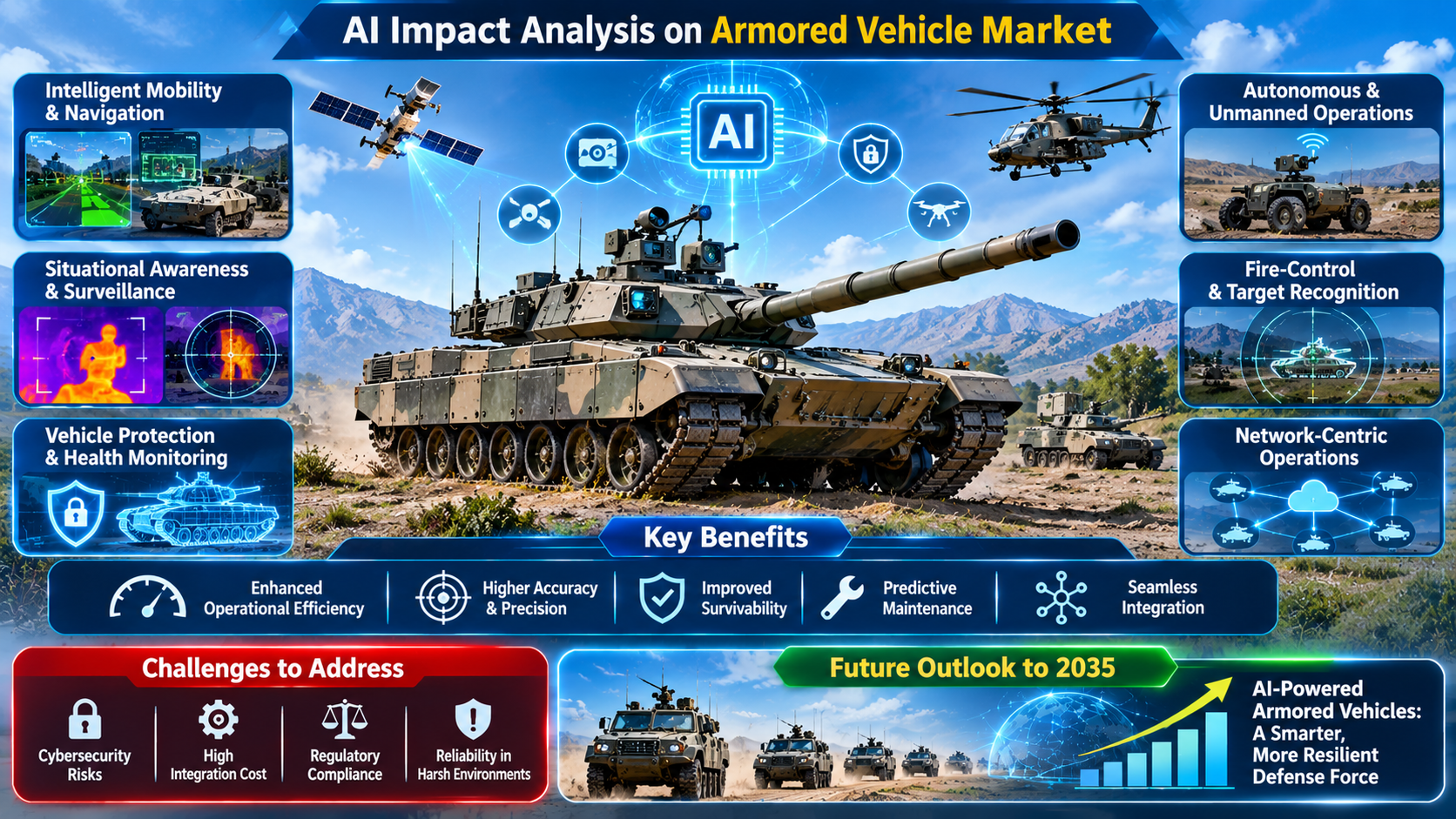
Introduction to the Armored Vehicles Market
Evolution of Modern Armored Platforms
The armored vehicles market includes a broad range of military ground platforms designed to provide protected mobility, transport, reconnaissance, command support, and other land-based capabilities. Major categories include main battle tanks, infantry fighting vehicles, armored personnel carriers, light protected vehicles, reconnaissance vehicles, and specialized engineering and logistics platforms. Each category has different requirements for protection, mobility, payload capacity, crew configuration, and electronic integration.
Historically, armored vehicle development focused heavily on mechanical performance, armor protection, firepower, and reliability. Modern platforms increasingly combine these traditional characteristics with digital architectures, electronic control systems, advanced sensors, navigation equipment, and secure communication networks. This shift reflects the growing importance of information and connectivity in land operations.
The transition toward digitally integrated vehicles is creating opportunities for AI. Modern armored platforms generate information from engine sensors, transmission systems, thermal cameras, navigation equipment, electronic subsystems, and crew interfaces. AI can help process this information and support functions such as vehicle health monitoring, image analysis, equipment diagnostics, and operational awareness.
Growing Demand for Intelligent Armored Platforms
Defense modernization programs are encouraging the development and upgrade of armored fleets. Countries are investing in new platforms and extending the service lives of existing vehicles through electronic modernization, improved protection, advanced communications, and upgraded mobility systems. AI can support both approaches because it can be incorporated into new vehicle architectures or introduced through selected modernization packages.
The market is not moving toward a single universal AI-enabled vehicle design. Instead, requirements differ according to platform type and mission. A main battle tank may prioritize crew awareness, vehicle health monitoring, and integration with digital command networks. An armored personnel carrier may emphasize protected transport, navigation assistance, and fleet management. Reconnaissance and support vehicles may place greater importance on sensor integration, remote monitoring, and autonomous mobility features.
AI is therefore becoming a cross-platform technology rather than a capability restricted to one vehicle category. Its commercial significance extends to vehicle manufacturers, electronics suppliers, software developers, sensor companies, maintenance providers, and defense technology integrators.
AI in Intelligent Mobility, Navigation, and Autonomous Armored Vehicles
Development of Autonomous and Optionally Crewed Platforms
One of the most visible areas of AI adoption in the armored vehicles market is autonomous mobility. Advances in computer vision, machine learning, navigation sensors, and onboard computing are enabling ground vehicles to perform selected driving and mobility tasks with reduced direct operator input. These capabilities range from driver assistance to supervised autonomy and, in some applications, remotely supervised unmanned operation.
AI-based perception systems can interpret information from cameras, radar, lidar, and other sensors to develop an understanding of the vehicle's surroundings. This information can support functions such as obstacle awareness, lane or path recognition, and monitoring of nearby objects. For military applications, these technologies must operate reliably across uneven terrain, changing weather, low visibility, and environments with limited infrastructure.
The development of autonomous ground platforms is also connected to the broader concept of optionally crewed vehicles. Such platforms are designed to retain conventional human-operated capabilities while supporting selected unmanned or remotely supervised functions. This approach offers flexibility because the level of automation can be matched to the vehicle's role, technical maturity, and operational requirements.
The US Army's research and development planning has included AI and machine learning for next-generation combat vehicle technologies, including human-agent teaming and autonomous systems. Its published program descriptions emphasize the development and evaluation of intelligent systems under relevant military operating constraints.
AI-Based Navigation and Terrain Understanding
Navigation in military environments can be more complex than navigation on conventional roads. Armored vehicles may operate across unpaved surfaces, damaged infrastructure, restricted routes, and areas where satellite navigation or communication services are unreliable. AI can contribute by interpreting information from multiple onboard sensors and supporting driver awareness.
Machine learning models can classify environmental features and help identify changes in terrain conditions. When integrated with digital maps and vehicle sensors, AI-based systems may support route awareness and mobility assessment. These capabilities can be particularly relevant to vehicles that operate in unfamiliar environments or support remote and semi-autonomous missions.
AI can also contribute to driver-assistance functions. Systems that monitor the vehicle's surroundings may help identify obstacles, detect proximity risks, and provide visual or audio alerts. Such functions can reduce some aspects of crew workload, although they do not eliminate the need for trained operators and appropriate control procedures.
Human-Machine Collaboration and Unmanned Ground Vehicles
The future of armored mobility is likely to include greater collaboration between crewed vehicles and unmanned ground systems. Unmanned platforms can be developed for logistics, reconnaissance, engineering support, transport, and other tasks where remote operation or reduced crew exposure may be valuable.
AI can support these platforms through perception, navigation assistance, equipment monitoring, and communication with human supervisors. However, autonomy in military environments remains technically demanding. Unstructured terrain, unpredictable obstacles, degraded communications, and the need for reliable human intervention create challenges that are not fully addressed by commercial autonomous-driving technologies.
The distinction between demonstrations and large-scale deployment is important. Reporting in 2026 has highlighted that broad autonomous ground vehicle operations remain a long-term development challenge, despite continuing investment and experimentation.
For the armored vehicles market, this means that near-term AI adoption is likely to include practical driver-assistance, remote operation, fleet monitoring, and supervised autonomous functions alongside longer-term research into more advanced unmanned platforms.
AI in Situational Awareness, Surveillance, and Battlefield Intelligence
Integrating Advanced Sensors and Onboard Information
Situational awareness is an important requirement for armored vehicle crews. Modern platforms can incorporate day and night cameras, thermal imaging systems, radar, navigation equipment, acoustic sensors, and other information sources. These systems generate large volumes of data that must be interpreted within the vehicle's electronic architecture.
AI can help organize this information by identifying patterns, classifying images, and presenting relevant observations to vehicle personnel. Computer vision can support the interpretation of camera feeds, while machine learning can assist with the categorization of objects and environmental features. AI-based information management can also help reduce the burden of manually reviewing multiple sensor displays.
The objective is not simply to add more sensors to a vehicle. It is to improve how information from existing and new sensors is consolidated, prioritized, and made accessible to the crew.
Computer Vision and Intelligent Image Analysis
Computer vision is one of the most relevant AI technologies for armored vehicle applications. It enables software systems to analyze images and video, recognize visual patterns, and identify changes in the observed environment. In vehicle systems, computer vision can support driver visibility, equipment inspection, navigation awareness, and general monitoring.
Thermal imaging and electro-optical sensors can provide information in conditions where ordinary visual observation is limited. AI can assist with image enhancement, classification, and the identification of unusual visual conditions. The quality of these outputs depends on sensor resolution, environmental conditions, data quality, and model validation.
AI-supported image analysis may also be useful for vehicle inspection and maintenance. Cameras can examine external surfaces, components, and assemblies to identify visible wear or damage that requires further assessment. This connects situational awareness technologies with the broader lifecycle management of armored platforms.
Connected Intelligence and Crew Decision Support
As armored vehicles become more digitally integrated, they are increasingly expected to exchange information with other platforms and command systems. AI can help process incoming data, organize vehicle status information, and support decision-making by presenting a more structured view of available information.
Crew decision-support systems may combine vehicle health, navigation status, communication availability, and sensor information. AI-based tools can highlight inconsistencies or unusual conditions and help personnel focus on information that requires attention.
This is particularly relevant as military platforms become part of wider digital defense networks. The value of AI will depend on the accuracy and timeliness of information, the usability of crew interfaces, and the ability to operate when connectivity is limited. Effective systems must avoid overwhelming crews with excessive alerts or presenting uncertain model outputs as confirmed information.
AI in Vehicle Protection, Survivability, and Health Monitoring
Intelligent Monitoring of Vehicle Protection Systems
Protection remains a central design consideration in the armored vehicles market. Modern platforms combine structural armor with other technologies intended to improve crew safety and vehicle survivability. These may include advanced materials, modular protection packages, environmental monitoring, and active protection system components.
AI can contribute to protection-system management by monitoring equipment status, analyzing sensor information, and identifying irregularities in system performance. Machine learning can help classify equipment anomalies and support diagnostics. These applications are primarily concerned with system health, reliability, and the presentation of relevant information to personnel.
The use of AI in this area requires particularly careful validation. Protection systems are safety-critical, and their operation cannot depend on unverified predictions. AI-supported monitoring should therefore complement established engineering controls, inspection procedures, and certified system functions.
Structural Health and Material Performance Assessment
Armored vehicles operate under demanding conditions that can place stress on structures, suspension assemblies, power systems, and other components. Repeated vibration, heavy loads, temperature changes, and prolonged use can contribute to component degradation.
AI can analyze data from sensors and maintenance records to help identify patterns associated with structural wear or equipment deterioration. When combined with engineering models, this information may support condition assessment and maintenance prioritization.
Machine learning can also assist manufacturers in evaluating material performance during design and testing. AI-supported analysis may help engineers compare simulation results, identify variations in test data, and assess how different design choices influence durability. Such applications can contribute to more efficient engineering processes without replacing physical testing and established certification methods.
Digital Twins and Vehicle Survivability Assessment
Digital twins can provide virtual representations of vehicle systems and their operating characteristics. Engineers can use them to examine component behavior, evaluate maintenance scenarios, and compare simulated performance with real-world data.
In armored vehicle development, digital twins may represent powertrains, suspension systems, electronic architectures, thermal management systems, and other subsystems. AI can help analyze large volumes of simulation and sensor data, identify patterns, and support engineering assessments.
This approach can also contribute to lifecycle planning. By comparing actual vehicle performance with expected operating behavior, maintenance teams may gain a better understanding of degradation and potential reliability issues.
AI-driven health monitoring is therefore relevant not only to protection systems but also to the broader objective of maintaining vehicle availability and crew safety throughout the platform lifecycle.
AI in Fire Control, Target Recognition, and Weapon-System Integration
Modernization of Digital Fire-Control Architectures
Fire-control systems are an important part of many armored combat platforms. They bring together electronic, optical, mechanical, and computing subsystems that support the operation and monitoring of vehicle weapon systems. As armored vehicles become more digitally integrated, fire-control architectures increasingly interact with onboard sensors, displays, diagnostic tools, and wider vehicle information systems.
AI may support selected information-processing and system-monitoring functions within these architectures. Machine learning can assist with the classification of sensor data, while predictive diagnostics can monitor the condition of electronic components. AI can also help organize system status information and identify anomalies that require engineering or operator attention.
The application of AI in this area must be distinguished from autonomous decisions to use force. Human responsibility, established authorization processes, and applicable legal and policy requirements remain essential. AI-enabled information support should not be treated as a substitute for human judgment and accountability.
Computer Vision and Sensor Information Management
Armored vehicles may use electro-optical and thermal imaging equipment to provide crews with information about their surroundings. AI can assist in processing these data streams and organizing visual information for display.
Computer vision can help classify objects and identify changes within an image. Machine learning can also support image-quality assessment and sensor diagnostics. These functions may help reduce the time personnel spend manually interpreting large quantities of sensor information.
In complex vehicle architectures, AI may also help assess whether sensor data are incomplete, inconsistent, or affected by equipment problems. This can support better information management and maintenance decisions.
Integration with Vehicle Electronics and Human Oversight
The effectiveness of AI in fire-control-related applications depends on how well it integrates with the wider electronic architecture. Vehicle manufacturers must consider software compatibility, processing capacity, data security, interface design, and the reliability of connected components.
Human oversight is particularly important in systems associated with the use of weapons. AI may help present information and monitor system condition, but consequential decisions must remain subject to appropriate human control and governance. Clear boundaries between automated assistance and human authorization are essential for responsible deployment.
As the armored vehicles market develops, suppliers that can provide secure, interoperable, and well-validated electronic systems may find opportunities in platform modernization and next-generation vehicle programs.
AI in Armored Vehicle Fleet Management, Predictive Maintenance, and Logistics
Transition from Scheduled to Predictive Maintenance
Maintenance is one of the most commercially relevant areas of AI adoption in the armored vehicles market. Military fleets include complex mechanical, electrical, electronic, and hydraulic systems that require regular inspection and servicing. Conventional maintenance programs often rely on fixed schedules, usage intervals, and technician assessments. While these methods remain important, they may not always reflect the actual condition of individual vehicles or components.
AI-based predictive maintenance offers an additional approach. Machine learning models can analyze information from vehicle sensors, maintenance histories, operating records, and diagnostic systems to identify patterns associated with component degradation. This can help maintenance teams recognize potential issues earlier and plan inspections or repairs according to vehicle condition.
For example, vehicle health monitoring systems can collect information related to engine performance, transmission behavior, temperature, vibration, electrical systems, and other measurable parameters. AI can compare this information with historical patterns to identify unusual changes. The results can support maintenance decisions, although physical inspection and technician verification remain necessary.
Improving Fleet Availability and Maintenance Planning
Large armored vehicle fleets often include different vehicle models, configurations, ages, and maintenance histories. Managing these differences can create challenges for defense organizations, particularly when spare parts, specialized technicians, and maintenance facilities are limited.
AI can help fleet managers consolidate information from multiple vehicles and identify maintenance priorities. Predictive analytics can support estimates of component replacement requirements, maintenance workload, and parts demand. These insights may help organizations allocate resources more effectively and reduce unnecessary vehicle downtime.
AI-based fleet management can also help assess vehicle availability across different units and locations. By analyzing maintenance records and equipment status, decision-support systems can provide a clearer picture of which platforms require attention and where maintenance resources may be needed.
The US Army's research program on predictive maintenance describes the use of AI and machine learning to assess maintenance conditions across emerging and legacy ground and aviation platforms. The program identifies sensor data, maintenance databases, and virtual simulations as inputs for improving maintenance analysis and operational readiness.
Digital Maintenance Ecosystems and Edge Analytics
Predictive maintenance becomes more valuable when vehicle data can be integrated with maintenance facilities, logistics systems, and fleet management platforms. AI can help connect these information sources, allowing maintenance teams to evaluate individual vehicle conditions alongside broader fleet trends.
However, military vehicles may operate in environments where communication with centralized systems is intermittent or unavailable. Edge computing can help address this limitation by processing selected diagnostic information closer to the vehicle or maintenance unit. This can allow personnel to access relevant equipment health information without depending entirely on continuous network connectivity.
The development of connected maintenance ecosystems will require common data standards, secure interfaces, reliable sensors, and appropriate software integration. It will also require investment in personnel training because maintenance technicians must understand both conventional mechanical systems and increasingly software-defined vehicle architectures.
The commercial opportunity extends beyond the sale of armored vehicles. AI-enabled maintenance software, diagnostic equipment, sensor systems, data platforms, and lifecycle support services may become important parts of the market's long-term value chain.
AI in Armored Vehicle Design, Manufacturing, and Testing
AI-Assisted Engineering and Vehicle Design
The design of armored vehicles involves complex engineering trade-offs between protection, mobility, weight, power consumption, payload capacity, maintainability, and cost. Engineers must evaluate how individual components interact with the wider platform and how the vehicle will perform throughout its expected service life.
AI can support this process by analyzing engineering datasets, comparing design alternatives, and identifying relationships between design parameters and expected performance. Generative design and machine learning may help engineers explore different structural configurations or component arrangements within defined engineering constraints.
AI can also support the analysis of materials and manufacturing processes. By examining test data and material characteristics, machine learning models may help identify promising options for further evaluation. These tools can accelerate engineering analysis, but final designs still require physical testing, engineering review, and compliance with relevant defense standards.
Smart Manufacturing and Quality Inspection
Armored vehicle manufacturing involves the production and integration of large structures, mechanical assemblies, electronic components, protection systems, powertrains, and communication equipment. Maintaining consistent quality across these processes is essential for platform reliability.
Computer vision can support automated quality inspection by examining components, welds, surface conditions, and assembly characteristics. AI systems can identify visible deviations and direct attention to areas requiring further inspection. This may help manufacturers improve production consistency and reduce the time required for certain quality-control activities.
AI can also support manufacturing process monitoring. Machine learning models can analyze production data to identify recurring delays, equipment performance issues, and patterns associated with manufacturing defects. These insights can help manufacturers improve production planning and process efficiency.
Robotics and industrial automation can complement AI by supporting repetitive manufacturing tasks. The combination of automated equipment, machine vision, and production analytics may contribute to more flexible and data-driven manufacturing facilities.
Digital Twins, Simulation, and Testing
Digital engineering is becoming increasingly important in complex defense manufacturing. Digital twins can represent vehicle components and systems in virtual environments, allowing engineers to study performance and evaluate design changes before committing to physical modifications.
AI can help process the large volumes of data generated through simulation, laboratory testing, and vehicle trials. It may identify relationships between test conditions and system behavior, flag unusual results, and support the comparison of predicted and measured performance.
For armored vehicles, these applications can be relevant to mobility systems, powertrains, thermal management, electronics, and maintainability. AI can also help organize test documentation and improve traceability across the development process.
Supply Chain and Production Planning
Armored vehicle manufacturing depends on complex supply chains involving specialized materials, engines, transmissions, electronics, sensors, communication equipment, and protection technologies. Delays in the availability of a single critical component can affect production schedules and modernization programs.
AI-based supply chain analytics can help manufacturers assess supplier performance, forecast component demand, and identify potential delivery risks. Predictive planning may support inventory management and improve coordination between suppliers, production facilities, and defense customers.
As manufacturers modernize their production systems, AI may become an important tool for improving quality, managing complexity, and supporting more efficient delivery of next-generation armored platforms.
AI Integration with Network-Centric Warfare and Multi-Domain Military Platforms
Connected Armored Vehicles and Digital Command Networks
Modern armored vehicles increasingly operate as part of connected military formations rather than as isolated platforms. Digital communication systems can allow vehicles to exchange information with command centers, other ground platforms, logistics units, and surveillance assets. This connectivity supports coordination, fleet visibility, and a broader understanding of operational conditions.
AI can help manage the volume of information generated by these connected systems. Machine learning can organize incoming data, identify inconsistencies, and highlight information that may require attention. AI-supported software can also assist with vehicle status reporting and the consolidation of maintenance or equipment information across a fleet.
The value of these systems depends on secure and dependable communications. Military networks may experience limited bandwidth, intermittent connectivity, and cybersecurity risks. AI applications must therefore be designed to operate with appropriate safeguards and should not assume that continuous access to centralized computing resources will always be available.
Integration with Unmanned Aerial and Ground Systems
The increasing use of unmanned systems is creating new opportunities for collaboration between armored vehicles, unmanned ground vehicles, and unmanned aerial vehicles. These platforms can provide different types of information and operational support, while AI can help manage the associated data and system status.
For example, AI-enabled information platforms can help consolidate vehicle health data, sensor observations, and reports from connected systems. This can provide commanders and support personnel with a more consistent view of platform availability and information received from different sources.
Manned-unmanned teaming is also influencing the development of future ground vehicle architectures. Research into autonomous systems increasingly considers how human operators and intelligent platforms can work together. The US National Defense University study of ground combat systems identifies autonomous ground vehicles, command-and-control applications, and predictive maintenance among the areas in which AI may influence the ground combat vehicle industry.
Edge AI and Resilient Information Processing
Edge AI refers to processing information close to where it is generated rather than transferring every dataset to a centralized computing environment. In armored vehicles, this can be relevant because onboard systems may need to process sensor and diagnostic information while operating with limited connectivity.
Edge computing can support equipment monitoring, image processing, and selected decision-support functions. It can also reduce dependence on continuous communication links for routine data analysis.
However, onboard computing systems face constraints related to power, heat, physical space, environmental durability, and cybersecurity. Manufacturers must balance processing requirements with vehicle design limitations. AI models also need to be tested to ensure that they remain dependable when operating with incomplete data or limited computing resources.
Interoperability Across Defense Platforms
Future armored vehicles are likely to use increasingly integrated software and communication architectures. Interoperability will be important because defense organizations often operate equipment from multiple manufacturers and across different generations of technology.
AI integration must therefore consider common data formats, secure interfaces, software compatibility, and the ability to exchange relevant information across platforms. Open and modular architectures may make it easier to introduce new sensors, computing systems, and software capabilities during vehicle upgrades.
For manufacturers and defense technology suppliers, the ability to integrate AI with existing command, communication, and information systems may become an important competitive consideration.
Challenges, Risks, and Regulatory Considerations in AI-Powered Armored Vehicles
Technical Reliability in Demanding Operating Environments
Armored vehicles operate under demanding environmental conditions. Dust, vibration, shock, extreme temperatures, moisture, electromagnetic interference, and physical stress can affect electronic equipment and sensors. AI systems must continue to perform reliably despite these conditions.
Machine learning models also face challenges when they encounter data that differ from their training environments. A perception system trained primarily on one type of terrain or weather condition may not perform equally well in another. This makes representative testing, ongoing validation, and careful performance monitoring essential.
Manufacturers must ensure that AI systems are integrated with dependable hardware and that failures do not create unacceptable risks for vehicle personnel. Redundant monitoring, conventional fallback functions, and established operating procedures remain important design considerations.
Cybersecurity and Software Vulnerabilities
Connected armored vehicles depend increasingly on software, communication networks, sensors, and digital control systems. These features can improve functionality but also expand the potential cybersecurity exposure of the platform.
AI software itself can be vulnerable to manipulated inputs, compromised datasets, unauthorized access, and software supply chain risks. A secure development process must therefore include software verification, access controls, network protection, secure updates, and continuous monitoring.
Cybersecurity must also extend across the vehicle lifecycle. Software updates, component replacement, integration with maintenance systems, and connection to external networks can all introduce new risks. Defense organizations and manufacturers will need clear procedures for managing software versions and validating changes before operational use.
Data Quality and Model Validation
AI performance depends on the quality, relevance, and completeness of the data used to develop and operate models. Armored vehicle fleets may contain platforms from different generations, manufacturers, and configurations. Their maintenance records and sensor data may not always use consistent formats.
This can make it difficult to create models that perform reliably across an entire fleet. Data standardization, sensor calibration, documentation, and governance are necessary to support dependable AI applications.
Validation is especially important for safety-related systems. AI outputs must be evaluated under realistic operating conditions, and organizations should establish clear limits on where automated recommendations can be used. Human operators and technical specialists must be able to review important decisions and identify when a model's output should not be trusted.
Cost, Interoperability, and Procurement Constraints
Introducing AI into armored vehicles can require investment in sensors, processors, software, communication systems, testing, training, and long-term technical support. Modernization programs must also account for the cost of integrating new systems with legacy vehicle architectures.
Defense procurement cycles can be lengthy, and requirements may change as technology develops. A system that is suitable for a new vehicle design may be difficult to incorporate into an older platform without substantial modification. This can influence the pace and scale of AI adoption.
Interoperability creates another challenge. Different suppliers may use different software environments, data structures, and communication standards. Without suitable integration frameworks, defense organizations may face fragmented systems that are difficult to maintain.
Ethical, Legal, and Human Oversight Considerations
AI adoption in military vehicles raises important questions about accountability, human control, transparency, and the limits of automation. These considerations are particularly important when AI is associated with weapon-system information or other consequential decisions.
Defense organizations must define the functions that can be automated, the decisions that require human authorization, and the procedures for intervention when systems behave unexpectedly. Clear responsibility must remain with authorized personnel and organizations.
The future development of AI-enabled armored vehicles will require not only engineering innovation but also responsible governance, testing, training, and compliance with applicable legal and policy frameworks.
Future Outlook: AI-Powered Armored Vehicles Market to 2035
Growth of Intelligent and Optionally Crewed Armored Platforms
By 2035, AI is likely to be more deeply integrated into armored vehicle electronics, mobility systems, maintenance platforms, and information architectures. The pace of adoption will vary across vehicle categories and defense customers, but intelligent monitoring and software-based capabilities are likely to become increasingly important in new platform development and modernization programs.
Optionally crewed vehicles and unmanned ground systems may expand their role in selected support and reconnaissance applications. AI can contribute to navigation assistance, perception, vehicle diagnostics, and communication with human supervisors. Large-scale autonomous operation will continue to depend on improvements in reliability, safety, computing, and operational acceptance.
Greater Focus on Predictive Maintenance and Fleet Readiness
Predictive maintenance is likely to remain one of the most practical near-term AI applications. Defense organizations have a direct interest in improving the availability of expensive vehicle fleets and reducing unplanned downtime.
As more platforms incorporate digital sensors and diagnostic systems, maintenance teams may gain access to more detailed information about component condition and vehicle usage. AI can help turn this information into maintenance forecasts, parts requirements, and fleet readiness assessments.
The development of digital maintenance ecosystems may also create recurring opportunities for software providers and lifecycle support companies. Suppliers that can integrate data across different vehicle generations and maintenance facilities may become important partners in long-term fleet modernization.
Integration of AI with Advanced Protection and Sensor Technologies
Next-generation armored vehicles are expected to incorporate more sophisticated electronic and sensor architectures. AI may support the monitoring of vehicle protection systems, equipment health, sensor performance, and crew information displays.
Computer vision and machine learning may improve how vehicles interpret sensor information and monitor their surroundings. At the same time, digital twins and predictive analytics can support engineering validation and lifecycle assessment.
The integration of these capabilities will depend on secure system architectures and clear boundaries between automated assistance and human control. Reliability will remain more important than simply increasing the number of AI functions available on a vehicle.
Smart Manufacturing and Software-Defined Vehicle Architectures
Manufacturers may increasingly use AI throughout vehicle development and production. Automated inspection, digital twins, production analytics, and predictive supply chain management can help improve manufacturing efficiency and product quality.
Software-defined architectures may also make it easier to introduce upgrades during a vehicle's service life. Modular computing systems, standardized interfaces, and secure software management can support the addition of new capabilities without requiring complete platform replacement.
This shift could influence competition in the armored vehicles market. Manufacturers may be evaluated not only on vehicle performance and protection but also on their ability to provide upgradeable electronic systems, software support, predictive maintenance, and long-term integration services.
Strategic Partnerships and Emerging Investment Opportunities
AI-enabled armored vehicle development requires collaboration across multiple industries. Traditional vehicle manufacturers bring platform engineering and defense integration experience, while software companies contribute machine learning, computer vision, data management, and cybersecurity capabilities. Sensor suppliers, electronics manufacturers, robotics developers, and maintenance providers also play important roles.
Partnerships between these stakeholders can accelerate technology integration and help defense customers evaluate new capabilities. Investment opportunities may emerge in autonomous ground mobility, vehicle health monitoring, AI-enabled diagnostics, digital engineering, secure computing, sensor fusion, and smart manufacturing.
The strongest commercial opportunities are likely to be associated with technologies that solve clear operational and lifecycle challenges. AI solutions that improve fleet readiness, reduce maintenance uncertainty, simplify information management, or support cost-effective modernization may have more immediate adoption potential than highly complex capabilities that require extensive changes to existing vehicle architectures.
AI as a Key Enabler of Next-Generation Armored Vehicles
Artificial intelligence is becoming an important technology in the transformation of the armored vehicles market. Its influence extends beyond autonomous mobility to include situational awareness, vehicle health monitoring, predictive maintenance, manufacturing, digital engineering, cybersecurity, and integration with wider military networks.
The most immediate opportunities are likely to emerge in applications that improve vehicle availability, reduce maintenance uncertainty, support crew awareness, and enhance the management of complex electronic systems. Predictive maintenance is particularly relevant because it can help defense organizations move toward condition-based fleet management. Autonomous mobility and manned-unmanned teaming represent longer-term opportunities that will require continued development, testing, and operational evaluation.
AI will not replace the fundamental requirements of armored vehicle design. Protection, mobility, reliability, maintainability, and crew safety will remain central to platform development. Instead, AI will increasingly complement these characteristics by making vehicles more connected, information-driven, and adaptable.
The future of the armored vehicles market will depend on how effectively manufacturers and defense organizations combine AI software with dependable hardware, secure digital architectures, validated engineering, and trained personnel. Companies that deliver interoperable, upgradeable, and lifecycle-oriented AI capabilities may be well positioned to participate in the next phase of armored vehicle modernization through 2035.
80% of the Forbes Global 2000 B2B companies rely on MarketsandMarkets to identify growth opportunities in emerging technologies and use cases that will have a positive revenue impact.
- Food Packaging Market Size Set for Strong Growth Through 2030 Amid Rising Demand for Convenience Foods
- Crop Protection Chemical Market Size, Share & Growth Forecast (2025–2030)
- Mulch Films Market: Driving Sustainable Agriculture Through Innovation
- Agricultural Adjuvants Market Analysis, Trends, and Growth Outlook (2026–2031)
- Japan Enterprise Asset Management Market Growth: AI and Smart Infrastructure Drive Demand


