



Armored Vehicles Market Size, Share & Trends
Report Code
AS 2369
Published in
Oct, 2026, By MarketsandMarkets™
Armored Vehicles Market by Platform (Armored Fighting, Artillery & Fire Support, Armored Engineering, Armored Logistics, Specialized Armored Vehicles), Mobility (Wheeled, Tracked), Technology, Expenditure Type, End User, and Region-Global Forecast to 2031

USD 60.81 BN
MARKET SIZE, 2031

CAGR 11.3%
(2026-2031)

300
REPORT PAGES

200
MARKET TABLES
ARMORED VEHICLES MARKET OVERVIEW
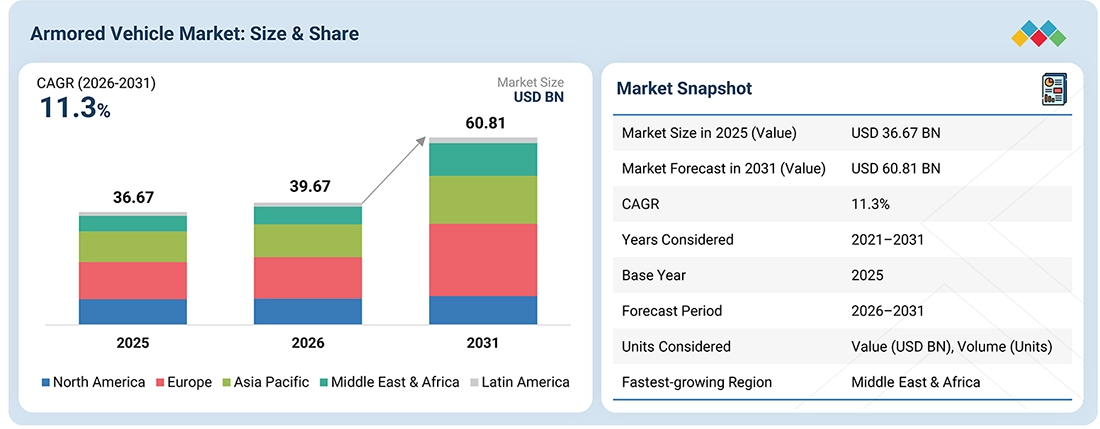
According to Marketsandmarkets, the Global Armored Vehicles Market Size was valued at USD 39.67 billion in 2026 and is projected to reach USD 60.81 billion by 2031, growing at a CAGR of 11.3% from 2026-2031. In terms of volume, the market is projected to grow from 87,159 units in 2026 to 130,039 units by 2031, at a CAGR of 10.8%. Demand for armored vehicles is increasing across army, marine, national guard/reserve, and paramilitary/gendarmerie end users as countries modernize land forces and replace aging vehicle fleets. Armored vehicle systems are being used across combat, fire support, engineering, mine clearance and breaching, logistics and resupply, recovery, CBRN reconnaissance, and explosive ordnance disposal missions. Their use across tracked and wheeled platforms is increasing as armed forces invest in improved protection, mobility, firepower, digital systems, and vehicle modernization to address changing operational requirements.
REPORT SCOPE
| REPORT METRIC | DETAILS |
|---|---|
| Market Size in 2026 | USD 39.67 Billion |
| Market Forecast in 2031 | USD 60.81 Billion |
| CAGR | 11.3% |
| Years Considered | 2021–2031 |
| Base Year | 2025 |
| Forecast Period | 2026-2031 |
| Units Considered | Value (USD Million/Billion), Volume (Units) |
| Report Coverage | Revenue forecast, company ranking, competitive landscape, growth factors, and trends |
| Top Companies |
|
| Growth Drivers |
|
| Segments Covered |
|
| Regions Covered | North America, Asia Pacific, Europe, Middle East & Africa, Latin America |
KEY TAKEAWAYS
-
By RegionThe Middle East & Africa armored vehicles market is expected to register the highest CAGR of 16.9% between 2026 and 2031.
-
By PlatformThe armored CBRNE vehicles segment is expected to register the highest CAGR of 21.5% between 2026 and 2031.
-
By MobilityThe wheeled segment is estimated to account for the largest market share in 2026.
-
Competitive LandscapeRheinmetall AG, General Dynamics Corporation, Oshkosh Corporation, BAE Systems, and Hanwha Aerospace Co., Ltd. were identified as some of the key players in the armored vehicles market (global), given their strong market share and product footprint.
The Armored Vehicles Industry is developing as armed forces require platforms with improved protection, mobility, firepower, survivability, and networked operational capabilities. Advances in sensors, communication systems, digital vehicle architecture, command and control, active protection systems, and onboard electronics are enabling armored vehicles to operate more effectively in complex combat environments. Modernization programs are also supporting wider adoption of digitally connected armored platforms for reconnaissance, direct combat, fire support, engineering, recovery, logistics, air defense, and CBRN-related missions.
Source: Secondary Research, Interviews with Experts, MarketsandMarkets Analysis
TRENDS & DISRUPTIONS IMPACTING CUSTOMERS' CUSTOMERS
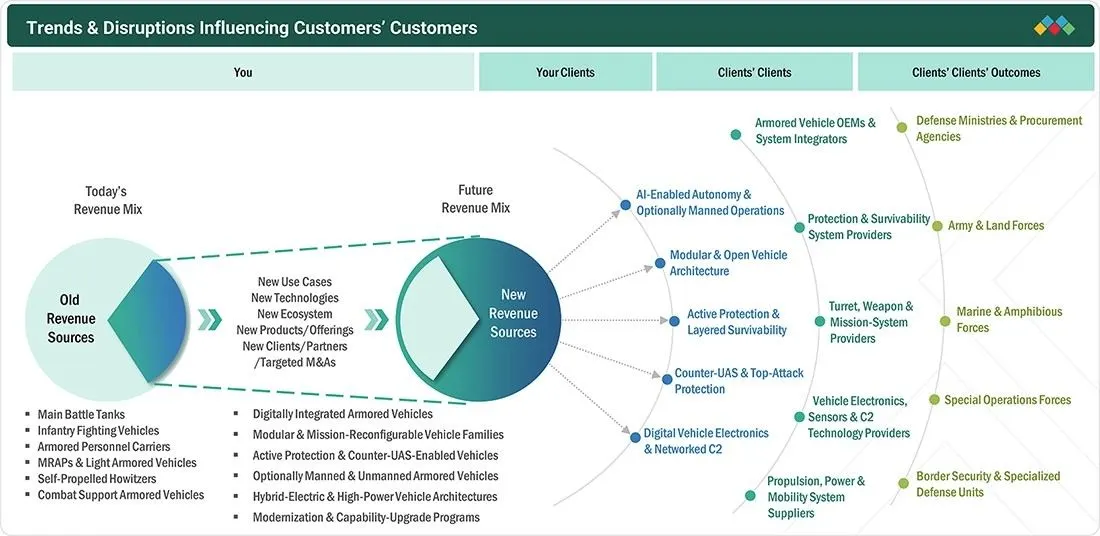
The impact on customers in the armored vehicles market is increasingly linked to the need for flexible platforms that can support different mission requirements without requiring a separate vehicle for each role. Modular vehicle designs, interchangeable mission modules, common vehicle architectures, and upgradeable electronic systems allow users to adapt weapons, protection, sensors, and mission equipment as operational needs change. This can reduce integration effort, simplify crew training and maintenance, and improve fleet commonality. As a result, defense users can extend vehicle service life, improve fleet utilization, and manage operating and lifecycle costs more effectively. Rheinmetall’s Boxer and Lynx platforms illustrate this approach through common drive modules, interchangeable mission modules, and modular digital architectures.
Source: Secondary Research, Interviews with Experts, MarketsandMarkets Analysis
ARMORED VEHICLES MARKET DYNAMICS

Drivers
Impact
Level
Level
-
Rising defense spending on new armored vehicles

-
Replacement of aging armored vehicle fleets


RESTRAINTS
Impact
Level
Level
-
Long development and procurement timelines

-
Long service life of existing armored vehicle fleets


OPPORTUNITIES
Impact
Level
Level
-
Modernization and retrofit of existing armored vehicle fleets

-
Growing adoption of unmanned armored ground vehicles


CHALLENGES
Impact
Level
Level
-
Balancing vehicle protection, weight, and mobility

-
Shortage of spare parts and skilled maintenance resources

Source: Secondary Research, Interviews with Experts, MarketsandMarkets Analysis
Driver: Rising defense spending on new armored vehicles
Defense ministries are increasing spending on new armored vehicles to replace aging fleets and improve protected mobility, firepower, survivability, and battlefield connectivity. Procurement programs cover main battle tanks, infantry fighting vehicles, armored personnel carriers, self-propelled artillery, and other protected platforms. For example, the U.S. FY2026 defense budget supports procurement of 86 Armored Multi-Purpose Vehicles (AMPVs) while continuing investment in next-generation ground combat vehicle programs. Such spending supports demand for vehicle manufacturers, armor suppliers, weapon systems, electronics, and integration providers.
Restraint: Long development and procurement timelines
Armored vehicle programs require extensive design, systems integration, testing, qualification, production preparation, and operational evaluation before large-scale fielding. Complex requirements involving protection, weapons, electronics, mobility, and software can extend development schedules, while supplier and production issues can create further delays. GAO reported that major U.S. defense acquisition programs take almost 12 years on average to deliver an initial capability, highlighting the long timelines associated with complex military equipment programs. These timelines can delay fleet replacement and defer supplier revenues.
Opportunity: Modernization and retrofit of existing armored vehicle fleets
Large installed fleets create opportunities to upgrade existing vehicles rather than replace them immediately. Modernization programs can include new turrets, weapons, active protection systems, sensors, communications, power systems, digital electronics, armor packages, and mobility improvements. The U.S. Army, for example, has funded Stryker upgrades and modifications to Bradley and M109 vehicle fleets, while earlier Stryker modernization efforts focused on increasing vehicle firepower. Such programs create recurring opportunities for OEMs and subsystem suppliers throughout the service life of armored vehicle fleets.
Challenge: Balancing vehicle protection, weight, and mobility
Armored vehicle designers must balance higher protection levels with vehicle weight, mobility, payload capacity, power demand, and transportability. Additional armor, weapons, electronic systems, and protection technologies can increase vehicle mass and place greater demands on engines, suspensions, cooling systems, and electrical architecture. This requires manufacturers to manage size, weight, power, and cooling while maintaining battlefield mobility and reliability. The U.S. AMPV program, for example, specifically addresses survivability and Size, Weight, Power and Cooling (SWAP-C) requirements as part of its vehicle design.
ARMORED VEHICLES MARKET SIZE, SHARE & TRENDS: COMMERCIAL USE CASES ACROSS INDUSTRIES
| COMPANY | USE CASE DESCRIPTION | BENEFITS |
|---|---|---|
 |
General Dynamics Land Systems’ Stryker A1 is used by the U.S. Army as an 8×8 armored vehicle platform for infantry transport and multiple combat-support missions. The upgraded configuration integrates improved survivability, mobility, electrical power, digital architecture, communications, and mission payloads, allowing the platform to support different battlefield roles. | Provides protected mobility while allowing different weapons, sensors, communications, and mission equipment to be integrated on a common vehicle platform. Its upgraded power and digital backbone also support future electronics and battlefield-network requirements. |
 |
KNDS’ LEOPARD 2 main battle tank is used by multiple armed forces for armored combat operations. The platform combines a 120 mm main gun, advanced protection, mobility, optronics, and command-and-information systems, with newer variants incorporating further improvements in survivability and battlefield connectivity. | Provides heavy direct-fire capability, crew protection, and cross-country mobility for high-intensity land operations. Its continuing upgrade path allows users to improve protection, firepower, electronics, and command capabilities without replacing the complete vehicle fleet. |
 |
Rheinmetall’s BOXER is a modular 8×8 armored vehicle used for troop transport, command, medical, engineering, reconnaissance, air-defense, and other mission roles. The platform combines a common drive module with interchangeable mission modules, allowing armed forces to configure vehicles for different operational requirements. | Enables multiple mission variants to use a common vehicle architecture, reducing fleet complexity and supporting common training, maintenance, and logistics. Interchangeable mission modules also allow users to adapt the platform as operational requirements change. |
 |
BAE Systems’ Armored Multi-Purpose Vehicle (AMPV) is being fielded by the U.S. Army to replace legacy M113 vehicles within Armored Brigade Combat Teams. The family supports roles such as general-purpose transport, mission command, medical evacuation, medical treatment, and mortar-carrier operations while operating alongside Abrams and Bradley vehicles. | Improves protection, mobility, reliability, and interoperability compared with the legacy M113 fleet. A common vehicle family also supports multiple battlefield functions while reducing dependence on separate legacy platforms. |
 |
Oshkosh Defense’s JLTV is used by U.S. and allied forces for protected troop transport, reconnaissance, patrol, convoy escort, and weapons-carrier missions. The vehicle combines scalable protection, TAK-4i independent suspension, integrated C4ISR capability, and configurable mission packages for different tactical requirements. | Provides protected tactical mobility across difficult terrain while supporting more than 100 mission-package configurations. Its modular design enables users to integrate weapons, communications, protection kits, and other equipment while maintaining mobility and transportability. |
Logos and trademarks shown above are the property of their respective owners. Their use here is for informational and illustrative purposes only.
ARMORED VEHICLES MARKET ECOSYSTEM
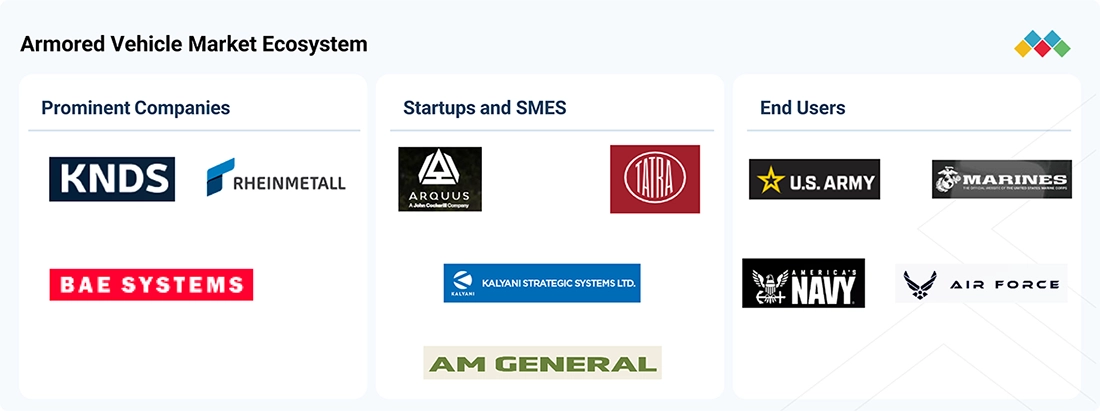
The armored vehicles market includes armored vehicle manufacturers, armor and protection-system suppliers, weapon and turret providers, propulsion and mobility-system suppliers, electronics and communication-system providers, and system integrators. Major companies such as Rheinmetall AG, General Dynamics Corporation, Oshkosh Corporation, BAE Systems, Hanwha Aerospace Co., Ltd., Lockheed Martin Corporation, Thales, ST Engineering, Elbit Systems Ltd., MITSUBISHI HEAVY INDUSTRIES, LTD., HYUNDAI ROTEM COMPANY, Textron Inc., Otokar Otomotiv ve Savunma Sanayi A.S, Denel SOC Ltd, KNDS, FNSS, RTX, IDV, Paramount Group, and Armoured Vehicles Nigam Limited provide armored vehicle platforms, subsystems, and related technologies across tracked and wheeled applications. Their portfolios cover areas such as main battle tanks, infantry fighting vehicles, armored personnel carriers, artillery and fire-support vehicles, engineering vehicles, recovery vehicles, protected mobility platforms, and related mission systems. Other players such as Arquus, Tatra Trucks A.S., Kalyani Strategic Systems Ltd., AM General, Mahindra Emirates Vehicle Armouring FZ LLC, Tata Advanced Systems Limited, Inkas Armored Vehicle Manufacturing, and Streit Group provide specialized armored vehicles, tactical mobility platforms, protection solutions, vehicle integration, and application-specific systems for defense and security users.
Logos and trademarks shown above are the property of their respective owners. Their use here is for informational and illustrative purposes only.
ARMORED VEHICLES MARKET SEGMENTS
Source: Secondary Research, Interviews with Experts, MarketsandMarkets Analysis
Armored Vehicles (AV) Market, By Platform
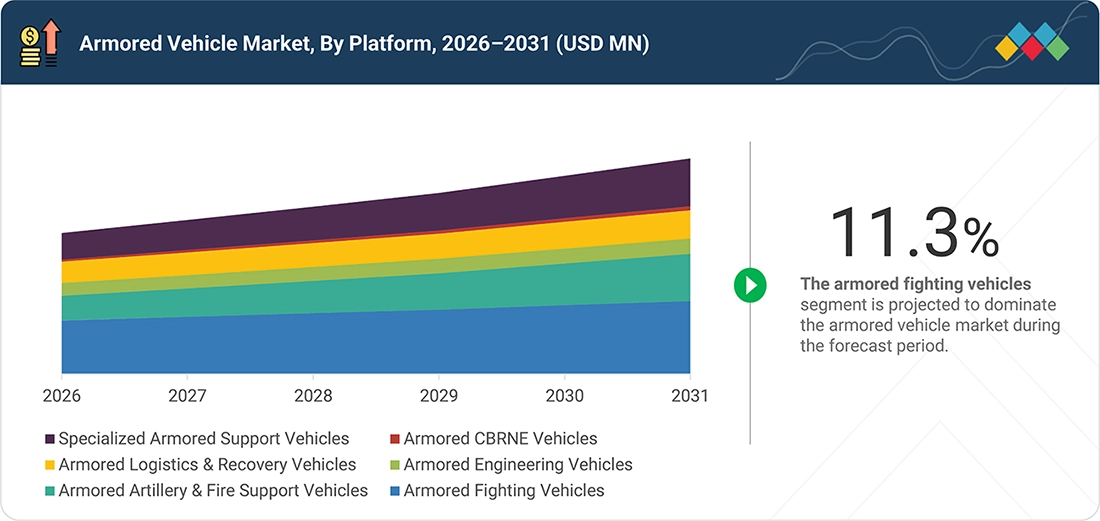
The market covers armored fighting vehicles, armored artillery & fire support vehicles, armored engineering vehicles, armored logistics & recovery vehicles, armored CBRNE vehicles, and specialized armored support vehicles. These platforms support combat, troop transport, reconnaissance, direct and indirect fire, air defense, engineering, recovery, logistics, command, medical, and specialized battlefield missions. Platform selection depends on mission role, protection requirement, weapon configuration, payload, mobility, and operating environment. Modular vehicle families are increasingly allowing a common base platform to support multiple mission variants.
Armored Vehicles (AV) Market, By Technology
Armored vehicles use conventional, electric, and hybrid-electric technologies, depending on vehicle architecture and operational requirements. Conventional platforms continue to rely primarily on internal combustion powertrains, while electric and hybrid-electric designs are being developed to improve onboard power availability, support advanced electronic systems, reduce certain mechanical dependencies, and enable future vehicle capabilities. The Lynx XM30, for example, incorporates a hybrid-electric powertrain designed to support power generation and battlefield mobility.
Armored Vehicles (AV) Market, By Mobility
Armored vehicles are broadly classified as wheeled and tracked platforms. Wheeled vehicles, including 4×4, 6×6, 8×8, and larger configurations, are used where road mobility, deployment flexibility, and lower operating burden are important. Tracked vehicles are used where cross-country mobility, traction, higher payload capacity, and operation over difficult terrain are required. Vehicle mobility configuration is therefore selected according to mission profile, terrain, protection level, payload, and deployment requirements.
Armored Vehicles (AV) Market, By Mode of Operation
The market includes crewed, uncrewed, and optionally crewed vehicles. Crewed platforms retain operators inside the vehicle for driving, weapon operation, and mission execution, while uncrewed configurations reduce direct personnel exposure during selected high-risk missions. Optionally crewed platforms can operate with or without onboard personnel depending on mission requirements. Current vehicle development is increasingly integrating digital controls, sensors, automation, and open architectures to support different levels of crew involvement.
Armored Vehicles (AV) Market, By System
Armored vehicles integrate multiple systems covering powertrain, weapon and turret systems, protection and survivability, C2/C4ISR, communications and navigation, vetronics and electrical power, hull and crew systems, and vehicle integration and testing. These systems work together to provide mobility, lethality, situational awareness, crew protection, power management, and mission connectivity. Modern vehicles increasingly use modular and open electronic architectures so sensors, weapons, protection systems, and digital applications can be upgraded during the vehicle lifecycle.
Armored Vehicles (AV) Market, By Point of Sale
The market includes new procurement, modernization & upgrades, and MRO & sustainment activities. New procurement covers the acquisition of newly manufactured vehicles, while modernization and upgrades involve improvements to existing fleets through new protection, weapons, electronics, powertrain, sensors, and digital systems. MRO and sustainment cover maintenance, repair, spare parts, refurbishment, and lifecycle support required to keep armored fleets operational over extended service periods. Existing vehicle families also provide recurring opportunities for capability upgrades during their operational life.
Armored Vehicles (AV) Market, By Weight Class
Armored vehicles are classified into light vehicles up to 15 tonnes, medium vehicles above 15 to 35 tonnes, heavy vehicles above 35 to 60 tonnes, and super-heavy vehicles above 60 tonnes. Weight class reflects differences in armor protection, payload, weapon systems, mobility, transportability, and powertrain requirements. Lighter vehicles generally provide greater deployment flexibility, while heavier platforms can accommodate higher protection levels, larger weapons, and greater mission payloads. Vehicle designers must balance these requirements with mobility and operational performance.
Armored Vehicles (AV) Market, By End User
The market serves army, navy, and air force users according to their respective ground mobility and force-protection requirements. Armies use armored vehicles extensively for maneuver warfare, troop transport, reconnaissance, fire support, engineering, recovery, and logistics. Naval forces can employ protected ground vehicles for marine and coastal operations, while air forces use armored and protected vehicles for air-base security, personnel movement, specialized support, and protection of critical installations. Vehicle configuration varies according to mission, deployment environment, protection requirement, and service-specific operational needs.
ARMORED VEHICLES MARKET REGION
Middle East & Africa to be fastest-growing region in global armored vehicles market during forecast period
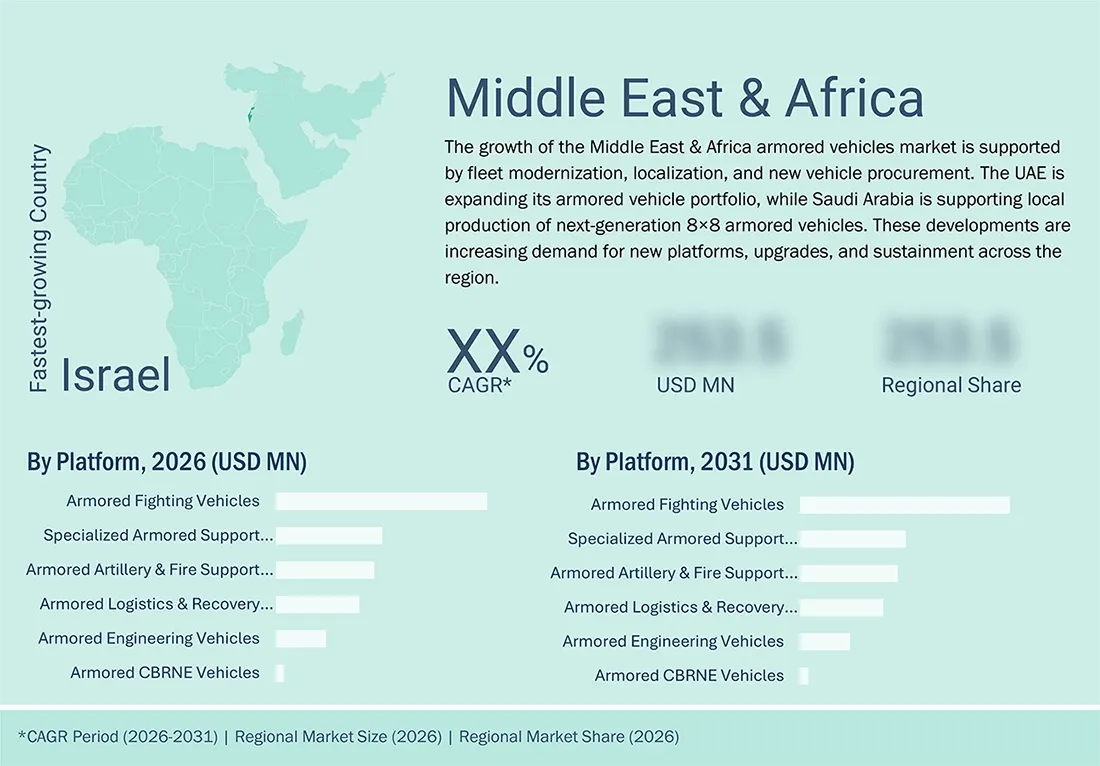
The Middle East & Africa armored vehicles market is expected to expand during the forecast period as countries invest in fleet modernization, protected mobility, local manufacturing, and lifecycle upgrades. In the UAE, EDGE expanded its land systems portfolio at IDEX 2025 with new AJBAN MK2 variants and an upgraded RABDAN 8x8 recovery vehicle, while AL TAIF and FNSS also agreed to support modernization of UAE Armed Forces infantry fighting vehicles. Saudi Arabia is also supporting domestic armored vehicle production through localization programs led by GAMI, including local manufacturing of Al-Dahna armored vehicles. These developments are supporting demand for new armored platforms, fleet upgrades, local production, and sustainment capabilities across the Middle East & Africa.
ARMORED VEHICLES MARKET SIZE, SHARE & TRENDS: COMPANY EVALUATION MATRIX
The armored vehicles market matrix includes General Dynamics Corporation (Star), supported by its established position across tracked and wheeled armored vehicle programs. Its portfolio includes the Abrams main battle tank, Stryker family of vehicles, and other combat vehicle platforms, covering missions such as direct combat, troop transport, reconnaissance, command, and battlefield support. The Stryker A1 combines enhanced survivability, mobility, electrical power, and digital architecture to support evolving battlefield requirements. Hanwha Aerospace Co., Ltd. (Emerging Leader) has strengthened its position through platforms such as the REDBACK infantry fighting vehicle, K21 IFV, K9 self-propelled howitzer, TIGON wheeled armored vehicle, and amphibious armored platforms. The company is expanding internationally through programs including Australia’s REDBACK procurement and continued K9 contracts across Europe.
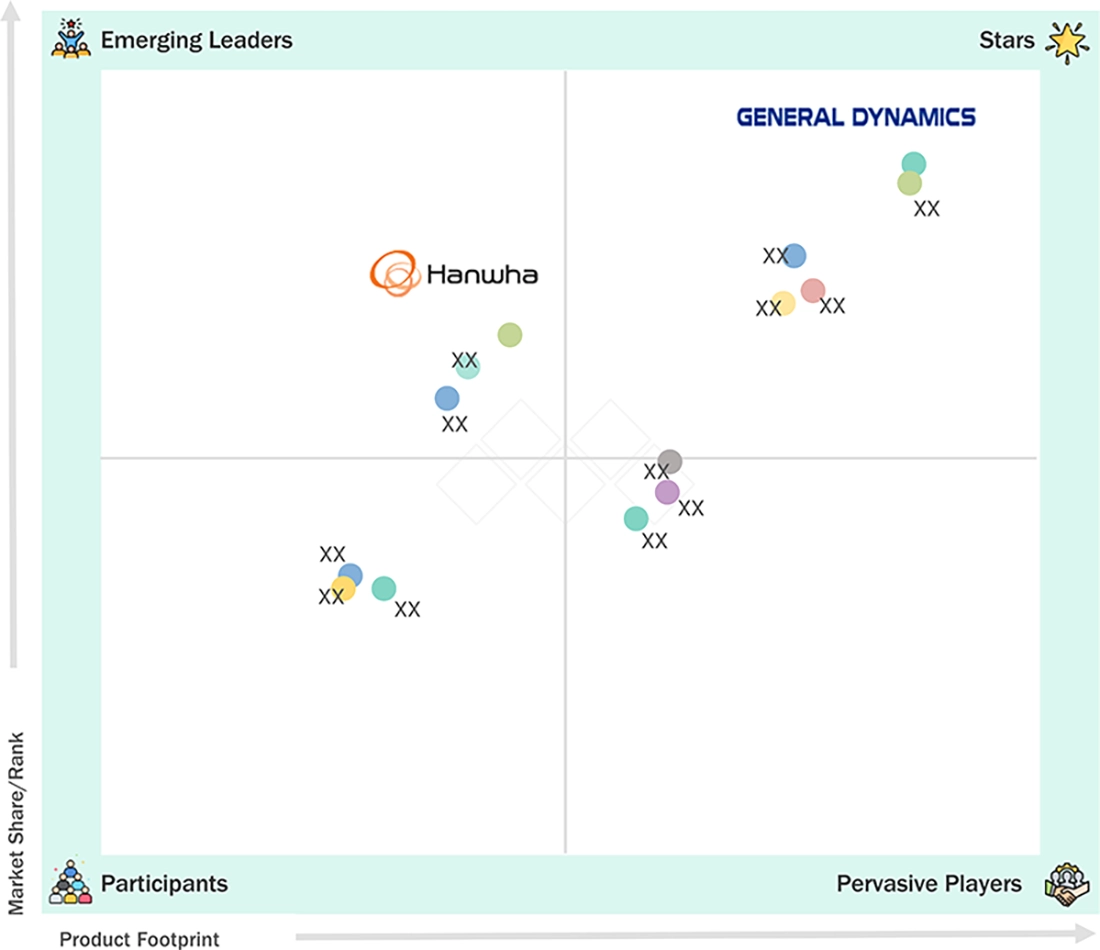
Source: Secondary Research, Interviews with Experts, MarketsandMarkets Analysis
KEY ARMORED VEHICLES MARKET PLAYERS
- General Dynamics Corporation (US)
- KNDS (Netherlands)
- Rheinmetall AG (Germany)
- BAE Systems plc (UK)
- Oshkosh Corporation (US)
- Hanwha Aerospace Co., Ltd. (South Korea)
- Lockheed Martin Corporation (US)
- Thales (France)
- ST Engineering (Singapore)
- Elbit Systems Ltd. (Israel)
- MITSUBISHI HEAVY INDUSTRIES, LTD. (Japan)
- HYUNDAI ROTEM COMPANY (South Korea)
- Textron Inc. (US)
- Otokar Otomotiv ve Savunma Sanayi A.S. (Türkiye)
- Denel SOC Ltd (South Africa)
- FNSS (Türkiye)
- RTX (US)
- IDV (Italy)
- Paramount Group (South Africa)
- Armoured Vehicles Nigam Limited (India)
WHAT IS IN IT FOR YOU: ARMORED VEHICLES MARKET SIZE, SHARE & TRENDS REPORT CONTENT GUIDE
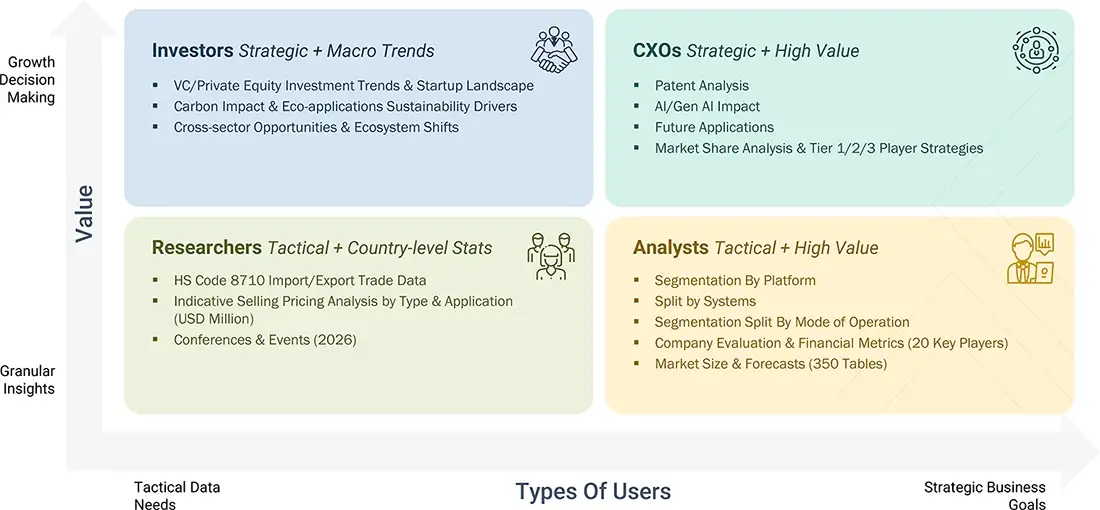
DELIVERED CUSTOMIZATIONS
We have successfully delivered the following deep-dive customizations:
| CLIENT REQUEST | CUSTOMIZATION DELIVERED | VALUE ADDS |
|---|---|---|
| Leading Manufacturer | Additional segment breakdown for countries | Additional country-level market sizing tables for segments/sub-segments covered at the regional/global level to gain an understanding of market potential by each country |
| Emerging Leader | Additional company profiles | Competitive information on targeted players to gain granular insights on direct competition |
| Regional Market Leader | Additional country market estimates | Additional country-level deep dive for a more targeted understanding of the total addressable market |
RECENT DEVELOPMENTS
- July 2026 : General Dynamics Corporation (US), through General Dynamics Land Systems–Canada, entered into a strategic partnership agreement with the Government of Canada (Canada) covering the development, delivery, sustainment, and future technology integration of wheeled armored combat vehicles. Under the partnership, GDLS-Canada received a nearly USD 2 billion award for an additional 190 Armoured Combat Support Vehicles for Canada and 35 vehicles for Ukraine. The agreement also supports future upgrades and integration of capabilities to address evolving threats across fielded armored vehicle fleets.
- June 2026 : FNSS (Türkiye) and CSG Defence a.s. (Czech Republic) signed a framework agreement to establish Danube Defence Systems, a Slovakia-based land-systems partnership focused on medium armored vehicle platforms. The cooperation includes the KARPAT Medium Tank and is intended to support manufacturing, marketing, technology transfer, and local industrial participation for armored vehicles serving European land forces and export customers. The agreement expands FNSS’s European armored-vehicle manufacturing footprint through localized production.
- April 2026 : KNDS (Netherlands) completed the acquisition of Texelis Defense (France), which was integrated into the group as KNDS Mobility. The acquisition adds specialized capabilities in military-vehicle mobility, drivetrains, suspension, and complete mobility solutions for 4×4, 6×6, 8×8, and tracked armored vehicles. Texelis already supplies the mobility solution for the SERVAL armored vehicle, and its integration is intended to strengthen KNDS’s control over critical vehicle technologies, industrial capacity, and armored-platform supply chains.
Table of Contents
 Exclusive indicates content/data unique to MarketsandMarkets and not available with any competitors.
TITLE
PAGE NO
1
INTRODUCTION
15
2
EXECUTIVE SUMMARY
3
PREMIUM INSIGHTS
4
MARKET OVERVIEW
Outlines emerging trends, technology impact, and regulatory signals affecting growth trajectory and stakeholder decisions.
4.1
INTRODUCTION
4.2
MARKET DYNAMICS
4.2.1
DRIVERS
4.2.2
RESTRAINTS
4.2.3
OPPORTUNITIES
4.2.4
CHALLENGES
4.3
UNMET NEEDS & WHITE SPACES
4.4
INTERCONNECTED MARKETS AND CROSS-SECTOR OPPORTUNITIES
4.5
STRATEGIC MOVES BY TIER-1/2/3 PLAYERS
5
INDUSTRY TRENDS
Explains the evolving landscape through demand-side drivers, supply-side constraints, and opportunity hotspots.
5.1
ECOSYSTEM ANALYSIS
5.2
VALUE CHAIN ANALYSIS
5.3
PRICING ANALYSIS
5.4
IMPACT OF 2025 US TARIFFS
5.4.1
INTRODUCTION
5.4.2
KEY TARIFF RATES
5.4.3
PRICE IMPACT ANALYSIS
5.4.4
IMPACT ON COUNTRY/REGION
5.4.5
NORTH AMERICA
5.4.6
EUROPE
5.4.7
ASIA PACIFIC
5.4.8
MIDDLE EAST
5.4.9
REST OF THE WORLD
5.4.10
IMPACT ON END-USE INDUSTRIES
5.5
TRADE ANALYSIS
5.6
CASE STUDY ANALYSIS
5.7
KEY CONFERENCES & EVENTS, 2026-2027
5.8
INVESTMENT AND FUNDING SCENARIO
5.9
TRENDS/DISRUPTION IMPACTING CUSTOMER'S BUSINESS
5.10
OPERATIONAL/VOLUME DATA
5.11
TOTAL COST OF OWNERSHIP (TCO)
5.12
MACROECONOMIC OUTLOOK
5.12.1
INTRODUCTION
5.12.2
GDP TRENDS AND FORECAST
5.12.3
TRENDS IN GLOBAL AEROSPACE & DEFENSE INDUSTRY
5.13
BILL OF MATERIALS
5.14
BUSINESS MODEL
6
TECHNOLOGICAL ADVANCEMENTS, AI-DRIVEN IMPACT, PATENTS, INNOVATIONS, AND FUTURE APPLICATIONS
6.1
KEY TECHNOLOGIES
6.2
COMPLEMENTARY TECHNOLOGIES
6.3
ADJACENT TECHNOLOGIES
6.4
TECHNOLOGY ROADMAP
6.5
PATENT ANALYSIS
6.6
FUTURE APPLICATIONS
6.7
IMPACT OF AI/GEN AI ON ARMORED VEHICLES MARKET
6.7.1
TOP USE CASES AND MARKET POTENTIAL
6.7.2
BEST PRACTICES FOLLOWED BY MANUFACTURERS
6.7.3
CASE STUDIES OF AI IMPLEMENTATION IN THE MARKET
6.7.4
INTERCONNECTED ADJACENT ECOSYSTEM AND IMPACT ON MARKET PLAYERS
6.8
SUCCESS STORIES AND REAL-WORLD APPLICATIONS
7
FUTURE & EMERGING ARMORED VEHICLE TECHNOLOGIES
7.1
HYBRID-ELECTRIC PROPULSION TECHNOLOGIES
7.1.1
MILD/PARALLEL HYBRID
7.1.2
SERIES HYBRID
7.2
BATTERY-ELECTRIC PROPULSION TECHNOLOGIES
7.2.1
FULL BATTERY-ELECTRIC PLATFORMS
7.2.2
ADVANCED BATTERY & ENERGY STORAGE TECHNOLOGIES
7.2.3
SILENT MOBILITY/SILENT WATCH TECHNOLOGIES
7.3
FUEL-CELL & ALTERNATIVE-POWER TECHNOLOGIES
7.3.1
HYDROGEN FUEL-CELL PROPULSION
7.3.2
ALTERNATIVE ENERGY/POWER SYSTEMS
7.4
NEXT-GENERATION PROPULSION ARCHITECTURES
7.4.1
CENTRAL ELECTRIC DRIVE
7.4.2
INTEGRATED E-AXLE
7.4.3
DISTRIBUTED ELECTRIC WHEEL DRIVE
7.5
SUPPORTING FUTURE VEHICLE TECHNOLOGIES
7.5.1
HIGH-VOLTAGE ELECTRICAL ARCHITECTURES
7.5.2
EXPORTABLE POWER & ONBOARD ENERGY MANAGEMENT
7.5.3
ADVANCE THERMAL MANAGEMENT
7.5.4
REGENERATIVE BRAKING & ENERGY RECOVERY
7.6
TECHNOLOGY READINESS & ADOPTION OUTLOOK
7.6.1
CURRENT DEVELOPMENT STATUS
7.6.2
KEY TECHNOLOGY CHALLENGES
7.6.3
FUTURE TECHNOLOGY ROADMAP
8
REGULATORY LANDSCAPE AND SUSTAINABILITY INITIATIVES
8.1
REGIONAL REGULATIONS AND COMPLIANCE
8.2
SUSTAINABILITY INITIATIVES
8.3
IMPACT OF REGULATORY POLICIES ON SUSTAINABILITY INITIATIVES
9
CUSTOMER LANDSCAPE & BUYER BEHAVIOR
9.1
DECISION-MAKING PROCESS
9.2
KEY STAKEHOLDERS IN BUYING PROCESS AND THEIR EVALUATION CRITERIA
9.2.1
KEY STAKEHOLDERS IN BUYING PROCESS
9.2.2
BUYING CRITERIA
9.3
ADOPTION BARRIERS & INTERNAL CHALLENGES
9.4
UNMET NEEDS FROM VARIOUS END USERS
9.5
PROCUREMENT CHANNELS
10
ARMORED VEHICLES MARKET, BY PLATFORM (MARKET SIZE & FORECAST TO 2031 – IN VALUE, USD MILLION)
(PLATFORM DEMAND POTENTIAL AND GROWTH PATHWAYS SHAPING ADOPTION IN THE MARKET)
10.1
INTRODUCTION
10.2
ARMORED FIGHTING VEHICLES
10.2.1
MAIN BATTLE TANKS
10.2.2
INFANTRY FIGHTING VEHICLES
10.2.3
ARMORED PERSONNEL CARRIERS
10.2.4
ASSAULT GUN VEHICLES
10.2.5
RECONNAISSANCE & SCOUT VEHICLES
10.2.6
ANTI-TANK COMBAT VEHICLES
10.2.7
AMPHIBIOUS ASSAULT VEHICLES
10.2.8
MULTI-ROLE ARMORED FIGHTING VEHICLES
10.3
ARMORED ARTILLERY & FIRE SUPPORT VEHICLES
10.3.1
SELF-PROPELLED HOWITZERS
10.3.2
ARMORED MORTAR CARRIERS
10.3.3
ARMORED AIR DEFENSE VEHICLES
10.3.4
ARMORED ROCKET ARTILLERY VEHICLES
10.3.5
OTHER ARMORED FIRE SUPPORT & TARGET ACQUISITION VEHICLES
10.4
ARMORED ENGINEERING VEHICLES
10.4.1
COMBAT ENGINEERING VEHICLES
10.4.2
MINE CLEARANCE & BREACHING VEHICLES
10.4.3
ARMORED BRIDGING VEHICLES
10.5
ARMORED LOGISTICS & RECOVERY VEHICLES
10.5.1
ARMORED LOGISTICS & RESUPPLY VEHICLES
10.5.2
ARMORED RECOVERY VEHICLES
10.6
ARMORED CBRNE VEHICLES
10.6.1
CBRNE RECONNAISSANCE & DECONTAMINATION VEHICLES
10.6.2
EXPLOSIVE ORDNANCE DISPOSAL (EOD) VEHICLES
10.7
SPECIALIZED ARMORED VEHICLES
10.7.1
ARMORED COMMAND & C2 VEHICLES
10.7.2
ARMORED MEDICAL VEHICLES
10.7.3
ARMORED EW/SIGINT VEHICLES
10.7.4
ARMORED PATROL & TACTICAL VEHICLES
10.7.5
BORDER SECURITY & SURVEILLANCE VEHICLES
11
ARMORED VEHICLES MARKET, BY TECHNOLOGY (MARKET SIZE & FORECAST TO 2031 – IN VALUE, USD MILLION)
(TECHNOLOGY-BASED DEMAND POTENTIAL AND GROWTH PATHWAYS SHAPING ADOPTION IN THE MARKET)
11.1
INTRODUCTION
11.2
CONVENTIONAL ARMORED VEHICLES
11.3
ELECTRIC ARMORED VEHICLES
11.4
HYBRID ELECTRIC ARMORED VEHICLES
12
ARMORED VEHICLES MARKET, BY MOBILITY (MARKET SIZE & FORECAST TO 2031 – IN VALUE, USD MILLION)
(DEMAND POTENTIAL AND GROWTH PATHWAYS SHAPING ADOPTION IN THE MARKET BASED ON MOBILITY)
12.1
INTRODUCTION
12.2
WHEELED
12.2.1
4X4
12.2.2
6X6
12.2.3
8X8
12.2.4
10X10 & ABOVE
12.3
TRACKED
13
ARMORED VEHICLES MARKET, BY MODE OF OPERATION (MARKET SIZE & FORECAST TO 2031 – IN VALUE, USD MILLION)
(DEMAND POTENTIAL AND GROWTH PATHWAYS SHAPING ADOPTION IN THE MARKET BASED ON MODE OF OPERATION)
13.1
INTRODUCTION
13.2
CREWED VEHICLE
13.3
UNCREWED VEHICLE
13.4
OPTIONALLY CREWED VEHICLE
14
ARMORED VEHICLES MARKET, BY SYSTEM (MARKET SIZE & FORECAST TO 2031 – IN VALUE, USD MILLION)
(SYSTEM-WISE DEMAND POTENTIAL AND GROWTH PATHWAYS SHAPING ADOPTION IN THE MARKET)
14.1
INTRODUCTION
14.2
POWERTRAIN SYSTEM
14.2.1
ENGINE
14.2.1.1
IC ENGINES
14.2.1.2
TURBINE ENGINES
14.2.2
TRANSMISSION & DRIVELINE
14.2.3
SUSPENSIONS
14.2.4
STEERING & BRAKING SYSTEM
14.2.5
WHEELS & TRACKS
14.2.6
ELECTRIC MOTOR
14.3
WEAPON & TURRET SYSTEMS
14.3.1
FIRE CONTROL & TARGETING SYSTEMS
14.3.2
FIRE CONTROL COMPUTERS
14.3.3
LASER RANGEFINDERS
14.3.4
GUNNER TARGETING SIGHTS
14.3.5
TARGET ACQUISITION & TRACKING SYSTEMS
14.3.6
TURRETS & REMOTE WEAPON STATIONS
14.3.7
TURRET DRIVE SYSTEMS
14.3.8
GUN DRIVE SYSTEMS
14.3.9
STABILIZATION SYSTEMS
14.3.10
AMMUNITION HANDLING & LOADING SYSTEMS
14.3.11
MAIN & SECONDARY ARMAMENTS
14.4
PROTECTION & SURVIVABILITY SYSTEMS
14.4.1
PASSIVE ARMOR SYSTEMS
14.4.2
ACTIVE PROTECTION SYSTEMS
14.4.3
MINE & BLAST PROTECTION SYSTEM
14.4.4
THREAT WARNING & COUNTERMEASURE SYSTEMS
14.4.5
FIRE SUPPRESSION & CBRN PROTECTION
14.5
C2/C4ISR, COMMUNICATIONS & NAVIGATION SYSTEMS
14.5.1
BATTLEFIELD MANAGEMENT SYSTEM
14.5.2
TACTICAL COMMUNICATIONS
14.5.3
INTERCOMS & DATA LINKS
14.5.4
NAVIGATION & POSITIONING SYSTEM
14.5.5
ELECTRONIC WARFARE SYSTEM
14.5.6
ISR & SITUATIONAL AWARENESS SYSTEM
14.6
VETRONICS & ELECTRICAL POWER SYSTEMS
14.6.1
VEHICLE ELECTRONIC ARCHITECTURE & DATA BUSES
14.6.2
ELECTRICAL POWER GENERATION
14.6.3
BATTERY PACK
14.6.4
POWER DISTRIBUTION & CONVERSION
14.6.5
AUXILIARY POWER UNIT
14.7
HULL, STRUCTURE & CREW SYSTEMS
14.7.1
HULL & STRUCTURE
14.7.2
CREW SEATING & RESTRAINT SYSTEMS
14.7.3
HVAC & ENVIRONMENTAL CONTROL SYSTEMS
14.7.4
DOORS, RAMPS AND STRUCTURAL MECHANISMS
14.8
INTEGRATION, ASSEMBLY, TESTING & PROGRAM EXECUTION
14.8.1
ENGINEERING & SYSTEM INTEGRATION
14.8.2
ASSEMBLY & INSTALLATION
14.8.3
TESTING, QUALIFICATION & ACCEPTANCE
14.8.4
PROGRAM & PRODUCTION MANAGEMENT
14.8.5
OEM OVERHEADS & MARGIN
15
ARMORED VEHICLES MARKET, BY EXPENDITURE TYPE (MARKET SIZE & FORECAST TO 2031 – IN VALUE, USD MILLION)
(DEMAND POTENTIAL AND GROWTH PATHWAYS SHAPING ADOPTION IN THE MARKET BASED ON THE TYPE OF MILITARY EXPENDITURE ON ARMORED VEHICLES)
15.1
INTRODUCTION
15.2
NEW PROCUREMENT
15.3
MODERNIZATION & UPGRADES
15.4
MRO & SUSTAINMENT
16
ARMORED VEHICLES MARKET, BY WEIGHT CLASS (MARKET SIZE & FORECAST TO 2031 – IN VALUE, USD MILLION)
(DEMAND POTENTIAL AND GROWTH PATHWAYS SHAPING ADOPTION IN THE MARKET BASED ON WEIGHT CLASS)
16.1
INTRODUCTION
16.2
LIGHT (UP TO 15 TONNES)
16.3
MEDIUM (GREATER THAN 15 TO 35 TONNES)
16.4
HEAVY (GREATER THAN 35 TO 60 TONNES)
16.5
SUPER (GREATER THAN 60 TONNES)
17
ARMORED VEHICLES MARKET, BY END USER (MARKET SIZE & FORECAST TO 2031 – IN VALUE, USD MILLION)
(END USER DEMAND POTENTIAL AND GROWTH PATHWAYS SHAPING ADOPTION IN THE MARKET)
17.1
INTRODUCTION
17.2
ARMY
17.3
NAVY
17.4
HOMELAND SECURITY
17.5
AIRFORCE
18
ARMORED VEHICLES MARKET, REGIONAL ANALYSIS (MARKET SIZE & FORECAST TO 2031 – IN VALUE, USD MILLION)
(ASSESSING GROWTH PATTERNS, INDUSTRY FORCES, REGULATORY LANDSCAPE, AND MARKET POTENTIAL ACROSS KEY GEOGRAPHIES AND COUNTRIES)
18.1
INTRODUCTION
18.2
NORTH AMERICA
18.2.1
US
18.2.2
CANADA
18.3
EUROPE
18.3.1
UK
18.3.2
FRANCE
18.3.3
GERMANY
18.3.4
ITALY
18.3.5
REST OF EUROPE
18.4
ASIA PACIFIC
18.4.1
INDIA
18.4.2
JAPAN
18.4.3
SOUTH KOREA
18.4.4
AUSTRALIA
18.4.5
REST OF ASIA PACIFIC
18.5
MIDDLE EAST & AFRICA
18.5.1
GCC
18.5.2
UAE
18.5.3
SAUDI ARABIA
18.5.4
ISRAEL
18.5.5
TURKEY
18.5.6
SOUTH AFRICA
18.6
LATIN AMERICA
18.6.1
BRAZIL
18.6.2
MEXICO
19
COMPETITIVE LANDSCAPE (STRATEGIC ASSESSMENT OF LEADING PLAYERS, MARKET SHARE, REVENUE ANALYSIS, COMPANY POSITIONING, AND COMPETITIVE BENCHMARKS INFLUENCING MARKET POTENTIAL)
19.1
OVERVIEW
19.2
KEY PLAYERS' COMPETITIVE STRATEGIES/RIGHT TO WIN (SEPTEMBER 2021 – SEPTEMBER 2026)
19.3
MARKET SHARE ANALYSIS,
19.4
REVENUE ANALYSIS, 2021-2025
19.5
COMPANY EVALUATION MATRIX: KEY PLAYERS,
19.5.1
STARS
19.5.2
EMERGING LEADERS
19.5.3
PERVASIVE PLAYERS
19.5.4
PARTICIPANTS
19.5.5
COMPANY FOOTPRINT: KEY PLAYERS,
19.6
COMPANY FOOTPRINT
19.6.1
REGION FOOTPRINT
19.6.2
PLATFORM FOOTPRINT
19.6.3
TECHNOLOGY FOOTPRINT
19.6.4
MOBILITY FOOTPRINT
19.7
COMPANY VALUATION AND FINANCIAL METRICS
19.8
COMPANY EVALUATION MATRIX: STARTUPS/SME,
19.8.1
PROGRESSIVE COMPANIES
19.8.2
RESPONSIVE COMPANIES
19.8.3
DYNAMIC COMPANIES
19.8.4
STARTING BLOCKS
19.8.5
COMPETITIVE BENCHMARKING: STARTUPS/SMES,
19.8.6
DETAILED LIST OF STARTUPS/SMES
19.8.7
COMPETITIVE BENCHMARKING OF KEY STARTUPS/SMES
19.9
TECHNOLOGY COMPARISON
19.10
COMPETITIVE SCENARIO
19.10.1
PRODUCT LAUNCHES
19.10.2
DEALS
19.10.3
EXPANSIONS
20
COMPANY PROFILES (IN-DEPTH REVIEW OF COMPANIES, PRODUCTS, SERVICES, RECENT INITIATIVES, AND POSITIONING STRATEGIES IN THE MARKET LANDSCAPE)
20.1
KEY PLAYERS
20.1.1
RHEINMETALL
20.1.1.1
BUSINESS OVERVIEW
20.1.1.2
PRODUCTS/SOLUTIONS/SERVICES OFFERED
20.1.1.3
RECENT DEVELOPMENTS
20.1.2
GENERAL DYNAMICS CORPORATION
20.1.2.1
BUSINESS OVERVIEW
20.1.2.2
PRODUCTS/SOLUTIONS/SERVICES OFFERED
20.1.2.3
RECENT DEVELOPMENTS
20.1.3
OSHKOSH CORPORATION
20.1.3.1
BUSINESS OVERVIEW
20.1.3.2
PRODUCTS/SOLUTIONS/SERVICES OFFERED
20.1.3.3
RECENT DEVELOPMENTS
20.1.4
BAE SYSTEMS
20.1.4.1
BUSINESS OVERVIEW
20.1.4.2
PRODUCTS/SOLUTIONS/SERVICES OFFERED
20.1.4.3
RECENT DEVELOPMENTS
20.1.5
HANWHA GROUP
20.1.5.1
BUSINESS OVERVIEW
20.1.5.2
PRODUCTS/SOLUTIONS/SERVICES OFFERED
20.1.5.3
RECENT DEVELOPMENTS
20.1.6
NORTHROP GRUMMAN
20.1.6.1
BUSINESS OVERVIEW
20.1.6.2
PRODUCTS/SOLUTIONS/SERVICES OFFERED
20.1.6.3
RECENT DEVELOPMENTS
20.1.7
LOCKHEED MARTIN CORPORATION
20.1.7.1
BUSINESS OVERVIEW
20.1.7.2
PRODUCTS/SOLUTIONS/SERVICES OFFERED
20.1.7.3
RECENT DEVELOPMENTS
20.1.8
THALES
20.1.8.1
BUSINESS OVERVIEW
20.1.8.2
PRODUCTS/SOLUTIONS/SERVICES OFFERED
20.1.8.3
RECENT DEVELOPMENTS
20.1.9
L3HARRIS TECHNOLOGIES, INC.
20.1.9.1
BUSINESS OVERVIEW
20.1.9.2
PRODUCTS/SOLUTIONS/SERVICES OFFERED
20.1.9.3
RECENT DEVELOPMENTS
20.1.10
ST ENGINEERING
20.1.10.1
BUSINESS OVERVIEW
20.1.10.2
PRODUCTS/SOLUTIONS/SERVICES OFFERED
20.1.10.3
RECENT DEVELOPMENTS
20.1.11
ELBIT SYSTEMS LTD.
20.1.11.1
BUSINESS OVERVIEW
20.1.11.2
PRODUCTS/SOLUTIONS/SERVICES OFFERED
20.1.11.3
RECENT DEVELOPMENTS
20.1.12
MITSUBISHI HEAVY INDUSTRIES, LTD.
20.1.12.1
BUSINESS OVERVIEW
20.1.12.2
PRODUCTS/SOLUTIONS/SERVICES OFFERED
20.1.12.3
RECENT DEVELOPMENTS
20.1.13
HYUNDAI ROTEM COMPANY
20.1.13.1
BUSINESS OVERVIEW
20.1.13.2
PRODUCTS/SOLUTIONS/SERVICES OFFERED
20.1.13.3
RECENT DEVELOPMENTS
20.1.14
TEXTRON INC.
20.1.14.1
BUSINESS OVERVIEW
20.1.14.2
PRODUCTS/SOLUTIONS/SERVICES OFFERED
20.1.14.3
RECENT DEVELOPMENTS
20.1.15
OTOKAR OTOMOTIV VE SAVUNMA SANAYI
20.1.15.1
BUSINESS OVERVIEW
20.1.15.2
PRODUCTS/SOLUTIONS/SERVICES OFFERED
20.1.15.3
RECENT DEVELOPMENTS
20.1.16
DENEL SOC LTD.
20.1.16.1
BUSINESS OVERVIEW
20.1.16.2
PRODUCTS/SOLUTIONS/SERVICES OFFERED
20.1.16.3
RECENT DEVELOPMENTS
20.1.17
KNDS
20.1.17.1
BUSINESS OVERVIEW
20.1.17.2
PRODUCTS/SOLUTIONS/SERVICES OFFERED
20.1.17.3
RECENT DEVELOPMENTS
20.1.18
FNSS
20.1.18.1
BUSINESS OVERVIEW
20.1.18.2
PRODUCTS/SOLUTIONS/SERVICES OFFERED
20.1.18.3
RECENT DEVELOPMENTS
20.1.19
CHINA NORTH INDUSTRIES CORPORATION (NORINCO)
20.1.19.1
BUSINESS OVERVIEW
20.1.19.2
PRODUCTS/SOLUTIONS/SERVICES OFFERED
20.1.19.3
RECENT DEVELOPMENTS
20.1.20
RTX
20.1.20.1
BUSINESS OVERVIEW
20.1.20.2
PRODUCTS/SOLUTIONS/SERVICES OFFERED
20.1.20.3
RECENT DEVELOPMENTS
20.1.21
IVECO DEFENCE VEHICLES
20.1.21.1
BUSINESS OVERVIEW
20.1.21.2
PRODUCTS/SOLUTIONS/SERVICES OFFERED
20.1.21.3
RECENT DEVELOPMENTS
20.1.22
PARAMOUNT GROUP
20.1.22.1
BUSINESS OVERVIEW
20.1.22.2
PRODUCTS/SOLUTIONS/SERVICES OFFERED
20.1.22.3
RECENT DEVELOPMENTS
20.2
OTHER PLAYERS
20.2.1
ARQUUS
20.2.2
TATRA TRUCKS A.S.
20.2.3
KALYANI STRATEGIC SYSTEMS LTD.
20.2.4
AM GENERAL
20.2.5
MAHINDRA EMIRATES VEHICLE ARMOURING FZ LLC
20.2.6
TATA ADVANCED SYSTEMS LIMITED
20.2.7
INKAS ARMORED VEHICLE MANUFACTURING
20.2.8
STREIT GROUP
21
RESEARCH METHODOLOGY
21.1
RESEARCH DATA
21.1.1
SECONDARY DATA
21.1.1.1
KEY DATA FROM SECONDARY SOURCES
21.1.1.2
LIST OF KEY SECONDARY SOURCES
21.1.2
PRIMARY DATA
21.1.2.1
KEY DATA FROM PRIMARY SOURCES
21.1.2.2
KEY PRIMARY PARTICIPANTS
21.1.3
BREAKDOWN OF PRIMARY INTERVIEWS
21.1.4
KEY INDUSTRY INSIGHTS
21.2
MARKET SIZE ESTIMATION
21.2.1
BOTTOM-UP APPROACH
21.2.2
TOP-DOWN APPROACH
21.3
MARKET FORECAST
21.4
DATA TRIANGULATION
21.5
RESEARCH ASSUMPTIONS
21.6
RESEARCH LIMITATIONS AND RISK ASSESSMENT
22
APPENDIX
22.1
DISCUSSION GUIDE
22.2
KNOWLEDGESTORE: MARKETSANDMARKETS' SUBSCRIPTION PORTAL
22.3
CUSTOMIZATION OPTIONS
22.4
RELATED REPORTS
22.5
AUTHOR DETAILS
Methodology
The study used four main activities to estimate the current size of the armored vehicles market. First, detailed secondary research was conducted to collect information on military robotic platforms, manufacturers, system types, applications, defense programs, procurement contracts, military budgets, deliveries, deployments, and ongoing development programs. The collected information and key assumptions were then checked through primary interviews with industry participants and experts across the value chain. Demand-side analysis was used to estimate spending on armored vehicles by platform, application, end user, and region. Finally, market breakdown and data triangulation were used to calculate the size of each segment and subsegment.
Secondary Research
Secondary research included information from government procurement portals, defense ministries, armed forces, defense agencies, company annual reports, regulatory filings, investor presentations, product documents, press releases, technical papers, journals and recognized defense databases. Sources such as SIPRI were used to review military spending, equipment transfers and procurement activity, while government budget documents and procurement records were used to track armored vehicle programs, contracts, orders and deliveries. Company filings and official product information were used to study armored vehicle portfolios, revenues, contracts, technologies, applications, customers and geographical presence.
Primary Research
Primary research was conducted after completing the secondary research. Interviews were carried out with unmanned system manufacturers, component and payload suppliers, autonomy and software providers, system integrators, distributors, procurement officials, commercial operators, defense personnel and other industry participants. The interviews covered major countries across North America, Europe, Asia Pacific, the Middle East & Africa, and Latin America. Primary information was collected through questionnaires, emails, and telephone interviews and was used to check market estimates, procurement trends, platform demand, pricing, delivery patterns, applications, adoption rates, and segment-level assumptions.
The following is the breakdown of primary respondents:
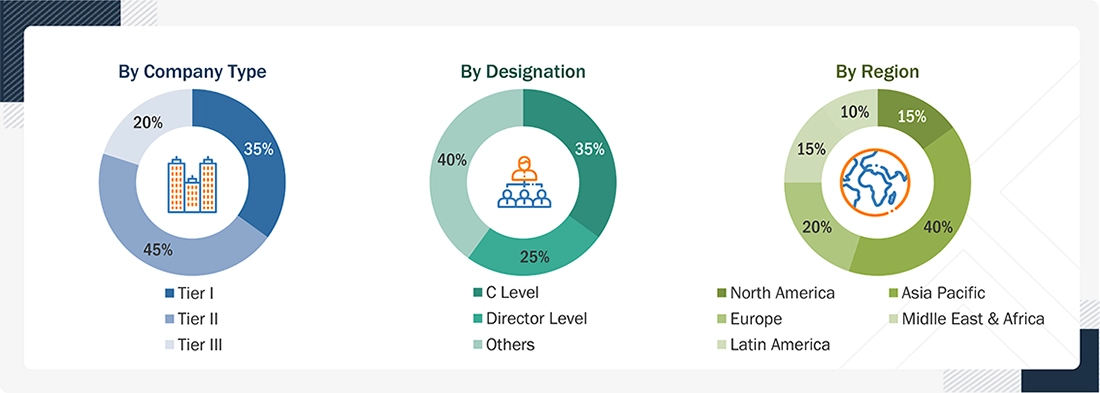
To know about the assumptions considered for the study, download the pdf brochure
Market Size Estimation
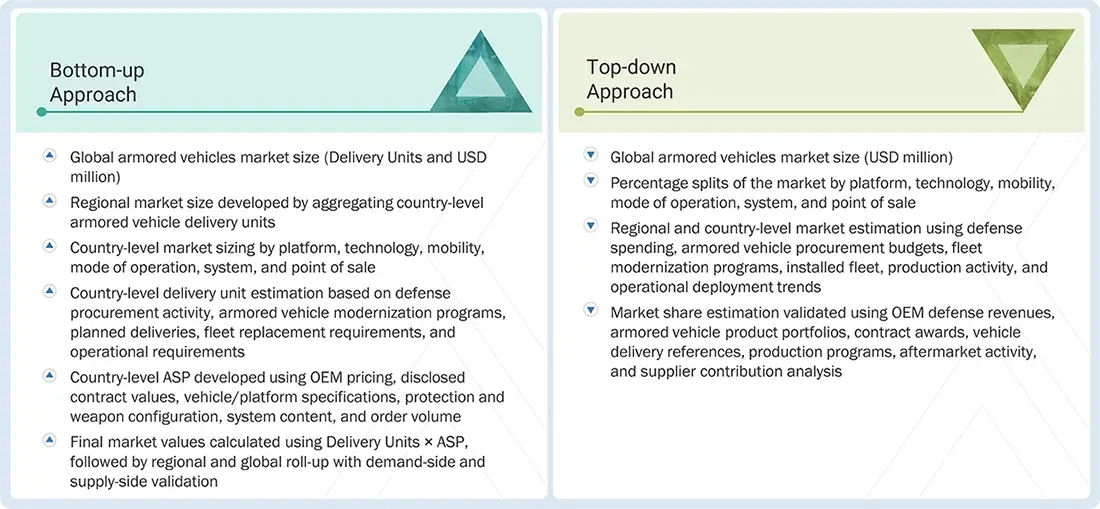
The top-down and bottom-up approaches were used to estimate and validate the size of the armored vehicles market. The research methodology used to estimate the size of the market included the following details:
- Key AV companies were identified through secondary research. Their market positions were estimated using company revenues, armored-vehicle portfolios, contract activity, production volumes, order backlogs, regional presence, and program participation. Annual reports, financial filings, product documents, procurement records, defense ministry sources, government budget documents, and interviews with company executives, engineers, system integrators, suppliers, military users, and other industry participants were used for the analysis. Rheinmetall, for example, reported approximately USD 5.72 billion in vehicle systems sales in 2025, while its segment backlog and vehicle-program order intake were used as additional indicators of market activity.
- Market shares, segment splits, regional shares, and growth rates were first estimated using secondary sources and then checked through primary interviews. The analysis covered the market by platform, by technology, by mobility, by mode of operation, by system, by point of sale, by weight class, and by end user, along with vehicle pricing, procurement volumes, deliveries, modernization programs, installed fleets, replacement cycles, and regional demand patterns.
- Demand for AVs across Army, Navy, Homeland Security, and Air Force users was considered. The analysis included new procurement, fleet modernization, vehicle replacement, survivability upgrades, localized production, sustainment requirements, and battlefield capability needs. For example, the U.S. FY2026 budget includes procurement of 86 Armored Multi-Purpose Vehicles and 91 Amphibious Combat Vehicles, while continuing investment in XM30, M1E3 Abrams, Stryker, Bradley, and other ground-combat programs.
- The collected information was compared and combined through data triangulation. Final market values were calculated using company-level revenues, vehicle delivery volumes, average selling prices, contract values, procurement activity, modernization spending, regional demand, installed fleet information, and primary-interview validation.
Armored Vehicle Market Size: Bottom-Up & Top-Down Approach
Data Triangulation
After determining the overall market size, the armored vehicles market was divided into its main segments and subsegments. Data triangulation and market breakdown were used to develop estimates for each segment and subsegment. The analysis considered factors from both the demand and supply sides, including defense procurement budgets, vehicle deliveries, platform replacement cycles, modernization programs, production capacity, company participation, contract values, vehicle pricing, installed fleets, localization programs, and regional defense requirements. Platform-specific indicators such as procurement of main battle tanks, infantry fighting vehicles, armored personnel carriers, artillery vehicles, engineering vehicles, recovery vehicles, and other protected platforms were also assessed.
Market Definition
The armored vehicles market comprises military and security vehicles designed with ballistic, blast, mine, and other forms of protective armor to safeguard personnel, equipment, and mission-critical systems during combat and security operations. These vehicles are used for a range of applications, including combat, troop transportation, protected mobility, reconnaissance, fire support, command and control, engineering, recovery, logistics, and other specialized missions.
Key Stakeholders
- Defense Ministries & Government Procurement Agencies
- Armies, Marines & Other Military End Users
- Armored Vehicle OEMs & Prime Contractors
- Armor, Weapon, Powertrain & Subsystem Suppliers
- Sensors, Vetronics, Communications & C4ISR Technology Providers
- AI, Autonomy & Software Technology Providers
- System Integrators & Engineering Service Providers
- Defense R&D, Testing & Certification Organizations
- Maintenance, Repair, Overhaul & Lifecycle Support Providers
- Defense Alliances & Standardization Bodies
Report Objectives
- To define, describe, segment, and forecast the size of the armored vehicles market based on platform, technology, mobility, mode of operation, system, point of sale, weight class, end user and region
- To forecast the size of the market segments across five regions: North America, Europe, Asia Pacific, the Middle East & Africa, and Latin America
- To identify and analyze key drivers, restraints, opportunities, and challenges influencing the growth of the market
- To identify industry trends, market trends, and technology trends in the armored vehicles market
- To analyze micro markets with respect to individual technology trends, growth prospects, and their contribution to the overall market
- To strategically profile key market players and analyze their market position and core capabilities
- To provide a detailed competitive landscape of the market and analyze competitive strategies such as product launches, partnerships, agreements, and collaborations adopted by key players
- To assess the financial position of key players along with their key products, unique offerings, and recent developments
Available customizations:
MarketsandMarkets offers the following customizations for this market report:
- Additional country-level analysis of the armored vehicles market
- Profiling of other market players (up to 5)
Product Analysis
- Product matrix, which provides a detailed comparison of the product portfolio of each company in the armored vehicles market
Key Questions Addressed by the Report
What is the projected size of the armored vehicles market by 2031?
The armored vehicles market is projected to grow from USD 39.67 billion in 2026 to USD 60.81 billion by 2031, registering a CAGR of 11.3%. In volume terms, the market is projected to reach 130,039 units by 2031.
What are the major factors driving the armored vehicles market?
Rising defense spending on new armored vehicles and the replacement of aging armored vehicle fleets are major market drivers. Defense programs are focused on improving protected mobility, firepower, survivability, and battlefield connectivity.
Which region is expected to grow fastest in the armored vehicles market?
The Middle East & Africa is expected to register the highest CAGR of 16.9% between 2026 and 2031. Fleet modernization, protected mobility, local manufacturing, and lifecycle upgrades are supporting regional growth.
Which platform segment is expected to grow fastest?
The armored CBRNE vehicles segment is expected to register the highest CAGR of 21.5% between 2026 and 2031. These platforms support specialized missions involving chemical, biological, radiological, nuclear, and explosive threats.
Which mobility segment holds the largest market share?
The wheeled segment is estimated to account for the largest market share in 2026. Wheeled platforms are favored where road mobility, deployment flexibility, and lower operating burden are important.
What are the key technology trends in the armored vehicles market?
Key trends include advances in sensors, communication systems, digital vehicle architecture, command and control, active protection systems, and onboard electronics. Modular vehicle designs, interchangeable mission modules, common architectures, and upgradeable electronic systems are also gaining importance.
What opportunities exist in the armored vehicles market?
Modernization and retrofit of existing armored vehicle fleets represent a major opportunity, with upgrades spanning turrets, weapons, active protection systems, sensors, communications, power systems, digital electronics, armor, and mobility. Growing adoption of unmanned armored ground vehicles also presents an opportunity.
What are the major challenges facing the armored vehicles market?
A key challenge is balancing vehicle protection, weight, and mobility. Increasing armor, weapons, electronics, and protection technologies can raise vehicle mass and power requirements, creating greater demands on engines, suspension, cooling, and electrical architectures.
What technologies are being adopted in modern armored vehicles?
Armored vehicles use conventional, electric, and hybrid electric technologies. Hybrid electric powertrains are being developed to improve onboard power availability, support advanced electronic systems, reduce certain mechanical dependencies, and enable future vehicle capabilities.
Who are the key players in the armored vehicles market?
Key players include General Dynamics Corporation, KNDS, Rheinmetall AG, BAE Systems, Oshkosh Corporation, Hanwha Aerospace, Lockheed Martin, Thales, ST Engineering, and Elbit Systems. Rheinmetall, General Dynamics, Oshkosh, BAE Systems, and Hanwha Aerospace are identified among the key players based on market share and product footprint.
Fact checked
Personalize This Research
- Triangulate with your Own Data
- Get Data as per your Format and Definition
- Gain a Deeper Dive on a Specific Application, Geography, Customer or Competitor
- Any level of Personalization
Let Us Help You
- What are the Known and Unknown Adjacencies Impacting the Armored Vehicles Market
- What will your New Revenue Sources be?
- Who will be your Top Customer; what will make them switch?
- Defend your Market Share or Win Competitors
- Get a Scorecard for Target Partners

Custom Market Research Services
We Will Customise The Research For You, In Case The Report Listed Above Does Not Meet With Your Requirements
Get 10% Free CustomisationTESTIMONIALS
- Canada Armored Vehicles Market
- US Armored Vehicles Market
- UK Armored Vehicles Market
- Germany Armored Vehicles Market
- France Armored Vehicles Market
- Poland Armored Vehicles Market
- India Armored Vehicles Market
- Japan Armored Vehicles Market
- Australia Armored Vehicles Market
- South Korea Armored Vehicles Market
- Saudi Arabia Armored Vehicles Market
- UAE Armored Vehicles Market
- Middle East Armored Vehicles Market
- Rest Of Europe Armored Vehicles Market
- Rest Of Asia Pacific Armored Vehicles Market
- Rest Of Middle East Armored Vehicles Market
Growth opportunities and latent adjacency in Armored Vehicles Market






Emmanuel
Apr, 2026
Can I understand how emerging battlefield requirements like asymmetric warfare and cross border conflicts are shaping demand across different vehicle categories?.
Henry
Apr, 2026
Can I see insights into procurement trends and defense programs across regions like India, Europe, and North America?.
Chayan
Jun, 2019
We are trying to understand the armored vehicles requirement, subsegment categorization, and the Indian customers for such products..
Adam
May, 2019
Hi. I'm particularity interested in the sections of the market report which covers advancements and new innovations in ballistic armor as well as projections regarding the value and anticipated growth of the US market over the period covered. Many thanks..
Simon
Feb, 2019
Hi. I am after data for the following: 1. Global market size split by region (top 10 markets) 2. Top 5 suppliers 3. Top 10 buyers 4. Best selling model and specs Many Thanks.
Paula
Nov, 2020
Would they have information for Colombia?.