

AI Impact Analysis on High Energy Laser Weapon Market
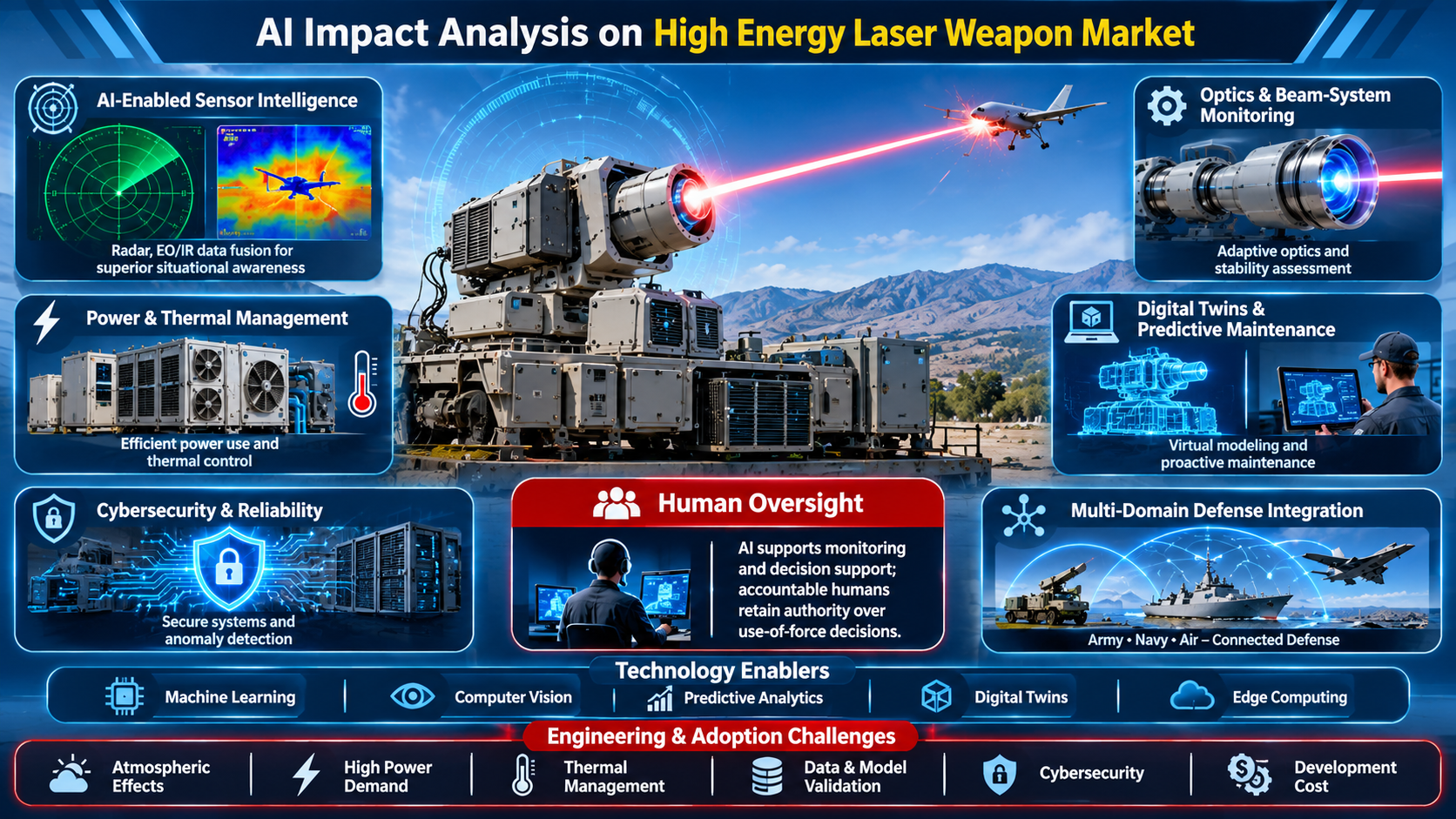
Artificial intelligence is emerging as a transformative technology in the global High Energy Laser Weapon Market, changing how directed energy systems detect threats, process sensor information, stabilize laser beams, manage power, monitor equipment health, and integrate with modern defense networks. High energy laser weapons use concentrated electromagnetic energy to engage or disable targets at the speed of light. Unlike conventional kinetic weapons, these systems do not require traditional ammunition for every engagement, although they depend on substantial electrical power, sophisticated thermal management, and precise optical control.
Growing defense requirements for countering unmanned aerial vehicles, rockets, artillery, and other aerial threats are increasing interest in directed energy technologies. Military organizations are evaluating high energy laser systems as complementary capabilities within layered air defense architectures. Their potential advantages include rapid engagement, precision, reduced cost per engagement under suitable operating conditions, and the ability to support repeated engagements when sufficient power and cooling capacity are available.
Operational effectiveness depends on much more than laser output power. Systems must detect and identify threats, maintain accurate tracking, compensate for atmospheric disturbances, manage energy consumption, and operate reliably under demanding environmental conditions. Artificial intelligence can help coordinate these functions by analyzing large volumes of sensor and equipment data and supporting faster, more informed decisions.
Machine learning, computer vision, predictive analytics, digital twins, and edge computing are creating new opportunities throughout the directed energy ecosystem. AI can improve threat recognition, assist adaptive optical systems, support equipment diagnostics, and optimize power and cooling operations. It can also help integrate laser weapons with radar, electro-optical sensors, command networks, and other defense platforms.
The integration of AI into high energy laser weapons must nevertheless be approached carefully. These are safety-critical and potentially lethal systems, making reliability, cybersecurity, human accountability, and regulatory compliance essential considerations. AI should be designed to support responsible human-supervised operations rather than remove appropriate human control over the use of force.
Between 2025 and 2035, artificial intelligence is likely to become increasingly important across the High Energy Laser Weapon Market. Its influence will extend from research and development to manufacturing, testing, deployment, maintenance, and integration with multi-domain defense networks. Understanding these developments is essential for evaluating the market's technological direction and long-term opportunities.
Introduction to the High Energy Laser Weapon Market
Evolution of High Energy Laser Weapon Technology
High energy laser weapons are part of the broader directed energy weapon category, which also includes high-power microwave systems and other technologies that deliver energy toward a target. Unlike conventional weapons that rely on projectiles or explosive payloads, high energy laser systems use concentrated laser energy to produce an effect on a selected target.
The development of these systems has been supported by advances in solid-state lasers, fiber lasers, beam directors, precision optics, electrical power generation, energy storage, and thermal management. Earlier directed energy programs faced substantial challenges involving system size, electrical efficiency, cooling requirements, and reliable operation under real-world conditions. Advances in these areas have enabled more compact and increasingly deployable systems.
High energy laser weapons are being evaluated for applications such as counter-unmanned aerial systems, protection of military installations, naval defense, and selected air defense missions. Their potential role is particularly relevant where defense organizations need to address large numbers of relatively inexpensive aerial threats without relying exclusively on conventional interceptors.
Artificial intelligence is adding another layer of capability to this technological evolution. Modern laser weapon architectures generate substantial information through tracking sensors, optical systems, power electronics, cooling equipment, and platform monitoring systems. AI can analyze this information to support system awareness, maintenance planning, and operational decision-making.
Growing Demand for Directed Energy Defense Systems
The increasing availability of inexpensive drones and other unmanned platforms has changed the economics of air defense. Conventional interceptors can be expensive, and the cost of repeatedly engaging relatively inexpensive threats can create significant pressure on defense budgets.
High energy laser weapons offer a potential complementary capability because their engagements do not consume a conventional missile or projectile. However, their effectiveness depends on factors such as atmospheric conditions, target characteristics, available electrical power, cooling capacity, range, and the duration of energy delivery.
AI can contribute to more efficient system operation by improving the interpretation of sensor information and helping operators understand the conditions affecting performance. It can also support equipment monitoring and coordination with other defense assets.
Applications Across Land, Naval, and Airborne Platforms
High energy laser systems are being considered for several military platforms. Ground-based systems can support the protection of military installations, forward operating locations, and critical infrastructure. Naval applications are attractive because ships can potentially accommodate substantial power generation and cooling infrastructure.
Airborne applications introduce additional engineering challenges because aircraft have strict limitations involving weight, space, electrical power, vibration, and thermal management. These requirements make compact and efficient AI-enabled monitoring and control architectures particularly important.
Artificial intelligence can help coordinate information across different platform types, improving equipment awareness and supporting integration with wider defense networks.
Artificial Intelligence as a Transformation Driver
AI is influencing the High Energy Laser Weapon Industry through several connected technology areas. Computer vision and machine learning can support the interpretation of sensor data, while predictive analytics can identify developing equipment faults. Digital twins can help engineers evaluate system performance, and AI-assisted manufacturing can improve inspection and production consistency.
The greatest long-term opportunity lies in integrating these capabilities into a reliable, secure, and human-supervised architecture. AI will not eliminate the physical limitations of laser weapons, but it can help engineers and operators manage complexity more effectively.
AI in Target Detection, Identification, and Threat Recognition
Machine Learning for Sensor Data Interpretation
High energy laser systems depend on accurate information about their surrounding environment. Radar, electro-optical cameras, infrared sensors, and other surveillance technologies can provide information about detected objects. These sensors produce different types of data, each with its own resolution, operating range, update frequency, and environmental limitations.
Machine learning can help interpret this information by identifying patterns and distinguishing relevant observations from background activity. AI models can analyze sensor measurements and support the classification of objects according to their observable characteristics.
This is particularly important in environments containing numerous airborne objects, where operators may need to review large quantities of information. AI-supported analysis can organize detections and present relevant information in a more understandable format.
Computer Vision and Object Recognition
Computer vision is becoming increasingly important in modern defense surveillance systems. Deep learning models can analyze images and video collected through electro-optical and infrared sensors to identify objects and recognize changes in their visual characteristics.
For high energy laser weapon programs, these capabilities can support broader situational awareness and equipment monitoring. Computer vision can also help identify environmental obstructions, inspect optical components, and detect changes in system conditions.
The reliability of visual recognition remains dependent on image quality, training data, sensor characteristics, and operating conditions. Fog, smoke, darkness, glare, and other environmental factors can reduce performance. Combining visual information with radar and other sensor measurements can help reduce dependence on any single source.
Multi-Sensor Data Fusion
One of the most important applications of AI is combining information from multiple sensors. Radar may provide range and movement information, while electro-optical and infrared systems provide complementary visual and thermal observations.
AI-supported sensor fusion can bring these different data sources together into a more consistent representation of the operating environment. This helps operators understand what the sensors are observing and identify inconsistencies that may require additional assessment.
Sensor fusion is particularly valuable when individual sensors experience degraded performance. Rather than depending on a single measurement, an integrated system can consider information from several sources.
Improving Situational Awareness
High energy laser systems are expected to operate as part of broader defense architectures rather than as isolated equipment. Their effectiveness depends on the quality of information available to operators and the coordination between sensors, command systems, and supporting platforms.
AI can organize incoming information, highlight unusual events, and provide summaries of system status. This can reduce information overload and improve the speed at which operators understand changing conditions.
Maintaining human oversight is essential. AI-generated classifications should be presented with appropriate uncertainty information, and operators must be able to question or reject automated assessments.
AI in Laser Beam Control, Precision, and Adaptive Optics
The Importance of Beam Quality
Beam quality is a fundamental performance consideration for high energy laser systems. The ability to deliver concentrated optical energy depends on the laser source, optical components, beam director, pointing stability, and atmospheric conditions.
Temperature variations, vibration, mechanical movement, and optical imperfections can influence beam quality. Atmospheric turbulence can also distort the propagation of laser energy, affecting how effectively a system performs over distance.
Artificial intelligence can support engineering analysis by evaluating sensor measurements and identifying patterns associated with changes in optical performance. These insights can help engineers understand system behavior and improve reliability.
Adaptive Optics and AI Assisted Monitoring
Adaptive optics technologies are used to address distortions that affect optical systems. They rely on measurements of optical performance and specialized correction components to compensate for changing conditions.
Machine learning can support the analysis of adaptive optics data, helping identify recurring performance variations and potential equipment degradation. AI can also assist engineers in evaluating system models under different environmental conditions.
The use of AI in this area requires rigorous validation because inaccurate predictions could reduce optical performance. Safety-critical optical functions must therefore remain subject to established engineering constraints and verified control architectures.
Intelligent Beam Alignment and Stability Assessment
High energy laser systems incorporate precision optical assemblies that must maintain reliable alignment under demanding operating conditions. Vibration, temperature changes, mechanical stress, and component aging can influence system stability.
AI-enabled monitoring can evaluate equipment measurements and identify trends that may indicate alignment drift or developing mechanical problems.
Rather than relying exclusively on scheduled inspection, maintenance teams can use continuous monitoring information to determine when further examination is required.
This approach can improve equipment availability while reducing unnecessary maintenance activity.
Digital Twins for Optical System Development
Digital twins provide virtual representations of physical systems. In high energy laser development, they can model optical assemblies, mechanical structures, thermal behavior, and other engineering characteristics.
AI can analyze simulation results and help engineers identify relationships between design variables and system performance.
Digital twins also provide opportunities to evaluate component changes before implementing them in physical prototypes. This can reduce development costs and accelerate engineering validation.
AI in Autonomous Engagement Management and Fire Control Systems
AI Assisted Operational Decision Support
High energy laser weapons are part of safety-critical defense systems. Their operation involves multiple information sources, equipment constraints, environmental considerations, and command procedures.
Artificial intelligence can support operators by organizing relevant information and presenting system status in a structured format. Machine learning can identify unusual conditions, highlight equipment limitations, and provide decision-support information.
The role of AI should be clearly separated from the authority to decide whether force may be used. Decisions involving the use of weapons require appropriate human judgment, legal review, and accountability.
Integration with Fire Control Architecture
Fire control systems connect sensors, tracking equipment, computing systems, and weapon platforms. AI can help improve the interpretation of information moving across these systems.
For example, machine learning can identify inconsistencies between sensor observations and system status measurements. Predictive analytics can also help determine whether equipment is operating within its approved performance limits.
This can improve system awareness and help operators recognize conditions that require attention.
Managing Multiple Sources of Information
Modern air defense environments can involve several sensors and defense platforms operating simultaneously. This creates a significant information management challenge.
AI can help organize incoming data, identify duplicate observations, and present a consolidated operational picture. This supports coordination across the wider defense architecture without requiring operators to interpret every data stream independently.
Human Oversight and Accountability
The integration of AI into weapon-related systems raises important questions about responsibility and decision-making authority.
High energy laser systems must operate within applicable laws, military procedures, and rules governing the use of force. AI can support information processing and equipment monitoring, but it should not independently determine the legitimacy of an engagement.
Human supervision, transparent system behavior, reliable audit records, and clear command responsibility are essential elements of responsible deployment.
AI in Laser Power Generation, Energy Storage, and Thermal Management
Intelligent Power System Monitoring
Electrical power is one of the most important engineering considerations in high energy laser weapon development. Unlike conventional systems that primarily depend on ammunition supplies, directed energy platforms require substantial electrical power to operate their laser sources, electronics, sensors, and supporting equipment.
The amount of power required depends on system architecture, laser efficiency, operating duration, and platform configuration. Ground and naval platforms may have different power generation and distribution capabilities compared with mobile or airborne systems.
Artificial intelligence can improve power system monitoring by analyzing information from generators, batteries, power converters, electrical distribution equipment, and other components. Machine learning can identify unusual consumption patterns and help engineers understand how system performance changes under different operating conditions.
AI-supported monitoring can also help predict equipment degradation and identify potential electrical faults before they cause operational interruptions. This improves maintenance planning and provides greater visibility into the condition of critical power infrastructure.
AI in Energy Storage Management
Energy storage is an important consideration for mobile high energy laser platforms. Batteries and other storage technologies can help manage variations between power generation and system demand.
Artificial intelligence can analyze battery temperature, charge status, operating history, energy consumption, and component health. These insights can support more accurate assessments of battery condition and remaining service life.
Predictive analytics can also help maintenance teams identify signs of battery degradation and schedule inspections or replacements before reliability is affected.
As battery technology improves, AI-enabled energy management will become increasingly relevant to compact and mobile directed energy platforms.
Predictive Thermal Management
High energy laser systems generate heat through their power sources, electronic components, and supporting equipment. Effective thermal management is essential for maintaining component reliability and preventing performance degradation.
Cooling systems must operate under varying environmental conditions and platform requirements. Excessive heat can reduce component life, affect optical stability, and increase maintenance requirements.
AI can analyze temperature measurements, cooling system performance, environmental conditions, and equipment operating history to identify developing thermal problems. Predictive analytics can help engineers understand whether cooling components are operating within expected limits.
This capability is particularly valuable for systems deployed in environments where temperature conditions vary significantly.
Digital Twins for Power and Cooling Systems
Digital twins can represent the electrical and thermal architecture of high energy laser platforms. Engineers can use these virtual models to study component behavior, identify potential bottlenecks, and evaluate design alternatives.
AI can analyze simulation results and compare predicted performance with information collected from physical equipment. This creates a continuous feedback process that can improve engineering decisions throughout the development lifecycle.
Digital twins can also help assess how changes in power generation, energy storage, and cooling equipment influence overall platform performance.
Future Energy Management Architectures
Future high energy laser platforms will increasingly combine intelligent power monitoring, advanced energy storage, efficient cooling technologies, and digital engineering.
AI will support the analysis of these interconnected subsystems, helping manufacturers improve equipment reliability and manage the complex relationship between electrical power, heat generation, and platform limitations.
The ability to monitor and predict system health will become an important competitive factor for manufacturers developing next-generation directed energy platforms.
AI Integration with Multi-Domain Defense Platforms and Counter-UAS Systems
Integration with Ground-Based Air Defense
Ground-based high energy laser systems are being evaluated as part of layered air defense architectures. Their potential applications include protection against selected unmanned aerial threats and other targets for which directed energy may provide a complementary engagement option.
These systems depend on information collected through radar, electro-optical sensors, infrared cameras, and command networks. AI can help organize information from these sources and improve the overall awareness available to defense operators.
Integration with broader air defense networks also allows high energy laser systems to operate alongside conventional interceptors and other defensive technologies. This is important because laser performance can be affected by atmospheric conditions, distance, target characteristics, and available power.
AI-supported monitoring can help operators understand system availability and environmental limitations when evaluating the role of different defensive assets.
Naval High Energy Laser Applications
Naval platforms provide an important development environment for directed energy systems because ships have established electrical generation, cooling, sensor, and command infrastructure.
High energy laser technologies are being explored for ship protection and selected maritime defense applications. Their integration requires coordination between the laser system, shipboard power architecture, combat management systems, radar, and optical sensors.
Artificial intelligence can support shipboard equipment monitoring, maintenance planning, sensor information management, and system health assessment.
The broader adoption of intelligent naval architectures may also improve the integration of directed energy systems with existing onboard technologies.
Counter-UAS System Integration
Counter-unmanned aerial systems represent one of the most visible application areas for high energy laser technologies. The proliferation of small and inexpensive drones has created demand for defense systems that can detect, track, classify, and respond to a broad range of aerial threats.
High energy lasers are being considered as one component of layered counter-UAS solutions. Their potential advantages include precision and the absence of conventional interceptor ammunition for each engagement, although their effectiveness is influenced by environmental and technical limitations.
AI can support the wider counter-UAS architecture through sensor information management, equipment diagnostics, threat classification, and the coordination of information across different defensive systems.
This integration is especially important because no single technology is suitable for every counter-UAS situation. Radar, electronic warfare, kinetic interceptors, and directed energy systems may each have different operational strengths and limitations.
Network-Centric Defense Integration
Modern defense platforms increasingly operate through interconnected command, control, communication, and surveillance networks.
AI can help organize information from distributed platforms and present a more consistent operational picture. High energy laser systems can contribute equipment status and sensor information to these networks, allowing commanders to understand system availability and operational constraints.
Secure connectivity, reliable data exchange, and interoperability will remain important requirements for successful integration.
Future Multi-Domain Directed Energy Ecosystems
The long-term development of high energy laser weapons will depend on their ability to operate within broader defense architectures. Ground vehicles, naval vessels, fixed installations, aircraft, and unmanned platforms have different power, cooling, mobility, and sensor requirements.
AI can help manufacturers develop common monitoring and analytics capabilities that can be adapted to different platforms.
As defense organizations modernize their multi-domain networks, intelligent system monitoring and data integration will become increasingly important for the deployment of directed energy technologies.
AI in High Energy Laser Weapon Manufacturing, Testing, and Predictive Maintenance
AI-Driven Manufacturing of Laser Components
High energy laser systems require sophisticated optical, electronic, mechanical, and thermal components. Manufacturing quality directly affects system reliability, consistency, and service life.
Artificial intelligence can improve production by analyzing manufacturing data, monitoring equipment performance, and identifying patterns associated with product defects.
Machine learning can help manufacturers understand how production conditions, material characteristics, and assembly processes influence final product quality.
These capabilities support more consistent manufacturing while helping reduce material waste and unnecessary rework.
Machine Vision for Optical Inspection
Optical components require precise manufacturing and inspection. Small surface defects, contamination, coating variations, and dimensional inconsistencies can affect optical performance.
Machine vision systems can inspect components using high-resolution imaging and automated measurement technologies. AI algorithms can identify visual patterns associated with defects and flag components for further examination.
This improves inspection consistency and helps manufacturers detect quality problems earlier in production.
Machine vision can also support inspection of electronic assemblies, connectors, cooling components, and mechanical structures used within directed energy systems.
AI-Assisted Testing and Validation
High energy laser systems undergo extensive testing before deployment. Testing evaluates components, subsystems, software, electrical performance, thermal behavior, optical characteristics, and system reliability.
AI can help organize test information and identify unusual patterns across large datasets. Automated analytics can compare results with established engineering requirements and highlight measurements that require further investigation.
AI-supported testing can improve the efficiency of engineering teams while maintaining the need for formal verification and certification.
Predictive Maintenance of Laser Systems
High energy laser platforms contain complex equipment that requires continuous maintenance. Laser sources, optical assemblies, power electronics, cooling equipment, sensors, and computing systems may experience degradation through regular use and environmental exposure.
AI can analyze equipment health information and identify patterns associated with developing faults. Predictive maintenance models can estimate when components may require inspection or replacement.
This enables maintenance organizations to move beyond purely calendar-based servicing and make greater use of actual equipment condition.
The resulting improvements can reduce unexpected downtime and help organizations plan maintenance resources more effectively.
Smart Factories and Digital Manufacturing
The integration of AI into manufacturing is creating opportunities for more intelligent production facilities.
Smart factories combine connected production equipment, machine vision, robotics, quality analytics, and digital manufacturing systems. AI can analyze production information to identify inefficiencies and support better resource allocation.
For high energy laser manufacturers, these capabilities can improve the production of precision optics, electronic subsystems, mechanical assemblies, and thermal management components.
Digital manufacturing also allows engineering changes to be evaluated more systematically before they are introduced into production.
Lifecycle Management Through AI
The value of AI extends beyond manufacturing and initial testing. Once high energy laser systems enter service, they generate operational information that can support long-term engineering improvements.
Manufacturers can use maintenance records, component performance information, inspection results, and equipment history to identify recurring problems.
This information can guide future product development, improve component selection, and strengthen reliability across successive generations of directed energy systems.
AI in Cybersecurity, System Reliability, and Operational Resilience
Cybersecurity for Connected Weapon Systems
High energy laser platforms increasingly incorporate software-based monitoring, digital control systems, communication interfaces, and network connectivity.
These technologies create new cybersecurity considerations. Unauthorized access, malicious software, compromised updates, and data manipulation could affect system availability or the integrity of operational information.
AI can support cybersecurity by monitoring software behavior, communication patterns, and system activity. Machine learning models can identify unusual behavior that may indicate an attempted intrusion or malfunction.
However, AI-based cybersecurity tools must themselves be protected against manipulation and unauthorized access.
Anomaly Detection and System Monitoring
Anomaly detection is an important application of AI in safety-critical equipment.
Machine learning can establish an understanding of normal system behavior using information from sensors, power electronics, cooling systems, and computing infrastructure.
When system measurements deviate from expected patterns, AI can generate alerts for engineering teams to investigate.
This can help identify equipment faults, sensor inconsistencies, software problems, or unexpected environmental effects.
Secure Software and Configuration Management
Modern high energy laser systems depend on software throughout their operating lifecycle. Software updates may introduce new features, improve reliability, address cybersecurity vulnerabilities, or support equipment modernization.
AI can assist software management by identifying unusual configuration changes and helping prioritize maintenance information.
Secure development practices, authenticated updates, configuration records, and independent software verification remain essential. AI should complement these processes rather than replace established security controls.
Reliability in Extreme Environments
High energy laser platforms may operate in environments characterized by temperature variation, vibration, dust, moisture, salt exposure, and other demanding conditions.
AI can analyze environmental measurements and equipment performance to identify conditions associated with reliability problems.
This information can support engineering improvements and more effective maintenance planning.
For mobile platforms, AI-based monitoring can also help maintenance teams understand how transportation, vibration, and repeated operating cycles affect component condition.
Building Resilient Directed Energy Architectures
Operational resilience depends on the ability of a system to maintain essential functions despite equipment degradation, environmental changes, or disruptions to supporting infrastructure.
AI can contribute through predictive maintenance, fault detection, equipment health monitoring, and improved visibility across interconnected subsystems.
Manufacturers that integrate cybersecurity, reliability engineering, and AI-driven diagnostics into their product development processes will be better positioned to address the demanding requirements of future directed energy programs.
Challenges, Risks, and Regulatory Considerations
Technical Limitations of AI Integration
Although artificial intelligence offers significant opportunities, integrating AI into high energy laser weapon systems presents substantial engineering challenges.
These systems combine optical equipment, power electronics, cooling infrastructure, sensors, software, and platform interfaces. Each subsystem has different operating requirements, and changes in one area may influence the performance of another.
AI models must therefore be validated within the complete system architecture rather than evaluated only as independent software applications.
Another challenge is the availability of representative training data. High energy laser systems operate in specialized environments, and obtaining comprehensive datasets covering different equipment configurations and environmental conditions can be difficult.
Manufacturers must combine simulation, laboratory testing, operational monitoring, and engineering validation to establish confidence in AI-supported functions.
Atmospheric Conditions and Environmental Limitations
Atmospheric conditions remain a fundamental physical limitation for high energy laser weapons. Fog, clouds, rain, dust, smoke, humidity, and atmospheric turbulence can influence the propagation of laser energy.
Artificial intelligence cannot eliminate these physical effects. However, it can help analyze environmental information and improve understanding of the conditions affecting system performance.
Machine learning can also support equipment monitoring by identifying relationships between environmental measurements and changes in optical or thermal performance.
Understanding these limitations is essential when evaluating the operational role of high energy laser weapons within broader defense architectures.
Reliability of AI-Based Recognition Systems
AI-based classification systems can make errors when they encounter unfamiliar objects, incomplete sensor information, or environmental conditions that differ from their training datasets.
In defense applications, inaccurate classification can have serious consequences. Systems must therefore be designed to communicate uncertainty and avoid treating algorithmic predictions as unquestionable facts.
Independent testing, representative datasets, explainability, and human review are important requirements for responsible AI integration.
High Development and Deployment Costs
Developing high energy laser systems requires significant investment in laser sources, precision optics, power generation, cooling equipment, sensors, software, testing facilities, and platform integration.
AI introduces additional costs associated with computing hardware, data infrastructure, software development, model validation, cybersecurity, and ongoing maintenance.
These expenses can be particularly challenging for smaller defense organizations and manufacturers with limited research and development budgets.
However, improvements in AI hardware, software development tools, digital engineering, and manufacturing automation may gradually reduce some development costs.
Cybersecurity and Adversarial Risks
AI-enabled weapon systems introduce cybersecurity risks beyond those associated with conventional equipment.
Machine learning models may be exposed to manipulated data, unauthorized software changes, adversarial inputs, or compromised communication channels. An AI system that produces incorrect information may reduce operator confidence and create additional operational risks.
Manufacturers must establish secure data pipelines, protect model development environments, verify software updates, and continuously evaluate system behavior.
Cybersecurity must remain part of the complete engineering lifecycle rather than a separate feature added after development.
Regulatory and International Legal Considerations
High energy laser weapons are subject to applicable national defense regulations, export controls, international humanitarian law, and other relevant legal frameworks.
AI integration introduces additional questions concerning system transparency, human control, accountability, and software verification.
Organizations developing these technologies must ensure that AI-supported functions remain consistent with applicable legal obligations and military policies.
International discussions concerning autonomous weapons and meaningful human control are particularly relevant to the development of increasingly automated defense systems.
Human Accountability in AI-Assisted Weapon Operations
The integration of artificial intelligence into weapon-related systems requires clear boundaries between automated technical functions and human authority.
AI can support equipment monitoring, sensor interpretation, predictive maintenance, and operational awareness. However, decisions involving the use of force require appropriate human judgment, legal oversight, and accountability.
Manufacturers and defense organizations must establish clear responsibility for system design, validation, operation, and maintenance.
The ability to review system recommendations, understand their limitations, and maintain human control will remain essential to public confidence and responsible deployment.
Future Outlook: AI-Powered High Energy Laser Weapon Market to 2035
Development of AI-Enabled Directed Energy Systems
By 2035, artificial intelligence is expected to become increasingly integrated into high energy laser weapon architectures.
Future systems will combine intelligent sensor monitoring, advanced optical diagnostics, predictive maintenance, power management, and digital engineering. AI will help engineers understand how different subsystems interact and identify opportunities to improve reliability.
This development will gradually shift the market from standalone laser equipment toward interconnected directed energy platforms supported by intelligent software and analytics.
Next-Generation Adaptive Optics
Advances in adaptive optics will remain important for improving the performance of high energy laser systems.
AI may support optical system monitoring, component diagnostics, and engineering analysis by evaluating large volumes of measurements from optical sensors.
Future systems are likely to incorporate more sophisticated monitoring architectures that provide greater visibility into optical condition and performance.
The combination of improved optical components, advanced materials, digital modeling, and AI-assisted engineering will support the development of increasingly sophisticated directed energy platforms.
AI-Powered Counter-Drone Defense
Counter-UAS applications are expected to remain an important area of interest for high energy laser weapon manufacturers.
The growing number of unmanned aerial platforms has increased demand for layered defense systems capable of addressing different types of aerial threats.
High energy lasers may serve as one component of these architectures, alongside radar, electro-optical sensors, electronic warfare systems, and conventional interceptors.
AI will support the wider defense ecosystem through sensor information management, equipment health monitoring, threat awareness, and system coordination.
The ability to integrate laser weapons with existing counter-UAS infrastructure will be an important factor influencing future procurement decisions.
Mobile and Naval Directed Energy Platforms
Future high energy laser systems will continue to evolve across different platform categories.
Ground-based systems will require improvements in mobility, power generation, cooling, and environmental protection. Naval systems will benefit from integration with shipboard electrical and combat management infrastructure.
Airborne platforms will face particularly demanding requirements because of their limited space, weight, power, and cooling capacity.
AI-based monitoring and digital engineering will help manufacturers evaluate these platform-specific requirements and develop suitable system architectures.
Advanced Energy Storage and Intelligent Thermal Management
Power generation and heat management will remain major determinants of high energy laser system development.
Future platforms will increasingly incorporate advanced electrical storage, efficient power electronics, improved cooling technologies, and intelligent equipment monitoring.
AI will help engineers evaluate the relationship between power consumption, thermal conditions, component health, and system availability.
As energy storage technologies and electrical architectures improve, manufacturers may be able to develop more compact and flexible directed energy systems.
Integration with Multi-Domain Defense Networks
High energy laser weapons will increasingly operate within connected defense ecosystems rather than as isolated platforms.
Future architectures will integrate ground-based sensors, naval surveillance systems, airborne platforms, command centers, and other defense technologies.
AI can help process information from these distributed systems and improve equipment status visibility across the network.
Secure communication, interoperability, data quality, and human-supervised decision-making will be essential to successful deployment.
Digital Twins and AI-Accelerated Research
Digital twins will become increasingly important in the research and development of directed energy technologies.
Engineers will use virtual models to evaluate optical assemblies, thermal systems, electrical architectures, mechanical components, and platform integration requirements.
AI can analyze simulation results, identify design variations, and support faster evaluation of engineering alternatives.
This approach can reduce reliance on repeated physical prototyping and improve the efficiency of product development.
Digital twins will also support maintenance planning after deployment by incorporating equipment performance and service history.
Long-Term Market Opportunities
The long-term development of the High Energy Laser Weapon Market will depend on continued progress in laser efficiency, optical engineering, electrical power, thermal management, miniaturization, and platform integration.
Artificial intelligence will influence these developments by improving engineering analysis, system monitoring, manufacturing quality, and maintenance efficiency.
Defense organizations are likely to evaluate AI-enabled directed energy systems as part of broader modernization programs, particularly where counter-UAS capabilities, installation protection, and layered air defense are priorities.
Companies that combine reliable laser technologies with advanced digital engineering, cybersecurity, and AI-based diagnostics will be well positioned to participate in the next generation of directed energy development.
Future Outlook
Artificial intelligence is becoming an important technology across the High Energy Laser Weapon Market, influencing the development, manufacturing, monitoring, and integration of directed energy systems. High energy laser weapons offer a different approach to defense by using concentrated optical energy rather than conventional projectiles. Their potential applications in counter-UAS operations, installation protection, naval defense, and selected air defense missions are encouraging continued investment in laser sources, optical assemblies, power systems, and thermal management technologies.
AI adds intelligence to this evolving ecosystem. Machine learning can support sensor data interpretation, improve equipment monitoring, identify developing component faults, and assist engineers with complex system analysis. Computer vision, predictive analytics, digital twins, and smart manufacturing can further improve the efficiency of development and maintenance processes.
However, the technology also faces important challenges. Atmospheric limitations, high electrical power requirements, thermal management, development costs, cybersecurity, certification, and operational reliability will continue to influence adoption. AI must be carefully validated, particularly when integrated into safety-critical and weapon-related systems. Human oversight, accountability, and compliance with applicable legal requirements must remain central to responsible deployment.
Looking toward 2035, the market is likely to move toward increasingly connected, digitally monitored, and AI-supported directed energy platforms. The combination of advanced laser technologies, intelligent diagnostics, improved power systems, and multi-domain defense integration will shape the next phase of market development.
Ultimately, artificial intelligence will not replace the underlying physics and engineering requirements of high energy laser weapons. Instead, it will help manufacturers and defense organizations manage system complexity, improve reliability, and make better use of available information. As investment in directed energy technologies continues, AI will become an increasingly important factor influencing innovation and competitive differentiation across the global High Energy Laser Weapon Market.
80% of the Forbes Global 2000 B2B companies rely on MarketsandMarkets to identify growth opportunities in emerging technologies and use cases that will have a positive revenue impact.
- Food Packaging Market Size Set for Strong Growth Through 2030 Amid Rising Demand for Convenience Foods
- Crop Protection Chemical Market Size, Share & Growth Forecast (2025–2030)
- Mulch Films Market: Driving Sustainable Agriculture Through Innovation
- Agricultural Adjuvants Market Analysis, Trends, and Growth Outlook (2026–2031)
- Japan Enterprise Asset Management Market Growth: AI and Smart Infrastructure Drive Demand


