High Energy Laser Weapon Market

High Energy Laser Weapons Market Size, Share, and Trends by Application (C-UAS, C-RAM, SHORAD, Missile Defense), Power (1-20 kW, 21-100 kW, 101-300 kW, >300 kW), Investment, Technology, Deployment, End User, Component, and Region - Global Forecast to 2035


OVERVIEW
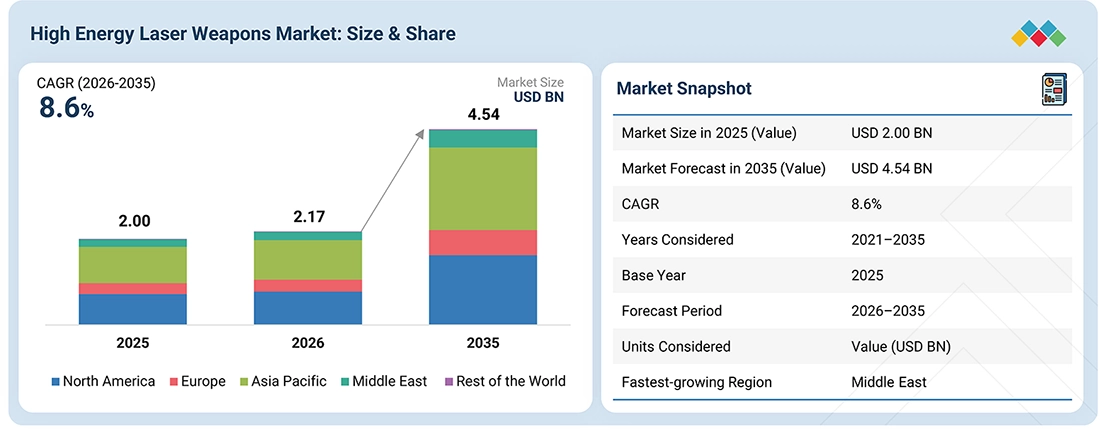
Source: Secondary Research, Interviews with Experts, MarketsandMarkets Analysis
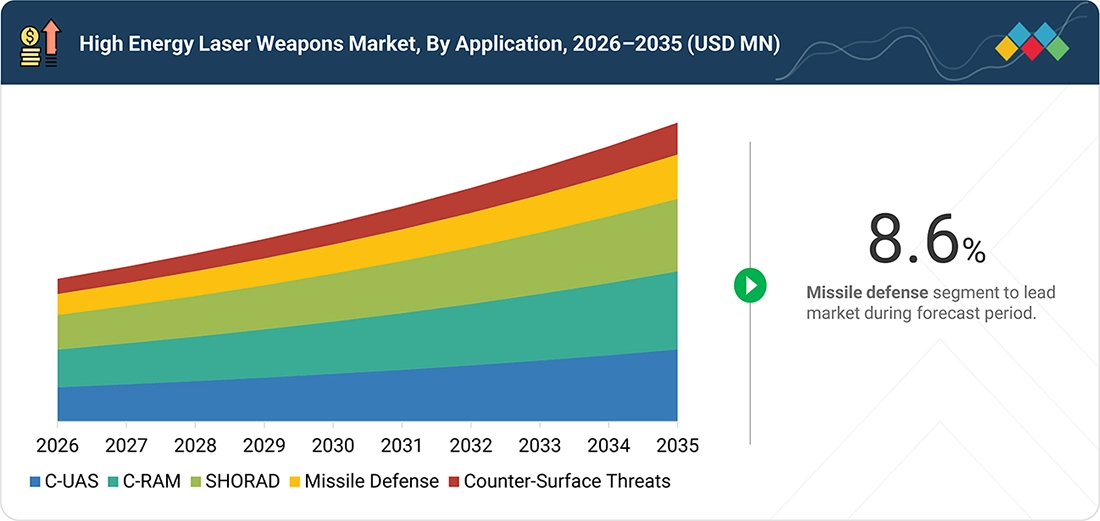
The high-energy laser weapons market is projected to grow from USD 2.17 billion in 2026 to USD 4.54 billion by 2035, at a CAGR of 8.6% during the forecast period. Demand for high-energy laser weapons is increasing across army, navy, and air force applications as countries strengthen their air defense capabilities and invest in advanced laser weapon systems. High-energy laser weapons are being used across counter-unmanned aerial systems, air defense, counter-rocket, artillery and mortar, and missile defense missions. Their use across land-based, naval, and airborne platforms is increasing as armed forces invest in improved laser power, beam control, target tracking, thermal management, and system integration to address changing operational requirements.
KEY TAKEAWAYS
-
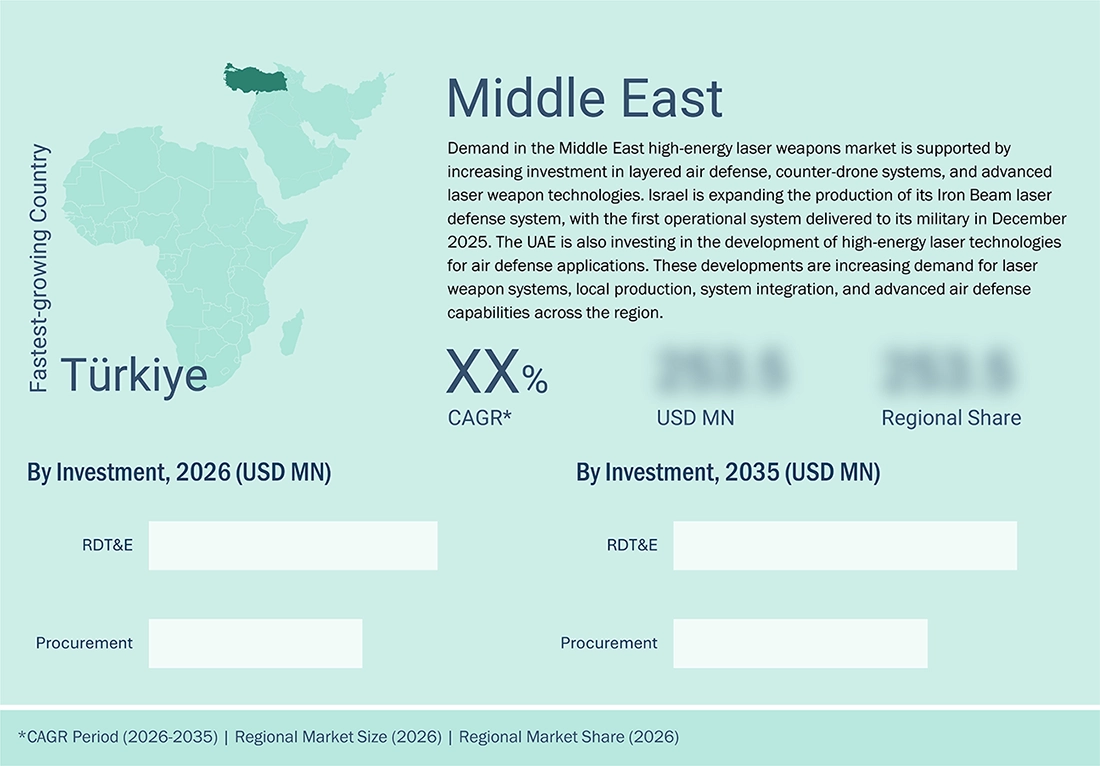
By RegionThe Middle East high-energy laser weapons market is expected to register the highest CAGR of 8.8% between 2026 and 2035.
-
By ApplicationThe missile defense segment is expected to register the highest CAGR of 8.7% between 2026 and 2035.
-
By DeploymentThe land-based segment is estimated to dominate the market in 2026, accounting for 84.5% of the global market.
-
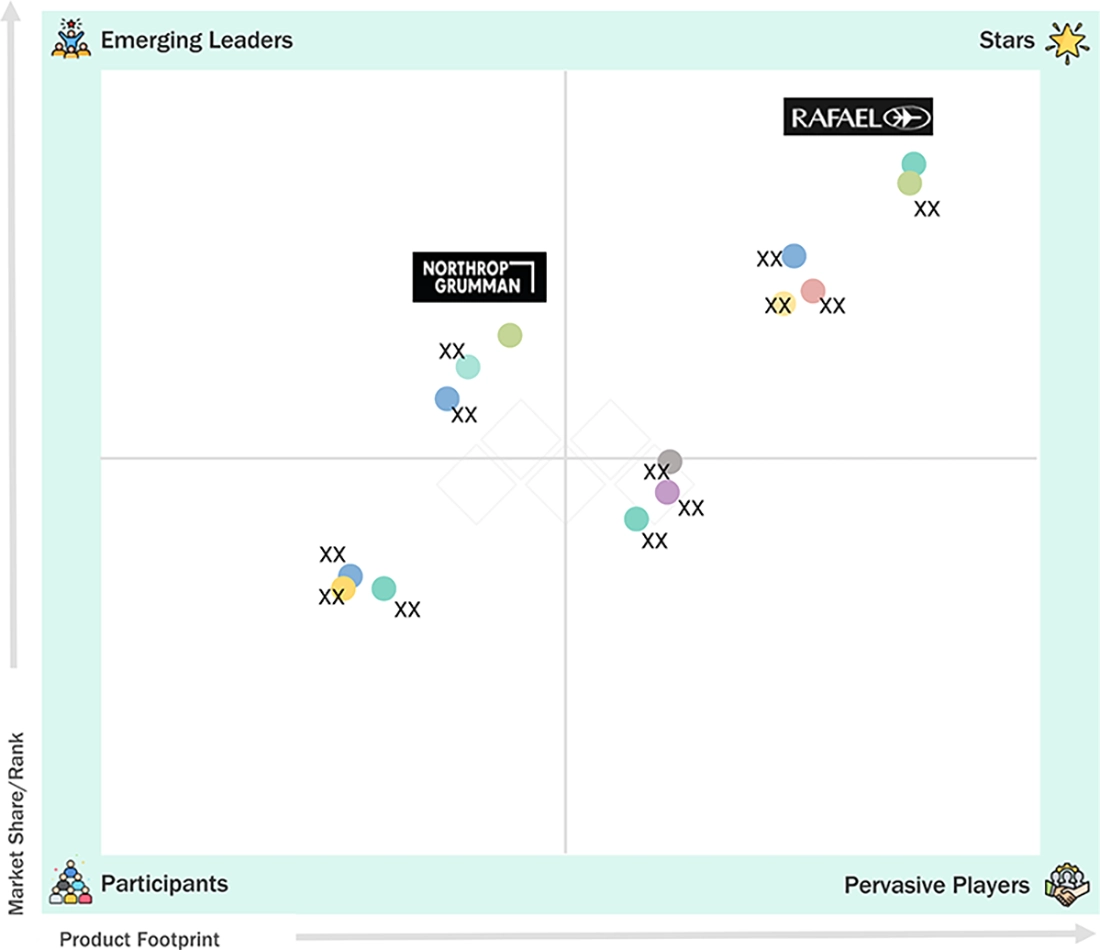
Competitive LandscapeRTX, Lockheed Martin Corporation, Northrop Grumman, Rafael Advanced Defense Systems Ltd., and MBDA were identified as some of the key players in the high-energy laser weapons market (global), given their strong market share and product footprint.
The high-energy laser weapons market is developing as armed forces require advanced defense systems with improved precision, faster threat engagement, operational efficiency, and counter-drone capabilities. Advances in laser power, beam control, target tracking, thermal management, sensor integration, and command and control systems are enabling high-energy laser weapons to engage aerial threats more effectively in complex combat environments. Modernization programs are also supporting wider adoption of high-energy laser weapons across land-based, naval, and airborne platforms for counter-unmanned aerial systems, air defense, counter-rocket, artillery and mortar, and missile defense missions.
TRENDS & DISRUPTIONS IMPACTING CUSTOMERS' CUSTOMERS
The impact on customers in the high-energy laser weapons market is increasingly linked to the need for flexible defense systems that can support different operational requirements without requiring separate weapon systems for each threat. Modular laser architectures, interchangeable subsystems, common control interfaces, and upgradeable laser technologies allow users to adapt laser power, beam control, target tracking, and sensor integration as operational needs change. This can reduce integration effort, simplify operator training and maintenance, and improve interoperability with existing air defense systems. As a result, defense users can improve operational flexibility, extend system service life, and manage operating and lifecycle costs more effectively. AeroVironment's Enduring High Energy Laser system illustrates this approach through its modular open-system architecture, which supports deployment across fixed installations, tactical sites, and mobile combat vehicles.
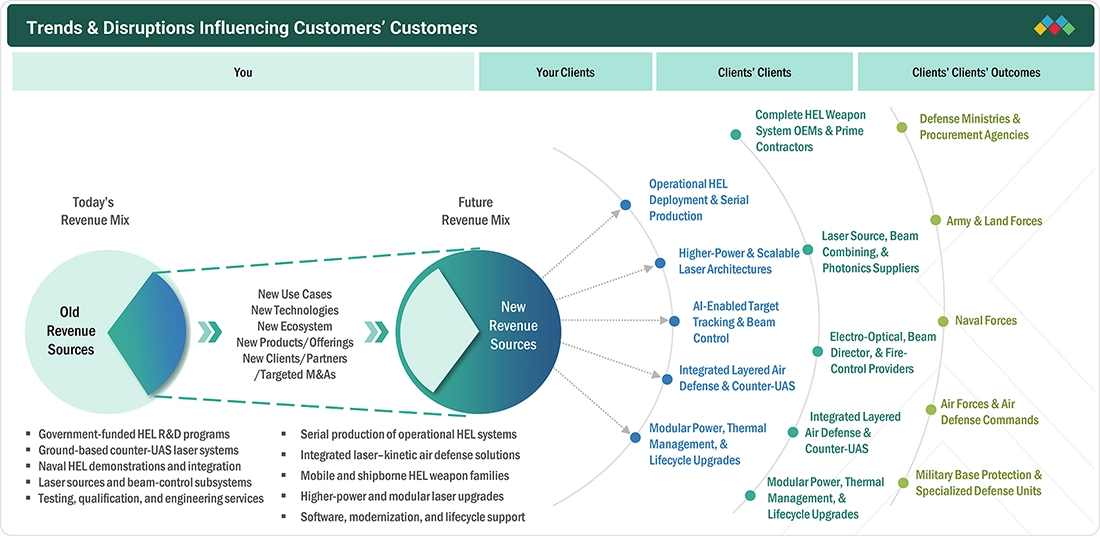
Source: Secondary Research, Interviews with Experts, MarketsandMarkets Analysis
MARKET DYNAMICS

Level
-
Increasing use of low-cost drones

-
Advancements in solid-state lasers and beam-control technologies


Level
-
Atmospheric propagation and line-of-sight limitations

-
Electrical power and thermal management requirements


Level
-
Procurement of modular laser effectors

-
Naval procurement programs


Level
-
Sequential target engagement

-
Transitioning demonstrators into qualified military products

Source: Secondary Research, Interviews with Experts, MarketsandMarkets Analysis
Driver: Increasing use of low-cost drones
Defense ministries are increasing investment in high-energy laser weapons to counter the growing use of low-cost drones and reduce dependence on expensive missile interceptors. Laser weapons offer low costs per engagement and can support repeated interceptions when sufficient electrical power and cooling are available. For example, in September 2026, the US Army awarded AeroVironment a production contract for the Enduring High Energy Laser system to counter unmanned aircraft threats. Such procurement programs support demand for laser weapon manufacturers, beam-control systems, power systems, and integration providers.
Restraint: Atmospheric propagation and line-of-sight limitations
High-energy laser weapons require a clear line of sight and favorable atmospheric conditions to deliver sufficient energy to targets. Fog, rain, dust, smoke, and atmospheric turbulence can absorb, scatter, or distort laser beams, reducing effective engagement range and accuracy. The US Government Accountability Office has identified atmospheric conditions and distance-related energy losses as important limitations affecting laser weapon performance. These restrictions reduce operational reliability under certain battlefield conditions and limit the ability of laser systems to replace conventional air defense weapons across all environments.
Opportunity: Procurement of modular laser effectors
Armed forces are integrating high-energy laser weapons with radars, electro-optical sensors, command-and-control networks, electronic warfare equipment, and conventional interceptors to establish layered air defense capabilities. Modular laser effectors allow defense operators to introduce directed-energy capabilities while retaining existing detection and tracking systems. For example, the US Army conducted exercises in 2025 integrating laser weapons with conventional short-range air defense systems against unmanned aircraft threats. Such programs create opportunities for laser weapon manufacturers, sensor suppliers, system integrators, and providers of power and thermal-management equipment.
Challenge: Sequential target engagement
High-energy laser weapons generally engage individual targets by directing concentrated laser energy onto a specific point for sufficient time to cause damage. During coordinated drone swarm attacks, sequential target engagement can restrict the number of threats intercepted within a short period. Laser systems must also maintain accurate target tracking, manage engagement times, and sustain power and cooling performance during repeated engagements. These requirements increase the importance of automated target prioritization, rapid beam repositioning, and coordination with other air defense effectors to maintain protection against simultaneous threats.
HIGH ENERGY LASER WEAPON MARKET: COMMERCIAL USE CASES ACROSS INDUSTRIES
| COMPANY | USE CASE DESCRIPTION | BENEFITS |
|---|---|---|
 |
Rafael's Iron Beam is a high-energy laser weapon system developed for Israel's layered air defense network. The system engages unmanned aerial vehicles, rockets, mortars, and other short-range aerial threats using laser energy, electro-optical tracking, and beam-control technologies. | Provides precise interception of aerial threats with low cost per engagement. Integration with existing air defense systems adds a laser-based interception option, reduces dependence on missile interceptors for suitable targets, and strengthens protection against repeated attacks. |
 |
Elbit Systems supplies high-power laser technology for Israel's Iron Beam air defense system. The company's laser source supports concentrated energy delivery for engaging unmanned aerial vehicles, rockets, mortars, and other airborne threats. Its involvement includes laser subsystem supply and technical support. | Supports precision interception through high-power laser generation and integration with air defense equipment. The technology enables repeated engagements using electrical power and reduces dependence on expendable ammunition against suitable aerial threats. |
 |
Lockheed Martin's High Energy Laser with Integrated Optical Dazzler and Surveillance system is integrated aboard US Navy destroyers. The shipborne system combines laser engagement, optical surveillance, tracking, and sensor-dazzling capabilities to counter unmanned aerial vehicles and support naval defense missions. | Combines laser engagement, surveillance, and optical disruption capabilities within one naval system. It provides an additional defensive option alongside conventional weapons, supports precision engagement, and reduces dependence on expendable interceptors against suitable threats. |
 |
RTX, through Raytheon, develops high-energy laser weapon systems for counter-unmanned aerial systems and short-range air defense applications. The systems combine laser weapons with electro-optical targeting, tracking, and command-and-control capabilities and support deployment on tactical vehicles and at military installations. | Enables precise interception of unmanned aerial threats with low cost per engagement. Integration with existing air defense systems improves operational flexibility, while adaptable configurations support deployment across different military environments. |
 |
MBDA leads the DragonFire High Energy Laser Weapon program for the UK's Royal Navy, working with Leonardo and QinetiQ. The system combines precision tracking, beam control, and high-power laser technology to engage fast-moving unmanned aerial vehicles and other aerial threats during naval operations. | Provides accurate laser engagement against moving aerial threats while reducing expenditure on conventional interceptors for suitable targets. Integration with naval defense systems strengthens ship protection and provides an additional interception capability against unmanned aerial threats. |
Logos and trademarks shown above are the property of their respective owners. Their use here is for informational and illustrative purposes only.
MARKET ECOSYSTEM
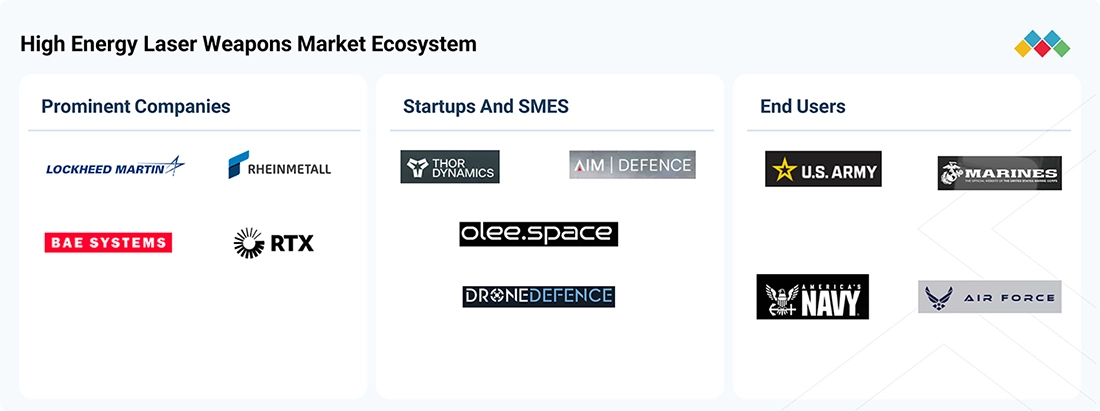
The high-energy laser weapons market includes laser weapon manufacturers, directed-energy technology developers, beam-control and optical-system suppliers, power and thermal-management system providers, and defense system integrators. Major companies such as RTX, Lockheed Martin Corporation, Northrop Grumman, Kawasaki Heavy Industries, AeroVironment, Inc., Rheinmetall AG, Boeing, Elbit Systems Ltd., MBDA, General Atomics, BAE Systems, Thales, Rafael Advanced Defense Systems Ltd., Leonardo S.p.A., and QinetiQ provide laser weapon systems, integrated defense solutions, and related technologies across land-based, naval, and airborne applications. Their portfolios cover areas such as counter-unmanned aerial systems, short-range air defense, counter-rocket, artillery and mortar defense, and missile defense. Other players such as AIM Defence, Carbine Systems, Aurelius Systems, Thor Dynamics, ESH Technology Co., Ltd., Olee.Space, Xcimer Energy, Drone Defence, Ground A GmbH, and Iris Lab focus on specialized laser technologies, counter-drone systems, optical components, beam-control technologies, and application-specific directed-energy solutions for defense and security applications.
Logos and trademarks shown above are the property of their respective owners. Their use here is for informational and illustrative purposes only.
MARKET SEGMENTS
Source: Secondary Research, Interviews with Experts, MarketsandMarkets Analysis
High Energy Laser Weapons Market, By Type
The market covers different types of high-energy laser weapons based on the laser technology used to generate and deliver concentrated energy. These include solid-state, fiber, chemical, and other laser technologies. Solid-state and fiber laser systems are increasingly used in military weapon development due to their electrical power requirements, compact configurations, and suitability for integration with defense platforms. Technology selection depends on laser efficiency, beam quality, power output, cooling requirements, system size, and operational applications.
High Energy Laser Weapons Market, By Power
High-energy laser weapons are classified according to their laser power output, which influences target engagement capabilities and operational applications. Lower-power systems are primarily used against small unmanned aerial vehicles and other short-range threats, while higher-power systems are being developed to engage rockets, artillery, mortars, and selected missile threats. Defense manufacturers are developing systems with increasing power levels to address more demanding air defense requirements. Power selection depends on target characteristics, engagement range, available electrical power, thermal management, and deployment requirements.
High Energy Laser Weapons Market, By Investment
The market includes investments across research and development, new weapon procurement, modernization and upgrades, and maintenance and sustainment activities. Research and development funding supports laser power scaling, beam control, testing, and weapon integration, while procurement expenditure covers the acquisition and delivery of complete laser weapon systems. Modernization spending supports improvements in laser modules, sensors, software, and supporting equipment. Maintenance and sustainment expenditure covers technical support, component replacement, system servicing, and operational readiness throughout the weapon lifecycle.
High Energy Laser Weapons Market, By Architecture
High-energy laser weapons use different system architectures depending on laser generation, beam combining, power distribution, and integration requirements. These architectures include standalone weapon configurations and modular or integrated systems designed to operate with existing defense equipment. Modular architectures allow laser modules, sensors, control systems, and supporting subsystems to be upgraded or replaced as technology develops. Architecture selection depends on weapon power, platform compatibility, scalability, subsystem integration, maintenance requirements, and the ability to support future capability upgrades.
High Energy Laser Weapons Market, By Deployment
High-energy laser weapons are deployed across land-based, naval, and airborne platforms to support different military operational requirements. Land-based systems include fixed installations, mobile ground vehicles, and tactical air defense platforms used for counter-drone and short-range air defense missions. Naval systems are integrated into surface vessels to counter aerial and maritime threats, while airborne laser systems require compact designs with suitable power and cooling arrangements. Deployment selection depends on mission requirements, platform size, available electrical power, operating environment, and target engagement capabilities.
High Energy Laser Weapons Market, By End User
The market serves military end users, including armies, navies, and air forces, with procurement requirements determined by their respective operational missions. Army applications focus on protecting ground forces, military installations, and critical assets against unmanned aerial vehicles and other aerial threats. Naval applications involve ship-based defense against drones, small boats, and selected missile threats. Air force applications include airbase protection and the development of airborne laser capabilities. Procurement priorities depend on operational threats, deployment environments, weapon integration requirements, and defense modernization programs.
High Energy Laser Weapons Market, By Component
High-energy laser weapons integrate multiple components, including laser sources, beam directors, beam-control systems, power supplies, thermal-management equipment, sensors, targeting systems, and command-and-control electronics. Laser sources generate the energy required for target engagement, while beam directors and control systems focus and maintain the laser beam on the target. Power and cooling systems support repeated weapon operation, while sensors and targeting equipment enable threat detection, tracking, and engagement. These components work together to provide accurate energy delivery, reliable system performance, and integration with military defense platforms.
REGION
Middle East to be fastest-growing region in global high-energy laser weapons market during forecast period
The Middle East high-energy laser weapons market is expected to expand at the highest CAGR of 8.8% between 2026 and 2035 as countries in the region invest in advanced air defense systems, counter-drone capabilities, and laser weapon technologies. In 2025, Israel completed the development and testing of its Iron Beam laser defense system, designed to intercept rockets, mortars, and unmanned aerial vehicles. The Israel Ministry of Defense also committed more than USD 500 million to expand Iron Beam production with Rafael Advanced Defense Systems and Elbit Systems. In December 2025, Rafael delivered the first Iron Beam system to the Israeli military, with additional systems entering production. These developments are supporting demand for laser weapon production, system integration, and layered air defense capabilities across the Middle East.
HIGH ENERGY LASER WEAPON MARKET: COMPANY EVALUATION MATRIX
The high-energy laser weapons market matrix includes Rafael Advanced Defense Systems Ltd. (Star), supported by its established position in laser-based air defense systems and expanding operational deployment. Its portfolio includes Iron Beam, Iron Beam-M, Lite Beam, and Naval Iron Beam, covering counter-unmanned aerial systems, rocket and mortar interception, and naval air defense applications. Iron Beam is a 100-kilowatt-class laser weapon system designed to complement existing layered air defense networks. Northrop Grumman (Emerging Leader) has strengthened its position through high-energy laser weapon systems such as the 150-kilowatt-class Laser Weapon System Demonstrator and the 10-kilowatt-class Phantom laser source. The company is expanding its laser weapon capabilities through naval system integration, compact laser development, scalable laser architectures, and advanced beam-control technologies.
Source: Secondary Research, Interviews with Experts, MarketsandMarkets Analysis
KEY MARKET PLAYERS
- Rafael Advanced Defense Systems Ltd. (Israel)
- Elbit Systems Ltd. (Israel)
- Lockheed Martin Corporation (US)
- RTX (US)
- MBDA (France)
- Northrop Grumman (US)
- Kawasaki Heavy Industries (Japan)
- AeroVironment, Inc. (US)
- Rheinmetall AG (Germany)
- Boeing (US)
- General Atomics (US)
- BAE Systems (UK)
- Thales (France)
- Leonardo S.p.A. (Italy)
- QinetiQ (UK)
MARKET SCOPE
| REPORT METRIC | DETAILS |
|---|---|
| Market Size in 2026 | USD 2.17 Billion |
| Market Forecast in 2035 | USD 4.54 Billion |
| CAGR | 8.6% |
| Years Considered | 2021–2035 |
| Base Year | 2025 |
| Forecast Period | 2026-2035 |
| Units Considered | Value (USD Million/Billion) |
| Report Coverage | Revenue forecast, company ranking, competitive landscape, growth factors, and trends |
| Segments Covered |
|
| Regions Covered | North America, Asia Pacific, Europe, Middle East, Rest of the World |
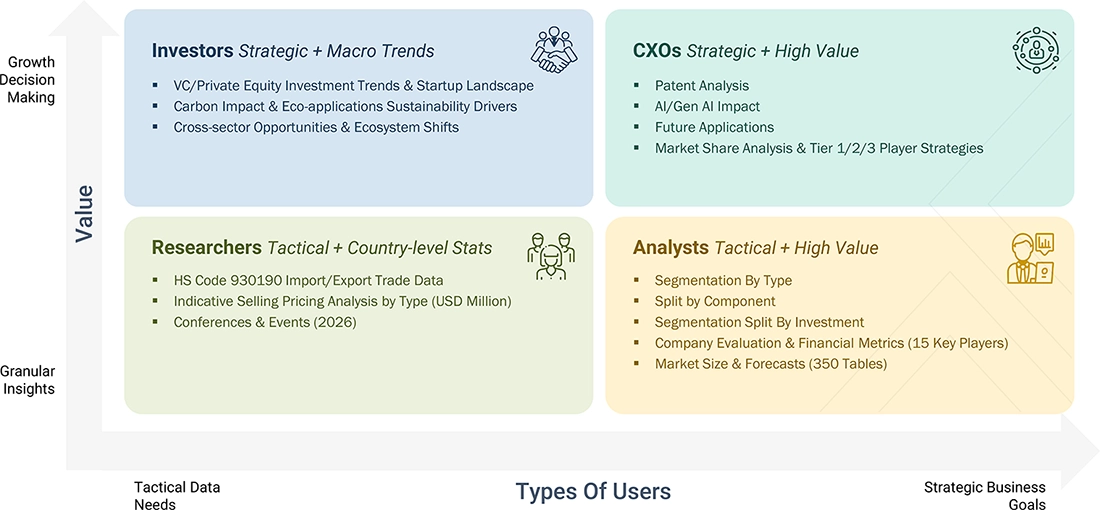
WHAT IS IN IT FOR YOU: HIGH ENERGY LASER WEAPON MARKET REPORT CONTENT GUIDE
DELIVERED CUSTOMIZATIONS
We have successfully delivered the following deep-dive customizations:
| CLIENT REQUEST | CUSTOMIZATION DELIVERED | VALUE ADDS |
|---|---|---|
| Leading Manufacturer | Additional segment breakdown for countries | Additional country-level market sizing tables for segments/sub-segments covered at the regional/global level to gain an understanding of market potential by each country |
| Emerging Leader | Additional company profiles | Competitive information on targeted players to gain granular insights on direct competition |
| Regional Market Leader | Additional country market estimates | Additional country-level deep dive for a more targeted understanding of the total addressable market |
RECENT DEVELOPMENTS
- July 2026 : AeroVironment, Inc. (US) received a production contract from the US Army in September 2026 for the Enduring High Energy Laser program. The contract supports production of laser weapon systems designed to counter unmanned aerial threats. The systems use a modular architecture that supports deployment at fixed military installations, tactical sites, and mobile combat vehicles. The award marks the US Army's transition from prototype development to the production of high-energy laser weapons.
- June 2026 : Rheinmetall AG (Germany) and MBDA (France) received a contract in July 2026 from the German Federal Office of Bundeswehr Equipment, Information Technology and In-Service Support to develop an operational High Energy Laser Weapon system for the German Navy. The contract, valued in the mid-hundreds of millions of euros, builds on a naval demonstrator that completed more than 1,000 laser firings against airborne, maritime, and land-based targets. The system is expected to become operational by 2029, strengthening Germany's naval laser weapon development and production capabilities.
- April 2026 : Rafael Advanced Defense Systems Ltd. (Israel) and the Israel Ministry of Defense completed a comprehensive air defense test series in June 2026, incorporating the Iron Beam High Energy Laser Weapon system into the Iron Dome battle management architecture. The tests included joint operational scenarios involving laser-based defense and existing air defense capabilities. The development supports the integration of Iron Beam into Israel's layered air defense network and strengthens coordination between laser weapon systems and conventional interceptors against aerial threats.
Table of Contents
 Exclusive indicates content/data unique to MarketsandMarkets and not available with any competitors.
Methodology
This study used four main activities to estimate the current size of the high-energy laser weapons market. First, detailed secondary research was conducted to collect information on high-energy laser weapon manufacturers, system types, power categories, applications, defense programs, procurement contracts, military budgets, production activities, deployments, and ongoing development programs. The collected information and key assumptions were then checked through primary interviews with industry participants and experts across the value chain. Demand-side analysis was used to estimate spending on high-energy laser weapons by application, power, investment, architecture, deployment, end user, component, and region. Finally, market breakdown and data triangulation were used to calculate the size of each segment and subsegment.
Secondary Research
Secondary research included information from government procurement portals, defense ministries, armed forces, defense agencies, company annual reports, regulatory filings, investor presentations, product documents, press releases, technical papers, journals, along with recognized defense databases. Sources such as SIPRI were used to review military spending, equipment transfers, and procurement activity, while government budget documents and procurement records were used to track military robot programs, contracts, orders, and deliveries. Company filings and official product information were used to study military robot portfolios, revenues, contracts, technologies, applications, customers, and geographical presence.
Primary Research
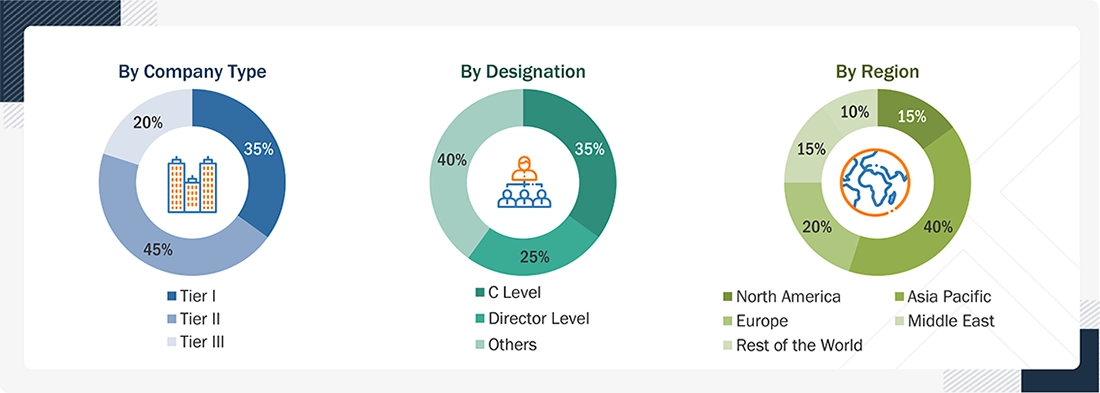
Primary research was conducted after completing the secondary research. Interviews were carried out with high-energy laser weapon manufacturers, laser source and optical component suppliers, beam control technology providers, power and thermal management system suppliers, defense system integrators, procurement officials, defense personnel, as well as other industry participants. The interviews covered major countries across North America, Europe, Asia Pacific, the Middle East, as well as the Rest of the World. Primary information was collected through questionnaires, emails and telephone interviews. This information was used to validate market estimates, defense procurement trends, platform demand, system pricing, production and delivery schedules, operational applications, adoption rates, as well as assumptions for individual market segments.
To know about the assumptions considered for the study, download the pdf brochure
Market Size Estimation
The top-down and bottom-up approaches were used to estimate and validate the size of the high-energy laser weapons market. The research methodology used to estimate the size of the market included the following details:
- Key high-energy laser weapons companies were identified through secondary research. Their market positions were estimated using company revenues, laser weapon portfolios, contract activity, production capabilities, order backlogs, regional presence, and defense program participation. Annual reports, financial filings, product documents, procurement records, defense ministry sources, government budget documents, and interviews with company executives, engineers, system integrators, suppliers, military users, and other industry participants were used for the analysis. Lockheed Martin Corporation, Rafael Advanced Defense Systems Ltd., Elbit Systems Ltd., RTX, and MBDA, for example, were assessed using their disclosed laser weapon contracts, development programs, production activities, and system integration capabilities as indicators of market activity.
- Market shares, segment splits, regional shares, and growth rates were first estimated using secondary sources and then checked through primary interviews. The analysis covered the application, power, investment, technology, deployment, end user, and component segments, along with laser weapon system pricing, procurement expenditure, research and development budgets, production schedules, operational deployments, and regional demand patterns.
- Demand for high-energy laser weapons across the army, air force, navy, joint air defense organizations, and homeland security users was considered. The analysis included new weapon procurement, research, testing, development and evaluation expenditure, military modernization programs, laser power scaling, system integration, domestic production, and operational capability requirements. For example, the US Department of Defense requested USD 110.4 million for High Energy Laser Advanced Development in fiscal year 2025, while Israel expanded production of the Iron Beam laser defense system through contracts involving Rafael Advanced Defense Systems Ltd. and Elbit Systems Ltd.
- The collected information was compared and combined through data triangulation. Final market values were calculated using company-level laser weapon revenues, disclosed contract values, procurement expenditure, research and development funding, system pricing, planned deliveries, regional defense demand, and primary-interview validation. Regional and country-level estimates were aggregated and reconciled with the global market size across all segments and subsegments.
High Energy Laser Weapons Market: Bottom-up & Top-Down Approaches

Data Triangulation
After determining the overall market size, the high-energy laser weapons market was divided into its main segments and subsegments. Data triangulation and market breakdown methods were used to estimate the size of each segment and subsegment. The analysis considered factors from both the demand and supply sides, including defense procurement budgets, research and development spending, laser weapon production capacity, company participation, contract values, system pricing, planned deliveries, operational deployments, as well as regional defense requirements. The assessment also covered specific weapon systems, including counter-unmanned aerial systems, counter-rocket, artillery and mortar defense systems, short-range air defense systems, naval laser weapons, as well as other high-energy laser weapon platforms.
Market Definition
The high-energy laser (HEL) weapons market comprises the development, production, procurement and integration of laser-based directed-energy weapons designed to damage, disable or destroy aerial, missile and surface threats using concentrated laser energy.
The market covers HEL weapons with a rated optical output of 1 kilowatt (kW) and above, including fiber lasers, bulk solid-state lasers and direct-diode lasers. These weapons are deployed across land-based, shipborne and airborne platforms to support counter-unmanned aerial systems (C-UAS), counter-rocket, artillery and mortar (C-RAM), short-range air defense (SHORAD), missile defense and counter-surface operations.
The market includes complete HEL weapons, dedicated laser weapon subsystems, detection and tracking equipment, fire control and command systems, power and thermal management solutions, and system integration activities. It covers both procurement expenditure and research, development, test and evaluation (RDT&E) investments directly attributable to HEL weapon programs.
The study evaluates market size and forecasts from 2021 to 2035, covering military and defense organizations and homeland security and law enforcement agencies across North America, Europe, Asia Pacific, the Middle East, Latin America and Africa.
Market Inclusions
- Complete HEL weapons with rated optical output of 1 kW and above and a demonstrated or intended capability to physically damage or disable targets.
- HEL-based C-UAS, C-RAM, SHORAD, missile-defense and counter-surface applications.
- Land-based, shipborne, and airborne HEL weapon configurations, including qualifying manned and unmanned platforms.
- Fiber-laser, bulk solid-state laser, and direct-diode laser technologies.
- Dedicated laser sources, beam control and direction, detection and tracking, fire control, C2, power supply, and cooling equipment.
- HEL-specific procurement, production, integration, testing, modernization, and attributable RDT&E expenditure.
- Government-funded HEL research programs, prototypes, demonstrators, and operational weapon procurements.
Market Exclusions
- High-power microwave (HPM), radio-frequency, millimeter-wave, and other non-laser directed-energy weapons.
- Standalone low-power laser dazzlers, laser warning devices, and optical countermeasure systems without qualifying hard-kill HEL capability.
- Laser rangefinders, target designators, laser-guided missiles, and laser-based communication systems.
- Industrial lasers, medical lasers, and commercial laser equipment not developed or procured for HEL weapon applications.
- General-purpose radar, EO/IR, C2, and platform equipment not directly attributable to HEL weapon installations.
- Complete vehicle, aircraft or ship procurement costs beyond the attributable HEL weapon and integration portion.
- Unfunded concepts, speculative technology applications, and unrelated defense research.
- Duplicate subcontract values, unexercised contract options, and contract ceilings not supported by attributable expenditure.
Key Stakeholders
- Defense Ministries & Government Procurement Agencies
- Armies, Navies, Air Forces & Other Military End Users
- High Energy Laser Weapon OEMs & Prime Contractors
- Laser Source, Photonics & Optical Component Suppliers
- Beam Control, Targeting & Sensor Technology Providers
- Power Generation, Energy Storage & Thermal Management Suppliers
- Defense Platform Integrators & System Engineering Providers
- Command, Control, AI & Fire-Control Software Providers
- Defense R&D, Testing & Certification Organizations
- Maintenance, Repair, Overhaul & Lifecycle Support Providers
Report Objectives
- To define, describe, segment, and forecast the size of the high-energy laser weapons market based on type, power, investment, architecture, deployment, end user, component, and region
- To forecast the size of the market segments across five regions: North America, Europe, Asia Pacific, Middle East and Rest of the World
- To identify and analyze key drivers, restraints, opportunities, and challenges influencing the growth of the market
- To identify industry trends, market trends, and technology trends in the market
- To analyze micro markets with respect to individual technology trends, growth prospects, and their contribution to the overall market
- To strategically profile key market players and analyze their market position and core capabilities
- To provide a detailed competitive landscape of the market and analyze competitive strategies such as product launches, partnerships, agreements, and collaborations adopted by key players
- To assess the financial position of key players along with their key products, unique offerings, and recent developments
Available customizations:
MarketsandMarkets offers the following customizations for this market report:
- Additional country-level analysis of the high-energy laser weapons market
- Profiling of other market players (up to 5)
Product Analysis
- Product matrix, which provides a detailed comparison of the product portfolio of each company in the high-energy laser weapons market


Personalize This Research
- Triangulate with your Own Data
- Get Data as per your Format and Definition
- Gain a Deeper Dive on a Specific Application, Geography, Customer or Competitor
- Any level of Personalization
Let Us Help You
- What are the Known and Unknown Adjacencies Impacting the High Energy Laser Weapons Market
- What will your New Revenue Sources be?
- Who will be your Top Customer; what will make them switch?
- Defend your Market Share or Win Competitors
- Get a Scorecard for Target Partners

Custom Market Research Services
We Will Customise The Research For You, In Case The Report Listed Above Does Not Meet With Your Requirements
Get 10% Free CustomisationTESTIMONIALS



Growth opportunities and latent adjacency in High Energy Laser Weapons Market