

How the Airbus–Diehl Defence Partnership Signals a New Growth Phase for the Integrated Air and Missile Defense Market
The modern battlefield is changing faster than ever. Hypersonic missiles, drone swarms, long-range precision weapons, and increasingly sophisticated air threats are forcing nations to rethink how they protect critical infrastructure, military assets, and civilian populations. Against this backdrop, a significant announcement emerged from the ILA Berlin Air Show 2026: Airbus Defence and Space and Diehl Defence signed an agreement to intensify their cooperation in Integrated Air and Missile Defence (IAMD).
At first glance, the agreement appears to be another defense-industry partnership. In reality, it reflects a much broader shift occurring across the global defense landscape. As military planners confront increasingly complex threat environments, no single sensor, interceptor, or command system can provide sufficient protection. Instead, modern defense strategies increasingly rely on integrated, layered architectures capable of detecting, tracking, and neutralizing threats across multiple domains. The Airbus–Diehl collaboration underscores growing demand for interoperable air and missile defense ecosystems that combine advanced sensors, command-and-control platforms, interceptor technologies, and networked communications into a unified defense framework.
For defense ministries, technology providers, investors, and strategic planners, this partnership provides valuable insight into the future trajectory of the Integrated Air and Missile Defense Market. According to MarketsandMarkets, Integrated Air and Missile Defence (IAMD) Market is projected to grow from USD 37.94 billion in 2025 to USD 68.38 billion by 2030, expanding at a CAGR of 12.5%. The announcement therefore represents more than a corporate agreement—it serves as a powerful indicator of where defense modernization priorities are headed over the next decade.
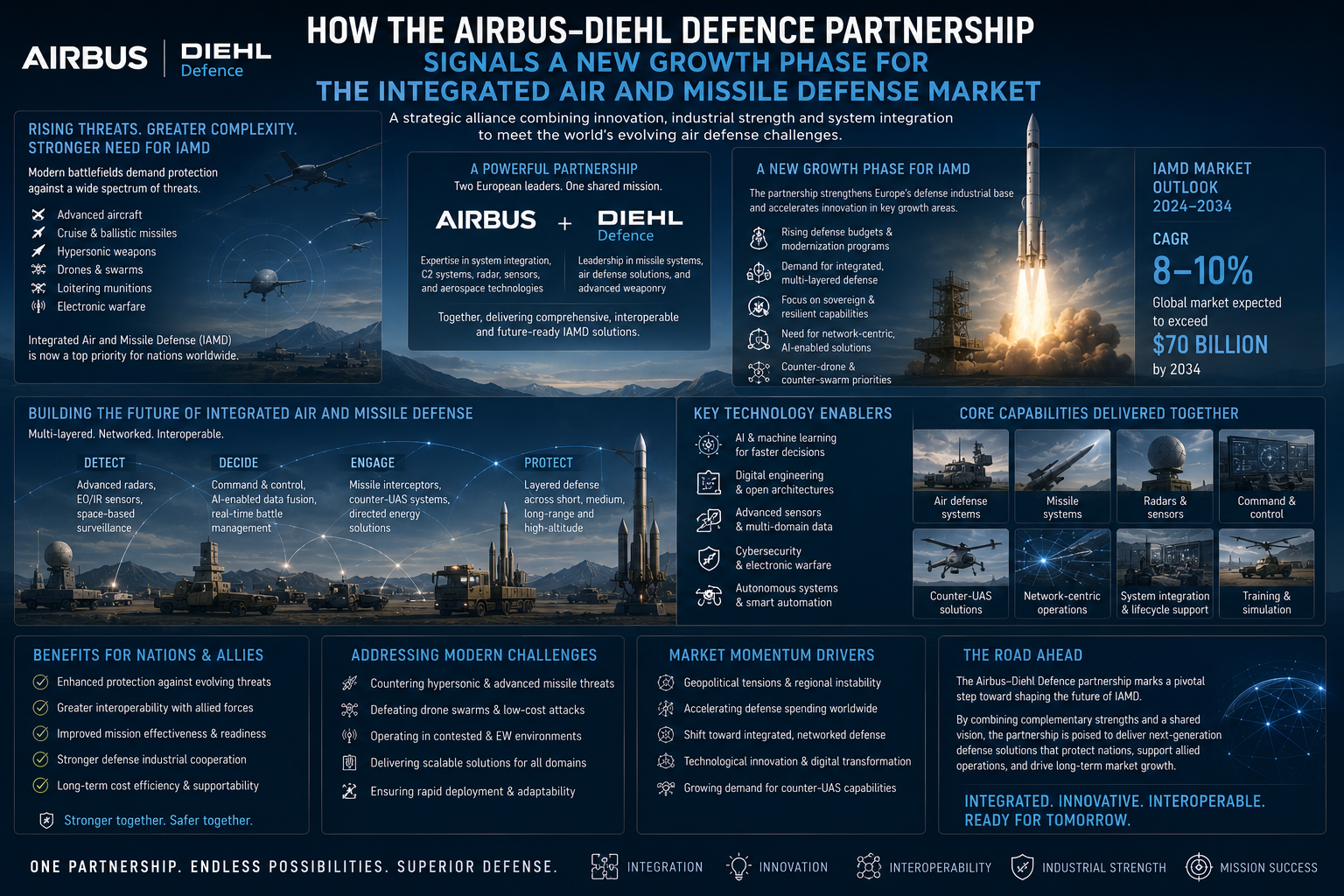

Breaking Down the News
Airbus Defence and Space and Diehl Defence announced an agreement to deepen collaboration in the field of Integrated Air and Missile Defence during the ILA Berlin Air Show 2026.
The partnership leverages the complementary capabilities of both organizations.
Airbus brings extensive expertise in:
- Military communications
- Command-and-control systems
- Sensor integration
- Multi-domain operations
- Defense networking technologies
Diehl Defence contributes strengths in:
- Air defense missile systems
- Interceptor technologies
- Ground-based defense solutions
- Missile engagement capabilities
Together, the companies aim to develop more comprehensive and interoperable defense solutions capable of addressing increasingly sophisticated airborne threats.
Download Sample of Report: https://www.marketsandmarkets.com/pdfdownloadNew.asp?id=134870061
What Is Integrated Air and Missile Defense?
Integrated Air and Missile Defense (IAMD) refers to a coordinated defense architecture that combines sensors, command systems, communications networks, interceptors, and battle management capabilities to detect, track, assess, and neutralize aerial threats.
Unlike standalone air defense systems, IAMD connects multiple defensive layers into a unified network.
These systems are designed to counter:
- Ballistic missiles
- Cruise missiles
- Hypersonic weapons
- Unmanned aerial systems (UAS)
- Drone swarms
- Fixed-wing aircraft
- Rotary-wing aircraft
The goal is to create a seamless defensive shield capable of responding to multiple threats simultaneously.
Why This News Matters Beyond the Headlines
The Airbus–Diehl agreement is significant because it validates several transformative trends currently reshaping global defense priorities.
The Shift Toward Layered Defense Architectures
Military organizations increasingly recognize that future threats will arrive from multiple vectors simultaneously.
A single defense layer is no longer sufficient.
Modern defense strategies require:
- Long-range detection systems
- Medium-range interceptors
- Short-range counter-drone systems
- Electronic warfare capabilities
- Space-based surveillance assets
The Airbus–Diehl partnership reflects growing demand for integrated architectures capable of combining these capabilities into a cohesive operational framework.
Growing Concern Over Hypersonic Threats
Hypersonic missiles represent one of the most disruptive developments in modern warfare.
Their speed, maneuverability, and unpredictable flight paths challenge traditional air defense systems.
As a result, governments worldwide are investing heavily in:
- Advanced radar technologies
- AI-enabled tracking systems
- Space-based sensors
- Next-generation interceptors
Partnerships like Airbus and Diehl demonstrate how industry leaders are aligning capabilities to address these emerging requirements.
Rising Importance of European Defense Sovereignty
The agreement also reflects Europe's broader efforts to strengthen defense autonomy.
Recent geopolitical developments have accelerated investments in indigenous defense capabilities across Europe.
Collaborative initiatives between European defense companies support:
- Regional security objectives
- Supply chain resilience
- Technological sovereignty
- Enhanced interoperability among allied nations
What This Means for the Integrated Air and Missile Defense Market
The partnership aligns directly with several key growth drivers accelerating the Integrated Air and Missile Defense Market.
Market Outlook
| Metric | Value |
|---|---|
| Market Size (2025) | USD 37.94 Billion |
| Market Size (2030) | USD 68.38 Billion |
| CAGR (2025–2030) | 12.5% |
This robust growth reflects increasing defense spending and rising demand for advanced threat protection capabilities.
Demand Drivers
Escalating Geopolitical Tensions
Growing regional conflicts and strategic competition continue to drive investments in missile defense systems.
Countries are prioritizing capabilities that improve deterrence and protect critical infrastructure.
Expansion of Drone Warfare
The rapid proliferation of drones and loitering munitions is reshaping air defense requirements.
Traditional missile defense systems must now integrate dedicated counter-UAS capabilities.
Multi-Domain Operations
Modern military doctrines emphasize integrated operations across:
- Land
- Air
- Sea
- Space
- Cyber domains
IAMD serves as a foundational enabler of multi-domain defense strategies.
Technology Shifts
The Airbus–Diehl partnership highlights several major technology trends influencing market growth:
- Artificial Intelligence-enabled battle management
- Space-based missile warning systems
- Advanced interceptor technologies
- Sensor fusion platforms
- Directed energy weapons
- Open architecture command-and-control systems
These innovations are transforming how nations approach air and missile defense.
Key Industry Trends Accelerating Market Growth
AI-Enabled Command and Control Systems
Artificial intelligence is becoming central to modern missile defense operations.
AI supports:
- Threat classification
- Target prioritization
- Engagement planning
- Sensor fusion
- Decision support
As threat volumes increase, AI-driven automation will become increasingly essential.
Why AI Matters
Modern defense networks may process thousands of sensor inputs simultaneously.
Human operators alone cannot manage this level of complexity.
AI enables faster and more accurate decision-making in high-pressure operational environments.
Space-Based Sensor Integration
Space is becoming an increasingly important component of missile defense architectures.
Satellite networks provide:
- Early warning capabilities
- Global surveillance coverage
- Persistent tracking
- Improved situational awareness
The integration of space-based sensors with terrestrial defense systems is expected to become a defining trend throughout the forecast period.
Counter-Drone and Swarm Defense Expansion
Drone swarms represent one of the fastest-growing threat categories.
Governments are investing in:
- Directed energy weapons
- Electronic warfare systems
- AI-enabled detection platforms
- Mobile counter-UAS solutions
These capabilities are becoming essential components of integrated defense networks.
Mobility and Rapid Deployment
Military forces increasingly require mobile defense systems capable of supporting expeditionary operations.
Demand is growing for:
- Vehicle-mounted missile defense systems
- Deployable radar platforms
- Portable command centers
- Networked battlefield sensors
Mobility enhances operational flexibility and survivability.
Interoperability Across Allied Forces
Future defense operations will increasingly involve multinational coalitions.
As a result, interoperability has become a critical procurement requirement.
Defense organizations seek systems capable of sharing:
- Sensor data
- Targeting information
- Command directives
- Threat intelligence
The Airbus–Diehl collaboration directly supports this trend.
Market Implications for Stakeholders
Enterprises and Defense Contractors
The growing emphasis on integrated defense architectures creates opportunities across the defense value chain.
Demand is increasing for:
- Advanced sensors
- Missile technologies
- Communications systems
- Cybersecurity solutions
- Battlefield networking platforms
Companies capable of delivering interoperable solutions will be particularly well positioned.
Investors
The IAMD market represents one of the fastest-growing segments within the defense sector.
Investment themes include:
- Missile defense technologies
- AI-enabled defense software
- Space-based surveillance
- Directed energy weapons
- Advanced radar systems
Long-term defense modernization programs provide strong visibility into future spending priorities.
Technology Providers
Technology vendors play a critical role in enabling next-generation defense capabilities.
Key opportunities include:
- AI platforms
- Cloud-enabled command systems
- Secure communications
- Sensor fusion technologies
- Autonomous threat detection systems
The convergence of software and defense hardware continues to create new innovation opportunities.
Governments
Governments face growing pressure to modernize defensive capabilities.
Priorities include:
- National security enhancement
- Critical infrastructure protection
- Alliance interoperability
- Multi-domain readiness
Investments in IAMD systems are increasingly viewed as strategic necessities rather than optional upgrades.
Frequently Asked Questions
What is the projected market size of the Integrated Air and Missile Defense Market?
The Integrated Air and Missile Defense Market is projected to grow from USD 37.94 billion in 2025 to USD 68.38 billion by 2030, reflecting a CAGR of 12.5%.
What is Integrated Air and Missile Defense?
Integrated Air and Missile Defense is a networked defense architecture that combines sensors, command-and-control systems, communications networks, and interceptors to detect, track, and defeat airborne threats.
Which regions are covered in the Integrated Air and Missile Defense Market?
The market spans North America, Europe, Asia Pacific, the Middle East, and the Rest of the World. Each region is investing in advanced defense capabilities to address evolving security challenges.
Which segment is expected to lead the market?
The Army segment is expected to lead procurement activities due to increasing investments in ground-based missile defense systems, battlefield protection, and integrated command networks.
Why is demand increasing for integrated defense systems?
Demand is rising due to the proliferation of hypersonic missiles, drone swarms, precision-guided munitions, and increasingly complex multi-domain threat environments.
Who are the key players in the Integrated Air and Missile Defense Market?
Major industry participants include Airbus, Diehl Defence, RTX, MBDA, Lockheed Martin, Northrop Grumman, BAE Systems, Thales, and other leading defense technology providers.
How is AI transforming missile defense?
AI improves threat detection, target prioritization, sensor fusion, and engagement planning, enabling faster and more accurate responses to complex attack scenarios.
Looking Beyond Today's Headlines
The Airbus–Diehl agreement reflects a broader transformation underway across the global defense landscape.
Future conflicts are expected to feature highly networked, multi-domain threat environments involving missiles, drones, electronic warfare systems, and space-based assets. Defending against these threats will require more than standalone platforms—it will require integrated ecosystems capable of coordinating sensors, shooters, and decision-makers in real time.
The next decade will likely see significant advances in:
- AI-enabled battle management
- Directed energy systems
- Hypersonic defense technologies
- Space-based tracking architectures
- Autonomous defense networks
Organizations that successfully integrate these capabilities will shape the future of global defense preparedness.
Conclusion
The Airbus–Diehl Defence partnership represents far more than a bilateral agreement. It serves as a clear indicator of where military modernization priorities are moving and highlights the growing importance of integrated, layered defense architectures.
As nations confront increasingly complex air and missile threats, investments in interoperable defense ecosystems are expected to accelerate. The announcement reinforces major market trends including AI-enabled command systems, space-based sensor integration, counter-drone technologies, and multi-domain defense operations.
With the Integrated Air and Missile Defense Market projected to reach USD 68.38 billion by 2030, stakeholders across the defense ecosystem face significant opportunities and strategic decisions.
Understanding how technologies, procurement priorities, regional investments, and emerging threats intersect requires deeper market intelligence. MarketsandMarkets research provides a comprehensive perspective on these evolving dynamics, helping decision-makers navigate one of the most critical defense modernization markets of the coming decade.
80% of the Forbes Global 2000 B2B companies rely on MarketsandMarkets to identify growth opportunities in emerging technologies and use cases that will have a positive revenue impact.
- Food Packaging Market Size Set for Strong Growth Through 2030 Amid Rising Demand for Convenience Foods
- Crop Protection Chemical Market Size, Share & Growth Forecast (2025–2030)
- Mulch Films Market: Driving Sustainable Agriculture Through Innovation
- Agricultural Adjuvants Market Analysis, Trends, and Growth Outlook (2026–2031)
- Japan Enterprise Asset Management Market Growth: AI and Smart Infrastructure Drive Demand

