

Armored Vehicle Technology Innovation: Global Trends and Market Forecast
Introduction to Armored Vehicle Technology
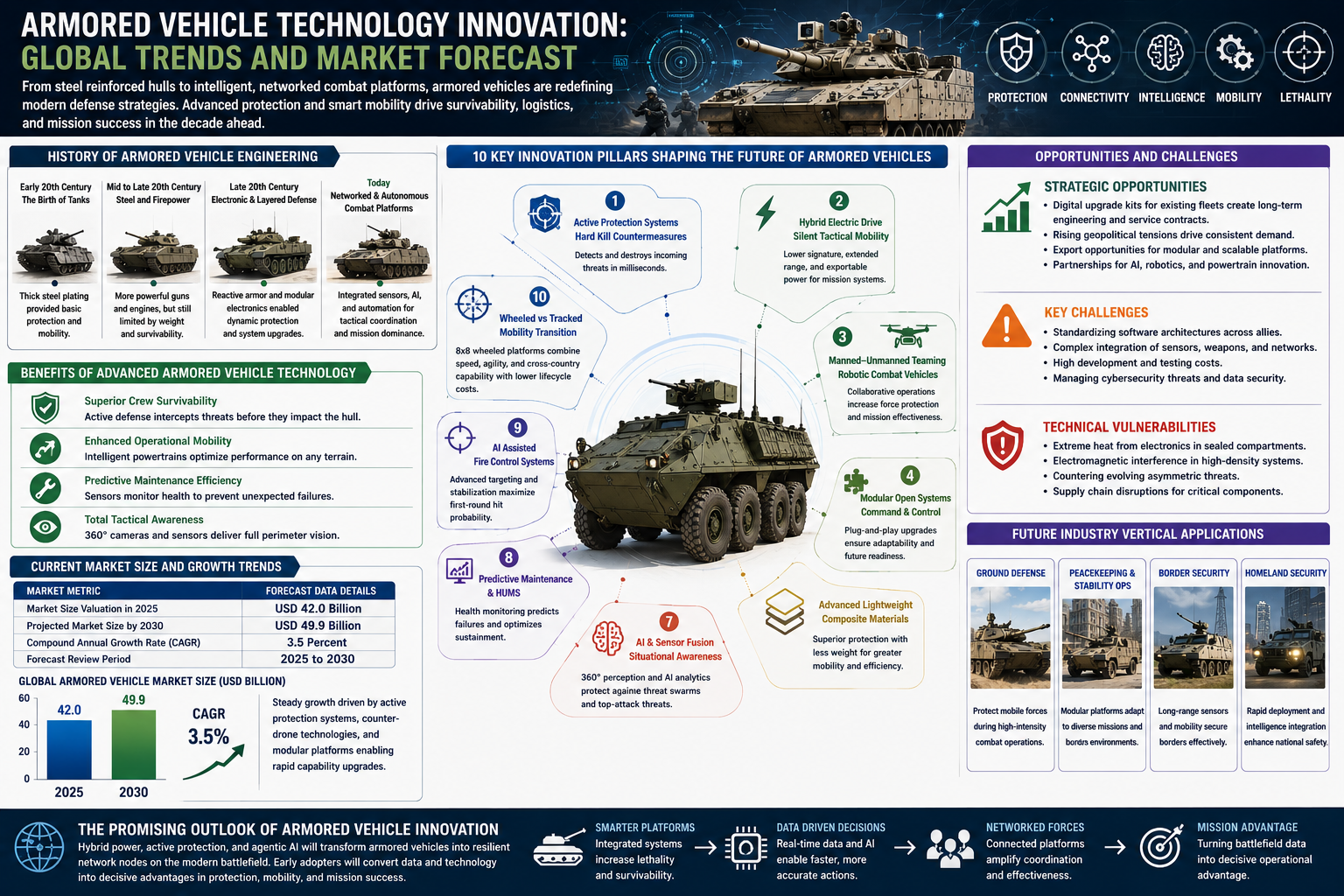
Armored vehicles have long served as a cornerstone of modern military operations, providing critical protection, mobility, and firepower across a wide range of combat scenarios. Over the decades, Armored Vehicle Technology has evolved significantly, transitioning from heavily armored platforms focused solely on survivability to highly sophisticated combat systems equipped with advanced sensors, network-centric communication capabilities, artificial intelligence, and active protection systems.
Today, defense forces worldwide are investing heavily in next-generation armored vehicles to address emerging threats, improve battlefield awareness, and enhance operational effectiveness. As warfare becomes increasingly data-driven and multidomain in nature, armored vehicle technology innovation is playing a vital role in shaping the future of military mobility and force protection.
History of Armored Vehicle Technology
The history of armored vehicles dates back to World War I, when tanks were first introduced to break through entrenched battlefield defenses. Early armored platforms were slow, mechanically complex, and limited in operational effectiveness. However, continuous advancements in armor materials, propulsion systems, weapon integration, and battlefield communications transformed armored vehicles into indispensable military assets.
Throughout the Cold War era, nations developed increasingly capable main battle tanks (MBTs), armored personnel carriers (APCs), and infantry fighting vehicles (IFVs). In recent years, technological innovation has accelerated further, driven by evolving combat requirements, asymmetric warfare threats, and the emergence of advanced battlefield technologies.
Benefits of Armored Vehicle Technology
Modern armored vehicle technology provides numerous operational advantages:
-
Enhanced Crew Protection: Advanced armor systems protect personnel against ballistic threats, mines, improvised explosive devices (IEDs), and anti-tank weapons.
-
Superior Mobility: Modern propulsion systems and suspension technologies enable rapid deployment across diverse terrains and operational environments.
-
Increased Battlefield Awareness: Integrated sensors, surveillance systems, and digital command networks improve situational awareness and decision-making.
-
Multirole Capability: Armored vehicles can perform combat, reconnaissance, troop transport, command-and-control, and logistics missions.
-
Force Multiplication: Advanced weapon systems and network-centric operations significantly enhance battlefield effectiveness.
Current Market Size and Growth Trends of the Armored Vehicle Industry
The armored vehicle market continues to expand as governments prioritize military modernization, force protection, and next-generation combat capabilities.
According to MarketsandMarkets, the Global Armored Vehicles Market Size was valued at USD 42.0 billion in 2025 and is projected to reach USD 49.9 billion by 2030, growing at a CAGR of 3.5% from 2025 to 2030.
This steady market growth is supported by several key factors:
-
Increasing military modernization programs across major economies
-
Rising procurement of advanced armored fighting vehicles and main battle tanks
-
Growing focus on troop survivability and force protection
-
Integration of digital battlefield management and network-centric warfare systems
-
Increasing demand for active protection systems (APS) against modern anti-armor threats
-
Expansion of autonomous and optionally manned combat vehicle programs
-
Growing geopolitical tensions and defense spending worldwide
Key Drivers and Factors Influencing the Future of Armored Vehicle Technology
Several major factors are accelerating armored vehicle technology innovation:
1. Military Modernization Initiatives
Governments worldwide are upgrading aging vehicle fleets to improve combat effectiveness, survivability, and operational flexibility.
2. Evolving Battlefield Threats
The proliferation of anti-tank guided missiles (ATGMs), loitering munitions, drones, and improvised explosive devices is driving demand for enhanced protection technologies.
3. Digital Transformation of Warfare
Network-centric operations require armored vehicles to function as connected battlefield nodes capable of sharing real-time intelligence and operational data.
4. Advanced Materials Development
The adoption of lightweight composite armor and advanced protection materials is improving vehicle survivability without compromising mobility.
5. Artificial Intelligence and Automation
AI-enabled systems are enhancing navigation, target identification, predictive maintenance, and autonomous operational capabilities.
Emerging Trends in Armored Vehicle Technology
The armored vehicle industry is witnessing several transformative trends:
1. Active Protection Systems (APS)
Modern APS technologies detect, track, and neutralize incoming threats before they impact the vehicle, significantly enhancing survivability.
2. Hybrid-Electric Propulsion Systems
Manufacturers are exploring hybrid-electric powertrains to improve fuel efficiency, reduce thermal signatures, and enhance operational endurance.
3. Autonomous and Optionally Manned Vehicles
Future combat vehicles are increasingly incorporating autonomous navigation and remote operation capabilities.
4. Advanced Situational Awareness Systems
360-degree sensor suites, thermal imaging, augmented reality displays, and AI-assisted battlefield visualization are improving crew effectiveness.
5. Modular Vehicle Architectures
Modular designs allow rapid integration of mission-specific equipment, weapons, and protection packages.
Opportunities and Challenges in the Armored Vehicle Market
As armored vehicle technologies continue to evolve, they create substantial opportunities and challenges for defense stakeholders.
Opportunities
1. Next-Generation Combat Vehicle Programs
Numerous countries are investing in future combat vehicle initiatives aimed at replacing aging armored fleets.
2. Increased Defense Spending
Rising geopolitical uncertainty is driving military procurement and armored vehicle modernization programs globally.
3. Autonomous Ground Combat Systems
The development of unmanned and robotic combat vehicles presents significant growth opportunities for defense manufacturers.
4. Export Market Expansion
Emerging economies are increasingly investing in armored vehicle procurement to strengthen national defense capabilities.
Challenges
1. High Development Costs
Advanced armored vehicle programs require substantial investment in research, development, testing, and manufacturing.
2. Integration Complexity
Combining advanced sensors, communication systems, protection technologies, and weapon platforms remains technically challenging.
3. Evolving Threat Environment
Manufacturers must continuously adapt vehicle designs to counter rapidly changing battlefield threats.
4. Logistics and Maintenance Requirements
Advanced armored platforms often require sophisticated support infrastructure and lifecycle maintenance capabilities.
Innovations and Advancements in Armored Vehicle Technology
The future of armored vehicles is being shaped by several groundbreaking innovations:
1. Active and Reactive Armor Systems
Advanced protection technologies significantly improve resistance against anti-armor weapons and kinetic threats.
2. Artificial Intelligence Integration
AI-powered systems support threat detection, route planning, predictive maintenance, and battlefield decision-making.
3. Drone and Counter-Drone Capabilities
Modern armored vehicles increasingly integrate UAV launch, surveillance, and counter-drone systems.
4. Digital Battlefield Connectivity
Secure communications and real-time data sharing enhance coordination across multidomain operations.
5. Directed Energy and Advanced Weapon Systems
Future armored platforms may incorporate high-energy lasers and advanced electronic warfare capabilities.
Future Applications and Industries That Will Benefit from Armored Vehicle Technology
The future of armored vehicle innovation extends across numerous military and security applications:
1. Defense and Combat Operations
Armored vehicles will remain essential for maneuver warfare, force protection, reconnaissance, and fire support missions.
2. Border Security and Homeland Protection
Security agencies will increasingly deploy armored platforms for border surveillance and critical infrastructure protection.
3. Peacekeeping Missions
International peacekeeping operations will benefit from enhanced mobility and protection capabilities.
4. Counterterrorism Operations
Armored vehicles provide critical protection and operational effectiveness in urban and asymmetric warfare environments.
5. Disaster Response and Emergency Support
Specialized armored vehicles can support rescue operations in hazardous environments and disaster-affected regions.
6. Future Autonomous Military Operations
Robotic and autonomous combat vehicle technologies will expand the role of armored platforms in next-generation military operations.
Conclusion: The Promising Future of Armored Vehicle Technology
Armored vehicle technology innovation is transforming the future of military mobility, survivability, and combat effectiveness. Advances in active protection systems, artificial intelligence, autonomous operations, digital battlefield connectivity, and advanced armor materials are enabling a new generation of highly capable combat platforms.
As the global armored vehicles market grows from USD 42.0 billion in 2025 to USD 49.9 billion by 2030, defense organizations will continue to prioritize modernization efforts to address emerging security challenges and maintain battlefield superiority.
While challenges related to development costs, integration complexity, and evolving threats remain significant, ongoing innovation is expected to drive substantial opportunities across the defense sector. The future armored vehicle ecosystem will increasingly feature intelligent, connected, and highly adaptable platforms capable of operating effectively in complex multidomain environments.
Organizations that invest in advanced armored vehicle technologies today will be better positioned to meet the operational demands of tomorrow's battlefield while ensuring enhanced protection, mobility, and mission success.
Download Sample Research Report for Armored Vehicles Market Future @ https://www.marketsandmarkets.com/Market-Reports/armored-vehicle-market-6322755.html
80% of the Forbes Global 2000 B2B companies rely on MarketsandMarkets to identify growth opportunities in emerging technologies and use cases that will have a positive revenue impact.
- Food Packaging Market Size Set for Strong Growth Through 2030 Amid Rising Demand for Convenience Foods
- Crop Protection Chemical Market Size, Share & Growth Forecast (2025–2030)
- Mulch Films Market: Driving Sustainable Agriculture Through Innovation
- Agricultural Adjuvants Market Analysis, Trends, and Growth Outlook (2026–2031)
- Japan Enterprise Asset Management Market Growth: AI and Smart Infrastructure Drive Demand


