

Autonomous C2 Market: From Traditional Command Systems to AI-Enabled Decision Advantage
Recent developments, technology trends, and product decision implications
The Autonomous C2 Market is emerging within the broader command and control ecosystem as defense forces move from traditional command systems toward AI-enabled decision support, sensor fusion, mission automation, tactical edge C2, and multi-domain coordination. While Autonomous C2 is still developing as a market label, the opportunity is highly relevant within the broader Command and Control Systems Market, C4ISR, JADC2/CJADC2, battle management software, and next-generation command architectures.
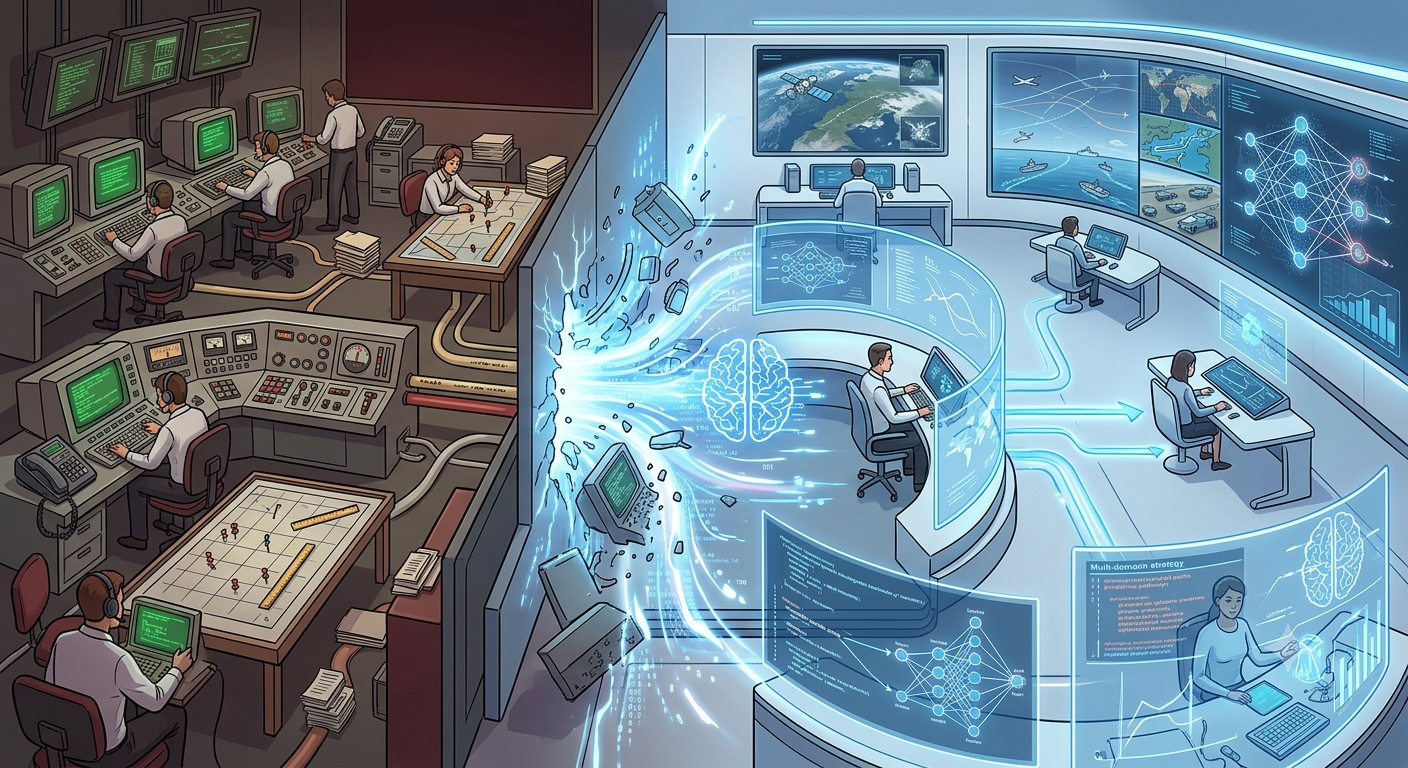
Autonomous C2 is not about removing commanders from the decision loop. The near-term opportunity is in human-machine decision support: helping commanders understand large volumes of data, connect sensors and shooters, prioritize threats, recommend actions, coordinate unmanned systems, and operate under compressed timelines.
The market is therefore shifting from the question “Which command system should we modernize?” to “How should AI, sensor fusion, tactical cloud, edge computing, open architecture, cybersecurity, and autonomous system integration improve decision speed?”
MarketsandMarkets Market Sizing & Forecast
Autonomous C2 should be positioned as an emerging opportunity area within the broader C2/C4ISR market, not yet as a fully mature standalone market. According to MarketsandMarkets, the global Command and Control Systems Market is projected to grow from USD 40.83 billion in 2026 to USD 54.34 billion by 2031, at a CAGR of 5.9%.
MarketsandMarkets notes that the broader C2 transition is supported by open architecture systems, Joint All-Domain Command and Control, edge computing, tactical cloud, zero-trust cybersecurity, autonomous system integration, and continuous software modernization. This directly supports Autonomous C2 as a software-, AI-, data-, and multi-domain-led growth theme.
Key Trends Shaping the Autonomous C2 Market
1. Decision Speed Becoming a Battlefield Advantage
Modern operations are becoming faster, more distributed, and more data-intensive. Commanders need to process sensor feeds, ISR data, cyber signals, EW inputs, drone video, satellite data, battlefield reports, and logistics information under time pressure.
Autonomous C2 addresses this challenge by supporting automated data fusion, threat prioritization, decision recommendations, and mission workflow acceleration. The value is not “full autonomy” in command decisions, but faster and more explainable decision support.
2. JADC2/CJADC2 Creating Program-Backed Demand
JADC2 and CJADC2 create strong program relevance for Autonomous C2 because they require multi-domain data sharing, sensor-to-shooter connectivity, resilient networks, and decision support across services and allied forces.
This creates opportunities for AI-enabled C2 software, data fabric tools, battle management systems, open architecture integration, tactical edge cloud, and interoperability solutions that can connect legacy and next-generation systems.
3. Sensor Fusion Becoming the Core Technical Layer
Autonomous C2 depends on sensor fusion. The system must connect radar, EO/IR, signals intelligence, cyber data, unmanned systems, satellites, battlefield sensors, and human reports into a coherent operational picture.
This creates opportunities for data integration, track correlation, entity resolution, threat scoring, automated alerting, decision support, and AI-enabled common operating picture tools.
4. Tactical Edge C2 and Cloud-Enabled Operations Gaining Importance
As forces operate in contested environments, C2 cannot rely only on centralized command centers. Tactical units need deployable, resilient, and edge-enabled C2 that can function under degraded connectivity, cyber threat, and electronic attack.
This creates opportunities for tactical cloud, edge computing, deployable servers, secure communications, zero-trust cybersecurity, distributed data architectures, and low-latency decision tools.
5. Autonomous System Integration Becoming a New C2 Requirement
The growing use of drones, robots, autonomous vehicles, loitering munitions, and unmanned maritime systems creates a new C2 challenge. Command systems must coordinate not only humans and platforms, but also autonomous and semi-autonomous systems.
This creates demand for unmanned system command applications, autonomy supervision tools, human-machine teaming interfaces, mission planning software, and safety/authorization workflows.
Recent Autonomous C2 Developments
|
Period |
Development |
Market Signal |
|---|---|---|
|
2026 |
MarketsandMarkets projected the broader C2 Systems Market to grow from USD 40.83B to USD 54.34B by 2031 |
C2 modernization remains a large, active market |
|
2026 |
C2 market segmentation includes land, air, maritime, space, cyber, joint & multi-domain operating domains |
Multi-domain C2 is becoming central to future command architectures |
|
2026 |
MarketsandMarkets highlighted open architecture, JADC2, edge computing, tactical cloud, zero-trust cybersecurity, and autonomous system integration |
Autonomous C2 is supported by multiple active modernization themes |
|
2026 |
Market opportunities include AI-enabled decision-support applications and unmanned system command integration |
AI and autonomy are becoming growth areas within C2 |
|
2026 |
System fragmentation and interoperability constraints remain key challenges |
Integration capability is likely to become a major right-to-win factor |
Product Opportunity Areas
The market is shifting from the question “Which C2 system should we deploy?” to “How should AI, data, cloud, edge, autonomy, and interoperability improve command decisions?” This creates opportunities across:
-
AI-enabled C2 software
-
Multi-domain sensor fusion
-
JADC2/CJADC2 integration tools
-
Battle management software
-
Autonomous mission planning
-
Human-machine decision support
-
Tactical edge C2 and deployable command systems
-
Open architecture C2 frameworks
-
Data fabrics and common operating picture tools
-
Zero-trust cybersecurity for C2 networks
-
Unmanned system command and autonomy supervision
- Simulation, wargaming, and decision-support environments
How the Autonomous C2 Market Report Supports Product Decisions
Product Portfolio Decisions: Identify which C2 capability areas show the strongest demand across AI-enabled decision support, sensor fusion, tactical edge C2, battle management, unmanned system integration, and multi-domain C2.
Technology Investment Prioritization: Compare technologies by adoption, maturity, procurement activity, interoperability requirements, operational relevance, cybersecurity needs, and future growth potential.
Target Customer Identification: Assess demand across defense ministries, joint commands, armies, navies, air forces, cyber commands, space commands, homeland security agencies, and system integrators.
Competitive Positioning: Benchmark companies across C2 software, battle management systems, sensor fusion, data fabrics, tactical cloud, cybersecurity, AI decision support, and autonomous system integration.
Partnership and M&A Strategy: Map ecosystem gaps and identify complementary partners, for example, defense primes with AI decision-support firms, cloud providers with tactical edge companies, or autonomy companies with C2 software integrators.
Program and Procurement Prioritization: Track JADC2/CJADC2 programs, command-post modernization, tactical edge computing programs, C4ISR upgrades, unmanned teaming initiatives, and software-defined command system opportunities.
Product Roadmap Development: Translate market direction from traditional command systems toward AI-assisted, open-architecture, multi-domain, and autonomy-enabled C2 into future product requirements.
Conclusion
Autonomous C2 is emerging as a high-value opportunity within the broader C2/C4ISR market. The opportunity is being shaped by AI-enabled decision support, multi-domain sensor fusion, JADC2/CJADC2, tactical edge cloud, open architecture, zero-trust cybersecurity, and autonomous system integration.
For technology providers, the key opportunity is not to replace commanders, but to help them make faster, better, and more explainable decisions under operational pressure. A detailed Autonomous C2 / Command and Control Systems Market report can help companies determine which C2 capability to develop, where to position it, which customer segment to target, which programs to track, and which partners or acquisition targets to pursue.
|
Metric |
2026 |
2031 |
2026–2031 CAGR |
|---|---|---|---|
|
Global Command and Control Systems Market |
USD 40.83 Billion |
USD 54.34 Billion |
5.9% |
Market sizing source: MarketsandMarkets broader C2 Systems Market. Autonomous C2 should be positioned as an emerging opportunity area within the broader C2/C4ISR market.
80% of the Forbes Global 2000 B2B companies rely on MarketsandMarkets to identify growth opportunities in emerging technologies and use cases that will have a positive revenue impact.
- Food Packaging Market Size Set for Strong Growth Through 2030 Amid Rising Demand for Convenience Foods
- Crop Protection Chemical Market Size, Share & Growth Forecast (2025–2030)
- Mulch Films Market: Driving Sustainable Agriculture Through Innovation
- Agricultural Adjuvants Market Analysis, Trends, and Growth Outlook (2026–2031)
- Japan Enterprise Asset Management Market Growth: AI and Smart Infrastructure Drive Demand

