

Home/ Aerospace and Defense / can-autonomous-military-robots-deliver-the-next-revolution-in-land-warfare

Can Autonomous Military Robots Deliver the Next Revolution in Land Warfare?

MarketsandMarkets™ Research Private Ltd,, 18 Jun 2026
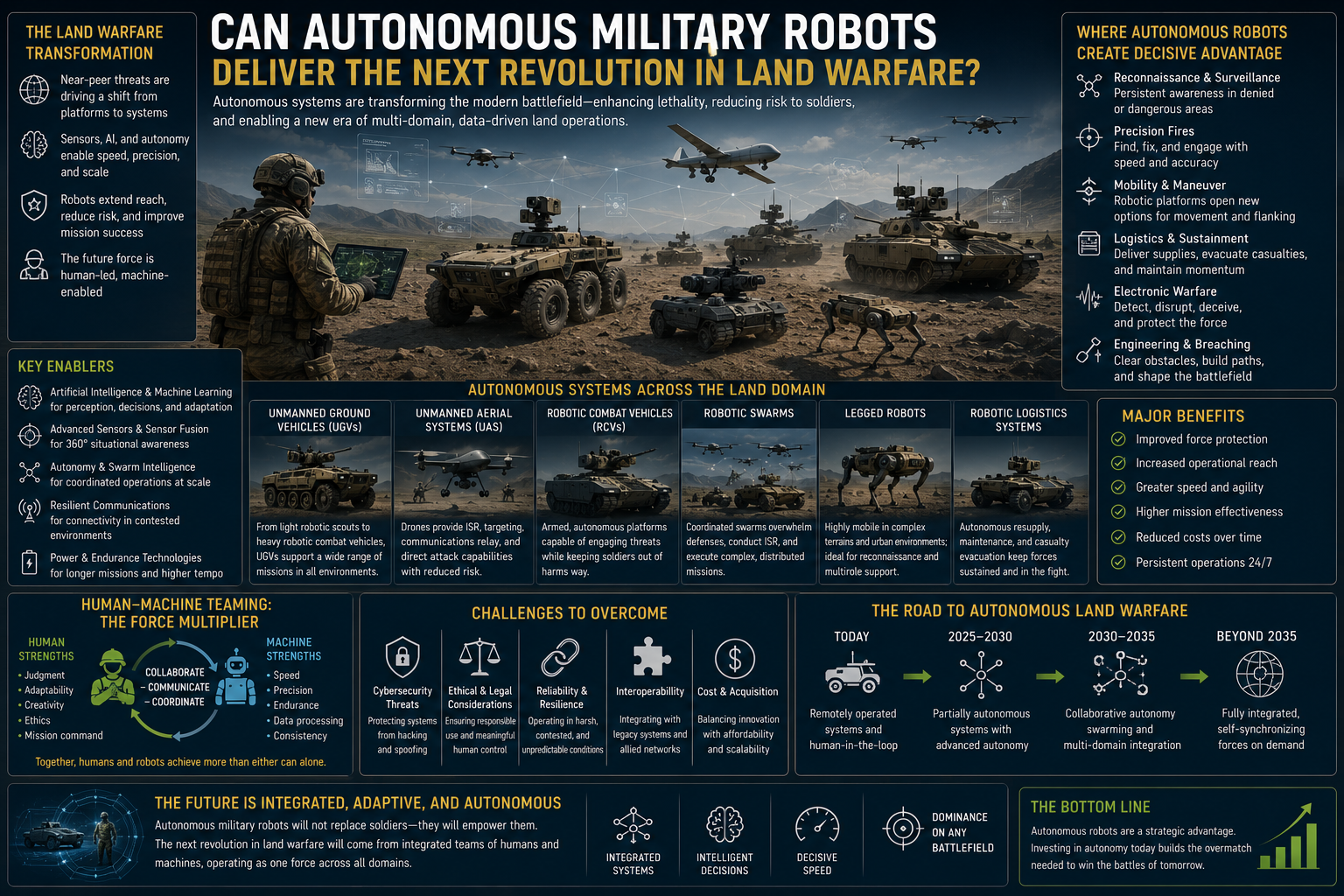
The history of warfare has been shaped by transformative technologies that fundamentally changed how military forces operate on the battlefield. From tanks and mechanized infantry to precision-guided weapons and network-centric warfare, each innovation has redefined military doctrine and operational effectiveness. Today, autonomous military robots are emerging as the latest disruptive force with the potential to revolutionize land warfare. Powered by advances in artificial intelligence, autonomous navigation, sensor fusion, and battlefield networking, these systems are rapidly evolving from specialized support tools into critical combat assets that could reshape the future of military operations.

The Evolution of Autonomous Ground Combat Systems

Military robots were initially developed to perform limited tasks such as explosive ordnance disposal, reconnaissance, and logistics support. However, rapid advancements in artificial intelligence and robotics have significantly expanded their capabilities. Modern autonomous ground systems can navigate complex terrain, gather and analyze battlefield intelligence, identify potential threats, and coordinate with other manned and unmanned assets in real time.

As these technologies mature, autonomous military robots are increasingly being viewed not simply as support equipment but as force multipliers capable of enhancing combat effectiveness across a wide range of operational environments. Their growing role reflects a broader shift toward automation and intelligent systems within modern defense strategies.

Enhancing Battlefield Awareness and Decision-Making

One of the most significant advantages offered by autonomous military robots is their ability to improve situational awareness. Equipped with advanced sensors, cameras, radar systems, and artificial intelligence algorithms, these platforms can continuously monitor operational environments and process vast amounts of data far more rapidly than human operators alone.

By collecting and analyzing information from multiple sources, autonomous robots provide commanders with real-time intelligence that supports faster and more informed decision-making. This enhanced battlefield awareness can improve mission planning, threat detection, target identification, and operational coordination, providing military forces with a significant tactical advantage.

Download PDF Brochure: https://www.marketsandmarkets.com/pdfdownloadNew.asp?id=245516013

Reducing Risks to Military Personnel

Force protection remains one of the primary motivations behind investments in autonomous military robotics. Modern battlefields present a wide range of threats, including improvised explosive devices, urban combat hazards, chemical and biological risks, and long-range precision attacks.

Autonomous robots can perform dangerous missions in contested environments without exposing soldiers directly to harm. Whether conducting reconnaissance, clearing obstacles, transporting supplies, or monitoring hostile areas, robotic platforms help reduce casualties while maintaining operational effectiveness. As military organizations continue prioritizing personnel safety, autonomous systems are expected to play an increasingly important role in future force structures.

Supporting Human-Machine Teaming on the Battlefield

Rather than replacing human soldiers, autonomous military robots are being developed to operate alongside them. Human-machine teaming has emerged as a central concept within modern military planning, combining the strengths of human judgment with the speed, precision, and endurance of autonomous systems.

In future operations, robotic platforms may scout ahead of infantry units, provide continuous surveillance coverage, carry heavy equipment, or support combat maneuvers while remaining under human supervision. This collaborative approach enables military forces to extend operational reach, improve efficiency, and enhance overall mission performance.

The success of autonomous robotics in land warfare will likely depend on how effectively military organizations integrate these systems into existing command structures and operational doctrines.

Expanding Roles Across Combat Operations

The potential applications of autonomous military robots extend far beyond traditional support functions. Advances in artificial intelligence and autonomous navigation are enabling robotic systems to contribute to a broader range of battlefield missions.

Future autonomous platforms may conduct perimeter security, route clearance, intelligence gathering, electronic warfare support, casualty evacuation, and autonomous logistics operations. Some systems are also being designed to provide direct combat support through remote weapon integration and battlefield coordination capabilities.

As these technologies continue to evolve, autonomous robots are expected to assume increasingly sophisticated operational responsibilities across the land warfare spectrum.

Swarm Intelligence and Distributed Operations

One of the most promising developments in military robotics is the emergence of swarm intelligence. Inspired by natural systems, swarm robotics allows multiple autonomous platforms to operate collaboratively, share information, and adapt dynamically to changing mission conditions.

On future battlefields, coordinated groups of autonomous ground robots could conduct surveillance missions, secure large operational areas, support reconnaissance efforts, and overwhelm adversary defenses through distributed operations. Swarm-enabled systems offer enhanced resilience because the loss of individual units does not necessarily compromise mission effectiveness.

This distributed approach to warfare could significantly alter traditional military tactics and create new operational possibilities for land forces.

Multi-Domain Integration Strengthening Operational Effectiveness

Modern warfare increasingly relies on coordinated operations across land, air, maritime, cyber, and space domains. Autonomous military robots contribute to this multi-domain framework by acting as interconnected nodes within broader military networks.

Ground robots can share intelligence with aerial drones, communicate with command centers, and coordinate with other autonomous systems to support unified operational objectives. This integration improves situational awareness, accelerates information flow, and enables more effective responses to emerging threats.

As defense organizations continue investing in network-centric warfare capabilities, autonomous robots will become increasingly important components of integrated battlefield ecosystems.

Challenges to Widespread Adoption

Despite their significant potential, autonomous military robots face several challenges that must be addressed before they can fully transform land warfare. Technical limitations related to navigation, communications reliability, cybersecurity, and decision-making in highly complex environments remain areas of ongoing development.

Military organizations must also address doctrinal, legal, and ethical considerations associated with increasing levels of autonomy. Ensuring appropriate human oversight, maintaining accountability, and establishing clear operational frameworks will be essential as robotic systems assume more prominent battlefield roles.

In addition, the integration of autonomous platforms into existing military structures will require substantial investments in training, infrastructure, and interoperability.

Defense Modernization Accelerating Development

Governments worldwide are actively investing in autonomous military robotics as part of broader defense modernization initiatives. Rising geopolitical competition, evolving threat environments, and advances in artificial intelligence are driving research, testing, and procurement programs focused on autonomous ground systems.

Defense agencies increasingly recognize that autonomous technologies can enhance force readiness, improve operational flexibility, and strengthen long-term military competitiveness. As a result, funding for robotic combat vehicles, autonomous reconnaissance platforms, and intelligent battlefield systems continues to expand across global defense markets.

The Future of Land Warfare

The future battlefield is likely to feature a combination of human soldiers, autonomous robots, and AI-enabled command systems operating together within highly connected military networks. Autonomous platforms will not eliminate the need for human decision-makers, but they will fundamentally change how military operations are planned, executed, and sustained.

As artificial intelligence, robotics, and autonomous technologies continue to mature, military forces will gain new capabilities that enhance mobility, intelligence gathering, force protection, and operational effectiveness. These advancements could represent one of the most significant shifts in land warfare since the introduction of mechanized combat systems.

Conclusion

Autonomous military robots have the potential to deliver the next major revolution in land warfare by transforming how armies conduct reconnaissance, logistics, force protection, and combat operations. Their ability to enhance situational awareness, reduce risks to personnel, support human-machine teaming, and enable multi-domain integration makes them a critical component of future military modernization efforts. While technical, ethical, and operational challenges remain, the rapid pace of innovation suggests that autonomous military robots will play an increasingly central role in shaping the battlefield of tomorrow.


DMCA.com Protection Status

