

Drone Market Dynamics: Transforming Industries Through AI and Automation
The Drone Market has transitioned from experimental innovation to a mainstream technological force reshaping industries across the globe. Over the past decade, drones have evolved beyond their military origins to become versatile assets across commercial, industrial, and civil sectors. The convergence of artificial intelligence (AI), autonomous flight systems, lightweight materials, and advanced communication networks has made unmanned aerial vehicles (UAVs) essential tools for data-driven operations, logistics optimization, and defense modernization.
Market Size & Share
The overall UAV (drone) market (OEM + Aftermarket) is estimated to be USD 26.12 billion in 2025 and projected to reach USD 40.56 billion by 2030, growing at a CAGR of 9.2% from 2025 to 2030. The drone (UAV) market volume (OEM) is projected to grow from 596.94 thousand units in 2025 to reach 869.76 thousand by 2030.
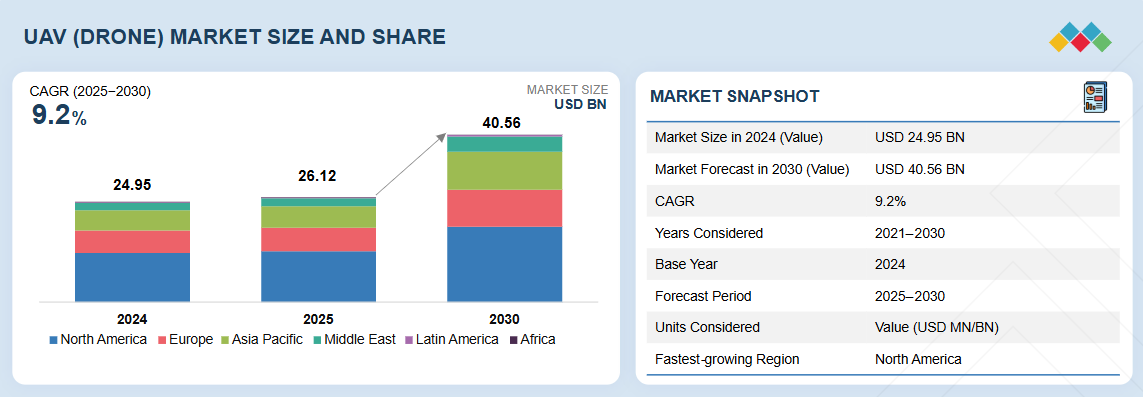

Today, the Drone (UAV) Market is one of the most dynamic segments within the aerospace and technology landscape, with applications spanning agriculture, construction, energy, mining, surveillance, environmental monitoring, and emergency response. Supported by regulatory evolution and increased investment in automation, drones are enabling organizations to enhance efficiency, safety, and situational awareness.
Market Evolution and Industrial Transformation
The Drone Market has evolved through three distinct phases — innovation, adaptation, and integration. Initially driven by defense applications such as reconnaissance, surveillance, and target acquisition, drones have since expanded into the commercial and industrial ecosystem. Technological advances have led to the emergence of miniaturized sensors, AI-driven navigation systems, and high-resolution imaging technologies that empower drones to perform precise, autonomous tasks with minimal human intervention.
The Drone (UAV) Market is now a key enabler of the Fourth Industrial Revolution. Sectors such as agriculture leverage drones for crop health assessment, irrigation management, and yield optimization. Construction and mining industries use UAVs for 3D mapping, volumetric analysis, and site inspection, reducing operational costs and improving project accuracy. Similarly, energy companies deploy drones for inspecting wind turbines, solar farms, and pipelines in hazardous or remote environments, ensuring safety and continuity.
In logistics, drone delivery systems are gaining traction as companies like Amazon Prime Air, UPS Flight Forward, and Wing (Alphabet) test last-mile delivery solutions to minimize delivery time and carbon emissions. These applications demonstrate the growing integration of UAV technology into sustainable and smart mobility systems.
Technological Advancements Driving Market Growth
The foundation of Drone Market growth lies in continuous technological innovation. Breakthroughs in artificial intelligence, machine learning, and edge computing have enhanced drone capabilities in navigation, image processing, and decision-making. AI-powered drones can identify objects, avoid obstacles, and plan optimized routes autonomously.
The integration of 5G networks is another critical enabler, facilitating real-time data transmission and seamless communication between drones and ground control systems. This connectivity allows for Beyond Visual Line of Sight (BVLOS) operations, expanding drone usage for mapping large areas, surveying, and long-range logistics missions.
Additionally, the introduction of hybrid propulsion systems and lightweight composite materials has increased endurance and payload capacity. New technologies like swarm intelligence are enabling multiple drones to collaborate on missions, whether for search and rescue, precision agriculture, or military reconnaissance.
The emergence of counter-UAV technologies has also become a vital part of the ecosystem, ensuring safe integration of drones into urban airspace and addressing security concerns.
Commercial Drone Applications
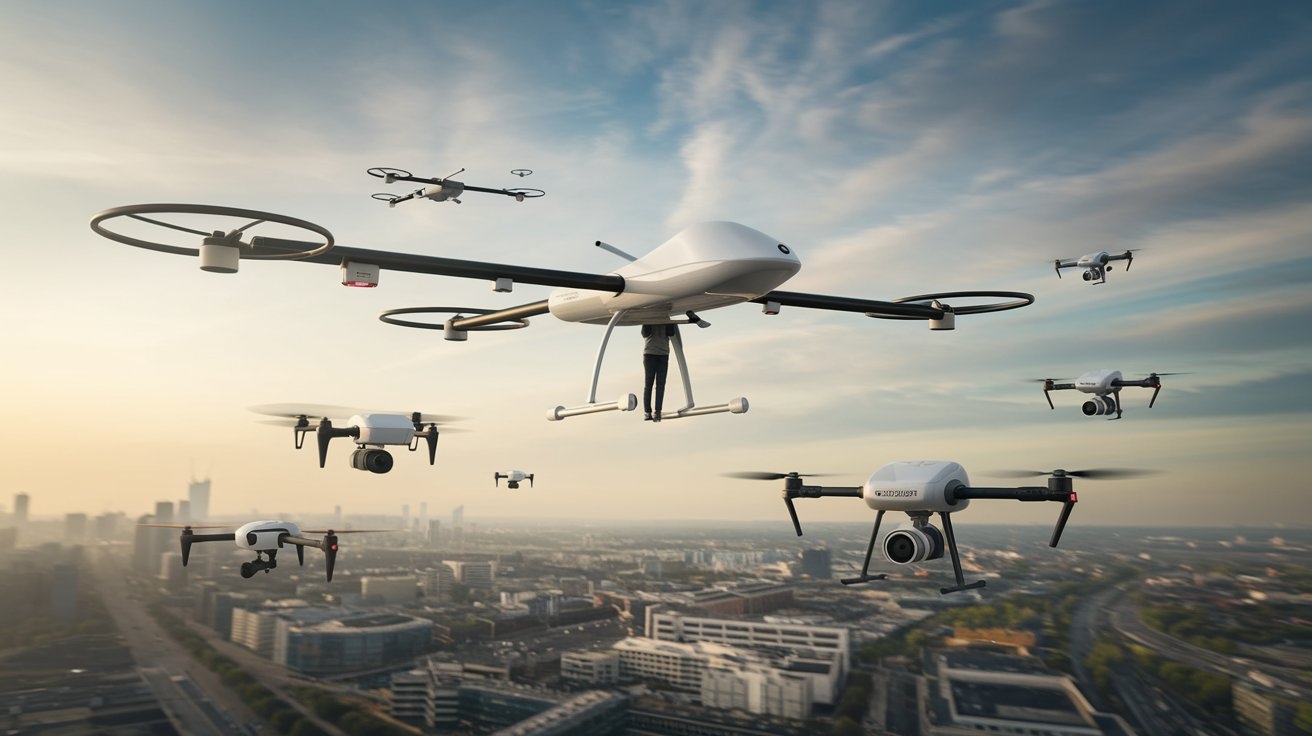
Commercialization has become one of the major growth drivers for the Drone Market. UAVs are being deployed across multiple industries to streamline operations and enhance data accuracy.
-
Agriculture: Drones equipped with multispectral and thermal sensors monitor crop health, detect pest infestations, and optimize irrigation. These applications improve yield quality while reducing costs and environmental impact.
-
Construction & Infrastructure: UAVs perform aerial mapping, progress tracking, and inspection of bridges, roads, and buildings. Real-time imaging enables faster decision-making and risk reduction.
-
Energy & Utilities: The Drone (UAV) Market supports remote inspection of power lines, offshore platforms, and renewable energy installations. This reduces downtime and improves worker safety.
-
Environmental Monitoring: Drones assist in tracking deforestation, wildlife, and natural disaster assessment, providing critical data for sustainability initiatives.
-
Healthcare & Logistics: Drones are increasingly used for emergency medical supply delivery in remote areas, helping save lives during natural disasters or pandemics.
These commercial applications are supported by regulatory advancements and technological readiness, driving broader adoption across global markets.
Defense and Security Applications
While commercial uses are expanding rapidly, defense remains a cornerstone of the Drone Market. Modern militaries rely on drones for intelligence, surveillance, reconnaissance (ISR), and combat operations. The Drone (UAV) Market is witnessing the emergence of loitering munitions, tactical drones, and stealth UAVs designed for multi-domain warfare.
Top defense companies such as Northrop Grumman, General Atomics, Lockheed Martin, Boeing Defense, and BAE Systems are investing in high-endurance and AI-driven combat drones. Platforms like the MQ-9 Reaper, RQ-4 Global Hawk, and X-47B demonstrate how unmanned systems are revolutionizing strategic and tactical missions.
Moreover, the rise of counter-drone solutions highlights the growing emphasis on airspace security. Companies like Dedrone, DroneShield, and Raytheon Technologies are developing radar and radio-frequency systems capable of detecting and neutralizing hostile UAVs.
Top Companies in the Drone Market
The Drone Market is highly competitive, with leading players offering differentiated technologies and services across commercial and defense applications.
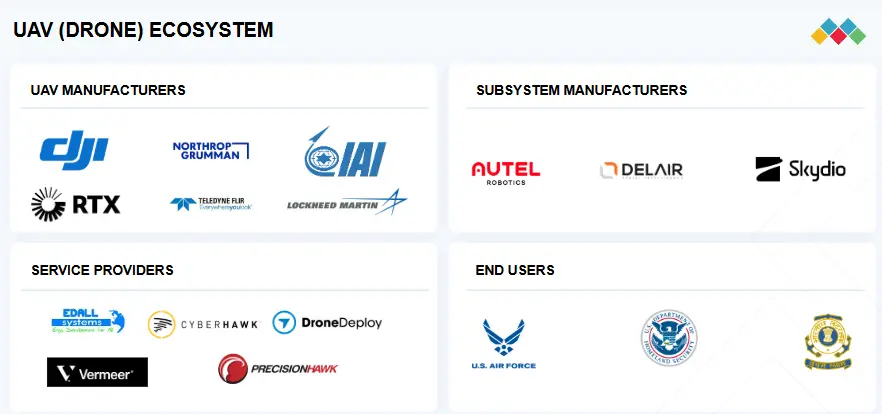
Top Drone Manufacturers and Technology Providers:
-
DJI (China): The global leader in consumer and enterprise drones, known for its innovation in camera technology and autonomous flight systems.
-
Parrot (France): Focuses on commercial UAVs for agriculture and mapping applications.
-
Autel Robotics (US): Provides high-performance drones for professional imaging and inspection.
-
Skydio (US): Specializes in AI-powered autonomous drones for defense, inspection, and infrastructure monitoring.
-
Teledyne FLIR (US): Known for its advanced thermal imaging sensors integrated into UAV platforms.
Defense and Aerospace Leaders:
-
Northrop Grumman, Boeing, General Atomics, Lockheed Martin, and Textron Systems dominate the defense UAV segment, emphasizing endurance, payload versatility, and autonomous mission execution.
Emerging Startups and Innovators:
-
Airobotics, Zipline, and Percepto are pioneering automated drone operations and industrial inspection solutions.
-
Wingtra and Kespry are transforming aerial mapping and geospatial data collection with hybrid VTOL drones.
These companies collectively define the competitive and innovative landscape of the Drone Market, driving forward both hardware and software evolution.
Regulatory and Airspace Modernization
A major catalyst for the expansion of the Drone Market is the continuous evolution of regulatory frameworks. Aviation authorities such as the Federal Aviation Administration (FAA) in the US, European Union Aviation Safety Agency (EASA), and Transport Canada are developing guidelines for safe drone operations, certification, and pilot training.
The implementation of UAS Traffic Management (UTM) systems has become crucial to integrate drones safely into low-altitude airspace. Additionally, Remote ID regulations are enhancing transparency and accountability by requiring drones to transmit identification data during flight.
Countries are also investing in digital airspace infrastructure to support autonomous drone corridors and cross-border UAV operations. This modernization effort ensures airspace safety while enabling scalability for commercial applications such as delivery, inspection, and mapping.
Investment and Market Opportunities
The global investment landscape for the Drone Market continues to expand, fueled by venture capital and government initiatives. Startups are attracting funding to develop next-generation drones featuring advanced autonomy, modular architecture, and cloud-based analytics platforms.
Major technology and aerospace companies are collaborating with software developers to enhance AI algorithms, improve battery efficiency, and enable swarm operations. Strategic partnerships between drone manufacturers, telecommunications providers, and logistics companies are creating end-to-end drone ecosystems capable of addressing complex business needs.
The Drone (UAV) Market also presents growth potential in defense modernization programs, smart city initiatives, and industrial automation. As urban air mobility (UAM) gains momentum, drones will play an essential role in infrastructure inspection, traffic monitoring, and aerial logistics.
Challenges and Restraints
Despite significant progress, the Drone Market faces several challenges that could affect its long-term scalability. Key restraints include airspace congestion, cybersecurity threats, and privacy concerns. Unauthorized drone flights, data breaches, and signal interference raise questions about security and compliance.
Battery limitations and weather sensitivity also constrain flight duration and reliability. However, R&D efforts are focusing on solid-state batteries, hydrogen fuel cells, and solar-powered propulsion systems to extend endurance. The development of robust encryption and data protection frameworks will be essential to maintaining trust in drone-based operations.
Future Outlook
The future of the Drone Market is closely tied to advancements in AI, 5G, and sustainable technologies. As drones become more autonomous, intelligent, and interconnected, they will play a central role in shaping smart cities, defense systems, and digital economies.
Emerging trends such as urban air mobility, autonomous cargo drones, and AI-based mission planning will further expand UAV capabilities. Governments and enterprises are expected to increase collaboration to harmonize regulations and integrate drones into national infrastructure.
Over the next decade, the convergence of defense-grade reliability with commercial innovation will drive exponential growth in both the Drone Market and Drone (UAV) Market. These unmanned systems will not only serve as tools for data collection and logistics but also as strategic assets for sustainability, national security, and industrial automation.
The Drone Market has entered an era of sustained expansion, supported by rapid technological progress, diversified applications, and robust investments. Drones are no longer peripheral technologies—they are integral to the future of mobility, security, and digital transformation.
80% of the Forbes Global 2000 B2B companies rely on MarketsandMarkets to identify growth opportunities in emerging technologies and use cases that will have a positive revenue impact.
- Food Packaging Market Size Set for Strong Growth Through 2030 Amid Rising Demand for Convenience Foods
- Crop Protection Chemical Market Size, Share & Growth Forecast (2025–2030)
- Mulch Films Market: Driving Sustainable Agriculture Through Innovation
- Agricultural Adjuvants Market Analysis, Trends, and Growth Outlook (2026–2031)
- Japan Enterprise Asset Management Market Growth: AI and Smart Infrastructure Drive Demand

