

Home/ Aerospace and Defense / from-soldiers-to-systems-how-military-robots-are-reshaping-the-battlefield-of-the-future

From Soldiers to Systems: How Military Robots Are Reshaping the Battlefield of the Future

MarketsandMarkets™ Research Private Ltd,, 17 Jun 2026
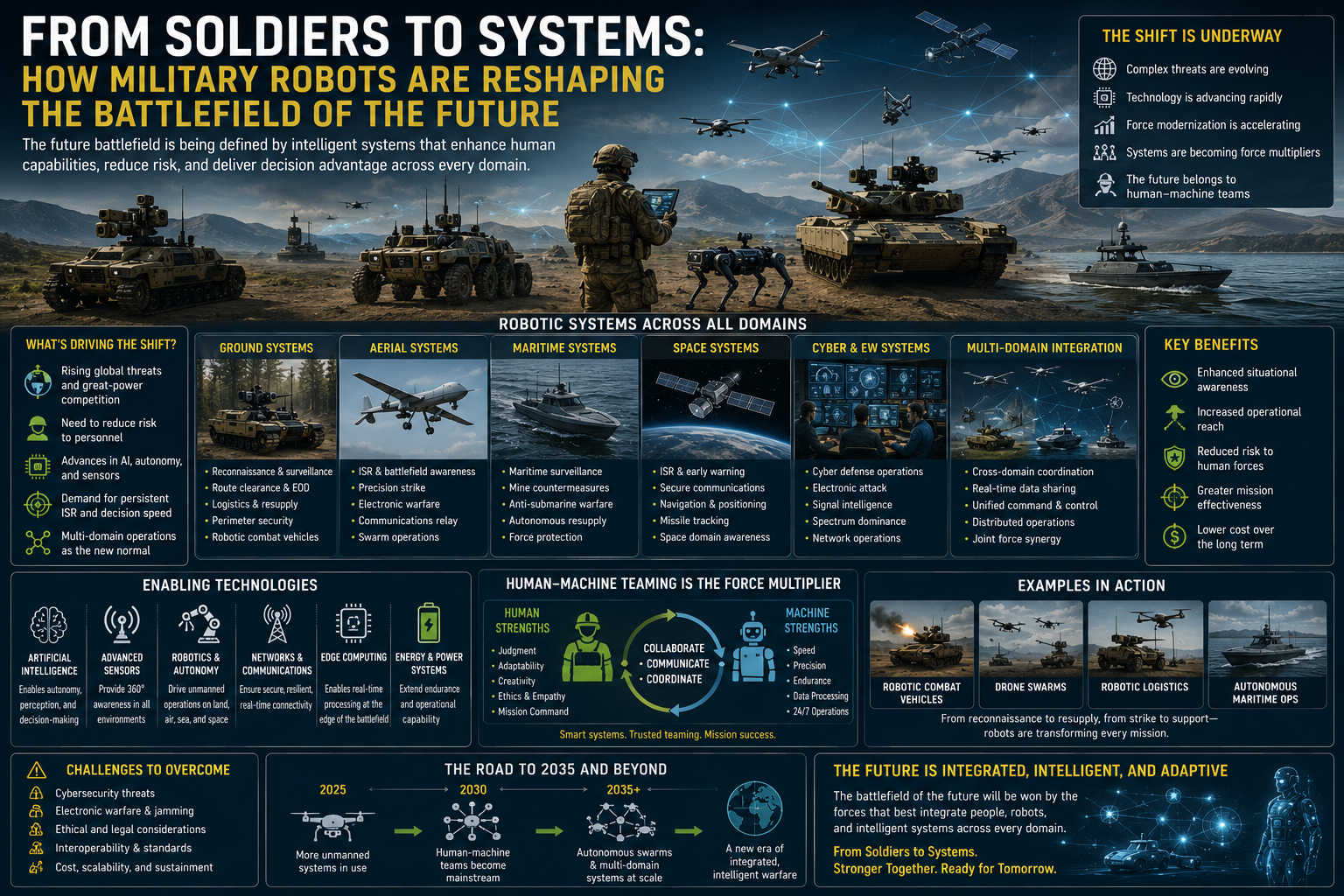
Modern warfare is undergoing a profound technological transformation as military organizations increasingly integrate robotic systems, artificial intelligence (AI), and autonomous platforms into their operational frameworks. What was once a battlefield dominated by human-operated equipment is rapidly evolving into an interconnected ecosystem of intelligent machines capable of performing reconnaissance, logistics, surveillance, electronic warfare, and combat support missions. As geopolitical tensions rise and defense modernization programs accelerate worldwide, military robots are emerging as critical assets that enhance operational effectiveness, reduce risks to personnel, and support decision-making in increasingly complex combat environments.

The shift from soldier-centric operations to system-enabled warfare does not imply the replacement of human warfighters. Instead, it reflects the growing importance of human-machine teaming, where soldiers collaborate with autonomous platforms to achieve greater battlefield awareness, faster response times, and improved mission outcomes. By 2035, military robots are expected to become an indispensable component of future defense strategies across land, air, sea, space, and cyber domains.

Evolving Threat Environments Driving Robotic Adoption

Military forces today face a diverse and rapidly expanding range of threats that require greater speed, precision, and adaptability than traditional force structures can provide.

Emerging challenges include:

  • Drone swarm attacks
  • Precision-guided munitions
  • Electronic warfare operations
  • Contested urban environments
  • Hypersonic weapons
  • Multi-domain conflicts
  • Near-peer military competition

These threats are forcing defense organizations to invest in technologies capable of operating effectively in highly contested and dynamic environments.

Military robots offer significant advantages by extending operational reach, improving situational awareness, and enabling forces to operate in dangerous areas without exposing personnel to unnecessary risk.

Download Sample of Report: https://www.marketsandmarkets.com/pdfdownloadNew.asp?id=245516013

Human-Machine Teaming Becoming the New Combat Model

One of the most important trends shaping modern defense operations is the rise of human-machine teaming.

Rather than replacing soldiers, military robots are increasingly designed to augment human capabilities through collaborative operations.

Human-machine teaming enables:

  • Faster battlefield decision-making
  • Enhanced situational awareness
  • Reduced cognitive workload
  • Improved operational coordination
  • Increased force survivability
  • Greater mission effectiveness

Robotic systems can process vast amounts of information, identify threats, and recommend courses of action while human operators retain command authority and strategic oversight.

This collaborative approach is expected to define the future battlefield.

Artificial Intelligence Transforming Military Operations

Artificial intelligence serves as the technological foundation for next-generation military robotics.

AI-powered systems support:

  • Autonomous navigation
  • Threat detection
  • Target recognition
  • Mission planning
  • Sensor fusion
  • Predictive analytics
  • Route optimization

Modern AI algorithms can rapidly analyze information from multiple sensors and operational networks, helping commanders make informed decisions in real time.

As battlefield data volumes continue to grow, AI-enabled systems will become increasingly important for maintaining operational superiority.

Autonomous Ground Robots Expanding Battlefield Roles

Ground-based military robots are evolving far beyond traditional support missions.

Modern unmanned ground vehicles (UGVs) now perform tasks such as:

  • Reconnaissance and surveillance
  • Route clearance
  • Explosive ordnance disposal
  • Logistics resupply
  • Casualty evacuation
  • Perimeter security
  • Combat support operations

Future robotic ground systems are expected to incorporate greater autonomy, allowing them to navigate challenging terrain, avoid obstacles, and operate collaboratively with other autonomous platforms.

These capabilities reduce risks to personnel while increasing operational flexibility in complex combat environments.

Robotic Combat Vehicles Redefining Military Mobility

The emergence of robotic combat vehicles (RCVs) is transforming battlefield mobility and force projection.

Advanced RCVs can support:

  • Armed reconnaissance
  • Direct-fire support
  • Anti-armor operations
  • Urban combat missions
  • Force protection
  • Forward area security

These platforms can operate in contested zones while reducing exposure of human crews to hostile threats.

As autonomy technologies mature, robotic combat vehicles are expected to become integral components of mechanized warfare and future combat formations.

Autonomous Aerial Systems Enhancing Battlefield Awareness

Military drones have already revolutionized modern warfare, but future systems will feature significantly enhanced autonomy and intelligence.

Advanced unmanned aerial systems (UAS) support:

  • Intelligence, surveillance, and reconnaissance (ISR)
  • Precision strike missions
  • Electronic warfare operations
  • Communications relay
  • Border security
  • Maritime surveillance
  • Autonomous swarm missions

AI-enabled drones can operate independently or as coordinated groups, providing persistent battlefield awareness and expanding operational reach.

Their ability to deliver real-time intelligence makes them essential tools for modern military operations.

Swarm Intelligence Creating New Tactical Advantages

Swarm robotics is becoming one of the most disruptive innovations in military technology.

Swarm systems consist of multiple autonomous platforms that coordinate actions using distributed intelligence and real-time communication.

Potential applications include:

  • Area surveillance
  • Electronic warfare
  • Target saturation
  • Reconnaissance operations
  • Decoy missions
  • Precision strike coordination
  • Logistics support

Because capabilities are distributed across many platforms, swarm systems offer enhanced resilience and adaptability compared to traditional single-platform solutions.

Defense agencies worldwide are investing heavily in swarm technologies as part of future autonomous warfare strategies.

Autonomous Logistics Transforming Military Sustainment

Logistics remains one of the most critical elements of military success, and robotics is increasingly reshaping sustainment operations.

Emerging autonomous logistics technologies include:

Unmanned Resupply Vehicles

Autonomous platforms transporting supplies to forward operating positions.

Logistics Drones

Aerial systems delivering ammunition, medical supplies, and critical equipment.

Robotic Warehousing

Automated inventory management and distribution systems.

Autonomous Maritime Logistics

Uncrewed vessels supporting naval sustainment missions.

These solutions improve supply chain resilience while reducing operational risks in contested environments.

Multi-Domain Operations Driving Robotic Integration

Future military operations increasingly require coordination across multiple operational domains.

Modern Multi-Domain Operations (MDO) encompass:

  • Land warfare
  • Air operations
  • Maritime missions
  • Space-based systems
  • Cyber operations
  • Electromagnetic spectrum activities

Military robots are becoming critical enablers of MDO by providing:

  • Persistent intelligence collection
  • Real-time communications
  • Cross-domain data sharing
  • Distributed mission execution
  • Enhanced operational coordination

The ability to integrate robotic systems across domains will become increasingly important as future conflicts grow more interconnected.

Electronic Warfare and Cyber Resilience Becoming Essential

Military robots must operate effectively in environments where communications and navigation systems may be disrupted.

Future robotic systems require:

  • Secure communications networks
  • Anti-jamming capabilities
  • Autonomous navigation technologies
  • Cybersecurity protections
  • Electronic warfare resilience

Defense organizations are investing heavily in these capabilities to ensure robotic platforms remain operational under contested conditions.

Cyber resilience is rapidly becoming a core requirement for next-generation military robotics.

Challenges Facing Military Robotics Adoption

Despite strong growth prospects, several challenges remain.

Ethical Considerations

Ensuring meaningful human oversight of autonomous systems.

Operational Reliability

Maintaining performance under complex battlefield conditions.

Interoperability Requirements

Integrating robots with existing military platforms and allied networks.

Cybersecurity Risks

Protecting autonomous systems from cyberattacks and electronic interference.

Technology Costs

Advanced robotic systems require significant investment in research, development, and deployment.

Addressing these challenges will be critical to maximizing the benefits of military robotics.

Future Outlook

The future battlefield will not be defined solely by soldiers or machines but by the effective integration of both. Military robots are evolving from specialized support tools into highly capable systems that enhance combat effectiveness, improve battlefield awareness, and support decision-making across all domains of warfare.

Several trends are expected to shape the next generation of military robotics:

  • AI-powered combat support systems
  • Human-machine teaming ecosystems
  • Autonomous robotic combat vehicles
  • Intelligent drone swarms
  • Multi-domain robotic operations
  • Autonomous logistics networks
  • Predictive battlefield analytics

As defense organizations continue investing in advanced robotics and artificial intelligence, the transition from soldiers to systems will accelerate. The convergence of autonomy, AI, advanced sensors, and network-centric warfare is creating a new era of military capability where intelligent systems work alongside human operators to deliver greater operational effectiveness, enhanced survivability, and sustained battlefield superiority in the conflicts of the future.


DMCA.com Protection Status

