

Unmanned Surface Vehicles (USV) Technology Innovation: Key Trends, Growth Drivers and Opportunities
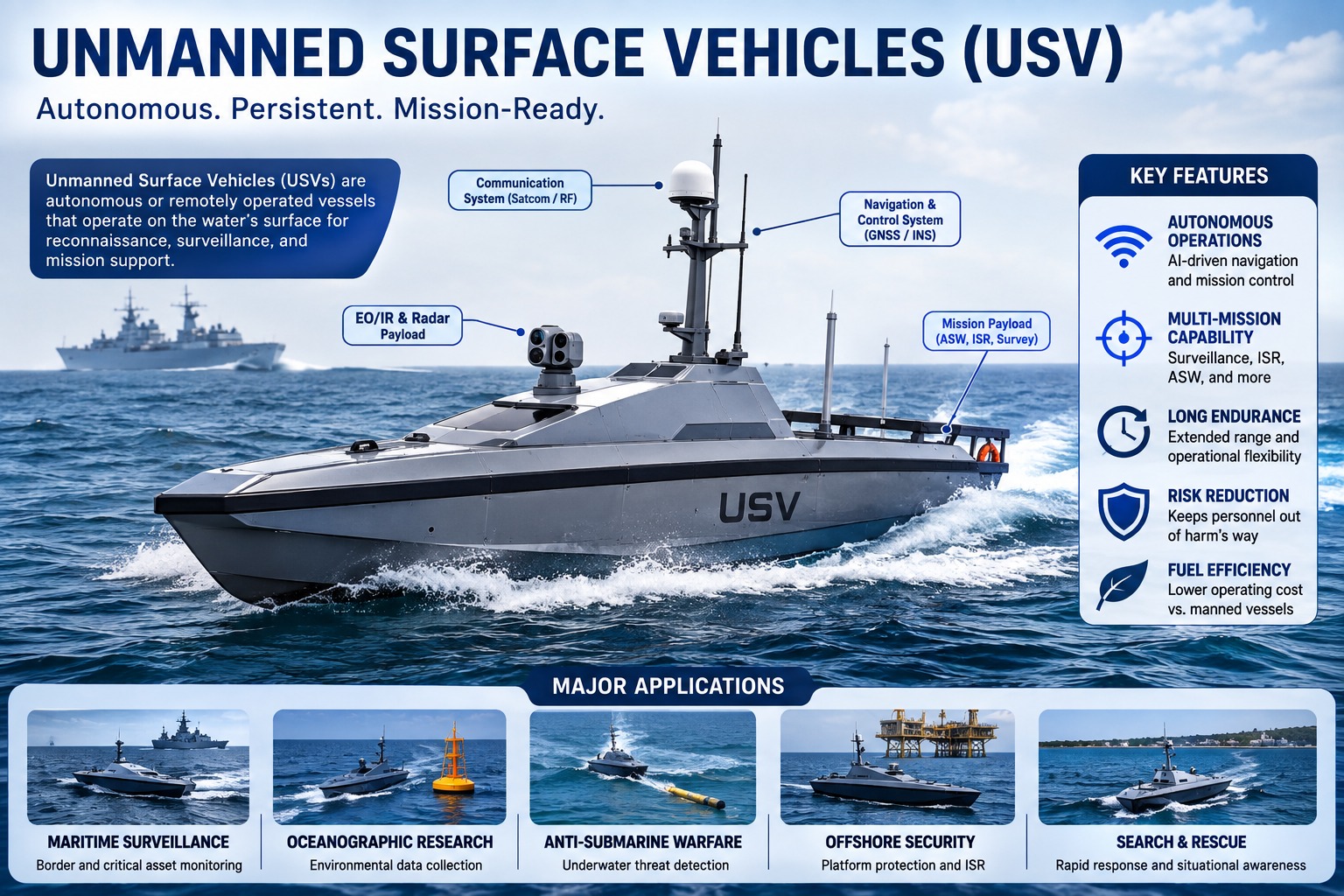
Introduction to unmanned surface vehicle technology
In the rapidly evolving world of maritime technology, Unmanned Surface Vehicles (USVs) have emerged as a transformative innovation, changing the way governments, defense organizations, researchers, and commercial operators conduct operations on the water. These autonomous or remotely operated vessels can perform missions without requiring personnel onboard, enabling safer, more efficient, and increasingly data-driven maritime operations. From ocean monitoring and hydrographic surveying to maritime security and offshore inspection, USVs are opening new possibilities across the maritime ecosystem. The development of Unmanned Surface Vehicles (USV) technology combines advances in autonomous navigation, sensors, communications, propulsion, artificial intelligence, and control systems. As organizations seek to improve operational efficiency while reducing risks and costs, USVs are becoming increasingly valuable platforms for missions that can be repetitive, hazardous, remote, or difficult to access.
History of unmanned surface vehicles
The concept of unmanned maritime operations has evolved alongside developments in radio control, marine robotics, navigation, and autonomous systems. Early remotely operated vessels were primarily developed for specialized military and research applications, where removing personnel from hazardous environments offered significant operational advantages. As computing power, satellite navigation, sensors, wireless communications, and robotics advanced, USVs evolved from relatively simple remotely controlled platforms into sophisticated autonomous systems. Modern USVs can integrate navigation, propulsion, communication, payload, guidance, and control technologies, allowing them to undertake increasingly complex missions with limited human intervention. Today, the technology is expanding beyond defense applications into hydrographic surveying, environmental monitoring, offshore energy, port operations, oceanographic research, and infrastructure inspection.
Benefits of unmanned surface vehicle technology
Unmanned surface vehicle technology offers numerous advantages compared with conventional crewed maritime platforms:
- Improved Safety: USVs can perform missions in hazardous or difficult environments without placing crew members directly at risk.
- Operational Efficiency: Autonomous systems can conduct repetitive monitoring, surveying, and inspection missions with reduced dependence on onboard personnel.
- Long-Endurance Operations: Advanced propulsion and energy systems can enable USVs to remain operational for extended periods, supporting persistent maritime monitoring.
- Cost Optimization: By reducing crew requirements and enabling automated operations, USVs can potentially lower operational costs across suitable missions.
Current market size and growth trends of the unmanned surface vehicles industry
The global unmanned surface vehicles market is experiencing strong growth as demand increases for autonomous maritime operations, ocean monitoring, marine data collection, defense modernization, and offshore applications. According to MarketsandMarkets, the global Unmanned Surface Vehicles (USV) Market size was valued at USD 0.82 billion in 2025 and is projected to reach USD 1.59 billion by 2030, growing at a CAGR of 14.1% from 2025 to 2030. The volume of USVs is also projected to increase from 2,036 units in 2025 to 4,010 units by 2030.
This rapid growth can be attributed to several factors, including:
- Increasing demand for ocean monitoring and marine data mapping
- Rising investments in naval modernization and maritime security
- Growing adoption of autonomous hydrographic and seabed surveys
- Increasing use of USVs for environmental monitoring and offshore operations
- Advancements in autonomous navigation, communications, sensors, and propulsion
MarketsandMarkets identifies autonomous surface vehicles as the fastest-growing type segment, while the defense application segment is expected to register the highest CAGR. Asia Pacific is projected to be the fastest-growing regional market during the forecast period.
Key drivers and factors influencing the future of unmanned surface vehicles
Several key drivers and factors are shaping the future of USV technology:
- Marine Environmental Monitoring: Growing attention to water quality, pollution detection, ocean conservation, and marine resource management is increasing demand for autonomous platforms capable of collecting environmental data.
- Maritime Security: Increasing maritime security requirements are encouraging governments and defense organizations to explore unmanned systems for surveillance, monitoring, and other maritime missions.
- Technological Advancements: Improvements in artificial intelligence, sensors, communications, navigation, robotics, and propulsion are making USVs more capable and reliable.
- Offshore Industry Adoption: Oil and gas, offshore energy, ports, and infrastructure operators are increasingly exploring USVs for inspection, mapping, and monitoring.
- Operational Safety: The ability to perform missions without placing crews directly in hazardous environments is an important factor supporting USV adoption.
Emerging trends in unmanned surface vehicle technology
The future of USV technology is being shaped by several exciting trends and innovations:
- Advanced Autonomous Navigation: USVs are increasingly incorporating sophisticated navigation and control systems that allow vessels to operate with reduced human intervention.
- AI-Enabled Operations: Artificial intelligence and machine learning are being explored for navigation, environmental interpretation, anomaly detection, route optimization, and decision-support functions.
- Long-Endurance Platforms: Advances in propulsion, energy management, solar power, and hybrid technologies are supporting longer-duration missions and persistent maritime monitoring.
- Multi-Sensor Integration: USVs can integrate cameras, radar, sonar, environmental sensors, communications systems, and other payloads to collect diverse types of maritime data.
- Zero-Emission Operations: Growing sustainability requirements are encouraging the development of electric, solar-assisted, and other lower-emission USV architectures for suitable applications.
Opportunities and challenges in the unmanned surface vehicles market
As the USV market continues to evolve, it presents numerous opportunities for businesses and technology providers:
- Market Expansion: Growing demand from defense, offshore energy, environmental monitoring, hydrographic surveying, and commercial maritime operations creates opportunities for USV manufacturers and technology suppliers.
- Technology Innovation: Companies investing in autonomous navigation, AI, sensors, propulsion, communications, and energy management can differentiate their solutions in a rapidly developing market.
- Defense Adoption: Increasing use of USVs in maritime security, surveillance, mine countermeasure, and other naval missions creates substantial opportunities for specialized defense technology providers.
- Commercial Applications: Offshore inspection, port management, seabed mapping, environmental research, and infrastructure monitoring provide opportunities beyond traditional defense applications.
However, the USV market also faces several challenges that need to be addressed:
- High Development and Maintenance Costs: Sophisticated sensors, navigation systems, software, propulsion technologies, and communications equipment can increase acquisition and lifecycle costs.
- Cybersecurity Risks: Increasing connectivity and autonomy expose USVs to cybersecurity threats that can affect communications, data integrity, and system operations.
- Collision Avoidance: Developing robust collision-avoidance capabilities for complex maritime environments remains an important technological challenge.
- Navigation Regulations: Clear operational frameworks and maritime navigation rules for autonomous vessels are important for wider commercial deployment.
MarketsandMarkets highlights high development and maintenance costs as a restraint and identifies cybersecurity threats and the absence of robust collision-avoidance systems as important challenges.
Innovations and advancements in unmanned surface vehicle technology
The future of USVs is being shaped by a multitude of innovative technologies and advancements:
- Autonomous Navigation Systems: Advanced navigation technologies are enabling USVs to determine routes, maintain course, and operate with increasing levels of autonomy.
- AI and Machine Learning: Intelligent software can support maritime data interpretation, navigation assistance, anomaly detection, and operational optimization.
- Advanced Propulsion: Electric, hybrid, solar-assisted, and highly efficient propulsion systems are being developed to extend endurance and support sustainable maritime operations.
- Integrated Sensor Platforms: High-performance radar, sonar, optical, environmental, and positioning sensors are enabling USVs to collect detailed information for diverse missions.
- Modular Payload Systems: Modular architectures allow USVs to be configured for different missions by integrating specialized sensors, communications equipment, inspection systems, or other payloads.
Future applications and industries that will benefit from unmanned surface vehicles
The future of unmanned surface vehicle technology holds immense potential across a wide range of applications and industries:
- Defense and Maritime Security: USVs can support surveillance, reconnaissance, maritime domain awareness, mine countermeasure operations, and coastal monitoring while reducing personnel exposure to hazardous environments.
- Hydrographic Surveying: Autonomous vessels can collect bathymetric and seabed information in shallow, remote, or difficult-to-access waters, improving survey efficiency.
- Environmental Monitoring: USVs can monitor water quality, pollution, marine ecosystems, and environmental conditions while collecting data over extended periods.
- Oil and Gas Industry: Offshore operators can use USVs for infrastructure inspection, subsea support, mapping, and monitoring, potentially reducing the need for crewed vessels.
- Offshore Renewable Energy: USVs can support inspection and monitoring of offshore wind farms, cables, foundations, and surrounding marine environments.
- Ports and Commercial Maritime Operations: Autonomous surface platforms can support port surveying, infrastructure inspection, security monitoring, and other operational activities.
Conclusion: The promising future of unmanned surface vehicle technology
The future of unmanned surface vehicle technology is filled with exciting possibilities and transformative advancements. As maritime organizations increasingly seek safer, smarter, more efficient, and sustainable ways to operate on the water, USVs will play an increasingly important role in shaping the next generation of maritime operations. From autonomous navigation and AI-enabled systems to advanced sensors, long-endurance propulsion, and modular payload architectures, technological innovation is expanding the capabilities and applications of USVs. The market outlook reflects this momentum, with MarketsandMarkets projecting growth from USD 0.82 billion in 2025 to USD 1.59 billion by 2030 at a CAGR of 14.1%.
However, realizing the full potential of USVs will require continued research and development to address cybersecurity, collision avoidance, navigation regulations, system reliability, and lifecycle costs. Collaboration among technology companies, maritime operators, defense organizations, researchers, regulators, and infrastructure providers will be crucial in creating an ecosystem capable of supporting safe and scalable autonomous maritime operations. As the maritime industry moves toward increasingly connected, autonomous, and data-driven systems, USVs are positioned to become an important technology platform across defense, environmental monitoring, offshore energy, surveying, research, and commercial operations.
Discover the latest advancements, market trends, and growth opportunities in unmanned surface vehicle technology through the MarketsandMarkets research report. Explore how autonomous navigation, advanced sensors, AI, propulsion, and communications are transforming the global maritime technology landscape and creating new opportunities for businesses and technology innovators.
Download Sample Research Report for Unmanned Surface Vehicles Market Future @ https://www.marketsandmarkets.com/Market-Reports/unmanned-surface-vehicle-market-220162588.html
80% of the Forbes Global 2000 B2B companies rely on MarketsandMarkets to identify growth opportunities in emerging technologies and use cases that will have a positive revenue impact.
- Food Packaging Market Size Set for Strong Growth Through 2030 Amid Rising Demand for Convenience Foods
- Mulch Films Market: Driving Sustainable Agriculture Through Innovation
- Agricultural Adjuvants Market Analysis, Trends, and Growth Outlook (2026–2031)
- Crop Protection Chemical Market Size, Share & Growth Forecast (2025–2030)
- Japan Enterprise Asset Management Market Growth: AI and Smart Infrastructure Drive Demand


