Unmanned Surface Vehicles (USV) Market Size, Share, Growth & Trends

Unmanned Surface Vehicles Market by Type (ROSV, ASV), Application (Defense, Commercial), Speed (<10, 10-30, >30 Knots), Endurance (<100, 100-500, >1,000 Hours), Hull Type (Single, Twin, Rigid Inflatable), Launch Mode, Power Source -Global Forecast to 2031




UNMANNED SURFACE VEHICLES (USV) MARKET SIZE, SHARE & TRENDS
According to Marketsandmarkets, The global Unmanned Surface Vehicles (USV) Market size was valued at USD 0.98 billion in 2026 and is projected to reach USD 1.92 billion by 2031, growing at a CAGR of 14.3% from 2026 to 2031. In terms of volume (new deliveries), the market is projected to reach 4,615 units by 2031, rising from 2,318 units in 2026. Growth in this market is driven by the adoption of autonomous platforms for maritime surveillance, hydrographic surveying, ocean monitoring, and offshore inspection. The US Navy reported in 2026 that it operates lots of small USVs and was expanding their use across multiple theaters. NOAA is also deploying USVs for hydrographic and oceanographic missions, including long-duration autonomous surveys. These developments are increasing demand for longer endurance, autonomous navigation, reliable communications, modular payloads, and multi-USV operations.
REPORT SCOPE
| REPORT METRIC | DETAILS |
|---|---|
| Market Size in 2025 (Value) | USD 0.86 Billion |
| Market Size in 2026 (Value) | USD 0.98 Billion |
| Market Forecast in 2031 (Value) | USD 1.92 Billion |
| Growth Rate | CAGR of 14.3% |
| Market Size in 2025 (Units) | 2,036 |
| Market Size in 2026 (Units) | 2,318 |
| Market Forecast in 2031 (Units) | 4,615 |
| Years Considered | 2021–2031 |
| Base Year | 2025 |
| Forecast Period | 2026–2031 |
| Units Considered | USD Billion |
| Report Coverage | Revenue Forecast, Company Ranking, Competitive Landscape, Growth Factors, and Trends |
| Top Companies |
|
| Growth Drivers |
|
| Segments Covered |
|
| Regions Covered | North America, Europe, Asia Pacific, Middle East & Africa, Latin America |
KEY TAKEAWAYS
-
By RegionThe Asia Pacific region is projected to register a CAGR of 16.5% during the forecast period
-
By ApplicationBy application, the defense & security segment is expected to register the highest growth rate of 15.8% during the forecast period.
-
By Length OverallBy length overall, the extra-large (>50 meters) segment will register the highest CAGR of 19.1% during the forecast period.
-
Competitive Landscape - Key PlayersL3Harris Technologies, Inc. (US), Exail Technologies (France), and Textron Inc. (US) were identified as key players in the unmanned surface vehicles market, given their strong market share and product footprint.
-
Competitive Landscape - Startups/SMEsMaritime Robotics AS has identified itself among SMEs by securing a strong foothold in specialized niche areas, underscoring its potential as an emerging market leader.
The growth of the Unmanned Surface Vehicles (USVs) Industry is driven by the rising adoption of these vehicles for various applications, including naval surveying, operations, ocean monitoring, and maritime security. In 2026, the US Navy reported that it was operating hundreds of small USVs and expanding their use across multiple theaters. Additionally, seven companies were selected for at-sea testing as part of the Navy's Medium Unmanned Surface Vessel program. The National Oceanic and Atmospheric Administration (NOAA) is also utilizing USVs for multi-day hydrographic surveys and coordinated ocean observation missions. These developments are increasing the demand for features such as autonomous navigation, longer endurance, modular payloads, reliable communications, and coordinated operations involving multiple USVs.
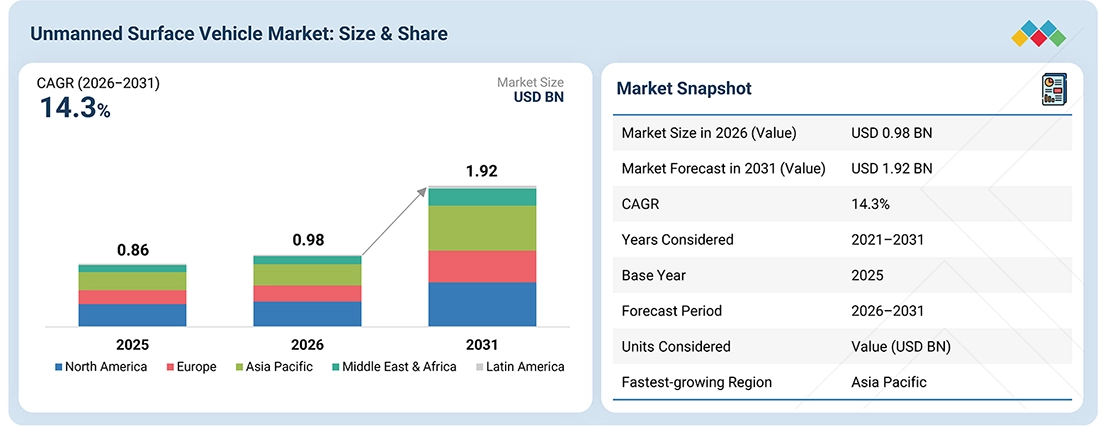
Source: Secondary Research, Interviews with Experts, MarketsandMarkets Analysis
TRENDS & DISRUPTIONS IMPACTING CUSTOMERS' CUSTOMERS
The unmanned surface vehicles market is increasingly influenced by defense and commercial maritime operators shifting from standalone remotely operated platforms toward autonomous, connected, and modular systems. Historically, the market relied mainly on USV platform sales, propulsion systems, communication equipment, navigation systems, and mission payloads, while newer revenue opportunities are emerging through multi-USV fleet operations, remote operations centers, software upgrades, autonomous mission management, and USV-as-a-service. Demand is being shaped by the need for persistent maritime surveillance, longer-duration missions, accurate hydrographic surveys, offshore inspection and continuous ocean monitoring. At the same time, naval and commercial operators are adopting open-system architectures, modular payloads, secure communications and autonomous navigation to support different missions and operating environments. These changes are shifting the unmanned surface vehicles market toward more autonomous, interoperable, and software-enabled systems, with defense organizations, commercial operators, research institutions, and maritime service providers becoming increasingly important across the value chain.
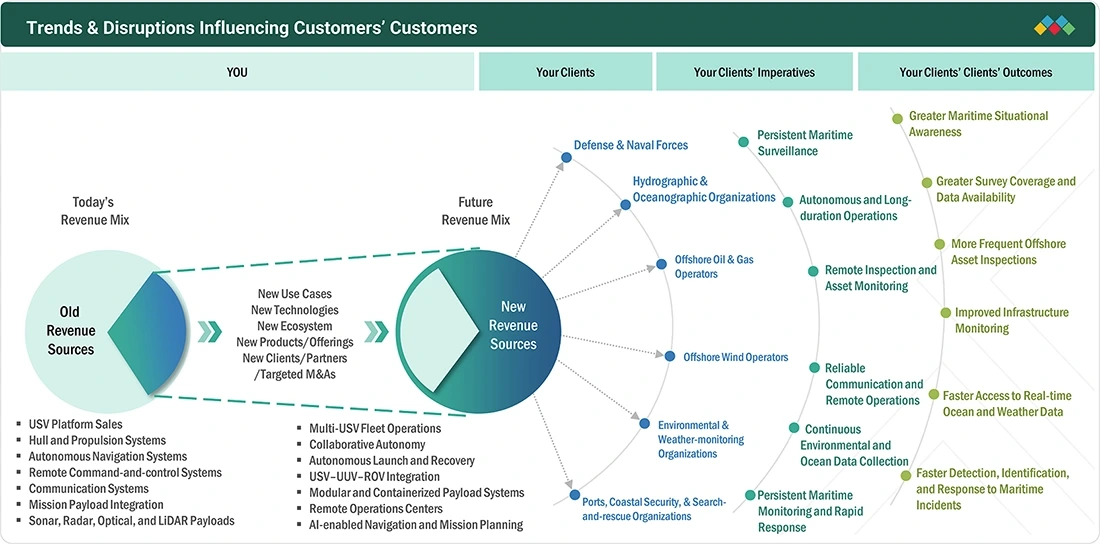
Source: Secondary Research, Interviews with Experts, MarketsandMarkets Analysis
MARKET DYNAMICS

Level
-
Growing naval adoption of autonomous and uncrewed systems for ISR, MCM, ASW, and maritime security

-
Rising demand for hydrographic survey, seabed mapping, and offshore asset inspection


Level
-
Evolving regulatory, certification, and COLREGs compliance requirements

-
High upfront cost of platforms, payloads, communication links, and systems integration


Level
-
Expansion of USV-as-a-service and mission-as-a-service models

-
Offshore wind, subsea cable, pipeline, and critical maritime infrastructure inspection


Level
-
Safe autonomous navigation in congested and mixed-traffic maritime environments

-
Cybersecurity, GNSS-denied navigation, and communications resilience

Source: Secondary Research, Interviews with Experts, MarketsandMarkets Analysis
Driver: Growing naval adoption of autonomous and uncrewed systems for ISR, MCM, ASW, and maritime security
There is a growing adoption of autonomous USVs by naval forces, which is supporting demand across ISR, mine countermeasures, maritime surveillance, as well as fleet operations. The US Navy reported hundreds of small USVs in 2026 and is expanding medium USV deployment, including integration with crewed forces and modular payloads.
Restraint: Evolving regulatory, certification, and COLREGs compliance requirements
USVs have to follow rules for safe navigation, remote operation, and vessel control. The IMO adopted the MASS Code in 2026, which covers navigation, remote operations, risk assessment and human oversight for applicable autonomous ships. These requirements can make USV testing and deployment more time-consuming.
Opportunity: Expansion of USV-as-a-Service and Mission-as-a-Service models
USV-as-a-service models let customers use USV sensors and data services without buying the full platform. This approach can support applications such as ocean surveys, environmental monitoring, maritime security, and offshore inspection while reducing the need for customers to manage the vessel themselves.
Challenge: Safe autonomous navigation in congested and mixed-traffic maritime environments
USVs might operate near fishing boats, commercial ships, naval vessels, and other autonomous systems. They need reliable navigation, collision avoidance, communication, and monitoring systems to operate safely in these conditions. Human operators may also need to intervene when the situation is difficult for autonomous systems to handle.
UNMANNED SURFACE VEHICLES (USV) MARKET SIZE, SHARE, GROWTH & TRENDS: COMMERCIAL USE CASES ACROSS INDUSTRIES
| COMPANY | USE CASE DESCRIPTION | BENEFITS |
|---|---|---|
 |
Saildrone develops and operates USVs for maritime surveillance, ocean mapping, undersea detection, and environmental data collection. Its platforms are used by defense and scientific organizations for long-duration missions, including hurricane observations, ocean monitoring, and maritime data collection. | Supports persistent maritime surveillance | Enables long-duration ocean monitoring | Provides real-time environmental and maritime data | Supports integration of mission-specific payloads |
 |
Exail provides DriX USVs for hydrographic surveying, oceanographic monitoring, maritime domain awareness, and defense missions. The DriX H-9 is designed for extended autonomous operations and can support hydrographic and oceanographic missions using integrated navigation, communication, and survey payloads. | Supports long-duration survey operations | Enables high-resolution hydrographic data collection | Supports maritime domain awareness | Reduces dependence on continuous crewed survey operations |
 |
Kongsberg provides Sounder USVs for hydrographic and oceanographic applications, with integrated autonomous navigation, communication, situational-awareness, and hydroacoustic capabilities. The platforms are designed to collect seabed and water-column data while operating remotely or autonomously. | Supports hydrographic and seabed surveys | Enables integration of acoustic payloads | Supports autonomous data collection | Provides remote mission-control capabilities |
Logos and trademarks shown above are the property of their respective owners. Their use here is for informational and illustrative purposes only.
MARKET ECOSYSTEM
The unmanned surface vehicles market ecosystem consists of USV platform OEMs and manufacturers, payload, sensor and subsystem providers, autonomy software, C2 and communication providers, service providers, operators, system integrators, and end users involved in the development, integration, operation, and deployment of USVs. USV platform manufacturers develop vessels for defense and commercial missions, while payload and subsystem providers supply sonar, radar, optical systems, LiDAR, propulsion, navigation, and other mission equipment. Autonomy software, C2, and communication providers support autonomous navigation, remote control, data exchange and coordination between USVs and other platforms. Service providers, operators, and system integrators support testing, maintenance, mission operations, system integration, and fleet management. End users include naval forces, maritime security agencies, hydrographic and oceanographic organizations, offshore operators, environmental agencies, ports, and search-and-rescue organizations. Together, these stakeholders support the development and deployment of USVs across defense, commercial, and scientific maritime applications.
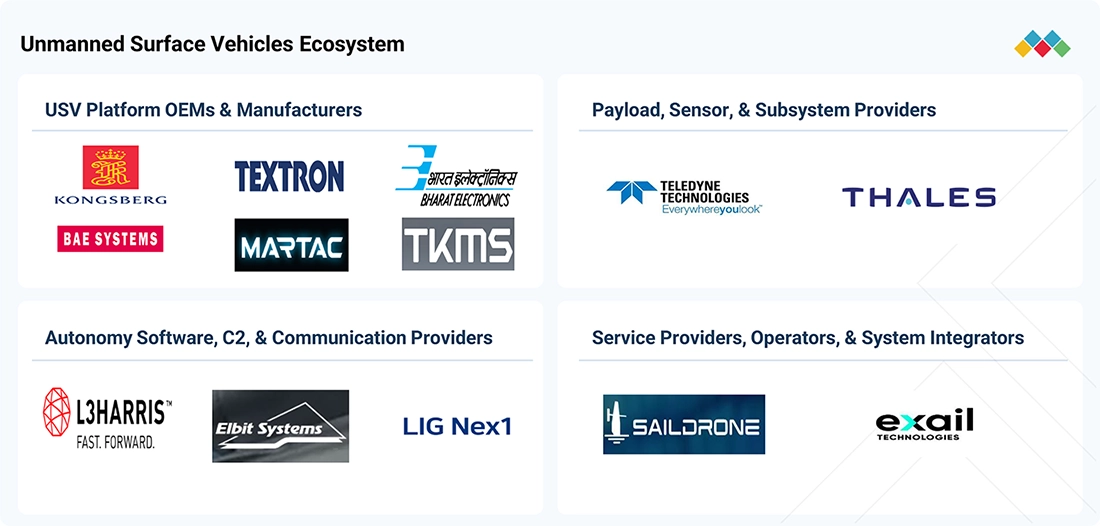
Logos and trademarks shown above are the property of their respective owners. Their use here is for informational and illustrative purposes only.
MARKET SEGMENTS
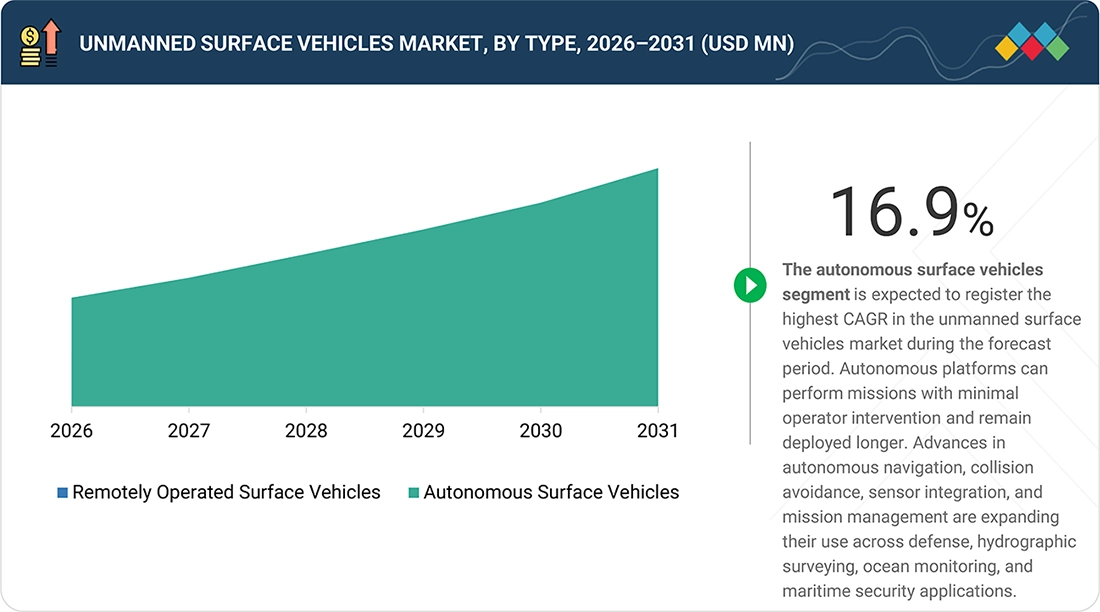
Source: Secondary Research, Interviews with Experts, MarketsandMarkets Analysis
Unmanned Surface Vehicles Market ,by Type
The autonomous surface vehicles segment is expected to account for the largest share of the unmanned surface vehicles market, supported by increasing demand for autonomous operations in defense and commercial maritime applications. Growing adoption for surveillance, mine countermeasures, hydrographic surveys, and ocean monitoring is supporting demand. Advances in autonomous navigation, collision avoidance, and remote monitoring further enable longer, more efficient missions.
Unmanned Surface Vehicles Market, by Length Overall
The extra-large (>50 meters) segment is expected to account for the largest share of the unmanned surface vehicles market, supported by rising demand for long-endurance, high-payload platforms for defense and commercial missions. These larger USVs can accommodate advanced sensors, communication systems, and multiple mission payloads. They have greater fuel and power capacity, which also supports extended operations and complex missions.
Unmanned Surface Vehicles Market, by Application
The defense & security segment is expected to account for the largest market share in the unmanned surface vehicles market, supported by the growing use of USVs for maritime surveillance, ISR, mine countermeasures, naval warfare, and border security. Growing naval adoption of autonomous systems and the need for persistent operations further support demand.
Unmanned Surface Vehicles Market, by System
The autonomy & mission management software segment is set to register the highest CAGR in the unmanned surface vehicles market, supported by increasing demand for autonomous navigation, mission planning, route optimization, and real-time decision-making. Growing deployment of multi-USV operations is also increasing the need for centralized mission management and coordination.
Unmanned Surface Vehicles Market, by Power Source
The renewable & energy harvesting segment is set to register the highest CAGR in the unmanned surface vehicles market, driven by the need for longer mission endurance without frequent refueling or battery replacement. Solar- and wind-based energy systems can extend operating periods, reduce maintenance requirements, and support persistent ocean monitoring and surveillance missions.
Unmanned Surface Vehicles Market, by Hull Configuration
The twin hull/Catamaran segment is expected to dominate the unmanned surface vehicles market due to its better stability as well as better payload capacity compared with single-hull designs. The wide deck area supports the integration of multiple sensors and mission systems, while the stable platform enables reliable operations in changing sea conditions.
Unmanned Surface Vehicles Market, by Cruising Speed
The >30 knots segment is set to register the highest CAGR in the unmanned surface vehicles market, driven by the need for rapid response and high-speed maneuverability in naval surveillance, maritime security, and tactical missions. High-speed USVs can reach operational areas quickly, improve mission responsiveness, and support time-sensitive defense operations.
Unmanned Surface Vehicles Market, by Endurance
The >1,000 hours segment is anticipated to register the highest CAGR in the unmanned surface vehicles market driven by the need for persistent operations in surveillance, ocean monitoring, and long-duration defense missions. Advances in energy systems, autonomous navigation, and remote monitoring are enabling USVs to remain operational for extended periods with limited human intervention.
Unmanned Surface Vehicles Market, by Launch Mode
The ship/mothership deployed segment is estimated to dominate the unmanned surface vehicles market, supported by the ability to deploy USVs from existing commercial and naval vessels. This extends operational coverage without requiring dedicated launch infrastructure and enables USVs to support mine countermeasures, surveillance, reconnaissance, and other missions alongside crewed platforms.
REGION
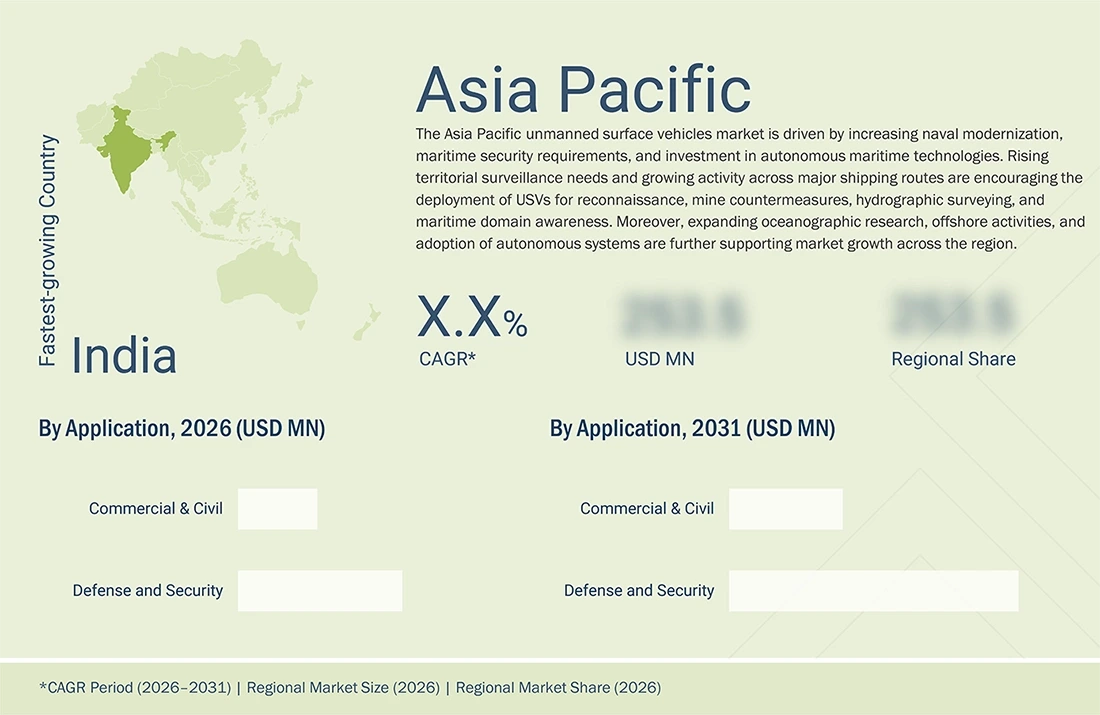
Asia Pacific to be the fastest-growing region in unmanned surface vehicles market during the forecast period
By region, Asia Pacific is expected to register the highest CAGR in the unmanned surface vehicles market, driven by expanding naval modernization programs and increasing investment in maritime surveillance and coastal security. Growing maritime activity, territorial monitoring requirements, and adoption of autonomous technologies are also creating opportunities for USVs across defense and commercial applications.
UNMANNED SURFACE VEHICLES (USV) MARKET SIZE, SHARE, GROWTH & TRENDS: COMPANY EVALUATION MATRIX
In the unmanned surface vehicles market matrix, L3Harris Technologies, Inc. is categorized as a “Star” because of its portfolio of autonomous surface vessels and unmanned maritime systems supporting intelligence, surveillance, reconnaissance, maritime security, and naval missions. Its capabilities combine autonomous navigation, mission payload integration, communications, and command-and-control technologies, supporting a range of defense applications and strengthening its position in the unmanned surface vehicles market. Kongsberg is classified as an “Emerging Player” due to its growing focus on autonomous surface vessels, maritime robotics, hydrographic surveying, and oceanographic applications. Its USV solutions combine hydroacoustic sensors, autonomous navigation, communications, and remote operations, supporting long-duration surveying as well as maritime missions while expanding its presence in the evolving unmanned surface vehicles market.
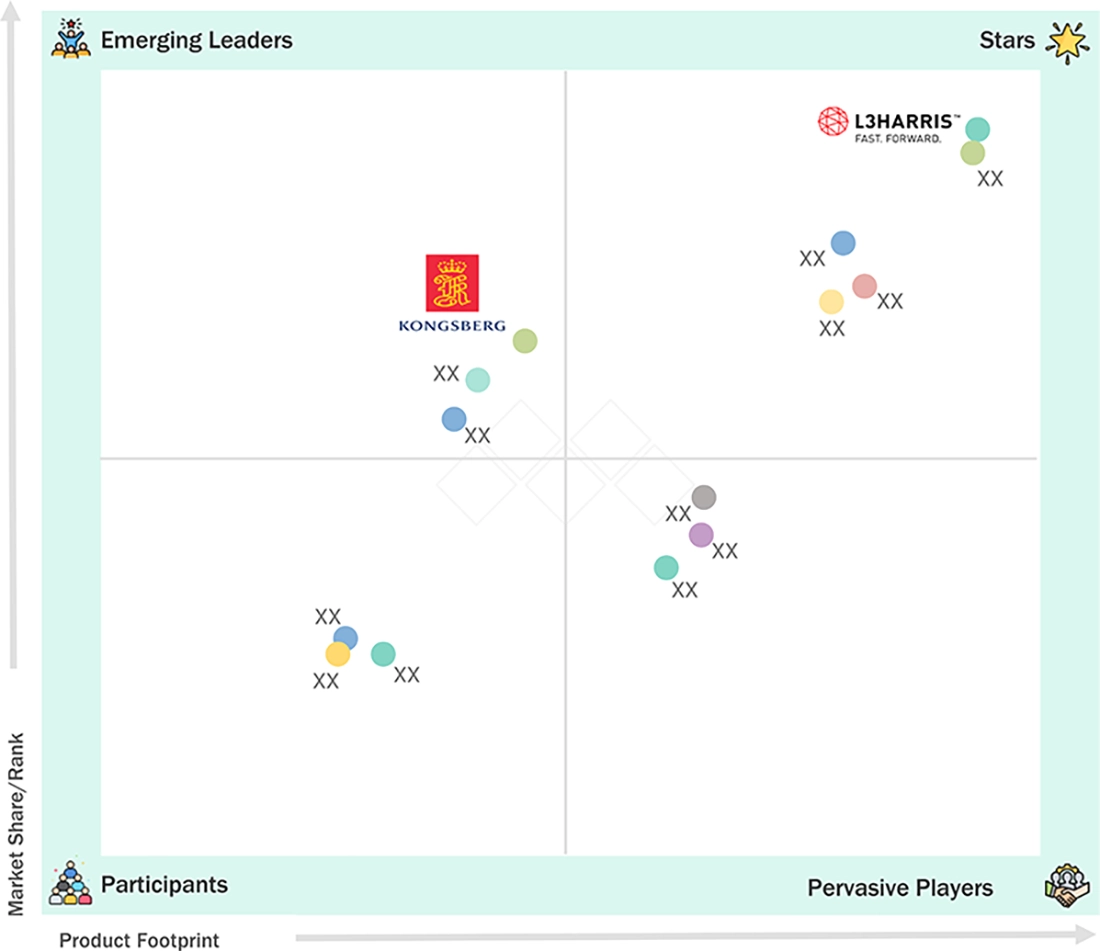
Source: Secondary Research, Interviews with Experts, MarketsandMarkets Analysis
KEY MARKET PLAYERS
List of Top Unmanned Surface Vehicles (USVs) Companies
- L3Harris Technologies, Inc. (US)
- Thales (France)
- Exail Technologies (France)
- Textron Inc. (US)
- Teledyne Technologies Incorporated (US)
- Elbit Systems Ltd. (Israel)
- Martac (US)
- LIG Defense & Aerospace (South Korea)
- TKMS (Germany)
- Saildrone, Inc. (US)
- Seafloor Systems, Inc. (US)
- Bae Systems (UK)
- Kongsberg (Norway)
- Israel Aerospace Industries(Israel)
- Bharat Electronics Limited (BEL) (India)
- Sea-Kit International (UK)
WHAT IS IN IT FOR YOU: UNMANNED SURFACE VEHICLES (USV) MARKET SIZE, SHARE, GROWTH & TRENDS REPORT CONTENT GUIDE
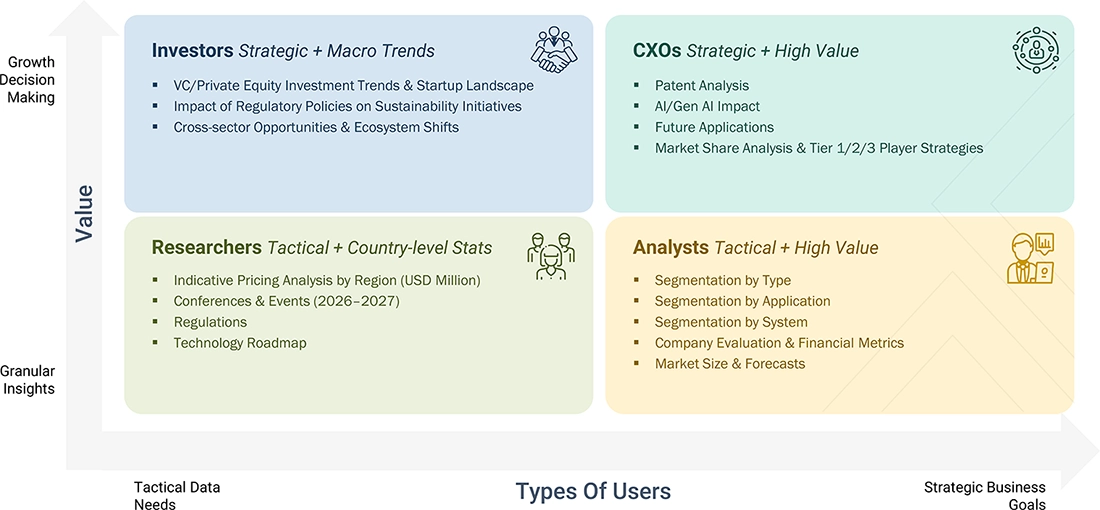
DELIVERED CUSTOMIZATIONS
We have successfully delivered the following deep-dive customizations:
| CLIENT REQUEST | CUSTOMIZATION DELIVERED | VALUE ADDS |
|---|---|---|
| Leading Manufacturer | Additional segment breakdown for countries | Additional country-level market sizing tables for segments/subsegments covered at the regional/global level to gain an understanding of market potential by each country |
| Emerging Leader | Additional company profiles | Competitive information on targeted players to gain granular insights on direct competition |
| Regional Market Leader | Additional country market estimates | Additional country-level deep dive for a more targeted understanding of the total addressable market |
RECENT DEVELOPMENTS
- September 2026 : Saildrone announced that the US Navy awarded the company a contract for seafloor mapping in the Atlantic using its Surveyor USV. The contract expands Saildrone’s ocean-mapping work for naval operations and uses autonomous deep-ocean multibeam surveying to support persistent maritime data collection.
- May 2026 : Saildrone announced a USD 15.5 million contract with the US Coast Guard to deploy 16 Voyager USVs across the Great Lakes and Northeast coast for persistent maritime domain awareness and northern maritime border-security missions. The contract was signed in March 2026.
- April 2026 : Exail Technologies received a new order from OMS Group for a DriX O-16 surface drone for subsea cable survey applications. The USV will support bathymetric surveys, route verification, and monitoring of telecommunications infrastructure, with operations supported by a remote operations center in Singapore.
Table of Contents
 Exclusive indicates content/data unique to MarketsandMarkets and not available with any competitors.
Methodology
The study involved four major activities to estimate the current size of the unmanned surface vehicles market. Exhaustive secondary research was conducted to gather information on the unmanned surface vehicles market, its adjacent markets, and its parent market. The next step was to validate these findings, assumptions, and sizing with industry experts across the value chain through primary research. Demand-side analysis was conducted to estimate the overall market size. Thereafter, data triangulation procedures were employed to estimate the sizes of various segments and subsegments within the unmanned surface vehicles market.
Secondary Research
During the secondary research process, various sources were consulted to identify and collect information for this study. Secondary sources included government sources such as SIPRI; corporate filings, including annual reports, press releases, and investor presentations; white papers, journals, and certified publications; and articles from recognized authors, directories, and databases.
Primary Research
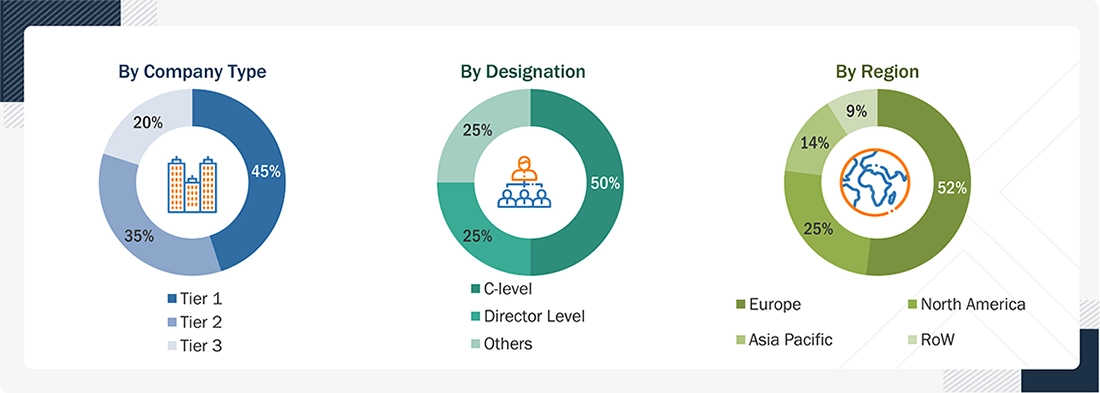
Extensive primary research was conducted after acquiring information on the unmanned surface vehicles market through secondary research. Several primary interviews were conducted with market experts from the demand and supply sides across major countries of North America, Europe, Asia Pacific, the Middle East and Africa, and Latin America. Primary data was collected through questionnaires, emails, and telephonic interviews.
To know about the assumptions considered for the study, download the pdf brochure
Market Size Estimation
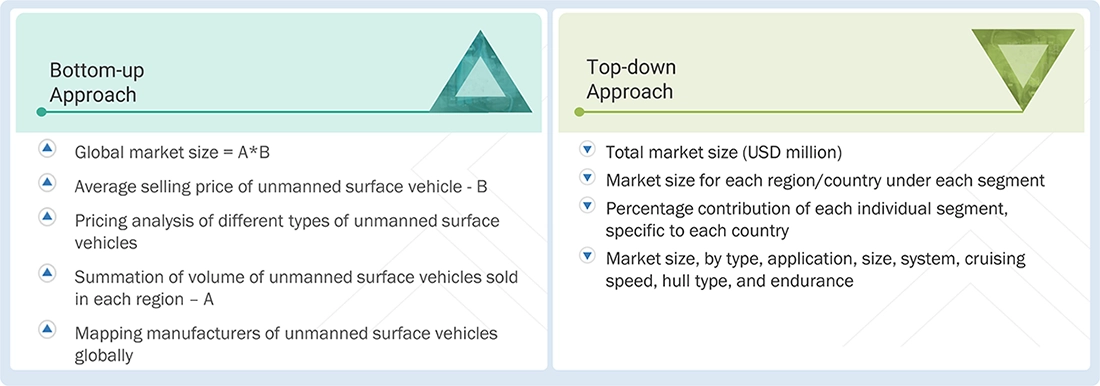
Top-down and bottom-up approaches were used to estimate and validate the size of the unmanned surface vehicles market. The research methodology used to estimate the size of the market included the following details:
- Key players in the unmanned surface vehicles market were identified through secondary research, and their market shares were determined through a combination of primary and secondary research. This included a study of the annual and financial reports of the top market players, as well as extensive interviews with leaders, including directors, engineers, marketing executives, and other key stakeholders of leading companies operating in the market.
- All percentage shares, splits, and breakdowns were determined using secondary sources and verified through primary sources.
- All possible parameters that affect the markets covered in this research study were accounted for, viewed in extensive detail, verified through primary research, and analyzed to obtain the final quantitative and qualitative data on the unmanned surface vehicles market. This data was consolidated, enhanced with detailed input, analyzed by MarketsandMarkets, and presented in this report.
Unmanned Surface Vehicles Market Size: Bottom-up and Top-down Approaches
Data Triangulation
After determining the overall market size, the total market was classified into several segments and subsegments. The data triangulation and market breakdown procedures explained below were implemented, wherever applicable, to complete the overall market engineering process and arrive at the estimated market numbers for the market segments and subsegments. The data was triangulated by examining various factors and trends on both the demand and supply sides. Additionally, the market size was validated using top-down and bottom-up approaches.
Market Definition
An unmanned surface vehicle (USV) is a marine vessel that operates on the water surface without human intervention. It has a complex system that includes system integration, environmental perception, and autonomous decision-making and control. USVs are powered by diesel/gasoline engines, rechargeable lithium-ion batteries, or solar energy. These vehicles are also equipped with various sensors, cameras, communication systems, and other payloads to collect data, perform tasks, and communicate information back to a control station or operator. They are primarily utilized for ocean exploration and various maritime applications.
Key Stakeholders
- USV Manufacturers
- Parts & Sub-component Manufacturers
- Maintenance, Repair, and Overhaul (MRO) Companies
- Research Organizations, Forums, Alliances, and Associations
- Ministries of Defense
- Original Equipment Manufacturers (OEMs)
- Regulatory Bodies
- R&D Companies
Report Objectives
- To define, describe, and forecast the unmanned surface vehicles market based on type, length overall, application, system, power source, hull configuration, cruising speed, endurance, launch mode, and region in terms of value
- To forecast the size of various segments of the market across North America, Europe, the Asia Pacific, the Middle East & Africa, and Latin America in terms of value
- To identify and analyze the drivers, restraints, opportunities, and challenges influencing the growth of the market
- To identify industry trends, market trends, and technology trends currently prevailing in the market
- To analyze micromarkets with respect to growth trends, prospects, and their contribution to the overall market
- To analyze opportunities in the market for stakeholders by identifying key market trends
- To profile key market players and comprehensively analyze their market share and core competencies
- To evaluate the degree of competition in the market by analyzing recent developments, such as contracts, agreements, and acquisitions adopted by leading market players
- To identify detailed financial positions, key products, and unique selling points of leading companies in the market
- To provide a detailed competitive landscape of the market, along with market share analysis and revenue analysis of key players
Available customizations:
MarketsandMarkets offers the following customizations for this market report:
- Additional country-level analysis of the unmanned surface vehicles market
- Profiling of other market players (up to five)
Product Analysis
- Product matrix, which provides a detailed comparison of the product portfolios of each company in the unmanned surface vehicles market
Key Questions Addressed by the Report
What is the Unmanned Surface Vehicles (USV) Market?
The Unmanned Surface Vehicles (USV) Market covers autonomous and remotely operated surface vessels used for defense, commercial, scientific, surveying, and maritime applications.
What is driving the growth of the USV Market?
Key factors include increasing maritime security requirements, growing demand for autonomous operations, oceanographic research, hydrographic surveying, and advancements in navigation and sensor technologies.
What is the projected growth of the USV Market?
The market is projected to grow from USD 0.98 billion in 2026 to USD 1.92 billion by 2031, at a CAGR of 14.3%.
What are the major applications of USVs?
Major applications include defense and security, hydrographic surveying, oceanographic research, environmental monitoring, search and rescue, and maritime transportation.
Which technologies are driving USV development?
AI, autonomous navigation, advanced sensors, satellite communication, remote monitoring, obstacle detection, and improved propulsion systems are key technologies supporting USV development.
What are the major benefits of USVs?
USVs can reduce operational costs, improve personnel safety, support long-duration missions, access hazardous areas, and enable continuous maritime data collection.
Which regions are expected to contribute significantly to USV market growth?
North America, Europe, and Asia Pacific are important markets, supported by defense modernization, maritime surveillance requirements, and increasing investments in autonomous marine technologies.
Who are the key companies in the USV Market?
Major companies include L3Harris Technologies, Teledyne Technologies, Textron, Exail Technologies, and Elbit Systems.
What factors are increasing demand for USVs in defense?
Rising maritime threats, border surveillance requirements, mine countermeasures, intelligence and reconnaissance missions, and the need to reduce risks to naval personnel are increasing defense demand.
What is the future outlook for the USV Market?
The market is expected to expand as autonomous navigation, AI, advanced sensors, and multi-mission capabilities improve, creating opportunities across defense, commercial, scientific, and environmental applications.


Personalize This Research
- Triangulate with your Own Data
- Get Data as per your Format and Definition
- Gain a Deeper Dive on a Specific Application, Geography, Customer or Competitor
- Any level of Personalization
Let Us Help You
- What are the Known and Unknown Adjacencies Impacting the Unmanned Surface Vehicles Market
- What will your New Revenue Sources be?
- Who will be your Top Customer; what will make them switch?
- Defend your Market Share or Win Competitors
- Get a Scorecard for Target Partners

Custom Market Research Services
We Will Customise The Research For You, In Case The Report Listed Above Does Not Meet With Your Requirements
Get 10% Free CustomisationTESTIMONIALS
- US Unmanned Surface Vehicles Market
- Canada Unmanned Surface Vehicles Market
- UK Unmanned Surface Vehicles Market
- Germany Unmanned Surface Vehicles Market
- France Unmanned Surface Vehicles Market
- Italy Unmanned Surface Vehicles Market
- Norway Unmanned Surface Vehicles Market
- China Unmanned Surface Vehicles Market
- India Unmanned Surface Vehicles Market
- Japan Unmanned Surface Vehicles Market
- Australia Unmanned Surface Vehicles Market
- South Korea Unmanned Surface Vehicles Market
- UAE Unmanned Surface Vehicles Market
- Saudi Arabia Unmanned Surface Vehicles Market
- Israel Unmanned Surface Vehicles Market
- Rest Of Europe Unmanned Surface Vehicles Market
- Rest Of Asia Pacific Unmanned Surface Vehicles Market
- Rest Of Middle East Unmanned Surface Vehicles Market
Growth opportunities and latent adjacency in Unmanned Surface Vehicles Market






Iñigo
Feb, 2019
We are developing small USV and associated systems and we are searching for the global business volume figures for a study..
Nicola
Dec, 2019
I'd like know only the data of the global market for monitoring water of the ocean. Thanks for your time..