

Software Defined Radio Market and General Dynamics Corporation: Advancing Secure Military Communications
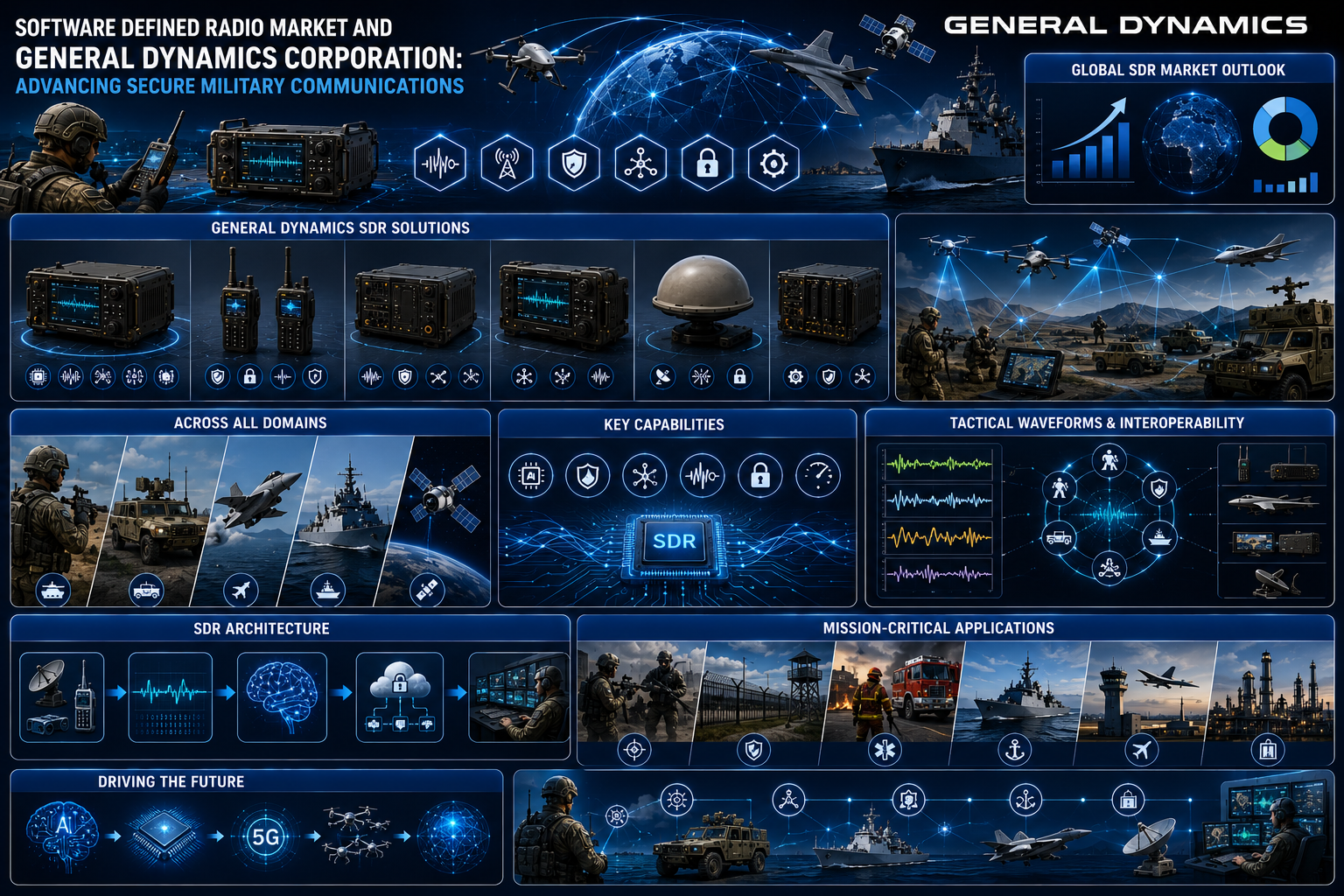
Introduction to Software Defined Radio
The evolution of military communications is moving from conventional hardware based radio systems toward flexible, programmable, and networked communication architectures. Software Defined Radio Technology is at the center of this transformation because it enables communication functions to be implemented and modified through software rather than relying entirely on fixed hardware configurations.
Modern defense operations require communication systems that can support voice, data, satellite communications, tactical networking, and multiple frequency bands. Military personnel may need to communicate across ground, maritime, airborne, and space connected environments while maintaining secure and interoperable links.
Software Defined Radio provides the flexibility needed to address these requirements. A single radio platform can support multiple communication functions and waveforms, while software updates can introduce new capabilities without necessarily replacing the entire hardware system.
The importance of this technology is increasing as defense organizations modernize legacy communication infrastructure. General Dynamics Corporation, through General Dynamics Mission Systems, has a long standing presence in military radio communications and Software Defined Radio technologies. Its Digital Modular Radio is particularly significant because General Dynamics identifies the DMR, AN/USC 61(C), as the first Software Defined Radio to become a communications system standard for the US military.
Evolution From Conventional Radios to Software Defined Communications
Traditional military radios were generally designed around specific hardware and communication functions. Changing operational requirements could require new equipment, hardware modifications, or additional radio systems.
Software Defined Radio changes this approach by moving more communication functions into programmable software.
The result is a communication platform that can potentially support different waveforms, frequency bands, security requirements, and networking functions through software configuration.
This evolution is particularly valuable for military organizations because communication requirements change over the lifecycle of a platform. A naval vessel, aircraft, vehicle, or command center may remain operational for decades, while communication technologies and network requirements can change significantly during that period.
Software based upgrades provide a mechanism for extending the usefulness of existing radio hardware.
General Dynamics has demonstrated this approach through its Digital Modular Radio. The company states that DMR uses open architecture standards and can accommodate new waveforms and advanced network connectivity through software.
Growing Importance of Flexible Military Communication Systems
Modern military operations increasingly depend on the rapid exchange of information.
A military force may need to connect commanders, soldiers, ships, submarines, aircraft, satellites, sensors, and other platforms. These systems can operate across different networks and frequency bands.
Flexible radio architectures can help consolidate communication requirements into fewer platforms.
General Dynamics states that its four channel DMR can simultaneously support voice and data satellite communication networks, MUOS waveforms, SINCGARS, HAVEQUICK, and other tactical HF, VHF, and UHF communications.
This illustrates how SDR technology is moving beyond basic voice communications toward multifunction communication systems capable of supporting tactical data and network connectivity.
Increasing Demand for Secure and Interoperable Tactical Networks
Interoperability is becoming increasingly important as military forces conduct joint and coalition operations.
Different branches and allied forces may use different communication networks, waveforms, and radio systems. SDR platforms can help bridge these requirements by supporting multiple waveforms and communication modes.
Security is equally important. Military communications must protect voice and data while maintaining reliable connectivity across contested and geographically dispersed environments.
General Dynamics describes DMR as capable of secure voice and data communications across HF, VHF, UHF, and SATCOM channels. The system is also designed for coalition interoperability.
Software Defined Radio Market Overview
Market Size and Forecast
According to MarketsandMarkets, the Global Software Defined Radio Market Size was valued at USD 23.52 billion in 2026 and is projected to reach USD 36.80 billion by 2033, growing at a CAGR of 6.6% from 2026 to 2033.
In terms of volume, the market is projected to grow from 3,424,776 units in 2026 to 4,476,811 units by 2033.
The Software Defined Radio Market is being supported by modernization of military communication systems, demand for interoperable communications, growing adoption of multiband and multimode radios, increasing use of SDRs in unmanned systems, and the need to consolidate multiple communication functions into a single radio platform. MarketsandMarkets identifies General Dynamics Corporation among the major companies covered in the market.
Several important factors are contributing to market growth:
- Modernization of military communication networks
- Growing demand for interoperability across military platforms
- Increasing adoption of multiband and multimode radios
- Rising use of SDR technology in unmanned and autonomous systems
- Increasing adoption of AI driven spectrum management
- Growing need to consolidate multiple communication functions into a single radio
- Increasing demand for secure voice and data communications
- Growing integration of satellite communication capabilities
The tactical and mission critical SDR segment currently represents the largest technology segment, reflecting the importance of secure communication in demanding military environments. The HF, VHF, and UHF frequency segment also holds a leading position because of its extensive use across military, government, public safety, aviation, and maritime applications.
Major Growth Drivers
Military communications modernization remains one of the strongest drivers of the Software Defined Radio Market.
Defense organizations are replacing older communication systems with programmable platforms capable of supporting secure voice, data, imagery, video, networking, and modern waveforms.
MarketsandMarkets identifies modernization of military communication systems and the need for communication between different forces, platforms, and radio systems as key market drivers.
Another important driver is the demand for multiband and multimode radios. A single platform that can operate across multiple frequency ranges can reduce equipment complexity and improve operational flexibility.
Interoperability is also becoming increasingly important. Military forces need to communicate across legacy and next generation systems, as well as across coalition networks.
Software Defined Radio provides an architecture that can accommodate these requirements through programmable waveforms and software based upgrades.
General Dynamics' Software Defined Radio Capabilities
Digital Modular Radio
The Digital Modular Radio is one of General Dynamics' most significant contributions to the Software Defined Radio Market.
The DMR, designated AN/USC 61(C), is described by General Dynamics Mission Systems as the first Software Defined Radio to become a communications system standard for the US military. It is a four channel radio designed for US Navy communications and has been deployed on US Navy surface ships and submarines.
The system supports communications across a broad frequency range and can integrate multiple waveforms.
General Dynamics states that DMR can support:
- HF, VHF, and UHF communications
- UHF SATCOM
- MUOS waveforms
- SINCGARS
- HAVEQUICK
- Voice and data communications
- Secure communications
- Multiple security levels
- Tactical data links
- Network connectivity
This multifunction capability illustrates the core value proposition of Software Defined Radio technology.
Software Defined Tactical Communications
Military tactical communications require systems that can operate across different environments while maintaining secure and reliable connectivity.
General Dynamics' DMR architecture allows a single radio system to support multiple communication functions.
The company's radio portfolio also includes systems for combat search and rescue, ground to air communications, line of sight communications, and maritime applications.
General Dynamics states that its current radio programs include Digital Modular Radios for US Navy ships and submarines, along with other military and government communication systems.
Secure Voice and Data Communications
Modern military communication systems need to transmit much more than voice.
Operational information can include tactical data, intelligence information, command information, imagery, and other digital content.
The DMR supports secure voice and data communications across multiple frequency bands and satellite communication channels. General Dynamics states that the system supports secure voice and data at multiple independent levels of security.
This capability allows the radio to function as a broader communication hub rather than simply a voice transceiver.
Tactical Waveforms
Waveforms determine how information is transmitted and received.
One of the primary benefits of Software Defined Radio is the ability to introduce or modify waveforms through software.
General Dynamics identifies multiple reprogrammable waveform capabilities for DMR, including UHF SATCOM, MUOS, SINCGARS, HAVEQUICK, Link 11, Link 4A, HF modem capabilities, and VHF and UHF line of sight communications.
This broad waveform support enables DMR to connect with multiple existing military communication systems.
SATCOM Integration
Satellite communications are increasingly important for military forces operating over large geographic areas.
General Dynamics has incorporated SATCOM capabilities into its Digital Modular Radio architecture.
The DMR supports UHF SATCOM waveforms and MUOS connectivity. General Dynamics has also released updated MUOS waveforms for its DMR radios, improving secure voice, video, and data communications across the MUOS satellite communication network.
This integration allows tactical communication systems to connect with satellite networks while maintaining compatibility with other tactical radio systems.
Naval Communications
Naval platforms have particularly demanding communication requirements.
Ships and submarines need to communicate with other vessels, aircraft, shore facilities, satellites, and tactical forces.
General Dynamics states that its DMR is currently deployed on US Navy surface and subsurface platforms.
The company also states that more than 900 Digital Modular Radios have been delivered for sailors deployed on 12 different US Navy ships and submarines.
The use of a common Software Defined Radio architecture can help simplify naval communication infrastructure by consolidating multiple functions into one system.
Technology Innovations in the Software Defined Radio Market
Software Programmable Waveforms
Software programmable waveforms are central to SDR technology.
Instead of requiring a dedicated hardware system for every communication protocol, programmable radios can accommodate multiple waveforms.
General Dynamics' DMR supports numerous reprogrammable waveforms and has been designed to accommodate new communication capabilities through software.
This capability helps extend radio functionality over the equipment lifecycle.
Multichannel Communications
Multichannel operation allows a single radio platform to support multiple communication links simultaneously.
The DMR is a four channel radio and can simultaneously support different communications requirements.
General Dynamics has also demonstrated how software upgrades can increase communication capacity without requiring additional radio hardware.
In one example, the company's DMR software upgrades expanded four physical channels into additional virtual communication channels, increasing HF communication capacity without changing the basic hardware configuration.
HF, VHF, and UHF Capabilities
Military communication environments require access to multiple frequency ranges.
HF can support long range communications, while VHF and UHF are widely used for tactical and line of sight applications.
General Dynamics' DMR operates across a 2 MHz to 2 GHz range and supports HF, VHF, UHF, and satellite communication requirements.
This broad frequency coverage is an important feature of multifunction Software Defined Radio platforms.
MUOS Connectivity
The Mobile User Objective System is an important military satellite communication network.
General Dynamics has developed and tested MUOS waveform capabilities for its DMR platform. The company's updated MUOS waveform supports secure voice, video, and data communications across the MUOS network.
This demonstrates how software upgrades can introduce new satellite communication capabilities without replacing the underlying radio platform.
Anti Jam Technologies
Military radios increasingly need to operate in challenging electromagnetic environments.
Anti jam capabilities, frequency management, waveform flexibility, and network resilience can improve communication reliability.
General Dynamics' broader disruptive radio portfolio includes technologies and waveforms designed for contested environments, while its DMR architecture provides programmable and configurable communication capabilities.
Future SDR systems are expected to combine these capabilities with intelligent spectrum management and adaptive communications.
Secure Communications
Security is a fundamental requirement for military SDR platforms.
General Dynamics' DMR includes embedded Type 1 encryption, secure voice and data capabilities, and support for multiple security technologies.
As SDR platforms become increasingly software driven, cybersecurity will become equally important. Software, waveforms, configuration files, and updates must be protected throughout the lifecycle.
MarketsandMarkets identifies protecting SDR software, waveforms, and updates from cyberattacks as a significant challenge for the market.
Military Applications of Software Defined Radio
Naval Communications
Naval communications are a major application for General Dynamics' Software Defined Radio technology.
The DMR provides a common communication architecture for surface vessels, submarines, and shore based systems.
Its ability to combine HF, VHF, UHF, and SATCOM functions makes it suitable for complex maritime communication environments.
Submarine Communications
Submarines operate in environments where communication can be particularly challenging.
Reliable communications with naval command centers, surface vessels, aircraft, and other platforms are critical.
The DMR is deployed on US Navy subsurface platforms and provides a multifunction communication architecture supporting several frequency bands and satellite communication capabilities.
Battlefield Communications
Ground forces require communication systems that can operate in rapidly changing environments.
Software Defined Radio platforms can provide flexible access to multiple waveforms, secure networks, and tactical communication systems.
General Dynamics has developed several Software Defined Radio and waveform technologies for military applications, including the DMR, SPEAKeasy II, Cluster 5, Blue Force Tracking, and other tactical systems.
Command and Control
Command and control systems depend on reliable communication between commanders and operational forces.
SDR platforms can transmit voice, data, and tactical information across multiple networks.
A multifunction radio can provide a communication bridge between different tactical systems and improve information flow between command centers and deployed units.
Search and Rescue
Search and rescue operations require reliable communication in difficult and rapidly changing environments.
General Dynamics' radio portfolio includes combat search and rescue communication systems. The company has also been selected by the US Air Force for the Next Generation Survival Radio program, designed to provide secure communications for combat search and rescue missions.
Airborne Communications
Aircraft require lightweight, secure, and flexible communication systems.
Airborne radios may need to communicate with ground forces, other aircraft, naval platforms, and command centers.
Software Defined Radio architectures allow airborne communication systems to support multiple waveforms and communication modes while providing opportunities for software based upgrades.
Competitive Landscape of the Software Defined Radio Market
The global Software Defined Radio Market includes several major defense and communications companies.
General Dynamics
General Dynamics has a strong position in military communication systems through General Dynamics Mission Systems.
Its Digital Modular Radio represents a significant Software Defined Radio platform for naval communications, while its broader radio portfolio includes tactical, airborne, maritime, and search and rescue communication systems.
L3Harris Technologies
L3Harris Technologies is a major defense communication company with a broad portfolio of tactical Software Defined Radios, networking systems, and secure communications technologies.
Thales
Thales is active in secure military communications and interoperable Software Defined Radio systems for land, air, naval, and tactical applications.
RTX
RTX, through Collins Aerospace, provides Software Defined Radio and networked communications technologies for airborne, ground, tactical, and space applications.
BAE Systems
BAE Systems participates in military communications, electronic systems, tactical networking, and defense electronics.
Motorola Solutions
Motorola Solutions has a significant presence in mission critical communications, public safety networks, and government communication systems.
Rohde & Schwarz
Rohde & Schwarz operates across secure communications, defense radio technology, spectrum monitoring, and radio testing solutions.
MarketsandMarkets identifies General Dynamics Corporation, Motorola Solutions, L3Harris Technologies, Thales, and RTX among the major companies covered in the Software Defined Radio Market.
Future Outlook for the Software Defined Radio Market
AI Enabled Radios
Artificial intelligence is expected to become increasingly important in SDR systems.
AI can help radios analyze spectrum conditions, identify interference, select frequencies, and optimize communication parameters.
MarketsandMarkets identifies AI based automatic frequency selection and interference control as an important opportunity in the Software Defined Radio Market.
Future AI enabled radios could provide more autonomous spectrum management and adaptive communication capabilities.
Cognitive Radio
Cognitive radio represents another major development direction.
Cognitive systems can monitor the surrounding electromagnetic environment and adjust communication parameters according to available spectrum and operating conditions.
The combination of cognitive radio with AI could make future SDR platforms more adaptive and capable of responding to changing electromagnetic environments.
Intelligent Spectrum Management
Spectrum is becoming increasingly congested.
Military systems must operate alongside commercial, government, civilian, and other communication systems.
Intelligent spectrum management can help identify available frequencies and manage interference.
SDR provides the programmable foundation needed to implement these capabilities.
Tactical Edge Networking
Future military communications will increasingly move toward tactical edge networking.
Instead of relying exclusively on centralized communication infrastructure, tactical users can exchange information through distributed networks.
Software Defined Radios can become network nodes capable of transmitting voice, data, imagery, and other mission information.
This transition will support more connected military operations.
5G Integration
5G technology is creating opportunities for high speed and low latency communications.
Future military communication architectures could combine SDR platforms with 5G networks, tactical broadband systems, satellite communications, and other connectivity technologies.
SDR platforms can provide flexibility for integrating these different communication environments.
Multi Domain Operations
Modern military operations increasingly involve multiple domains including land, sea, air, space, and cyber environments.
Communication systems must connect these domains and enable information sharing between different platforms.
The ability of Software Defined Radios to support multiple waveforms, frequency bands, networks, and communication modes makes them an important technology for multi domain operations.
Opportunities and Challenges in the Software Defined Radio Market
The Software Defined Radio Market presents substantial opportunities as military forces transition toward programmable, interoperable, and network centric communication architectures.
Key Opportunities
-
Military Modernization: Replacement of legacy communication systems with flexible SDR platforms is creating sustained demand.
-
Multiband Communications: Radios capable of operating across multiple frequency ranges can consolidate communication requirements.
-
Multimode Operation: A single platform can support multiple communication functions and waveforms.
-
SATCOM Integration: Integration with military satellite communication systems expands tactical connectivity.
-
AI Based Spectrum Management: AI can improve frequency selection and interference management.
-
Tactical Networking: Networked SDR systems can provide connectivity between distributed military users.
-
Unmanned Systems: Increasing adoption of SDRs in UAVs and autonomous systems is opening new market opportunities.
-
Software Based Modernization: Software upgrades can extend the functionality of existing radio hardware.
At the same time, the market faces challenges. SDR development requires sophisticated hardware, software, waveform development, encryption, testing, and system integration. MarketsandMarkets identifies the high cost of SDR development, integration, testing, and maintenance as a market restraint.
Cybersecurity is another major consideration because software based radios depend heavily on programmable functions. Protecting waveforms, software, updates, and configuration data is essential for maintaining secure military communications.
Interoperability between SDR hardware from different suppliers can also remain technically challenging when different systems use proprietary architectures or waveforms.
General Dynamics and the Future of Software Defined Radio
The Software Defined Radio Market is moving toward increasingly programmable, interoperable, secure, and networked communication systems. Defense organizations are modernizing legacy radios to support secure voice, high speed data, tactical networking, satellite communications, and multi domain operations.
According to MarketsandMarkets, the Global Software Defined Radio Market Size was valued at USD 23.52 billion in 2026 and is projected to reach USD 36.80 billion by 2033, growing at a CAGR of 6.6% from 2026 to 2033. In terms of volume, the market is projected to grow from 3,424,776 units in 2026 to 4,476,811 units by 2033.
Explore the Software Defined Radio Market Report: https://www.marketsandmarkets.com/Market-Reports/software-defined-radio-market-138946173.html
General Dynamics Corporation represents an important participant in this transformation through General Dynamics Mission Systems and its military radio portfolio. The company's Digital Modular Radio provides a strong example of how SDR technology can consolidate multiple communication functions into a single platform.
The DMR supports HF, VHF, UHF, and SATCOM communications, multiple programmable waveforms, secure voice and data, and MUOS connectivity.
Its software based architecture also demonstrates one of the most important advantages of SDR technology: communication capabilities can evolve through software rather than requiring complete hardware replacement.
General Dynamics has continued to expand the functionality of DMR through software based upgrades. The company has introduced MUOS waveform capabilities and other networking enhancements, demonstrating how SDR platforms can remain relevant as military communication requirements evolve.
The future of the market will be shaped by AI enabled radios, cognitive radio technology, intelligent spectrum management, tactical edge networking, 5G integration, resilient SATCOM, and multi domain operations.
As military communication architectures become increasingly connected, Software Defined Radio will serve as an important technological foundation for interoperability between soldiers, vehicles, ships, submarines, aircraft, satellites, command centers, and autonomous systems.
General Dynamics' experience with Digital Modular Radio demonstrates the long term value of programmable military communications. Its combination of multiband capabilities, secure voice and data, reprogrammable waveforms, SATCOM integration, and naval deployment illustrates how SDR technology can support communication modernization across the defense sector.
80% of the Forbes Global 2000 B2B companies rely on MarketsandMarkets to identify growth opportunities in emerging technologies and use cases that will have a positive revenue impact.
- Food Packaging Market Size Set for Strong Growth Through 2030 Amid Rising Demand for Convenience Foods
- Crop Protection Chemical Market Size, Share & Growth Forecast (2025–2030)
- Mulch Films Market: Driving Sustainable Agriculture Through Innovation
- Agricultural Adjuvants Market Analysis, Trends, and Growth Outlook (2026–2031)
- Japan Enterprise Asset Management Market Growth: AI and Smart Infrastructure Drive Demand


