

How the Global AI Race Is Accelerating Growth in the Artificial Intelligence (AI) in Military Market
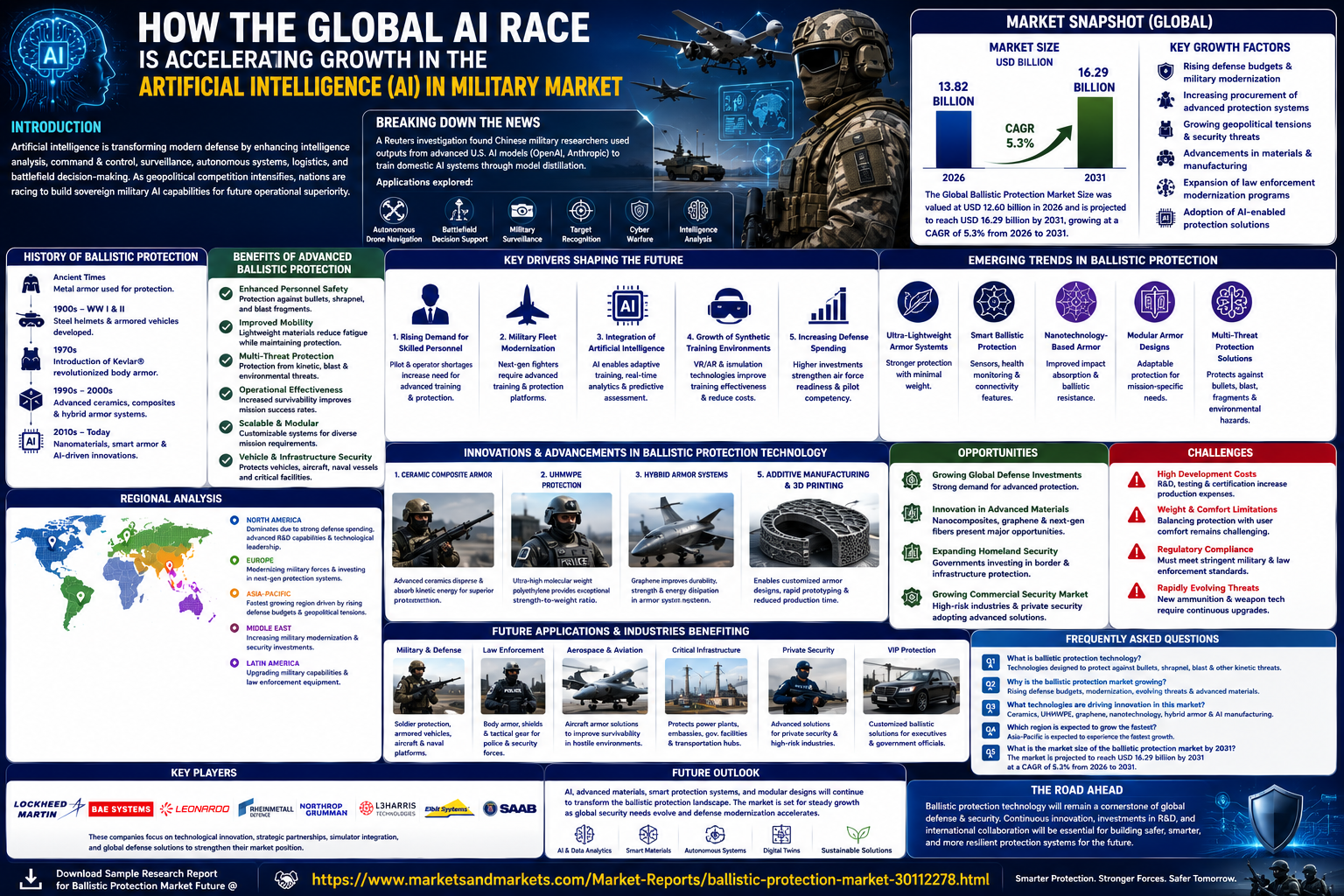
Artificial intelligence has become one of the defining technologies shaping the future of global defense. Military organizations are rapidly integrating AI into intelligence analysis, command and control, surveillance, autonomous systems, logistics, and battlefield decision-making to improve operational speed and effectiveness. As geopolitical competition intensifies, the race to develop sovereign military AI capabilities is becoming a strategic priority for major powers worldwide.
A recent Reuters investigation highlights the growing importance of this technological competition. According to the report, Chinese military researchers have used outputs from advanced U.S. artificial intelligence models developed by OpenAI and Anthropic to train domestic AI systems through a process known as model distillation. Reuters reviewed more than 80 Chinese academic papers and patents indicating that researchers affiliated with the People's Liberation Army (PLA) explored applications including autonomous drone navigation, surveillance, cyber warfare, target recognition, and battlefield decision support.
The report illustrates how artificial intelligence is rapidly becoming a force multiplier across modern military operations. It also reflects broader concerns surrounding AI capability development, intellectual property protection, sovereign technology strategies, and the accelerating pace of defense innovation.
For defense organizations, policymakers, investors, and technology providers, the findings reinforce the long-term momentum behind the Artificial Intelligence (AI) in Military Market, where demand for intelligent defense systems continues to expand across every operational domain.
Breaking Down the News
The Reuters investigation examined publicly available Chinese academic papers and patents that describe the use of outputs generated by advanced U.S. artificial intelligence models to accelerate domestic AI development through model distillation.
Model distillation is a machine learning technique in which a smaller model learns behavior from the outputs of a more capable model. When used appropriately, the approach can improve efficiency and reduce computational requirements for AI deployment.
According to the report, the documented military-oriented research explored potential applications including:
- Autonomous drone navigation
- Battlefield decision support
- Military surveillance
- Target recognition
- Cyber warfare
- Intelligence analysis
The investigation highlights how military organizations increasingly recognize AI as a strategic capability that can improve operational planning, battlefield awareness, and mission execution.
Rather than representing an isolated research effort, the report reflects the broader global competition to develop advanced military AI capabilities.
Why This News Matters Beyond the Headlines
The Reuters findings underscore a broader transformation taking place across the defense sector.
Artificial intelligence is evolving from an enabling technology into a foundational element of future military capability.
AI Is Becoming Central to Military Decision Making
Modern military operations generate enormous volumes of information from:
- Satellites
- Radar systems
- UAVs
- Ground sensors
- Intelligence platforms
- Cyber networks
Human analysts alone cannot process this information at operational speed.
AI enables faster:
- Data analysis
- Threat prioritization
- Operational planning
- Intelligence fusion
- Decision support
This capability is becoming increasingly valuable during high-tempo military operations.
Sovereign AI Capabilities Are Becoming National Priorities
The Reuters investigation also highlights a growing emphasis on developing indigenous AI ecosystems.
Governments worldwide are investing in:
- Domestic AI research
- National computing infrastructure
- Defense software development
- Advanced semiconductor capabilities
- Military AI innovation
Sovereign AI is increasingly viewed as an essential component of long-term national security strategies.
Military AI Is Expanding Across Multiple Domains
Artificial intelligence is no longer confined to research laboratories.
Today, AI supports:
- Autonomous drones
- Robotic combat systems
- Cyber defense
- Logistics optimization
- Predictive maintenance
- Battlefield management
- Intelligence analysis
This expanding scope continues to drive investment across the Military Artificial Intelligence Market.
What This Means for the Artificial Intelligence (AI) in Military Market
The developments highlighted in the Reuters investigation align closely with long-term trends shaping the Artificial Intelligence (AI) in Military Market.
According to MarketsandMarkets, the Artificial Intelligence (AI) in Military Market is estimated at USD 9.2 billion in 2023 and is projected to reach USD 38.8 billion by 2028, growing at a CAGR of 33.3%.
This rapid expansion reflects increasing adoption of AI across virtually every aspect of military operations.
| Market Driver | Industry Impact |
|---|---|
| AI-enabled command systems | Faster operational decision-making |
| Autonomous military platforms | Greater deployment of intelligent systems |
| Machine learning adoption | Improved intelligence and analytics |
| Defense digital transformation | Increased investment in AI infrastructure |
| Multi-domain operations | Expansion of AI across land, air, sea, cyber, and space |
The Reuters findings reinforce the strategic importance of AI as governments continue accelerating investments in advanced defense technologies.
Organizations seeking deeper insights into industry developments can explore broader trends within the Artificial Intelligence (AI) in Military Market and understand how AI innovation is reshaping military modernization worldwide.
Related Resource: Read about the Artificial Intelligence (AI) in Military Market: https://www.marketsandmarkets.com/Market-Reports/artificial-intelligence-military-market-41793495.html
Key Industry Trends Accelerating Market Growth
AI-Enabled Command and Control Is Becoming Standard
Military organizations increasingly rely on artificial intelligence to support command-and-control operations.
AI assists commanders by:
- Processing operational data
- Identifying threats
- Recommending courses of action
- Supporting mission planning
- Enhancing battlefield awareness
These capabilities improve both speed and operational effectiveness.
Autonomous Military Systems Continue to Expand
Artificial intelligence is enabling greater autonomy across:
- Unmanned aerial systems
- Ground robots
- Maritime platforms
- Logistics vehicles
- Reconnaissance systems
Autonomous systems reduce operator workload while improving operational flexibility across contested environments.
Computer Vision Is Transforming Military Intelligence
Computer vision technologies are becoming essential for:
- Target recognition
- Surveillance
- Object detection
- Battlefield monitoring
- ISR missions
Improved visual intelligence enables more accurate and timely operational decisions.
AI Is Strengthening Cyber Defense
Cyber operations increasingly depend on artificial intelligence for:
- Threat detection
- Vulnerability analysis
- Automated response
- Network monitoring
- Behavioral analytics
AI enhances cyber resilience while reducing response times against increasingly sophisticated threats.
Multi-Domain Operations Are Driving AI Integration
Modern defense strategies require coordinated operations across:
- Land
- Air
- Maritime
- Cyber
- Space
Artificial intelligence enables these domains to exchange information more effectively while improving command coordination and mission execution.
Market Implications for Stakeholders
For Defense Organizations
Military forces are prioritizing AI-enabled capabilities that improve operational effectiveness and decision superiority.
Future procurement strategies are expected to emphasize:
- Intelligent command systems
- Autonomous platforms
- AI-powered surveillance
- Battlefield analytics
- Decision-support software
These capabilities support increasingly complex operational environments.
For Investors
The Defense AI Market continues to present significant long-term opportunities.
Key investment themes include:
- Military AI software
- Autonomous systems
- Machine learning platforms
- Computer vision technologies
- Battlefield intelligence solutions
Strong defense modernization programs continue supporting market expansion.
For Technology Providers
AI developers are increasingly focused on delivering defense-ready capabilities that integrate with existing military architectures.
Competitive differentiation will depend on:
- Algorithm performance
- System security
- Reliability
- Scalability
- Interoperability
Innovation remains a primary driver of competitive advantage.
For Governments
Governments continue increasing investments in sovereign AI capabilities to strengthen national security and technological independence.
Priority areas include:
- Indigenous AI research
- Defense digital transformation
- Military computing infrastructure
- Advanced AI talent development
- Strategic technology partnerships
These initiatives are expected to sustain long-term market growth.
Frequently Asked Questions
What is the Artificial Intelligence (AI) in Military Market?
The Artificial Intelligence (AI) in Military Market includes AI software, hardware, and services supporting defense applications such as intelligence analysis, command and control, autonomous systems, surveillance, cybersecurity, and mission planning.
What is model distillation?
Model distillation is a machine learning technique in which a smaller model learns from the outputs of a larger or more capable model to improve efficiency while retaining useful capabilities.
Why is AI becoming important for military operations?
AI helps military organizations analyze information faster, improve battlefield awareness, automate routine tasks, enhance intelligence, and support faster operational decision-making.
What military applications are driving AI adoption?
Major applications include autonomous drones, target recognition, intelligence analysis, cyber defense, surveillance, logistics optimization, predictive maintenance, and command-and-control systems.
Why are governments investing in sovereign AI capabilities?
Governments seek to strengthen technological independence, protect national security interests, accelerate innovation, and reduce reliance on foreign technologies.
What role does AI play in multi-domain operations?
AI enables faster coordination across land, air, maritime, cyber, and space operations by integrating information from multiple sources and supporting real-time operational decisions.
Which region currently leads the Military AI Market?
North America currently leads due to strong defense spending and technological leadership, while Asia Pacific is expected to experience significant growth driven by military modernization initiatives.
Where can organizations find deeper insights into military AI trends?
Industry stakeholders often rely on specialized market intelligence to evaluate technology developments, competitive dynamics, investment opportunities, procurement strategies, and future market growth.
Looking Beyond Today's Headlines
The Reuters investigation highlights more than a single research trend. It illustrates how artificial intelligence has become a strategic capability shaping the future balance of military technology.
As defense organizations continue modernizing their forces, AI will increasingly support every phase of military operations—from planning and intelligence gathering to autonomous execution and battlefield management.
Several trends are expected to define the coming decade:
- AI-enabled command systems
- Autonomous combat platforms
- Computer vision intelligence
- Predictive battlefield analytics
- Sovereign defense AI ecosystems
- Human-machine teaming
The ability to develop, deploy, and continuously improve military AI capabilities is likely to become one of the defining competitive advantages for future armed forces.
Future Outlook
The Reuters investigation into the use of advanced AI model outputs by Chinese military researchers highlights the accelerating strategic importance of artificial intelligence within global defense. As governments invest in indigenous AI capabilities, autonomous systems, and intelligent battlefield technologies, competition is extending beyond conventional military hardware into advanced software and machine learning.
These developments align closely with broader trends shaping the Artificial Intelligence (AI) in Military Market, where increasing adoption of AI-enabled command systems, autonomous platforms, battlefield analytics, and defense digital transformation continues to drive rapid market expansion.
For defense organizations, investors, technology providers, and policymakers, understanding these trends will be essential as AI becomes one of the defining technologies of future military capability development. The convergence of artificial intelligence, advanced computing, and defense modernization suggests that military AI will remain one of the fastest-growing segments of the global defense industry.
For readers seeking deeper insights into market forecasts, technology trends, competitive dynamics, and growth opportunities, MarketsandMarkets provides comprehensive research on the Artificial Intelligence (AI) in Military Market and the factors shaping its continued evolution.
Download Sample Report: https://www.marketsandmarkets.com/pdfdownloadNew.asp?id=41793495
Explore the Artificial Intelligence (AI) in Military Market: https://www.marketsandmarkets.com/Market-Reports/artificial-intelligence-military-market-41793495.html
80% of the Forbes Global 2000 B2B companies rely on MarketsandMarkets to identify growth opportunities in emerging technologies and use cases that will have a positive revenue impact.
- Food Packaging Market Size Set for Strong Growth Through 2030 Amid Rising Demand for Convenience Foods
- Crop Protection Chemical Market Size, Share & Growth Forecast (2025–2030)
- Mulch Films Market: Driving Sustainable Agriculture Through Innovation
- Agricultural Adjuvants Market Analysis, Trends, and Growth Outlook (2026–2031)
- Japan Enterprise Asset Management Market Growth: AI and Smart Infrastructure Drive Demand


