

How the US Army’s ‘Hammer of the Gods’ Test Signals the Next Evolution of the Electronic Warfare (EW) Market
The modern battlefield is no longer defined solely by firepower or platform superiority. Increasingly, military success depends on controlling the electromagnetic spectrum, disrupting adversary communications, protecting friendly navigation systems, and denying access to critical positioning and targeting information. As precision-guided weapons, autonomous systems, and network-centric warfare become more prevalent, electronic warfare (EW) has emerged as one of the most strategically important capabilities for modern armed forces.
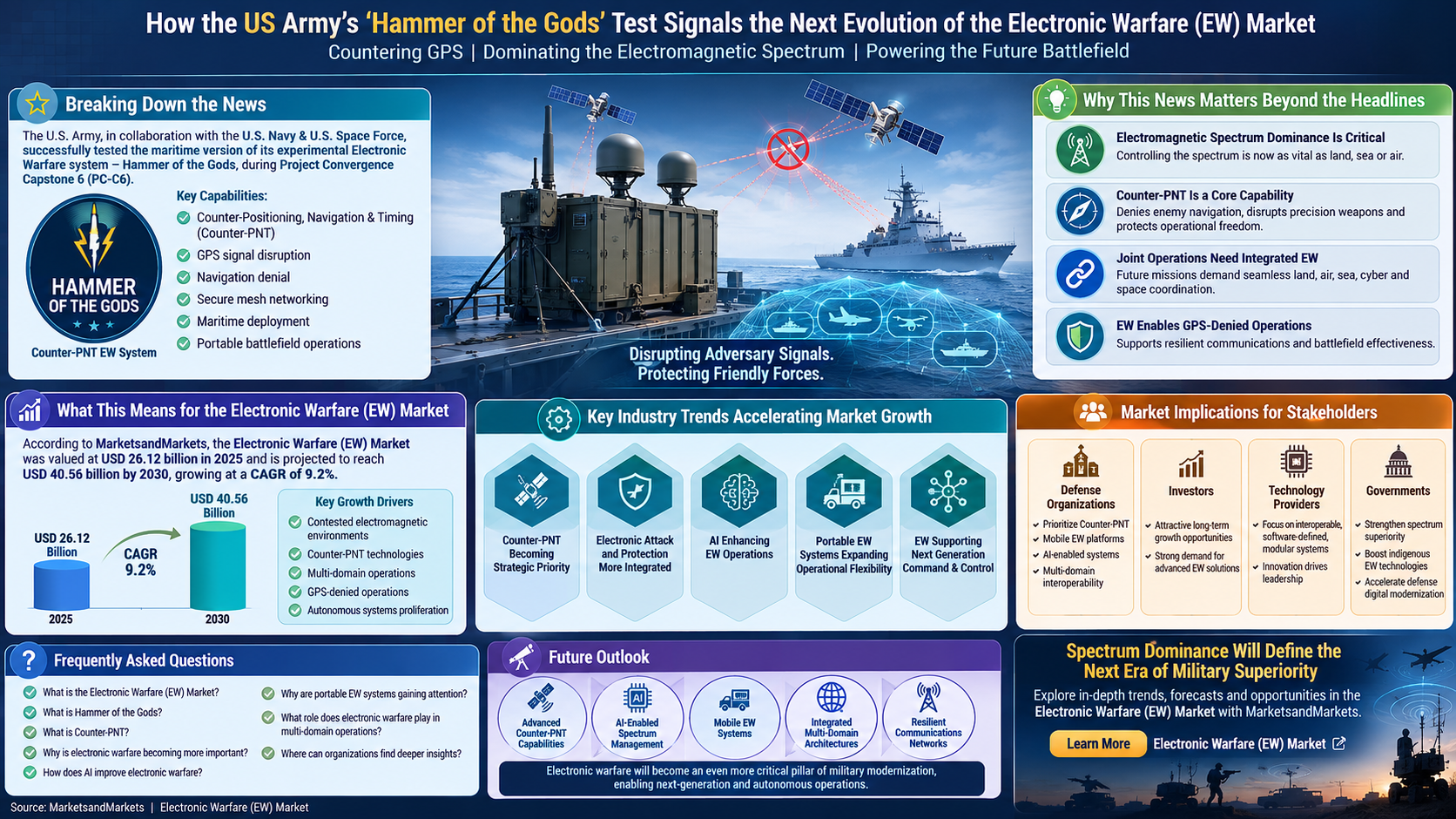
A recent demonstration by the U.S. Army illustrates this shift. During Project Convergence Capstone 6 (PC-C6), the Army, working alongside the U.S. Navy and U.S. Space Force, successfully tested the maritime version of its experimental electronic warfare system known as Hammer of the Gods. The portable counter-Positioning, Navigation, and Timing (counter-PNT) system is designed to disrupt GPS and navigation signals used by hostile precision-guided weapons while maintaining secure communications for friendly forces through resilient mesh networking.
The successful sea-based demonstration represents an important milestone for deployable electronic warfare capabilities. It also reflects broader defense modernization efforts focused on operating effectively in contested electromagnetic environments where GPS jamming, signal spoofing, cyber attacks, and electronic surveillance have become routine elements of military competition.
For defense organizations, technology providers, investors, and policymakers, the demonstration reinforces long-term growth opportunities within the Electronic Warfare (EW) Market, where integrated electronic attack, electronic protection, and spectrum dominance capabilities are becoming indispensable across land, air, maritime, cyber, and space operations.
Breaking Down the News
The U.S. Army recently conducted the first successful maritime demonstration of the Hammer of the Gods electronic warfare system during Project Convergence Capstone 6.
Developed in collaboration with the U.S. Navy and U.S. Space Force, the portable counter-PNT platform is designed to disrupt adversary positioning, navigation, and timing capabilities while preserving secure communications for friendly forces.
Key capabilities include:
- Counter-Positioning, Navigation, and Timing (Counter-PNT)
- GPS signal disruption
- Navigation denial
- Secure mesh networking
- Maritime deployment
- Portable battlefield operations
Unlike traditional fixed electronic warfare installations, Hammer of the Gods is designed for rapid deployment across multiple operational environments, providing commanders with greater flexibility during expeditionary and joint-force missions.
The demonstration also highlights the increasing importance of electronic warfare systems capable of supporting operations where access to satellite navigation or uncontested communications can no longer be assumed.
Why This News Matters Beyond the Headlines
The significance of the Hammer of the Gods demonstration extends beyond a single prototype or technology demonstration.
It illustrates several major trends reshaping military operations.
Electromagnetic Spectrum Dominance Is Becoming Critical
Modern militaries increasingly depend on:
- GPS navigation
- Satellite communications
- Precision targeting
- Data networks
- Radar systems
- Command-and-control platforms
Disrupting these systems can significantly degrade an adversary's operational effectiveness.
As a result, control of the electromagnetic spectrum is becoming as strategically important as control of land, sea, or air.
Counter-PNT Is Emerging as a Core Capability
Positioning, Navigation, and Timing services underpin nearly every modern military platform.
Counter-PNT technologies seek to:
- Deny enemy navigation
- Disrupt precision-guided weapons
- Interfere with autonomous systems
- Reduce targeting accuracy
- Protect friendly operational freedom
The successful maritime demonstration reinforces the growing strategic value of these capabilities.
Joint Operations Require Integrated EW Architectures
Future military operations increasingly involve coordinated activities across:
- Land
- Maritime
- Air
- Cyber
- Space
Electronic warfare systems must therefore operate seamlessly across multiple domains while supporting joint command structures.
Hammer of the Gods reflects this evolution toward integrated electronic warfare architectures.
What This Means for the Electronic Warfare (EW) Market
The latest demonstration closely aligns with long-term growth drivers shaping the global Electronic Warfare (EW) Market.
According to MarketsandMarkets, the Electronic Warfare (EW) Market was valued at USD 26.12 billion in 2025 and is projected to reach USD 40.56 billion by 2030, growing at a CAGR of 9.2%.
This expansion is being driven by increasing reliance on communication, navigation, radar, targeting, and spectrum management systems across modern military operations.
| Market Driver | Industry Impact |
|---|---|
| Contested electromagnetic environments | Increased procurement of advanced EW platforms |
| Counter-PNT technologies | Growing demand for navigation disruption capabilities |
| Multi-domain operations | Greater integration of electronic attack and protection systems |
| GPS-denied operations | Expanded investment in resilient communications |
| Autonomous systems proliferation | Higher demand for advanced electronic protection technologies |
The Hammer of the Gods demonstration reinforces each of these trends while highlighting how portable and deployable EW capabilities are becoming increasingly important for future operations.
Organizations seeking deeper insights into evolving procurement priorities can explore broader developments within the Electronic Warfare (EW) Market and understand how spectrum dominance is reshaping modern defense strategies.
Related Resource: Read about the Electronic Warfare (EW) Market: https://www.marketsandmarkets.com/Market-Reports/electronic-warfare-market-1301.html
Key Industry Trends Accelerating Market Growth
Counter-PNT Technologies Are Becoming Strategic Priorities
Counter-Positioning, Navigation, and Timing systems are rapidly becoming essential components of military modernization.
These technologies help:
- Deny GPS access
- Disrupt enemy navigation
- Protect friendly operations
- Reduce weapon effectiveness
- Enhance operational survivability
Demand is expected to increase as precision-guided weapons become more widespread.
Electronic Attack and Electronic Protection Are Becoming More Integrated
Modern electronic warfare increasingly combines:
- Electronic attack
- Electronic protection
- Electronic support
- Signal intelligence
- Spectrum monitoring
Integrated architectures improve operational flexibility while enabling more effective responses against evolving threats.
AI Is Enhancing Electronic Warfare Operations
Artificial intelligence is increasingly supporting:
- Automated spectrum management
- Signal classification
- Threat detection
- Electromagnetic analysis
- Decision support
These capabilities improve operational responsiveness while reducing operator workload.
Portable EW Systems Are Expanding Operational Flexibility
Military organizations increasingly seek deployable electronic warfare platforms that can support expeditionary operations.
Portable systems provide:
- Faster deployment
- Greater mobility
- Lower logistical burden
- Flexible mission support
- Improved tactical responsiveness
Hammer of the Gods reflects this growing emphasis on mobility.
Electronic Warfare Is Supporting Next Generation Command and Control
Electronic warfare is becoming closely integrated with Next Generation Command and Control (NGC2) systems.
This integration improves:
- Situational awareness
- Communications resilience
- Battlefield coordination
- Decision-making
- Multi-domain synchronization
The convergence of EW and advanced command systems is expected to continue accelerating.
Market Implications for Stakeholders
For Defense Organizations
Military forces increasingly recognize electronic warfare as a foundational capability supporting future military operations.
Procurement priorities are likely to emphasize:
- Counter-PNT technologies
- Mobile electronic warfare platforms
- Integrated EW architectures
- AI-enabled spectrum management
- Multi-domain interoperability
These capabilities improve operational resilience in contested environments.
For Investors
The Electronic Warfare Systems Market continues to offer attractive long-term growth opportunities.
Key investment themes include:
- Counter-PNT technologies
- Signal intelligence platforms
- AI-enabled EW software
- Electronic protection systems
- Spectrum management solutions
Growing defense modernization programs continue supporting sustained market demand.
For Technology Providers
Electronic warfare manufacturers increasingly compete by delivering interoperable, software-defined, and modular systems.
Competitive differentiation depends on:
- Spectrum awareness
- Signal processing performance
- Platform integration
- Software adaptability
- Operational reliability
Innovation remains central to long-term market leadership.
For Governments
Governments continue increasing investments in electronic warfare capabilities to strengthen national defense and improve battlefield resilience.
Strategic priorities include:
- Electromagnetic spectrum superiority
- Secure communications
- Indigenous EW technologies
- Multi-domain integration
- Defense digital modernization
Public-sector investment is expected to remain a major market catalyst.
Frequently Asked Questions
What is the Electronic Warfare (EW) Market?
The Electronic Warfare (EW) Market includes technologies designed to detect, disrupt, protect against, and exploit electromagnetic signals used for communications, radar, navigation, surveillance, and targeting across military operations.
What is Hammer of the Gods?
Hammer of the Gods is an experimental portable counter-Positioning, Navigation, and Timing (counter-PNT) electronic warfare system developed by the U.S. Army to disrupt enemy GPS and navigation signals while supporting secure communications for friendly forces.
What is Counter-PNT?
Counter-Positioning, Navigation, and Timing technologies are designed to interfere with an adversary's navigation capabilities, reducing the effectiveness of precision-guided weapons, autonomous systems, and GPS-dependent military operations.
Why is electronic warfare becoming more important?
Modern military platforms depend heavily on communications, radar, navigation, and targeting systems. Electronic warfare enables armed forces to disrupt adversary capabilities while protecting their own systems.
How does AI improve electronic warfare?
Artificial intelligence enhances spectrum management, signal analysis, threat detection, target identification, and automated decision-making, improving the effectiveness of modern EW systems.
Why are portable electronic warfare systems gaining attention?
Portable systems offer rapid deployment, operational flexibility, expeditionary support, and lower logistical requirements while providing advanced electronic attack and protection capabilities.
What role does electronic warfare play in multi-domain operations?
Electronic warfare supports coordinated military operations across land, air, sea, cyber, and space by protecting communications, disrupting adversary networks, and improving operational awareness.
Where can organizations find deeper insights into electronic warfare trends?
Industry stakeholders often rely on specialized market intelligence to evaluate technology developments, procurement strategies, competitive dynamics, investment opportunities, and future market forecasts.
Looking Beyond Today's Headlines
The successful maritime demonstration of Hammer of the Gods reflects the growing importance of electronic warfare within future military operations.
As armed forces increasingly operate in contested electromagnetic environments, the ability to disrupt adversary navigation, protect friendly communications, and maintain spectrum superiority will become increasingly decisive.
Several trends are expected to define the future of electronic warfare:
- Counter-PNT technologies
- AI-enabled spectrum management
- Mobile electronic warfare systems
- Integrated multi-domain EW architectures
- Software-defined electronic attack capabilities
- Resilient communications networks
As these capabilities continue to mature, electronic warfare will become even more deeply integrated into broader military modernization strategies, supporting next-generation command-and-control systems and increasingly autonomous operations.
Future Outlook
The U.S. Army's successful maritime demonstration of the Hammer of the Gods electronic warfare system highlights the growing strategic importance of controlling the electromagnetic spectrum during modern military operations. By combining Counter-PNT capabilities with resilient communications, the platform demonstrates how future electronic warfare systems will help protect friendly forces while disrupting increasingly sophisticated adversary capabilities.
These developments align closely with broader trends shaping the Electronic Warfare (EW) Market, where rising investments in electronic attack, electronic protection, GPS denial, AI-enabled spectrum management, and integrated multi-domain operations continue to drive sustained market growth.
For defense organizations, investors, technology providers, and policymakers, understanding these trends will be essential as electronic warfare becomes an increasingly critical pillar of military modernization. The continued evolution of contested electromagnetic environments ensures that advanced EW capabilities will remain among the highest-priority investment areas across the global defense sector.
For readers seeking deeper insights into market forecasts, technology developments, competitive dynamics, and future opportunities, MarketsandMarkets provides comprehensive research on the Electronic Warfare (EW) Market and the technologies shaping the future of spectrum dominance.
Download Sample Report: https://www.marketsandmarkets.com/pdfdownloadNew.asp?id=1301
Explore the Electronic Warfare (EW) Market: https://www.marketsandmarkets.com/Market-Reports/electronic-warfare-market-1301.html
80% of the Forbes Global 2000 B2B companies rely on MarketsandMarkets to identify growth opportunities in emerging technologies and use cases that will have a positive revenue impact.
- Food Packaging Market Size Set for Strong Growth Through 2030 Amid Rising Demand for Convenience Foods
- Mulch Films Market: Driving Sustainable Agriculture Through Innovation
- Agricultural Adjuvants Market Analysis, Trends, and Growth Outlook (2026–2031)
- Crop Protection Chemical Market Size, Share & Growth Forecast (2025–2030)
- Japan Enterprise Asset Management Market Growth: AI and Smart Infrastructure Drive Demand


