How Is the Military Cybersecurity Market Evolving in the Era of Digital Warfare
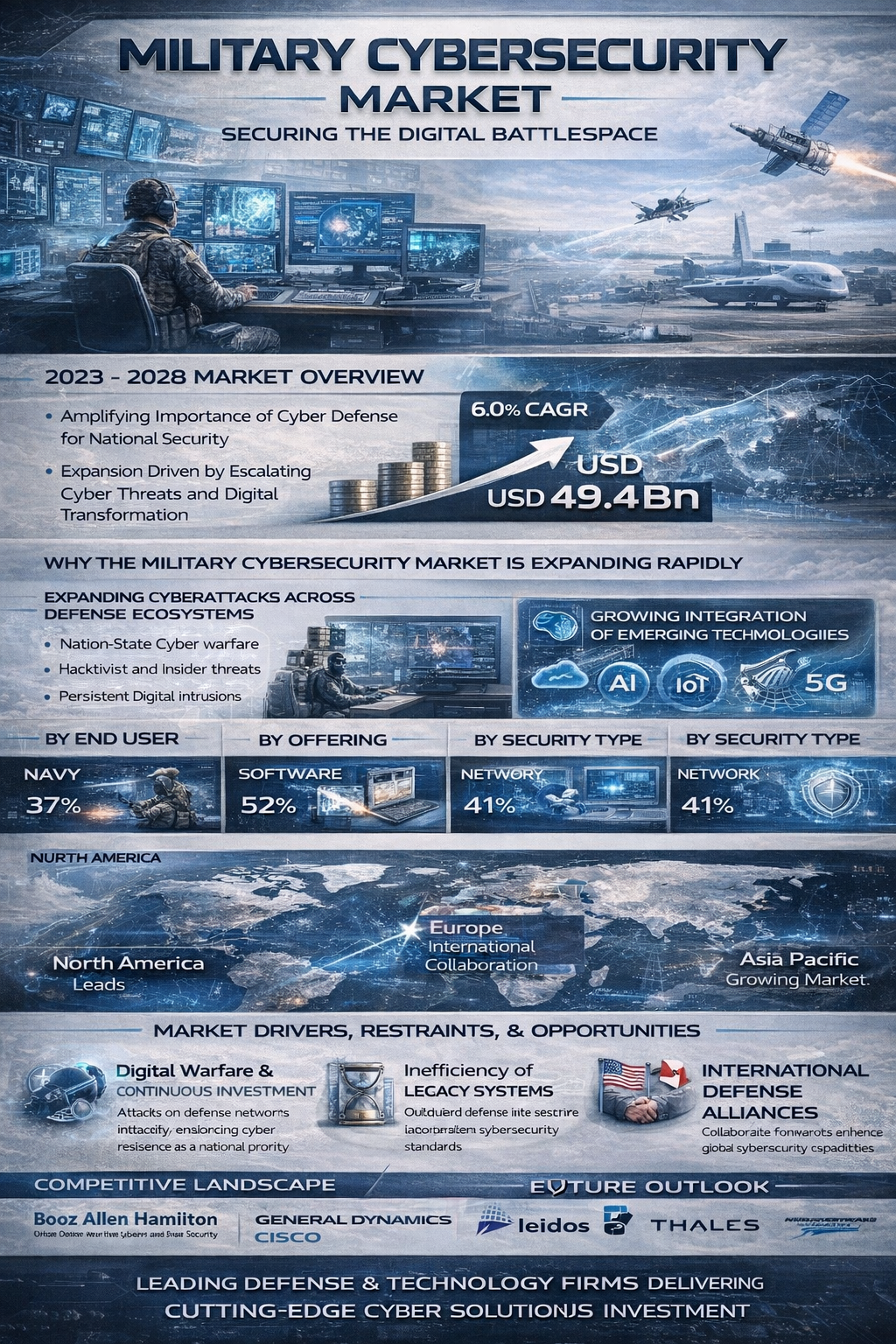
As digital warfare transforms defense tactics globally, the Global Military Cybersecurity Market is about to enter a pivotal growth phase. The Military Cybersecurity Market is the most strategically important and quickly developing part of this ecosystem, while the larger Defense Cybersecurity Market was estimated to be worth USD 20.34 billion in 2026 and is expected to grow at a CAGR of 11.2% to reach USD 34.53 billion in 2031.
The growing sophistication of cyberattacks that target command networks, defense infrastructure, classified communications, and operational technology is what propels the military cybersecurity market. The attack surface grows significantly as military forces adopt network-centric warfare doctrines, artificial intelligence, cloud integration, and Internet of Things deployments. As a result, national security requirements and digital transformation converge in the military cybersecurity market.
The Military Cybersecurity Market has become essential to preserving operational dominance and defending national interests, from securing satellite networks and tactical systems to defending naval fleets and combat communications.
To know about the assumptions considered for the study download the pdf brochure
Why the Market for Military Cybersecurity Is Growing Quickly
Increasing Cyberattacks in Defense Ecosystems
The exponential rise in cyberattacks on defense companies is the main factor propelling the military cybersecurity market. Nation states, hacktivists, cybercriminal networks, and insider threats always target military systems. Because they oversee highly classified material, cutting-edge weaponry, and strategic intelligence, defense organizations are frequently targeted.
State-sponsored attacks are becoming more and more similar to digital warfare campaigns that involve theft of intellectual property, disruption of vital command networks, and advanced persistent threats. Incidents involving long-term network breaches demonstrate the seriousness of vulnerabilities in military infrastructures. Investments in the military cybersecurity market are growing as adversaries use more advanced malware, ransomware, and zero-day attacks.
Thus, the defense of national security and the military cybersecurity market are closely related. A successful cyberattack on military systems might jeopardize strategic operations, interfere with missions, and reveal private information. In the military cybersecurity market, this high-stakes environment guarantees ongoing funding and modernization.
Increasing Incorporation of New Technologies
The incorporation of IoT, cloud computing, 5G, artificial intelligence, and machine learning into military operations is transforming modern warfare. This technological integration greatly increases the difficulty of cybersecurity management.
The military cybersecurity market must change to safeguard these interconnected environments as defense forces embrace autonomous systems, networked combat platforms, and digital logistics systems. AI-powered cyber protection systems are being used more frequently to automate incident response processes, stop breaches, and identify anomalies in real time.
The military cybersecurity market is kept innovative and dynamic by the ongoing incorporation of cutting-edge technologies.
Market Segmentation Analysis for Military Cybersecurity
By End User: The Navy Dominates the Military Cybersecurity Industry
The Navy category holds the largest market share within the Military Cybersecurity Market. Network-centric operations, in which ships, submarines, aircraft, and command centers function inside interconnected digital environments, are crucial to naval forces. Cyber assaults target these intricate marine networks.
Strong cybersecurity designs are necessary to protect naval assets like communication hubs and aircraft carriers. The Navy is a major force behind the expansion of the military cybersecurity market due to its emphasis on safeguarding vital marine infrastructure.
As nations engage in strengthening combat cyber resilience and protecting tactical communications, the Army segment is likewise anticipated to develop significantly. Secure digital networks are becoming more and more important in modern ground warfare, which is growing the size of the military cybersecurity market.
By Providing: Services and Software Rule
The Military Cybersecurity Market is dominated by the software and services sector. Real-time network monitoring, intrusion prevention, and threat detection are made possible by sophisticated cybersecurity software. Operational readiness is improved by services like managed security operations, incident response, and consultancy.
The need for safe cloud-based cybersecurity solutions has increased due to the use of cloud computing in military operations. Defense companies can grow safely while preserving data integrity thanks to cloud security standards.
As digital modernization picks up speed, software-driven innovation will continue to shape the military cybersecurity market.
Network Security Leads by Security Type
By security type, network security is expected to lead the military cybersecurity market. Network infrastructure security has grown critical due to the growing attack surfaces caused by IoT integration, satellite communications, and 5G connections.
Network security systems enable continuous traffic monitoring, anomaly detection, and quick threat mitigation. Mission continuity and resilience against cyber interruptions are guaranteed by real-time visibility into network activity. The network security segment's anticipated 6.8% CAGR highlights its significance in the military cybersecurity market.
The military cybersecurity market's regional outlook
North America Leads the World in Growth
Because of its sophisticated cybersecurity ecosystems and strong defense budgets, North America has the biggest market share in military cybersecurity. The presence of top defense contractors and cybersecurity solution suppliers further reinforces regional dominance.
North America's dedication to enhancing military cyber resilience is demonstrated by important projects like the Defense Information Systems Agency's creation of the Zero Trust Network. The military cybersecurity market in this area is kept robust by high-value contracts and continuous upgrading initiatives.
Europe and Global Cooperation
Investments in cooperative defense cybersecurity frameworks are rising among European countries. Collective cyber defense capabilities are enhanced by international collaborations and intelligence sharing agreements. The significance of international collaboration in bolstering the Military Cybersecurity Market is demonstrated by contracts granted by multinational alliances.
International cooperation improves cooperative technological development, threat intelligence sharing, and resource pooling. This international collaboration is a key driver of the military cybersecurity market's expansion.
Drivers, Restraints, Opportunities, and Challenges
National Security Requirements and Digital Warfare
Digital warfare is now a crucial component of contemporary combat. Infrastructure disruption, sabotage, and cyber espionage must be prevented by military troops. The military cybersecurity market is still primarily driven by the requirement to safeguard national security interests.
Restraints: Legacy Systems' Inefficiency
In the context of the military cybersecurity market, legacy defense systems pose serious risks. Modern cybersecurity rules were not incorporated into the design of many antiquated facilities. These systems must be updated or replaced, which necessitates significant financial outlays and operational reorganization, posing logistical and financial difficulties.
Opportunities: Increase in Global Partnerships
In the military cybersecurity market, international cooperation presents enormous opportunities. Coordinated incident response procedures, cooperative R&D projects, and shared threat intelligence improve global cyber resilience. Additionally, collaborative frameworks speed up the creation of cutting-edge cybersecurity standards.
Challenges: Lack of Skilled Workers
One of the most significant issues facing the military cybersecurity market is the lack of qualified cybersecurity experts. Defense businesses find it difficult to hire and retain professionals who can handle intricate security infrastructures as cyber threats change quickly. There is still a great need for specialized knowledge in threat intelligence, penetration testing, and cloud security.
The Military Cybersecurity Market's Competitive Environment
Defense integrators, cybersecurity experts, and technology suppliers make up the fiercely competitive ecosystem of the military cybersecurity market.
Booz Allen Hamilton Inc. is a significant player in the military cybersecurity market, offering defense agencies cyber defense technologies, analytics, and consultancy. The company's proficiency in risk management and intelligence enhances military cyber resistance.
General Dynamics Corporation provides mission-critical cybersecurity services and secure communication technologies. Its defense-focused cyber capabilities improve operational security in the air, sea, land, and space domains.
In the military cybersecurity market, Cisco Systems Inc. is a key player in network security solutions. The company supports defense digital transformation by offering software services, cloud security, and secure networking.
Microsoft strengthens military digital infrastructures with cutting-edge cloud security and AI-driven cybersecurity technologies. Defense agencies use its secure cloud platforms extensively.
Leidos provides managed services and integrated cybersecurity solutions to safeguard vital defense networks. The business places a strong emphasis on innovation in cyber analytics and threat identification.
Through international cyber defense programs and AI-powered security intelligence platforms, IBM promotes defensive cybersecurity. Network security is improved by its proficiency with zero trust architectures.
Thales supports defense cybersecurity requirements in international markets by providing cutting-edge encryption and secure communication technology.
Lockheed Martin Corporation ensures safe mission execution by integrating cybersecurity into cutting-edge defense equipment.
Northrop Grumman supports military operations with comprehensive cyber protection equipment and intelligence solutions.
Raytheon Technologies creates network protection and secure communications systems specifically for use in military settings.
For defense clients, L3Harris Technologies Inc. specializes in robust cyber infrastructures and safe communication solutions.
Leonardo S.p.A. supports aerospace and naval defense operations with integrated cybersecurity capabilities.
To improve military cyber preparedness, CACI International Inc. provides cyber intelligence and mission support services.
Elbit Technologies Ltd. offers cyber defense and safe electronic warfare technologies that improve battlefield security.
BAE Systems supports international military clients by creating cutting-edge cyber intelligence and defense technology.
Together, these businesses influence competition and innovation in the military cybersecurity market.
Future Prospects for the Military Cybersecurity Industry
As defense companies continue to place a high priority on cyber resilience, the military cybersecurity market is expected to grow steadily through 2028. Cyber defense frameworks will be redefined by artificial intelligence, machine learning, zero trust architectures, and quantum resistant encryption technologies.
The military cybersecurity market's major pillars will continue to be network security, cloud security, and real-time threat intelligence platforms. Proactive cyber defense tactics will become just as important as conventional kinetic weapons as digital warfare escalates.
The development of the military cybersecurity market is a reflection of the larger changes in contemporary combat, when strategic advantage is determined by cyber superiority, secure communications, and data integrity.
A key component of contemporary defense strategy is the military cybersecurity market. The market is expected to rise to USD 49.4 billion by 2028, reflecting the pressing need to defend national security interests and combat growing cyber threats. The military cybersecurity market is constantly changing in response to more advanced cyber adversaries, from network-centric naval operations to AI-powered threat detection systems.
80% of the Forbes Global 2000 B2B companies rely on MarketsandMarkets to identify growth opportunities in emerging technologies and use cases that will have a positive revenue impact.
- Food Packaging Market Size Set for Strong Growth Through 2030 Amid Rising Demand for Convenience Foods
- Crop Protection Chemical Market Size, Share & Growth Forecast (2025–2030)
- Mulch Films Market: Driving Sustainable Agriculture Through Innovation
- Agricultural Adjuvants Market Analysis, Trends, and Growth Outlook (2026–2031)
- Japan Enterprise Asset Management Market Growth: AI and Smart Infrastructure Drive Demand