

Home/ Aerospace and Defense / military-robots-market-trends-2026-ai-robotics-battlefield-automation-drive-growth

Military Robots Market Trends 2026: AI, Robotics, and Battlefield Automation Drive Growth

MarketsandMarkets™ Research Private Ltd,, 19 Jun 2026
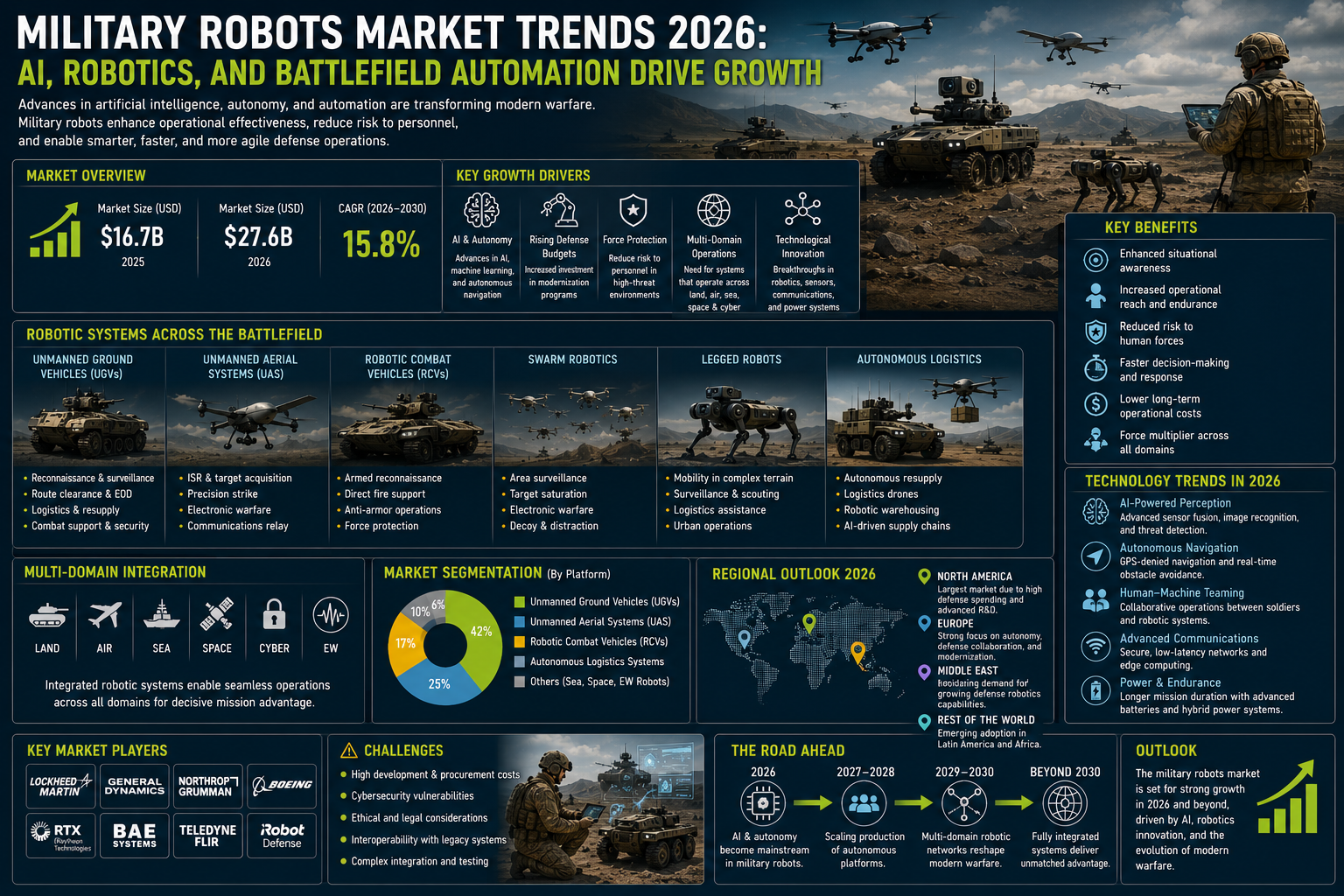
The global military robots market is experiencing rapid growth as defense organizations accelerate investments in artificial intelligence (AI), autonomous systems, and battlefield automation technologies. From unmanned ground vehicles and autonomous combat platforms to intelligent logistics systems and robotic reconnaissance assets, military robots are becoming increasingly important for modern defense operations. As armed forces seek to enhance operational efficiency, reduce personnel risk, and improve decision-making speed, robotic systems are emerging as critical force multipliers across land, air, maritime, and multi-domain environments.

In 2026, military robotics is moving beyond experimental programs and limited deployments toward large-scale integration within defense modernization initiatives. Advances in AI, machine learning, autonomous navigation, sensor fusion, and network-centric warfare are enabling a new generation of robotic systems capable of supporting increasingly complex missions. These developments are creating significant opportunities across the military robots market while reshaping the future of global defense operations. as armed forces seek to enhance operational efficiency, reduce personnel risk, and improve decision-making speed, robotic systems are emerging as critical force multipliers across land, air, maritime, and multi-domain environments.

Artificial Intelligence Is Transforming Military Robotics

Artificial intelligence is emerging as the primary force behind the rapid evolution of military robotics. Modern robotic systems are no longer limited to remote-controlled operations but are increasingly capable of analyzing data, recognizing threats, navigating complex environments, and supporting tactical decision-making with minimal human intervention.

Advanced machine learning algorithms, computer vision technologies, and sensor fusion capabilities allow military robots to process information from multiple sources in real time. This enables faster threat detection, improved situational awareness, and more efficient mission execution. As defense agencies prioritize information superiority and operational agility, AI-powered robotic systems are becoming indispensable assets across military operations.
 
Download Brochure Analyst-Verified Insights @ https://www.marketsandmarkets.com/pdfdownloadNew.asp?id=245516013

Battlefield Automation Is Reshaping Military Operations

The growing emphasis on battlefield automation is fundamentally changing how military forces conduct missions. Automated robotic systems can perform a variety of tasks that traditionally required significant human involvement, including surveillance, reconnaissance, logistics transport, perimeter security, and explosive ordnance disposal.

Automation enables military organizations to improve operational efficiency while reducing the physical and cognitive burden on personnel. By integrating robotic systems into battlefield workflows, armed forces can enhance mission effectiveness, accelerate response times, and maintain operational readiness in increasingly complex environments.

The expansion of battlefield automation is expected to remain a major driver of military robot adoption throughout 2026 and beyond.

Autonomous Ground Vehicles Gaining Strategic Importance

Autonomous Ground Vehicles (AGVs) are becoming one of the fastest-growing segments of the military robots market. These systems are being deployed for reconnaissance, route clearance, logistics support, and force protection missions across diverse operational environments.

Advances in autonomous navigation, terrain mapping, and obstacle avoidance technologies are enabling ground robots to operate effectively in challenging conditions with reduced operator oversight. Military organizations are increasingly viewing autonomous ground systems as force multipliers capable of extending operational reach while minimizing risks to soldiers.

As defense modernization programs continue to prioritize unmanned capabilities, demand for autonomous ground vehicles is expected to increase significantly.

Human-Machine Teaming Enhancing Combat Effectiveness

A key trend shaping the military robots market is the growing adoption of human-machine teaming concepts. Rather than replacing personnel, military robots are being designed to work alongside soldiers, enhancing their capabilities and improving mission outcomes.

Robotic systems can conduct reconnaissance missions, transport equipment, monitor operational areas, and provide intelligence support while human operators maintain strategic control and decision-making authority. This collaborative approach combines the adaptability and judgment of human personnel with the endurance, precision, and data-processing capabilities of autonomous systems.

Human-machine teaming is becoming a central element of future military doctrines and operational planning.

Robotic Logistics Supporting Operational Readiness

Military logistics is increasingly benefiting from advances in robotics and automation. Autonomous transport vehicles, robotic resupply systems, and AI-enabled maintenance platforms are improving the efficiency and resilience of military supply chains.

These technologies enable the delivery of fuel, ammunition, medical supplies, and equipment to frontline units while reducing exposure to enemy threats. Predictive maintenance capabilities also help improve equipment availability by identifying potential failures before they occur.

As military organizations focus on sustaining operations in contested environments, robotic logistics solutions are becoming an important area of investment and innovation.

Swarm Robotics Emerging as a Game-Changing Capability

Swarm robotics is gaining attention as defense agencies explore new approaches to battlefield operations. Swarms of interconnected autonomous systems can coordinate actions, share information, and execute missions collaboratively without relying on centralized control structures.

This capability offers several operational advantages, including expanded surveillance coverage, greater mission flexibility, and enhanced resilience. Swarm-enabled robotic systems can support reconnaissance, electronic warfare, force protection, and other military missions while adapting dynamically to changing battlefield conditions.

As swarm intelligence technologies mature, they are expected to become an increasingly influential segment of the military robotics market.

Multi-Domain Operations Increasing Demand for Robotic Systems

Modern warfare requires coordinated operations across land, air, maritime, cyber, and space domains. Military robots are playing a crucial role in enabling this multi-domain approach by serving as interconnected platforms capable of gathering, sharing, and acting upon battlefield information.

Ground robots, aerial drones, autonomous maritime systems, and AI-driven command networks are being integrated into comprehensive operational ecosystems that support real-time decision-making and coordinated mission execution. This growing emphasis on multi-domain operations is creating new opportunities for military robotics manufacturers and technology developers.

Defense Modernization Programs Fueling Market Expansion

Governments around the world are increasing investments in military robotics as part of broader defense modernization strategies. Armed forces recognize that autonomous systems can improve force protection, enhance operational efficiency, and strengthen military readiness in an increasingly competitive security environment.

Research and development programs focused on artificial intelligence, autonomous vehicles, advanced sensors, and robotic combat systems are accelerating innovation across the sector. Partnerships between defense agencies, technology companies, and defense contractors are further contributing to the rapid advancement of military robotics capabilities.

These modernization efforts are expected to remain a key source of market growth throughout the forecast period.

Technological Advancements Expanding Operational Capabilities

Continuous innovation in robotics, communications, sensors, and computing technologies is significantly enhancing the capabilities of military robots. Improvements in edge computing, cybersecurity, autonomous navigation, and real-time data processing are enabling robotic platforms to operate more effectively in contested and dynamic environments.

At the same time, advances in energy storage and power management are extending operational endurance, allowing military robots to support longer-duration missions. These technological developments are expanding the range of applications for military robotic systems and accelerating their adoption across defense organizations.

Conclusion

The military robots market in 2026 is being shaped by the convergence of artificial intelligence, advanced robotics, and battlefield automation technologies. As defense agencies pursue modernization initiatives and prepare for future operational challenges, autonomous systems are becoming essential tools for enhancing battlefield awareness, improving force protection, and increasing operational efficiency. From autonomous ground vehicles and robotic logistics platforms to swarm-enabled systems and human-machine teaming solutions, military robots are redefining modern warfare and driving the next phase of growth in the global defense sector.


DMCA.com Protection Status

