

How RTX Is Transforming the Software Defined Radio Market
Introduction to Software Defined Radio
The evolution of military communications is moving from conventional hardware focused radio systems toward flexible, software driven communication architectures. Software Defined Radio Technology enables communication functions to be implemented through software, allowing radio platforms to support different waveforms, frequency bands, communication modes, and network configurations.
This flexibility is becoming increasingly important as defense forces operate across complex and contested environments. Modern military operations require secure connectivity between soldiers, vehicles, aircraft, command centers, unmanned platforms, satellites, and other assets. These systems must exchange voice, data, imagery, video, and mission information while maintaining interoperability across different platforms and networks.
Software Defined Radio technology addresses these requirements by allowing communication capabilities to evolve through software updates and configurable architectures. Instead of depending exclusively on dedicated hardware for each communication requirement, a single SDR platform can potentially support multiple functions and waveforms.
Within this changing environment, RTX, through its Collins Aerospace business, has developed a broad portfolio of software defined communication technologies. Collins Aerospace provides software defined radio technologies across airborne, ground, tactical, and space applications. Its communication portfolio includes the TruNet networked communications family, airborne Software Defined Radios, ground networking radios, tactical data links, and ProtoStar space based Software Defined Radio technology.
Evolution From Conventional Radios to Software Defined Communications
Conventional radio systems were traditionally designed around specific hardware configurations and dedicated communication functions. When requirements changed, organizations often needed new equipment or significant hardware modifications.
Software Defined Radio changes this model by shifting important communication functions into programmable software. This allows radio platforms to accommodate new waveforms, communication modes, networking capabilities, and mission requirements without necessarily replacing the complete radio hardware.
This capability can be particularly valuable for defense organizations because military communication requirements evolve continuously. Radios may need to operate across multiple frequency bands, support different waveforms, connect to tactical networks, and maintain compatibility with legacy systems.
The evolution toward SDR also supports longer equipment lifecycles. Software based upgrades can provide a pathway for introducing new capabilities as communication standards and operational requirements change.
Collins Aerospace describes its military communication portfolio as combining modernized communication systems with Software Defined Radio technologies that provide capabilities across and between operational domains while integrating with existing platforms.
Growing Importance of Flexible Military Communication Systems
Modern military operations increasingly depend on flexible communication networks.
A single military operation may involve ground forces, aircraft, naval assets, satellites, command centers, sensors, and unmanned systems. These platforms may operate with different communication requirements while still needing to exchange information.
Multiband and multimode SDR platforms can help address this challenge by supporting several communication functions within configurable systems.
Collins Aerospace's TruNet portfolio is designed around this networked approach. The company describes TruNet as an integrated software defined communications solution incorporating ground and airborne radios, advanced networking waveforms, applications, supporting equipment, and services.
Increasing Demand for Secure and Interoperable Tactical Networks
Interoperability has become one of the most important requirements for modern military communications.
Joint operations can involve multiple branches of the armed forces and coalition partners. Communication systems therefore need to exchange information across different platforms, networks, and generations of equipment.
Security is equally important. Tactical networks can operate in environments where communication systems face interference, spectrum congestion, and other electromagnetic challenges.
Modern SDR architectures can support secure communication, programmable waveforms, networking capabilities, and software based upgrades.
Collins Aerospace states that TruNet enables secure connectivity between ground and airborne forces and supports communication across joint and coalition environments.
Software Defined Radio Market Overview
Market Size and Forecast
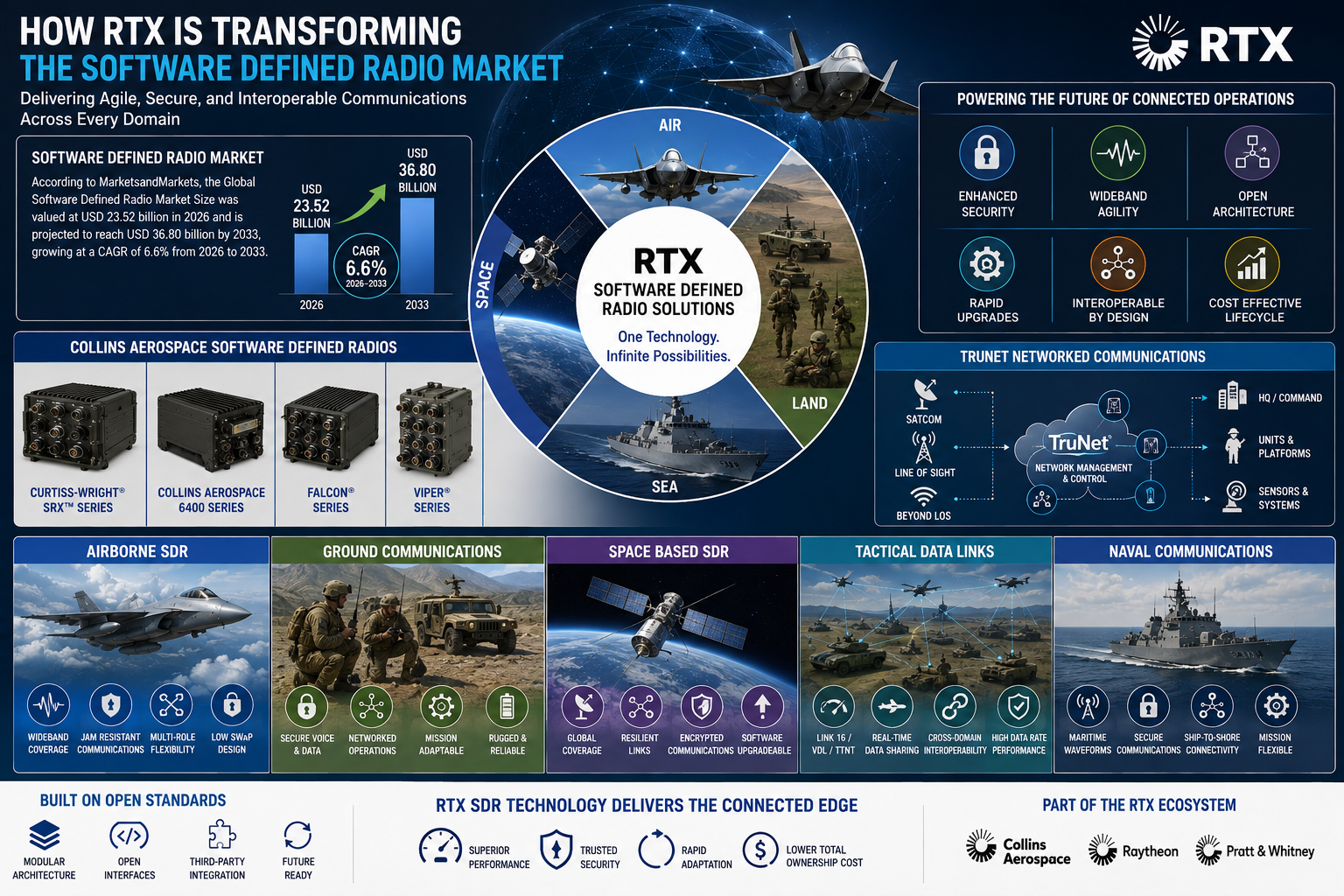
According to MarketsandMarkets, the Global Software Defined Radio Market Size was valued at USD 23.52 billion in 2026 and is projected to reach USD 36.80 billion by 2033, growing at a CAGR of 6.6% from 2026 to 2033.
In terms of volume, the market is projected to grow from 3,424,776 units in 2026 to 4,476,811 units by 2033.
The market is supported by increasing military communication modernization, growing demand for interoperable communications, adoption of multiband and multimode radios, increasing use of SDR in UAVs and autonomous systems, and growing demand for flexible communication architectures.
MarketsandMarkets also identifies AI driven spectrum management, tactical networking, and the growing requirement for secure communications as important areas influencing the evolution of the Software Defined Radio Market.
Several factors are supporting the expansion of the market:
- Defense communication modernization
- Increasing demand for interoperable military communications
- Growing adoption of multiband radios
- Increasing use of multimode communication systems
- Rising adoption of software programmable architectures
- Growth of tactical networking
- Increasing integration of broadband and satellite communications
- Growing use of SDR technology in airborne and space applications
The market's evolution reflects a broader shift from individual radio systems toward interconnected communication ecosystems.
Major Market Growth Drivers
Defense modernization is one of the most important drivers of the Software Defined Radio Market.
Military organizations are increasingly replacing legacy communication systems with flexible platforms that can support modern waveforms, secure networking, high speed data, and interoperability.
The demand for interoperable communications is also increasing because modern military operations frequently involve joint and coalition forces.
Another important driver is the adoption of multiband and multimode radios. These systems can consolidate multiple communication functions into fewer platforms, helping reduce equipment complexity while improving operational flexibility.
The increasing use of unmanned systems is creating additional opportunities. UAVs and autonomous platforms require lightweight, programmable, secure communication systems capable of transmitting data and connecting to wider tactical networks.
The Software Defined Radio Market is consequently evolving from traditional voice communication toward software driven platforms supporting data, networking, imagery, video, and integrated mission information.
RTX's Software Defined Radio Capabilities
Collins Aerospace Software Defined Radios
RTX's Collins Aerospace business has developed a broad portfolio of military communication systems that incorporate Software Defined Radio technology.
Its portfolio covers airborne communication, ground communication, tactical networking, and space based communication applications. Collins Aerospace states that its military communications portfolio includes sophisticated SDR technologies designed to support communication across domains and integrate with existing platforms.
This approach allows RTX to participate in the broader transformation toward software defined military communication architectures.
TruNet Networked Communications
TruNet is one of the most important elements of the Collins Aerospace SDR portfolio.
Collins Aerospace describes TruNet as an integrated software defined communications solution that combines ground and airborne radios, networking waveforms, applications, supporting equipment, and services.
The system is designed to enable secure and real time sharing of critical data, imagery, voice, and video between ground, airborne, and mobile forces.
TruNet also supports multiple narrowband and wideband waveforms, legacy waveform integration, configurable components, and waveform portability.
This architecture demonstrates how the SDR market is moving beyond individual radios toward complete networked communication solutions.
Airborne SDR
Airborne communication is a major application area for Collins Aerospace.
The company offers Software Defined Radio technologies for military aircraft, including the ARC 210 family and TruNet AR 1500.
The ARC 210 RT 2036 C is described by Collins Aerospace as a single channel Software Defined Radio supporting multiple waveforms, high speed mobile ad hoc networking, beyond line of sight connectivity, data, voice, and imagery.
The TruNet AR 1500 is another airborne Software Defined Radio designed for networked communications. It is fully software programmable and supports secure communications, interoperability with Collins Aerospace and non Collins VHF and UHF radio systems, and high speed ad hoc networking.
RTX announced in 2024 that Collins Aerospace delivered its first TruNet AR 1500 networked communications airborne radio to a European nation for Poland's C 130H Hercules fleet. The radio provides software defined capabilities, expanded waveforms, L Band functionality, Link 22 data links, encryption, and anti jam technologies.
Ground Communications
Ground communication systems require flexibility because military units may operate in rapidly changing environments where infrastructure is limited or unavailable.
Collins Aerospace offers ground communication systems spanning secure high frequency radios and Software Defined Radio technologies. Its portfolio includes the TruNet AN PRC 162 ground networking radio.
The AN PRC 162 provides two channel networked communications with multiple narrowband and wideband waveforms, high speed mobile ad hoc networking, point to point data, voice, and next generation SATCOM capabilities.
This demonstrates how modern ground SDR systems are increasingly becoming networking nodes rather than standalone voice radios.
Space Based SDR
Space based Software Defined Radio is another emerging area for RTX.
Collins Aerospace's ProtoStar architecture is designed to provide resilient space based communications. The platform supports simultaneous waveforms and can receive software and waveform updates, allowing radio characteristics to change while in orbit.
ProtoStar supports frequencies from UHF through Ka Band and includes network router capabilities and encryption compatibility.
The ability to update a radio in orbit is particularly significant because it demonstrates how software defined architectures can provide adaptability beyond traditional terrestrial and airborne communication systems.
Tactical Data Links
Tactical data links are increasingly important because military platforms need to exchange digital information rather than simply voice communications.
Collins Aerospace integrates tactical data link capabilities into its broader communication portfolio.
The TruNet AR 1500, for example, supports Link 22 interoperability, extending its role beyond traditional radio communications into networked tactical information exchange.
Technology Innovations in the Software Defined Radio Market
Software Programmable Architectures
Software programmability is one of the defining characteristics of SDR technology.
A programmable architecture allows communication systems to evolve through software changes rather than requiring complete hardware replacement for every new capability.
The Collins Aerospace ARC 210 RT 2036 C is fully software programmable and supports software and network management, SCA compliant waveform development, and customer specific configuration.
This capability can help defense organizations introduce new functions while extending the operational life of existing equipment.
Multiband Communications
Multiband communication enables a radio to operate across different frequency ranges.
This is valuable for military users who need access to multiple networks and communication systems.
The Collins Aerospace TruNet AR 1500 covers a broad frequency range and supports multiple communication modes and waveforms.
The adoption of multiband SDR systems can also reduce the need for multiple dedicated radios.
Multimode Operation
Multimode operation allows a radio to support different communication functions within the same platform.
A modern military radio may need to support voice, data, networking, satellite communication, and tactical waveforms.
The TruNet portfolio combines narrowband and wideband waveforms and supports multiple communication applications across ground and airborne platforms.
Advanced Networking Waveforms
Networking waveforms transform radios into nodes within a broader tactical network.
TruNet incorporates advanced networking waveforms designed to enable communication between airborne and ground forces.
Its multi hop networking capabilities can extend communication beyond direct line of sight while allowing information to move through network nodes.
SATCOM Integration
Satellite communication is becoming increasingly important for military forces operating across large geographic areas.
The TruNet AN PRC 162 supports next generation SATCOM capabilities, while other Collins Aerospace communication systems incorporate satellite communication into broader military communication architectures.
SATCOM integration allows tactical communication systems to remain connected when terrestrial infrastructure is unavailable or insufficient.
High Speed Data
Military operations increasingly depend on high speed data.
Information can include intelligence, imagery, video, sensor information, maps, targeting information, and operational data.
Collins Aerospace's TruNet family is designed to support the secure sharing of data, imagery, voice, and video.
High speed data capabilities are consequently becoming a core requirement for modern SDR platforms.
Secure Communications
Security is fundamental to military communications.
Modern SDR systems need to protect information while maintaining interoperability and operational flexibility.
Collins Aerospace describes TruNet as providing secure connectivity across ground and airborne elements and its airborne communication portfolio includes secure communication capabilities.
The TruNet AR 1500 also incorporates encryption and anti jam technologies for secure tactical communications.
Military Applications of Software Defined Radio
Battlefield Communications
Battlefield communications are among the most important applications for SDR technology.
Soldiers and military units need secure communications with nearby forces, vehicles, aircraft, and command centers.
SDR systems provide flexibility by allowing communication platforms to support different waveforms and networks.
Command and Control
Command and control depends on reliable communication between decision makers and operational units.
SDR platforms can support the transmission of voice, data, imagery, and other information required for tactical decision making.
Networked SDR architectures can also connect different command levels across a broader operational environment.
Situational Awareness
Situational awareness depends on the timely exchange of information.
Sensors, aircraft, ground vehicles, unmanned platforms, and personnel can generate information that needs to be distributed across military networks.
TruNet is designed to support secure sharing of critical data, imagery, voice, and video across ground and airborne forces.
ISR Data Transmission
Intelligence, surveillance, and reconnaissance operations generate large amounts of information.
Modern communication networks need to transmit this information quickly and securely to commanders and operational units.
High speed data capabilities in SDR platforms can support this transition from voice focused communications toward information rich tactical networks.
Air Ground Communications
Air ground connectivity is essential for joint military operations.
Aircraft need to exchange information with ground units while operating across different environments.
Collins Aerospace identifies secure air to ground networking as a key capability of its airborne communication portfolio.
The ARC 210 RT 2036 C provides high speed mobile ad hoc networking and beyond line of sight communication for data, voice, and imagery.
Tactical Networking
Tactical networking is transforming military communication architecture.
Rather than connecting users through isolated radio links, networked SDR systems allow multiple nodes to exchange information.
TruNet is designed to connect ground, airborne, and mobile forces through an integrated networked communications architecture.
Multi Domain Operations
Modern defense operations increasingly span land, air, maritime, space, and other domains.
Communication systems therefore need to support interoperability across different platforms and operational environments.
RTX's Collins Aerospace portfolio addresses this requirement through communication systems covering airborne, ground, tactical, and space applications.
Competitive Landscape of the Software Defined Radio Market
The Software Defined Radio Market includes several major defense and communication technology companies.
RTX
RTX, through Collins Aerospace, provides Software Defined Radio and networked communications technologies across airborne, ground, tactical, and space applications.
Its TruNet family provides a major example of an integrated software defined communication architecture.
L3Harris Technologies
L3Harris Technologies is a major participant in tactical communications and Software Defined Radio, with a broad portfolio of military radios and networking solutions.
Thales
Thales has a significant presence in secure and interoperable Software Defined Radio solutions through its military communication portfolio and programs such as CONTACT and SYNAPS.
BAE Systems
BAE Systems participates in defense electronics, secure communications, tactical networks, and military communication technologies.
Motorola Solutions
Motorola Solutions has a strong position in mission critical communications, public safety communications, government networks, and secure communication platforms.
Rohde & Schwarz
Rohde & Schwarz operates across secure communications, defense radio technology, spectrum monitoring, and related communication systems.
The competitive environment is increasingly focused on integrated solutions combining SDR hardware, programmable waveforms, tactical networking, cybersecurity, spectrum management, and lifecycle software upgrades.
Future Outlook for the Software Defined Radio Market
AI Enabled Communications
Artificial intelligence is expected to create new opportunities for SDR technology.
AI can assist communication systems in analyzing spectrum conditions, identifying interference, optimizing frequency selection, and adapting network configurations.
AI enabled communication systems could make SDR platforms more responsive to changing electromagnetic environments.
Cognitive Radio
Cognitive radio technology represents another important future direction.
Cognitive radios can analyze their operating environments and make decisions about spectrum utilization.
When combined with AI, cognitive SDR systems could potentially select communication parameters dynamically based on spectrum availability, network conditions, interference, and mission requirements.
5G Integration
5G technology is creating new possibilities for high speed and low latency communications.
Future military communication architectures could combine SDR platforms with private 5G, broadband networks, tactical networks, and satellite communications.
This convergence could create communication architectures that connect tactical users with broader digital infrastructure.
Resilient Tactical Networks
Future military networks will need to maintain connectivity in increasingly challenging environments.
Resilient tactical networking will require secure communication, flexible waveforms, spectrum awareness, networking redundancy, and interoperability.
SDR platforms can support these requirements because their software based architecture enables communication capabilities to evolve as network requirements change.
Space Based SDR
Space based SDR is expected to become increasingly important as military and government organizations expand space based communication networks.
Collins Aerospace's ProtoStar illustrates this trend by providing a reprogrammable space based SDR architecture capable of supporting waveform updates while in orbit.
This approach could enable satellites to adapt communication capabilities after deployment rather than remaining limited to their original configuration.
Joint All Domain Operations
Joint all domain operations require connectivity across land, air, maritime, space, and other operational domains.
SDR technology can provide a flexible communications foundation for these environments because programmable radios can support multiple waveforms and networks.
RTX's combination of airborne, ground, tactical, and space communication technologies positions Collins Aerospace to participate in this broader transition toward connected military architectures.
Opportunities and Challenges in the Software Defined Radio Market
The Software Defined Radio Market presents significant opportunities as defense organizations transition from legacy communication systems toward flexible and networked architectures.
Key Opportunities
- Defense Communication Modernization: Military organizations are replacing legacy systems with programmable communication platforms.
- Interoperability: Joint and coalition operations are increasing demand for communication systems that can operate across different networks.
- Multiband Communications: Multiband SDR platforms can consolidate several communication functions into fewer systems.
- Tactical Networking: Network centric operations are increasing demand for high speed networking capabilities.
- Airborne Communications: Modern military aircraft require secure data, voice, imagery, and networking capabilities.
- Space Based Communications: Reprogrammable space based SDR platforms create new opportunities for resilient satellite communication.
- AI Integration: AI can support spectrum management, interference detection, and communication optimization.
- 5G Integration: The combination of SDR with broadband and 5G networks can support new military communication architectures.
The market also faces challenges. SDR systems can require significant investment in hardware, software, waveforms, integration, cybersecurity, testing, and maintenance. Interoperability across systems from different suppliers can also create technical complexity.
Cybersecurity is another important consideration because software based communication systems must protect programmable functions, waveforms, encryption, and software updates.
RTX and the Future of Software Defined Radio
The Software Defined Radio Market is undergoing a significant transformation as defense organizations move from conventional communication systems toward flexible, secure, interoperable, and network centric architectures.
According to MarketsandMarkets, the Global Software Defined Radio Market Size was valued at USD 23.52 billion in 2026 and is projected to reach USD 36.80 billion by 2033, growing at a CAGR of 6.6% from 2026 to 2033. In terms of volume, the market is projected to grow from 3,424,776 units in 2026 to 4,476,811 units by 2033.
RTX, through Collins Aerospace, is participating in this transformation through a portfolio that covers airborne communications, ground communications, tactical networking, and space based Software Defined Radio.
The TruNet networked communications family represents an important part of this strategy. It combines ground and airborne radios, advanced networking waveforms, applications, and supporting services to provide secure connectivity across the battlespace.
The company's airborne SDR portfolio also demonstrates the evolution toward high speed, secure, software programmable communication systems. The TruNet AR 1500 provides software defined capabilities, interoperability, networking, and secure communication for airborne operations.
On the ground, the TruNet AN PRC 162 provides multiple waveforms, high speed mobile ad hoc networking, voice, data, and next generation SATCOM capabilities.
In space, the ProtoStar Software Defined Radio architecture demonstrates another direction for the industry by allowing software and waveform updates while the radio is operating in orbit.
Looking forward, AI enabled communications, cognitive radio, 5G integration, resilient tactical networking, space based SDR, and joint all domain operations are expected to influence the next generation of military communication systems.
The competitive advantage in the Software Defined Radio Market will increasingly depend on the ability to combine programmable radio hardware with advanced waveforms, secure networking, tactical data links, satellite communications, cybersecurity, and software based lifecycle upgrades.
As defense organizations seek communication systems capable of adapting to rapidly changing mission requirements, Software Defined Radio will remain an important technology for future military communications.
RTX's Collins Aerospace portfolio demonstrates how SDR is evolving from an individual radio technology into a broader communication ecosystem connecting aircraft, ground forces, tactical networks, and space based assets.
https://www.marketsandmarkets.com/Market-Reports/software-defined-radio-market-138946173.html
80% of the Forbes Global 2000 B2B companies rely on MarketsandMarkets to identify growth opportunities in emerging technologies and use cases that will have a positive revenue impact.
- Food Packaging Market Size Set for Strong Growth Through 2030 Amid Rising Demand for Convenience Foods
- Crop Protection Chemical Market Size, Share & Growth Forecast (2025–2030)
- Mulch Films Market: Driving Sustainable Agriculture Through Innovation
- Agricultural Adjuvants Market Analysis, Trends, and Growth Outlook (2026–2031)
- Japan Enterprise Asset Management Market Growth: AI and Smart Infrastructure Drive Demand


