

Satellite Payload Technology Innovation: Key Trends, Growth Drivers and Opportunities
Introduction to satellite payload technology
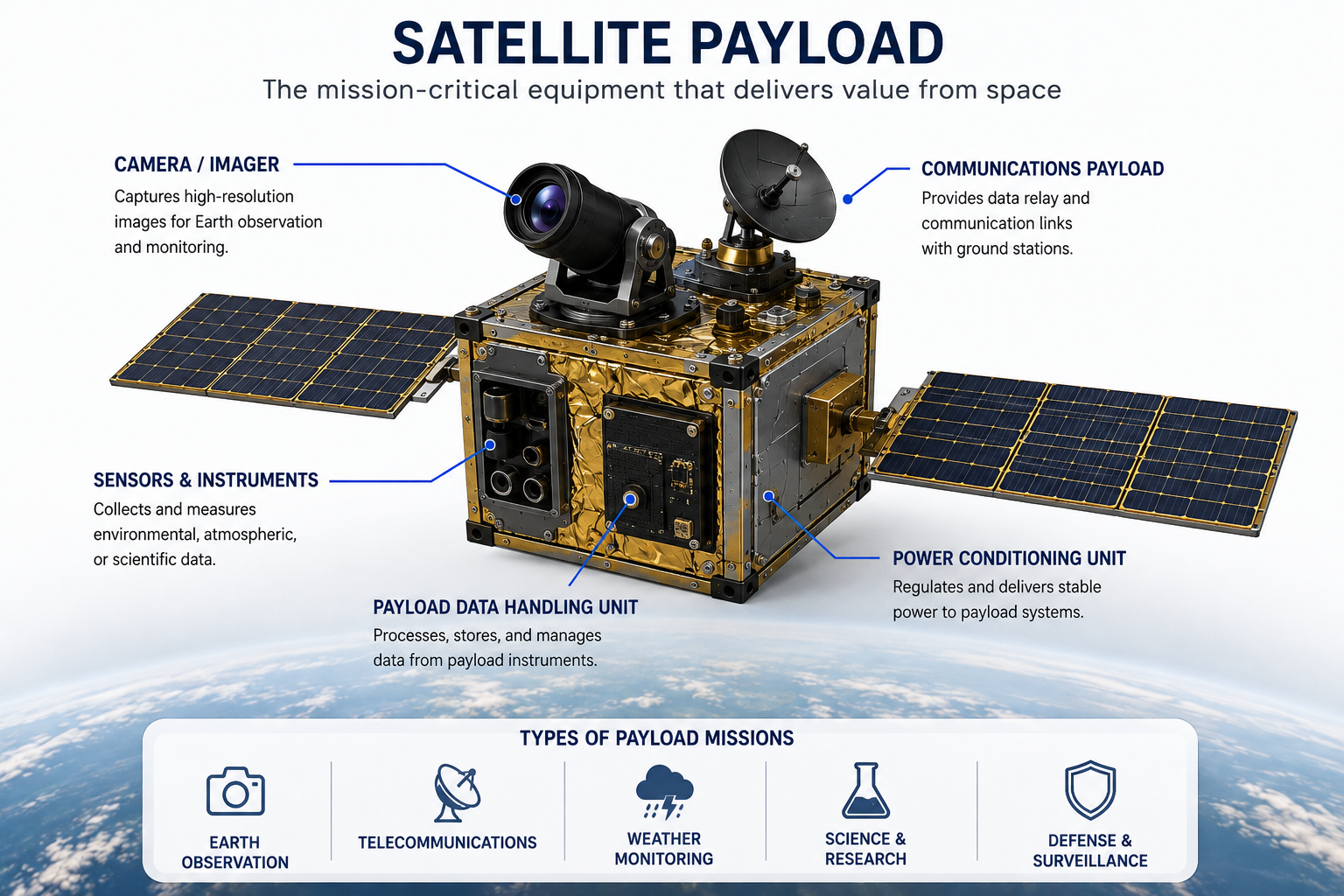
Satellite payload technology has become one of the most transformative innovations in the modern space industry, enabling advanced communication, Earth observation, navigation, scientific research, weather forecasting, and defense operations. Unlike the satellite bus, which provides structural support and power, the payload represents the mission-specific equipment responsible for collecting, processing, and transmitting valuable data. Advances in miniaturization, artificial intelligence (AI), software-defined architectures, high-throughput communications, and onboard data processing have significantly enhanced payload performance while reducing satellite size, weight, and operational costs. As governments and commercial space companies continue deploying Low Earth Orbit (LEO) constellations, demand for intelligent satellite payloads is accelerating. Modern payloads can dynamically allocate bandwidth, process data onboard using AI algorithms, and support multiple applications simultaneously. These technological breakthroughs are enabling faster connectivity, real-time Earth monitoring, secure military communications, and expanded broadband coverage, making satellite payload technology one of the fastest-growing segments of the global aerospace and satellite industry.
History of satellite payload technology
The evolution of satellite payload technology mirrors the remarkable progress of the global space industry. Early satellites launched during the late 1950s and 1960s carried relatively simple payloads designed primarily for scientific experiments and basic communication. As satellite missions became increasingly sophisticated, payload capabilities expanded to include television broadcasting, weather monitoring, navigation, reconnaissance, and high-resolution Earth observation. During the last two decades, digital electronics, advanced sensors, miniaturized components, and high-performance processors have revolutionized payload design. Modern satellites now incorporate software-defined payloads, electronically steerable antennas, hyperspectral imaging systems, AI-enabled onboard processors, and high-throughput communication transponders. These innovations allow operators to reconfigure payload functions in orbit, increase operational flexibility, and deliver significantly higher data capacity than previous generations of satellites.
Benefits of satellite payload technology
Satellite payload technology offers numerous advantages that improve mission capability, operational flexibility, and overall satellite performance.
-
Enhanced Mission Capability: Advanced payloads enable high-speed communications, precision Earth observation, weather monitoring, navigation, scientific exploration, and defense surveillance using a single satellite platform.
-
Greater Operational Flexibility: Software-defined payloads allow operators to modify frequencies, coverage areas, and bandwidth allocation remotely, enabling satellites to adapt to changing mission requirements throughout their operational lifespan.
-
Higher Data Processing Efficiency: AI-enabled onboard processing reduces data transmission requirements by analyzing and filtering information before sending it to ground stations, improving response times and lowering communication costs.
-
Improved Cost Efficiency: Lightweight electronics, miniaturized sensors, and multifunctional payload architectures reduce launch mass while increasing payload capability, improving overall mission economics for commercial and government operators.
Current market size and growth trends of the satellite payload industry
The satellite payload market is experiencing robust expansion as demand increases for high-capacity communications, Earth observation, navigation services, and national security applications. According to MarketsandMarkets, the global Satellite Payload Market size was valued at USD 6.31 Billion in 2025 and is projected to reach USD 11.74 Billion by 2030, growing at a CAGR of 13.2% during the forecast period.
The market's growth is being driven by rising investments in satellite constellations, expanding commercial space activities, growing defense modernization programs, and increasing demand for broadband connectivity across remote regions. AI-powered onboard processing, software-defined payloads, digital beamforming, and high-throughput satellite technologies are enabling operators to deliver more efficient, flexible, and scalable satellite services. The rapid deployment of LEO satellite constellations and increasing adoption of small satellites are further accelerating payload innovation while creating new opportunities across commercial, civil, and military applications.
Key factors contributing to market growth include:
-
Increasing deployment of Low Earth Orbit (LEO) satellite constellations for global broadband connectivity.
-
Rising adoption of AI-enabled onboard processing and software-defined satellite payloads.
-
Growing demand for Earth observation, weather forecasting, navigation, and secure defense communications.
-
Continuous advancements in high-throughput satellites, digital payload architectures, and electronically steerable antenna technologies.
Key drivers and factors influencing the future of satellite payload technology
The rapid evolution of the global space economy is creating unprecedented demand for advanced satellite payload technology. Governments, commercial satellite operators, defense organizations, and private space companies are investing heavily in next-generation payloads capable of delivering higher data throughput, improved imaging accuracy, secure communications, and enhanced mission flexibility. According to MarketsandMarkets, the global Satellite Payload Market was valued at USD 6.31 billion in 2025 and is projected to reach USD 11.74 billion by 2030, growing at a CAGR of 13.2% during the forecast period. This strong market expansion reflects the increasing importance of payload innovation across commercial, civil, and military space programs.
Several major drivers are accelerating the development of satellite payload technology:
-
Growing demand for high-capacity satellite communications supporting broadband internet, 5G backhaul, and enterprise connectivity.
-
Increasing defense modernization programs requiring secure communications, ISR capabilities, and electronic intelligence payloads.
-
Rapid deployment of LEO satellite constellations demanding compact, lightweight, and software-defined payload architectures.
-
Advancements in AI, edge computing, and digital signal processing that enable autonomous onboard data processing.
-
Expansion of Earth observation missions supporting climate monitoring, disaster management, agriculture, and infrastructure planning.
These factors continue to encourage manufacturers to develop payloads that offer higher efficiency, lower mass, improved reliability, and greater operational flexibility.
Emerging trends in satellite payload technology
Satellite payload technology is undergoing a significant transformation as digital engineering, artificial intelligence, and advanced electronics reshape spacecraft capabilities. Modern payloads are becoming increasingly intelligent, allowing satellites to process information onboard rather than transmitting massive datasets directly to Earth. This reduces latency while improving mission efficiency.
One of the biggest trends is the adoption of software-defined payloads, enabling satellite operators to reconfigure frequencies, beam patterns, bandwidth allocation, and communication protocols throughout a satellite's operational life. This flexibility significantly improves asset utilization while reducing operational costs.
Artificial intelligence and machine learning are also becoming integral components of payload systems. AI-powered processing enables autonomous target recognition, anomaly detection, traffic optimization, predictive maintenance, and intelligent spectrum management. These capabilities are particularly valuable for defense surveillance and Earth observation missions.
Miniaturization remains another defining trend. High-performance sensors, antennas, processors, and communication modules are being integrated into increasingly smaller payload packages, allowing nanosatellites and microsatellites to perform missions previously reserved for much larger spacecraft.
Other emerging trends include:
-
Digital beamforming antennas supporting dynamic coverage areas.
-
Multi-mission payloads capable of communications, navigation, and Earth observation simultaneously.
-
Optical communication payloads delivering significantly higher data transmission speeds.
-
Hyperspectral imaging payloads providing advanced environmental and agricultural monitoring.
-
Quantum-enabled secure communication payloads for future cybersecurity applications.
Together, these innovations are expanding satellite functionality while improving operational efficiency across commercial, scientific, and military missions.
Opportunities and challenges in the satellite payload market
The satellite payload market presents substantial growth opportunities as governments and commercial organizations increase investments in space infrastructure. The rapid expansion of satellite broadband services, space-based IoT networks, environmental monitoring programs, precision agriculture, and defense modernization initiatives continues to create new revenue opportunities for payload manufacturers.
Growing private-sector investment is further accelerating innovation. Commercial launch providers, satellite manufacturers, and NewSpace startups are introducing cost-effective payload technologies that shorten development cycles while improving mission flexibility. Increasing international collaboration on lunar exploration, deep-space missions, and climate observation programs is also expanding demand for advanced payload systems.
Key market opportunities include:
-
Expansion of LEO satellite constellations supporting global broadband connectivity.
-
Rising investments in military ISR and electronic warfare satellites.
-
Growing adoption of AI-enabled Earth observation payloads.
-
Increasing commercial demand for high-throughput communication satellites.
-
Development of optical inter-satellite communication technologies.
Despite these opportunities, several challenges continue to influence market growth.
Developing advanced payload technology requires substantial investment in research, testing, and qualification. Payload components must withstand radiation exposure, vibration during launch, extreme thermal environments, and long operational lifetimes, making engineering highly complex. Supply chain constraints for specialized electronic components and semiconductor devices can also affect production schedules.
Additionally, increasing orbital congestion, stricter space sustainability regulations, cybersecurity risks, and evolving spectrum management requirements require continuous innovation. Manufacturers must balance performance improvements with cost efficiency while ensuring long-term mission reliability.
Innovations and advancements in satellite payload technology
Continuous innovation is redefining satellite payload capabilities across communications, Earth observation, navigation, scientific research, and defense applications. Modern payloads are becoming lighter, smarter, and significantly more efficient than previous generations, enabling higher mission performance while reducing launch costs.
One of the most important advancements is the emergence of digital payload architectures, replacing traditional analog systems with software-controlled processing units. Digital payloads provide greater flexibility by allowing operators to modify bandwidth allocation, communication frequencies, beam coverage, and mission priorities after launch.
Artificial intelligence is transforming onboard payload operations by enabling autonomous image processing, target recognition, anomaly detection, predictive diagnostics, and intelligent resource allocation. AI-powered payloads reduce dependence on ground stations while improving response times during critical missions.
Additional innovations include:
-
Electronically steerable phased-array antennas that eliminate mechanical pointing systems.
-
High-throughput communication payloads supporting terabit-class data transmission.
-
Compact synthetic aperture radar (SAR) payloads enabling all-weather Earth observation.
-
Hyperspectral sensors delivering highly detailed environmental and agricultural data.
-
Optical laser communication payloads providing ultra-high-speed inter-satellite links.
Advanced materials, radiation-hardened electronics, additive manufacturing, and modular payload architectures are further improving spacecraft performance while lowering overall manufacturing costs. These technologies are expected to play a central role in the next generation of commercial and government satellite missions.
Future applications and industries that will benefit from satellite payload technology
Satellite payload technology will become increasingly essential across numerous industries as global dependence on space-based infrastructure continues to grow.
-
Telecommunications: High-throughput payloads will deliver faster satellite broadband, 5G backhaul, and global connectivity.
-
Defense and Security: ISR, missile warning, secure communications, and electronic intelligence missions will rely on increasingly advanced payload systems.
-
Earth Observation: High-resolution optical, SAR, and hyperspectral payloads will support environmental monitoring, disaster response, and climate research.
-
Agriculture: Precision farming applications will benefit from satellite imaging, crop health monitoring, and resource optimization.
-
Transportation and Maritime: Navigation, fleet management, aviation communications, and logistics tracking will utilize advanced satellite payload capabilities.
-
Scientific Exploration: Future lunar, Martian, and deep-space missions will depend on highly specialized scientific payloads capable of autonomous operation in extreme environments.
Conclusion: The promising future of satellite payload technology
Satellite payload technology is entering a new era of innovation driven by artificial intelligence, digital engineering, miniaturization, software-defined architectures, and high-speed communications. As governments and commercial operators continue expanding satellite deployments, payload systems will become increasingly intelligent, flexible, and mission-adaptive. From advanced Earth observation and broadband communications to national security, navigation, scientific research, and deep-space exploration, next-generation payload technologies will enable capabilities that were previously impossible. Continued investments in AI, optical communications, onboard processing, modular electronics, and autonomous operations will further strengthen the role of satellite payloads within the rapidly expanding global space economy.
Although challenges related to manufacturing complexity, cybersecurity, orbital sustainability, and regulatory compliance remain, ongoing technological advancements are creating significant opportunities for innovation across the aerospace industry. Organizations that invest in advanced payload technologies today will be well positioned to support future satellite missions and capitalize on the growing demand for space-based services. Discover the latest innovations shaping the future of satellite payload technology by exploring comprehensive market intelligence and industry insights. Learn how emerging technologies, digital payload architectures, AI-powered processing, and next-generation communication systems are transforming the global satellite industry.
Download Sample Research Report for Satellite Payload Market @ https://www.marketsandmarkets.com/Market-Reports/satellite-payload-market-223389741.html
80% of the Forbes Global 2000 B2B companies rely on MarketsandMarkets to identify growth opportunities in emerging technologies and use cases that will have a positive revenue impact.
- Food Packaging Market Size Set for Strong Growth Through 2030 Amid Rising Demand for Convenience Foods
- Crop Protection Chemical Market Size, Share & Growth Forecast (2025–2030)
- Mulch Films Market: Driving Sustainable Agriculture Through Innovation
- Agricultural Adjuvants Market Analysis, Trends, and Growth Outlook (2026–2031)
- Japan Enterprise Asset Management Market Growth: AI and Smart Infrastructure Drive Demand

