

How Motorola Solutions Is Shaping the Future of the Global Software Defined Radio Market
Introduction to Software Defined Radio
In the rapidly evolving communications environment, Software Defined Radio has emerged as an important technology for organizations that require flexible, interoperable, secure, and adaptable communications. Unlike conventional radio systems that depend heavily on dedicated hardware for specific frequencies, modulation schemes, and communication protocols, SDR architectures shift many radio functions into software.
This approach enables communication platforms to support multiple waveforms, frequency bands, networks, and applications through software configuration and upgrades. As communication requirements become increasingly complex across military, public safety, government, transportation, and critical infrastructure environments, SDR technology is becoming an important foundation for next generation communication networks.
The Software Defined Radio Market is benefiting from growing demand for interoperable communications, military modernization, network convergence, software configurable architectures, and secure data exchange. Within this evolving environment, Motorola Solutions has a significant position in mission critical communications and has expanded its portfolio across tactical SDR, P25 communications, broadband connectivity, interoperability, cybersecurity, and integrated command platforms.
Motorola Solutions describes its defense portfolio as including tactical Software Defined Radio, deployable communications, HF and VHF tactical communications, P25, TETRA, DMR, and LTE devices.
Evolution From Conventional Radios to Software Defined Communication Systems
Traditional radio systems were designed around dedicated hardware components. Changes in frequency, modulation, waveform, or communication protocol could require hardware modifications or replacement equipment. This approach created limitations for organizations operating across multiple networks and communication environments.
The evolution toward SDR changed this model by allowing more communication functionality to be implemented through software. A common hardware platform can support different communication configurations, enabling organizations to adapt systems to changing operational requirements.
This evolution is particularly important for defense organizations. Modern military operations increasingly involve multiple domains, including land, air, maritime, space, cyber, and electromagnetic spectrum operations. Personnel need to communicate across different networks while maintaining security and interoperability.
Public safety organizations face similar challenges. Police, fire, emergency medical services, government agencies, and other organizations may need to communicate across different radio systems and broadband networks during major incidents.
Motorola Solutions has built its broader mission critical communications strategy around integrating voice, data, video, analytics, and communications technologies into a connected ecosystem.
Importance of SDR in Modern Defense and Public Safety Networks
SDR technology provides flexibility that is increasingly important in modern communications.
In defense environments, SDR platforms can support multiple waveforms and communication networks, enabling forces to operate across changing mission environments. Software based architectures can also facilitate upgrades without requiring complete hardware replacement.
In public safety environments, interoperability is equally important. Different agencies may operate different communication systems, making cross agency coordination challenging during emergencies.
Motorola Solutions provides interoperability technologies such as Critical Connect, which enables communication between different networks, carriers, devices, and applications while supporting voice and data interoperability.
The growing convergence between land mobile radio and broadband communications is also creating new opportunities for SDR technologies. Radio users can increasingly combine traditional mission critical voice communications with LTE, broadband data, applications, video, and location information.
Motorola Solutions' Position in Mission Critical Communications
Motorola Solutions has a long history in mission critical communications and has expanded from traditional radio equipment toward an integrated ecosystem involving communications, software, command centers, video security, analytics, and cybersecurity.
Its public safety portfolio includes ASTRO P25 and APX radio systems, while its defense portfolio includes tactical communications and Software Defined Radio capabilities.
The company's strategy reflects an important change in the communications industry. Modern mission critical communications are no longer limited to voice radio. Organizations increasingly require interconnected systems capable of delivering voice, data, video, analytics, location, and intelligence through secure networks.
Motorola Solutions' defense offering specifically identifies Tactical SDR alongside HF and VHF tactical communications, deployable communications, and LTE devices.
Software Defined Radio Market Overview
Market Size and Forecast
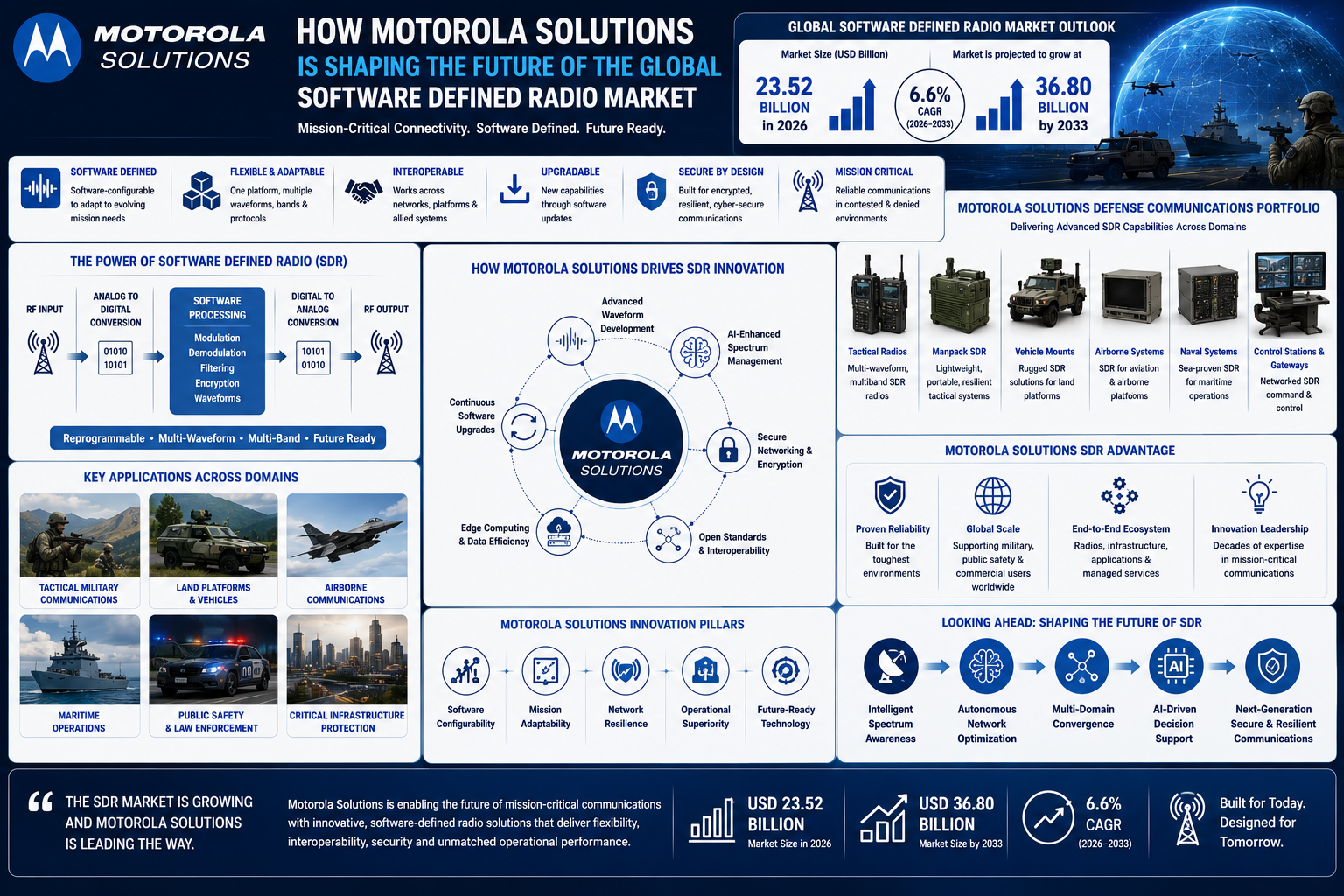
According to MarketsandMarkets, the Global Software Defined Radio Market Size was valued at USD 23.52 billion in 2026 and is projected to reach USD 36.80 billion by 2033, growing at a CAGR of 6.6% from 2026 to 2033.
In terms of volume, the market is projected to grow from 3,424,776 units in 2026 to 4,476,811 units by 2033.
The market's growth reflects increasing demand for flexible communication architectures across defense, government, public safety, commercial, and other mission critical applications.
The expansion of SDR technology can be associated with several important developments:
- Increasing military modernization programs
- Growing demand for interoperable communication systems
- Increasing adoption of software configurable radio architectures
- Expansion of broadband and LTE based communications
- Growing requirements for secure and encrypted communications
- Increasing use of tactical networks and MANET architectures
- Rising adoption of software based upgrades for communication equipment
Major Growth Drivers
The Software Defined Radio Market is being influenced by the transition from hardware dependent communication systems toward flexible software driven platforms.
Military organizations are modernizing communications infrastructure to support multi domain operations. At the same time, public safety organizations are integrating radio systems with broadband networks to improve information sharing and operational coordination.
Another important driver is the requirement for interoperability. Defense and public safety organizations often operate heterogeneous networks. SDR platforms can help bridge these environments by supporting multiple communication configurations.
Motorola Solutions and SDR Technology
Tactical Software Defined Radio
Tactical SDR represents an important component of modern military communication architectures. Tactical users require reliable communications across changing operational environments, often with limitations related to bandwidth, range, spectrum availability, mobility, and electronic interference.
Motorola Solutions identifies Tactical SDR as part of its military and defense portfolio. Its defense communications offering is designed around mission critical connectivity and includes tactical communication technologies for military users.
The software configurable nature of SDR allows systems to evolve as mission requirements change. Instead of relying exclusively on fixed hardware functionality, software can be updated to introduce new capabilities and support changing communication requirements.
Multi Band and Multi Network Communications
Modern defense operations often require communications across multiple frequency bands and networks. A single operational environment may include tactical radio networks, broadband networks, satellite communications, command networks, and other communication systems.
SDR architectures can help organizations consolidate multiple communication capabilities within adaptable platforms.
Motorola Solutions' broader radio portfolio includes multi band and dual band communication devices, while its defense ecosystem supports communication across different networks and devices.
Tactical Communications
Tactical communications must operate in demanding environments where reliability, security, mobility, and interoperability are critical.
SDR platforms can support tactical users by providing adaptable communication capabilities. They can also support software based updates that allow organizations to respond to changing requirements without continuously replacing physical equipment.
Motorola Solutions' defense solutions emphasize secure communications, situational intelligence, command structures, and multi domain operations.
Interoperability Across Different Networks
Interoperability is one of the most important requirements shaping the SDR Market.
Different agencies and military units may operate separate communication systems. During joint operations, these systems must exchange information reliably.
Motorola Solutions' Critical Connect technology demonstrates the company's focus on connecting different networks, devices, carriers, and applications. It supports mission critical voice and data interoperability and integrates with ASTRO P25 and other Motorola Solutions technologies.
This interoperability approach complements the flexibility provided by SDR architectures.
Software Based Upgrades and Modernization
One of the major advantages of software based radio architectures is the ability to update capabilities through software.
Motorola Solutions provides SmartProgramming for LTE enabled radios, allowing radio software updates to be delivered remotely through LTE networks. The company states that updates can be performed in the field without requiring traditional physical configuration processes.
This type of software driven lifecycle management illustrates how radio modernization is moving beyond hardware upgrades toward continuously managed communication platforms.
Technology Trends Shaping the Software Defined Radio Market
AI Enabled Communications
Artificial intelligence is expected to influence the next generation of SDR platforms by enabling intelligent spectrum management, automated signal analysis, network optimization, threat detection, and adaptive communications.
AI can process large volumes of communication and spectrum data faster than traditional manual approaches. In tactical environments, AI enabled systems could support more efficient decision making and improve awareness of electromagnetic conditions.
The combination of AI with SDR hardware creates opportunities for radios to become increasingly adaptive rather than simply programmable.
Edge Computing
Edge computing is becoming increasingly relevant for military and mission critical communications because information often needs to be processed close to where it is generated.
SDR systems operating at the tactical edge can potentially process communication information locally while reducing dependency on centralized infrastructure.
This approach is particularly relevant for environments where connectivity may be intermittent, contested, or bandwidth constrained.
Mobile Ad Hoc Networks
Mobile Ad Hoc Networks, commonly known as MANETs, are important for tactical communications because they enable distributed communication among mobile nodes.
MANET enabled SDR platforms can support dynamic network structures where communication paths can change as users and platforms move.
Motorola Solutions highlights MANET radios within its defense portfolio, describing them as supporting high bandwidth video and data in challenging multi domain operations while helping minimize detection and jamming.
LTE and Broadband Integration
The convergence between traditional land mobile radio and broadband communications is another major trend.
LTE and broadband networks provide higher data capacity for applications involving video, imagery, location information, mapping, and other data intensive requirements.
Motorola Solutions' SmartConnect technology is designed to automatically switch voice and data to broadband when radio coverage is unavailable, illustrating the growing convergence between mission critical radio and broadband connectivity.
Cloud Connected Communications
Cloud technologies are changing how communication networks are managed, configured, and integrated with applications.
Cloud connected radio systems can support centralized management, software updates, analytics, and application integration.
Motorola Solutions' broader technology ecosystem combines on premise and cloud based technologies for military and defense applications.
Cybersecurity and Encryption
As communications become more software driven and network connected, cybersecurity becomes increasingly important.
SDR platforms need protection against unauthorized access, interception, manipulation, and cyber attacks. Secure software updates, encryption, authentication, and network security are therefore becoming essential components of modern radio architectures.
Motorola Solutions emphasizes cybersecurity across its mission critical technology ecosystem and provides security capabilities for military communications and network environments.
Defense Applications of Software Defined Radio
Battlefield Communications
Battlefield communications are among the most important applications for SDR technology.
Military forces need reliable communications between soldiers, vehicles, command centers, aircraft, and other platforms. SDR systems can provide flexible communication capabilities across different tactical networks.
Command and Control
Command and control systems depend on reliable communication and information exchange.
SDR technologies can support command structures by connecting users across multiple communication networks and providing access to voice and data services.
Motorola Solutions' military ecosystem focuses on connecting command structures with communications, video, analytics, and cybersecurity technologies.
Situational Awareness
Modern military communications increasingly involve more than voice.
Commanders and frontline personnel require information from sensors, cameras, mapping systems, intelligence platforms, and other sources.
SDR systems can provide communication infrastructure through which this information is transferred between tactical users and command systems.
Intelligence Sharing
The ability to securely share intelligence is becoming increasingly important as military operations become more data intensive.
Software defined communications can support data exchange across heterogeneous networks while maintaining secure communication requirements.
Multi Domain Operations
Multi domain operations require coordination across land, air, maritime, space, cyber, and electromagnetic environments.
This creates strong demand for flexible communications systems that can operate across different networks and adapt to changing operational requirements.
Motorola Solutions describes its military ecosystem as supporting multi domain operations and the secure dissemination of information to edge devices across different networks.
Competitive Landscape of the Software Defined Radio Market
The Software Defined Radio Market includes major defense and communications companies developing tactical radios, secure communication systems, networking technologies, waveforms, broadband connectivity, and mission critical communication platforms.
Key companies include:
Motorola Solutions
Motorola Solutions has a broad mission critical communications portfolio spanning public safety, defense, radio communications, software, cybersecurity, video, analytics, and command center technologies.
Its defense portfolio includes Tactical SDR, MANET radios, P25 communication systems, broadband connectivity, and other technologies designed for military and government applications.
L3Harris Technologies
L3Harris is an important defense communications company with capabilities spanning tactical radios, secure communications, networking, and mission systems.
Thales
Thales operates across defense communications, secure networks, avionics, cybersecurity, and digital technologies, making it an important participant in the broader SDR ecosystem.
BAE Systems
BAE Systems develops defense electronics, communications, electronic warfare, and mission systems that support military users across different operational environments.
Collins Aerospace
Collins Aerospace provides aerospace and defense communication technologies, including systems supporting secure connectivity and military platforms.
Rohde & Schwarz
Rohde & Schwarz is active in secure communications, radio technologies, spectrum monitoring, test and measurement, and defense communication systems.
The competitive environment is increasingly shaped by the ability of companies to combine SDR hardware with software, networking, cybersecurity, artificial intelligence, cloud infrastructure, and interoperability solutions.
Future Outlook for the Software Defined Radio Market
AI Enhanced SDR
AI is expected to become increasingly integrated into SDR platforms. Intelligent systems could dynamically analyze spectrum conditions, optimize communication parameters, identify signals, and support automated network management.
This could transform SDR platforms from programmable radios into increasingly autonomous communication systems.
Cognitive Radio Technologies
Cognitive radio represents another potential direction for SDR development.
Cognitive radio systems can sense their operating environment and adapt communication parameters based on available spectrum and network conditions.
The integration of cognitive technologies with AI could make future SDR platforms more responsive to changing electromagnetic environments.
5G and Tactical Networks
The integration of 5G technologies with tactical communication architectures is expected to create new opportunities for high bandwidth military applications.
Future tactical networks could combine SDR, 5G, MANET, satellite communications, and edge computing to provide connected environments for military personnel and autonomous platforms.
Software Defined Battlefield Communications
The battlefield of the future is expected to become increasingly software defined.
Communication systems will need to connect soldiers, vehicles, unmanned platforms, sensors, command centers, and intelligence systems through adaptable networks.
SDR technology can serve as an important communications layer within this environment.
Autonomous and Connected Military Systems
The growth of autonomous vehicles, unmanned aerial systems, robotics, and intelligent sensors is creating new communication requirements.
These systems need reliable links to exchange data with one another and with human operators.
SDR platforms can provide flexible communication capabilities for connected military systems while supporting different frequency bands, protocols, and network architectures.
Opportunities and Challenges in the Software Defined Radio Market
The Software Defined Radio Market presents significant opportunities as governments and defense organizations modernize communication infrastructure.
Opportunities
- Military Modernization: Defense modernization programs are creating demand for flexible tactical communication platforms.
- Interoperability: Growing requirements for communication between different networks are supporting SDR adoption.
- Broadband Integration: The integration of LTE, 5G, and broadband networks creates new opportunities for software defined communications.
- AI Integration: AI can improve spectrum management, signal analysis, network optimization, and adaptive communications.
- Connected Military Platforms: Increasing deployment of autonomous and connected military systems will require flexible communication infrastructure.
At the same time, several challenges remain.
- Cybersecurity: Greater software dependence creates additional cybersecurity requirements.
- Spectrum Complexity: Increasing congestion and electromagnetic interference can make reliable communication more challenging.
- Integration Complexity: Connecting legacy systems with modern SDR and broadband architectures can require substantial engineering and investment.
- Technology Lifecycle Management: Continuous software upgrades require effective configuration management, cybersecurity processes, and technical support.
- Cost: Advanced SDR platforms and integrated communication ecosystems can require significant investment.
The Future of Software Defined Radio and Motorola Solutions
The Software Defined Radio Market is entering an important phase of technological transformation. The shift from hardware dependent radio architectures toward software configurable, networked, intelligent, and interoperable communication systems is creating new opportunities across defense, public safety, government, and other mission critical environments.
According to MarketsandMarkets, the Global Software Defined Radio Market is projected to increase from USD 23.52 billion in 2026 to USD 36.80 billion by 2033, representing a CAGR of 6.6%. In volume terms, the market is expected to increase from 3,424,776 units in 2026 to 4,476,811 units by 2033.
Motorola Solutions is positioned within this transformation through its broader mission critical communications ecosystem and its defense portfolio, which includes Tactical SDR, MANET radios, P25 communications, broadband connectivity, interoperability technologies, cybersecurity, and command capabilities.
The company's approach also demonstrates how the SDR market is moving beyond standalone radio hardware. Modern communication platforms increasingly combine radios with software, cloud technologies, broadband networks, analytics, cybersecurity, command systems, and other mission critical capabilities.
Future SDR development is expected to be influenced by AI enabled communications, cognitive radio technologies, MANET, 5G, edge computing, cloud connected systems, advanced cybersecurity, and autonomous military platforms. These technologies can make communications more adaptive and better suited to increasingly complex operational environments.
The competitive landscape will increasingly favor companies capable of delivering complete communication ecosystems rather than isolated radio products. Interoperability, software upgradeability, secure networking, spectrum awareness, and integration with emerging military technologies will remain important differentiators.
As defense organizations continue to modernize communications and public safety agencies seek more connected mission critical networks, Software Defined Radio is expected to remain an important technology platform. The combination of flexible radio architectures, intelligent software, broadband connectivity, and secure networking will help define the next generation of mission critical communications.
Discover the latest market size, growth trends, technology developments, competitive landscape, regional analysis, and opportunities in the global Software Defined Radio Market.
https://www.marketsandmarkets.com/Market-Reports/software-defined-radio-market-138946173.html
80% of the Forbes Global 2000 B2B companies rely on MarketsandMarkets to identify growth opportunities in emerging technologies and use cases that will have a positive revenue impact.
- Food Packaging Market Size Set for Strong Growth Through 2030 Amid Rising Demand for Convenience Foods
- Crop Protection Chemical Market Size, Share & Growth Forecast (2025–2030)
- Mulch Films Market: Driving Sustainable Agriculture Through Innovation
- Agricultural Adjuvants Market Analysis, Trends, and Growth Outlook (2026–2031)
- Japan Enterprise Asset Management Market Growth: AI and Smart Infrastructure Drive Demand


