

Software Defined Radio Market and Thales Company: Driving the Future of Secure Tactical Communications
Introduction to Software Defined Radio
The evolution of military communication systems is increasingly centered on flexibility, interoperability, security, and the ability to adapt rapidly to changing operational requirements. Traditional radio systems were generally designed around dedicated hardware and specific communication functions. Modern Software Defined Radio technology changes this approach by shifting many communication functions into software, allowing a common radio platform to support multiple waveforms, frequency bands, networks, and applications.
This transformation is becoming increasingly important as military forces operate in highly connected and contested environments. Soldiers, vehicles, aircraft, naval platforms, command centers, sensors, and other systems must exchange voice, data, imagery, and other mission information across different networks.
Software Defined Radios can help address these requirements by providing configurable communication capabilities that can evolve through software updates. This makes SDR technology an important component of modern military communication architectures and network centric operations.
Within this ecosystem, Thales has developed a significant position in secure and interoperable Software Defined Radio solutions. The company identifies itself as a major player in interoperable secure SDR solutions and as the prime contractor for the French Armed Forces CONTACT program.
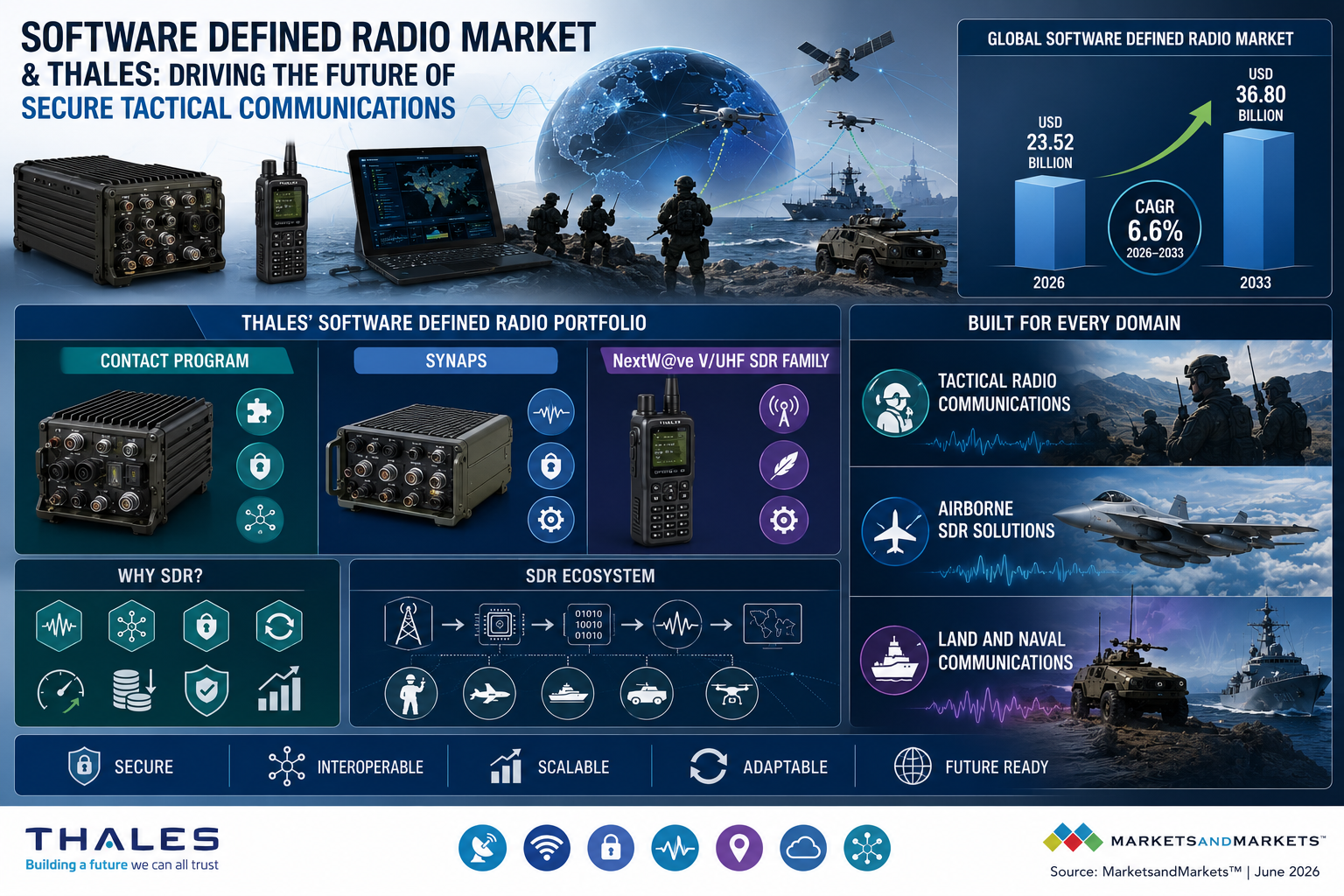
Thales also offers SDR technologies and tactical communication solutions spanning land, naval, and airborne applications. Its portfolio includes the CONTACT program, SYNAPS, and the NextW@ve V/UHF Software Defined Radio family.
Evolution From Conventional Radio Systems to Software Defined Communications
Conventional military radio systems traditionally depended heavily on dedicated hardware. When a new communication requirement emerged, organizations could require new equipment or significant hardware modifications.
The introduction of Software Defined Radio technology changed this model. SDR platforms can implement many radio functions through software, allowing the same physical platform to support different communication configurations.
This flexibility is particularly valuable for military forces because battlefield requirements can change rapidly. Communication systems may need to support different frequencies, waveforms, encryption requirements, network configurations, and interoperability standards during the same mission.
Modern SDR architectures can also help military organizations extend equipment lifecycles. Instead of replacing complete radio platforms whenever communication requirements evolve, software based capabilities can provide pathways for introducing new functions.
Thales' approach reflects this evolution. Its CONTACT program provides a common software defined radio architecture for French land, air, and naval forces, while SYNAPS represents the export version of the CONTACT radio family. Thales states that CONTACT is continuing under an incremental development approach, with its roadmap extended toward 2030.
Growing Importance of Flexible Military Communications
Military operations increasingly require communications that can function across multiple domains and network environments.
A soldier may need to communicate with another ground unit, connect to a command network, exchange information with an aircraft, or communicate through a tactical data network. These requirements create demand for radios that can support multiple modes of communication.
Multiband and multimode SDR platforms can help consolidate communication functions into fewer devices while providing greater operational flexibility.
The ability to update software and waveforms is also important because military communication standards and operational requirements continue to evolve.
Thales' NextW@ve family illustrates this approach. Its airborne TRA 6030 N radio is described as providing multiband and multimode interoperability, fast frequency hopping, data capabilities, legacy interoperability, embedded tactical waveforms, and wideband capabilities for high data rate applications.
Increasing Demand for Secure and Interoperable Tactical Networks
Interoperability has become a fundamental requirement for modern military communications.
Joint operations can involve multiple branches of the armed forces, allied nations, and different generations of communication equipment. A communication system that cannot connect effectively with other networks can limit operational effectiveness.
SDR technology addresses this challenge by supporting multiple waveforms and communication standards within configurable platforms.
Security is another critical requirement. Tactical communications can operate in environments characterized by electronic interference, spectrum congestion, and deliberate attempts to disrupt communications. SDR systems therefore increasingly incorporate secure communication technologies, frequency hopping, encryption, networking, and other resilience features.
Thales' 2024 Universal Registration Document describes the company as a major player in interoperable secure Software Defined Radio solutions and identifies CONTACT as a key program for the French Armed Forces.
Software Defined Radio Market Overview
Market Size and Forecast
According to MarketsandMarkets, the Global Software Defined Radio Market Size was valued at USD 23.52 billion in 2026 and is projected to reach USD 36.80 billion by 2033, growing at a CAGR of 6.6% from 2026 to 2033.
In terms of volume, the market is projected to grow from 3,424,776 units in 2026 to 4,476,811 units by 2033.
The market is being supported by modernization of military communication networks, growing demand for interoperable communications, increasing use of SDR technology in UAVs and autonomous systems, rising adoption of AI driven spectrum management, and the need to consolidate multiple communication functions into a single radio platform.
The market covers technologies including general purpose SDR, tactical and mission critical SDR, broadband and high bandwidth SDR, UAV and autonomous systems SDR, and cognitive and AI enabled SDR. Applications extend across military aircraft, unmanned aerial systems, defense land systems, naval platforms, satellites and ground stations, public safety, government systems, and other connected environments.
The growth of the Software Defined Radio Market can be associated with several important developments:
- Modernization of military communication networks
- Increasing demand for interoperability across military forces and platforms
- Growing adoption of multiband and multimode radios
- Increasing use of SDR technology in UAVs and autonomous systems
- Rising adoption of AI driven spectrum management
- Growing requirement to consolidate multiple communication functions into a single platform
- Increasing demand for secure tactical networking
MarketsandMarkets identifies tactical and mission critical SDR as the largest technology segment and public safety and government systems as the dominant application segment in 2026.
Key Growth Drivers
Military communication modernization is one of the primary factors supporting the Software Defined Radio Market.
Defense organizations are replacing legacy communication systems with flexible platforms that can support secure voice, data, imagery, and video. The ability to introduce new waveforms through software can also help organizations adapt communication systems as mission requirements change.
The demand for interoperability is another important factor. Military operations increasingly require communications between different forces, platforms, and radio systems.
The increasing use of SDRs in UAVs and autonomous systems is also opening new market opportunities. MarketsandMarkets expects the UAV and autonomous systems SDR segment to register the highest CAGR among technology segments between 2026 and 2033.
AI is another emerging opportunity. AI can potentially assist with automatic frequency selection, interference management, and spectrum analysis, allowing SDR systems to respond more effectively to changing communication environments.
Thales' Software Defined Radio Portfolio
CONTACT Program
CONTACT is one of the most important elements of Thales' Software Defined Radio activities.
The program is designed to provide secure and interoperable tactical communications for the French Armed Forces. Thales identifies itself as the prime contractor for the French CONTACT program.
The program covers communications requirements across land, air, and naval forces. Thales' 2024 reporting states that the CONTACT program continued with the signing of rider 13 at the end of 2024, establishing a new roadmap toward 2030 and introducing an incremental development approach for tactical applications.
The CONTACT architecture demonstrates the industry's transition toward software defined communications that can evolve throughout the operational lifecycle.
SYNAPS
SYNAPS is the export version of the CONTACT Software Defined Radio family.
Thales describes CONTACT as the Software Defined Radio developed for French forces, while its 2019 materials identify SYNAPS as the corresponding export market name. The system provides real time communications intended to allow military forces to operate as a network.
SYNAPS is therefore an important example of how Thales is extending its SDR technology beyond the French domestic defense market.
MarketsandMarkets also identifies Thales as a major SDR market player and notes that Thales is supplying more than 6,000 SquadNet and SYNAPS Software Defined Radios to the Irish Defense Forces. These systems are intended to support secure communications across military branches and coalition waveforms, including the ESSOR broadband waveform.
NextW@ve V/UHF SDR Family
The NextW@ve family represents another important component of Thales' SDR portfolio.
The family provides V/UHF Software Defined Radio capabilities for tactical communications. The TRA 6030 N airborne version offers multiband and multimode interoperability, fast frequency hopping, data capabilities, and interoperability with legacy TR 6000 systems.
The platform also supports embedded tactical waveforms and wideband capabilities designed to enable high data rate communications and emerging network centric operational concepts.
Tactical Radio Communications
Tactical radio communications are central to modern military operations.
Thales' SDR solutions are designed to provide communication capabilities that can connect personnel, vehicles, command centers, aircraft, and other military platforms.
The transition from voice focused radio systems toward networked voice and data platforms is changing the role of tactical radios. Modern systems increasingly function as communication nodes within larger battlefield networks.
Airborne SDR Solutions
Airborne communication requirements are different from many land based applications because aircraft need reliable connectivity while moving at high speeds and operating across large geographic areas.
Thales' NextW@ve TRA 6030 N provides an example of an airborne SDR platform designed for multiband and multimode interoperability, frequency hopping, data communications, and high data rate waveforms.
Thales has also integrated CONTACT based SDR technology into military aviation platforms. In the French Guépard helicopter program, Thales' Software Defined Radio developed under CONTACT is part of the aircraft's connectivity suite and supports interoperability with French military cooperative systems.
Land and Naval Communications
Thales' CONTACT program is designed to address communications requirements across French land, air, and naval forces.
This tri service approach highlights one of the major advantages of SDR architecture. A common technology foundation can support communications across different military platforms while maintaining interoperability.
Technology Innovations in the Software Defined Radio Market
Software Programmable Waveforms
Software programmable waveforms are at the heart of SDR technology.
Traditional radio systems may require hardware changes to support new communication functionality. Software defined architectures can allow new waveforms to be introduced through software.
This capability can help military organizations modernize communication networks while retaining existing hardware platforms.
Thales' SDR portfolio supports this broader shift toward configurable communications and waveform interoperability.
Multiband Communications
Multiband communication enables a single radio platform to operate across different frequency bands.
This capability is increasingly important for military forces because tactical networks can include multiple communication layers.
A multiband SDR can potentially reduce the number of separate radios required by soldiers and platforms while providing access to multiple networks.
Multimode Operation
Multimode capability allows radios to operate using different communication modes.
Modern tactical radios may need to support narrowband voice, broadband data, networking, satellite communications, and other applications.
Thales' NextW@ve family specifically emphasizes multiband and multimode interoperability.
Frequency Hopping
Frequency hopping is an important technology for resilient military communications.
The technique enables communication systems to change operating frequencies according to defined patterns, helping reduce vulnerability to interference.
Thales' NextW@ve TRA 6030 N includes fast frequency hopping capabilities as part of its tactical communication architecture.
High Speed Data
Modern military operations require more than voice communications.
Commanders and frontline forces increasingly need access to maps, sensor information, imagery, video, intelligence, and other digital information.
High speed data capabilities allow SDR systems to become part of broader tactical information networks.
Thales' NextW@ve family includes wideband capabilities designed to support high data rate waveforms and emerging communication services.
Tactical Networking
The evolution toward network centric military operations is increasing demand for tactical networking.
Instead of treating each radio as an isolated communication device, tactical networking connects multiple users and platforms into a broader information environment.
Thales' CONTACT and SYNAPS technologies are designed around this networked approach. Thales describes CONTACT as providing real time communications that enable forces to operate as a network.
Anti Jamming Capabilities
Tactical communication networks may operate in environments where electromagnetic interference can affect communications.
This creates demand for technologies that improve resilience against jamming and interference.
Thales' broader tactical networking portfolio includes systems designed to provide protection against jamming and interference, demonstrating the growing importance of resilient communications within military networks.
Military Applications of Software Defined Radio
Battlefield Communications
Battlefield communications are one of the most important applications for SDR technology.
Soldiers require secure and reliable connectivity with other personnel, vehicles, command centers, aircraft, and supporting systems.
Software defined architectures can provide flexible communications that adapt to changing battlefield requirements.
Command and Control
Command and control systems depend on rapid information exchange.
SDR platforms can support the movement of voice, data, and other mission information between tactical users and command networks.
The integration of SDR technology with broader communication architectures can improve connectivity between different levels of military command.
Situational Awareness
Situational awareness depends on information from multiple sources.
Sensors, aircraft, vehicles, unmanned systems, and personnel can generate information that needs to reach decision makers.
Networked SDR platforms can provide communication links that help distribute this information across tactical environments.
Intelligence Sharing
Modern military operations rely heavily on timely intelligence.
Intelligence information may include sensor data, imagery, surveillance information, and other mission information.
Secure tactical communication networks can help move this information between collection platforms, command centers, and frontline units.
Air Ground Communications
Air ground communication connects aircraft with ground based forces and command systems.
Thales' airborne SDR technologies are designed around interoperability between airborne and other tactical communication environments.
The integration of CONTACT technology into French military aviation platforms further demonstrates the role of SDR in connecting air and ground forces.
Network Centric Operations
Network centric operations depend on connecting people, platforms, sensors, and command systems.
SDR technology supports this transformation by providing flexible communication nodes that can operate across different networks and waveforms.
The NextW@ve family specifically identifies emerging Network Centric Operations concepts as an area supported by its extended capabilities.
Competitive Landscape of the Software Defined Radio Market
The Software Defined Radio Market includes global defense and communications companies developing tactical radios, secure networking systems, waveforms, communication architectures, and mission critical connectivity.
Thales
Thales has a significant position in the SDR ecosystem through CONTACT, SYNAPS, NextW@ve, and related tactical communication technologies.
The company identifies itself as a major player in interoperable secure SDR solutions and the prime contractor for France's CONTACT program.
L3Harris Technologies
L3Harris Technologies is a major competitor in tactical Software Defined Radio, particularly through its Falcon family of radios and multiband tactical communication systems.
BAE Systems
BAE Systems participates in defense electronics, military communications, tactical systems, and networked defense technologies.
Motorola Solutions
Motorola Solutions has a strong position in mission critical communications, public safety radio systems, government communications, and related digital platforms.
Collins Aerospace
Collins Aerospace develops aerospace and defense communication systems supporting military and commercial platforms.
Rohde & Schwarz
Rohde & Schwarz operates across secure communications, radio technologies, spectrum monitoring, defense communications, and test and measurement systems.
MarketsandMarkets identifies Thales, Motorola Solutions, L3Harris Technologies, RTX, and General Dynamics among the major companies in the SDR market.
Future Outlook for the Software Defined Radio Market
AI Enabled SDR
Artificial intelligence is expected to create new possibilities for Software Defined Radio technology.
AI can potentially help radios analyze spectrum conditions, identify interference, select appropriate frequencies, and optimize communication parameters.
MarketsandMarkets identifies AI based automatic frequency selection and interference control as an opportunity within the SDR market.
The integration of AI with SDR could ultimately enable more adaptive communication systems capable of responding automatically to changing environments.
Cognitive Radio
Cognitive radio represents a further evolution of programmable communications.
Cognitive systems can analyze their operating environment and make intelligent decisions about spectrum utilization.
The combination of cognitive radio and AI could create communication systems that dynamically adapt to spectrum availability, interference, network conditions, and mission requirements.
5G Integration
5G technologies are creating new possibilities for high speed and low latency connectivity.
Military communication architectures may increasingly combine SDR systems with broadband networks, private 5G, tactical networks, and other connectivity technologies.
Thales has already demonstrated interoperability between military aviation communication technologies and 4G and LTE networks in the French Guépard helicopter program.
This indicates the broader direction toward converged military communication environments.
Resilient Tactical Networking
Future military networks will need to maintain connectivity under challenging operating conditions.
Resilient tactical networking will require secure, flexible, interoperable, and adaptive communication technologies.
SDR platforms can contribute to this objective by supporting multiple waveforms, frequency bands, networks, and software based capabilities.
Electronic Warfare
Electronic warfare will increasingly influence the development of military communication systems.
Radios operating in contested electromagnetic environments need to manage interference and maintain communications while operating alongside other spectrum dependent systems.
This will increase demand for adaptive spectrum management, frequency agility, secure waveforms, and intelligent radio technologies.
Software Defined Battlefield
The Software Defined Battlefield represents a broader evolution beyond individual communication devices.
Future military environments are expected to connect soldiers, vehicles, aircraft, naval platforms, satellites, sensors, unmanned systems, and command centers through integrated digital networks.
SDR technology can provide a foundational communications layer for this environment because software defined systems can evolve as network architectures and mission requirements change.
Opportunities and Challenges in the Software Defined Radio Market
The Software Defined Radio Market presents significant opportunities as military and government organizations transition from legacy communication systems toward flexible and networked architectures.
Key Opportunities
- Military Communications Modernization: Defense organizations are replacing legacy radios with software defined platforms capable of supporting modern networks.
- Interoperability: Joint operations and coalition missions are increasing demand for communication systems capable of supporting multiple waveforms and standards.
- Multiband Communications: Multiband radios can consolidate multiple communication functions into fewer platforms.
- Tactical Networking: Network centric military operations are increasing demand for radios that support high speed data and tactical networking.
- AI Integration: AI can enable automated spectrum analysis, frequency selection, and interference management.
- UAV and Autonomous Systems: Increasing use of unmanned platforms is creating new applications for compact and intelligent SDR systems.
- 5G and Broadband Integration: The convergence of SDR and broadband technologies can create new tactical communication architectures.
Key Challenges
Despite strong growth prospects, the Software Defined Radio Market faces several challenges.
The development, integration, testing, and maintenance of SDR systems can be expensive because these platforms require sophisticated hardware, software, waveforms, encryption, and network technologies. MarketsandMarkets identifies the high cost of SDR development, integration, testing, and maintenance as an important market restraint.
Cybersecurity is another major challenge. Because SDR functions depend heavily on software, protecting radio software, waveforms, and software updates against cyber threats is essential.
Interoperability between SDR hardware from different manufacturers can also remain complex. Different platforms may use different architectures and waveform implementations, creating technical challenges when organizations attempt to connect systems from multiple suppliers.
Thales and the Future of Software Defined Radio
The Software Defined Radio Market is undergoing a significant transformation as military organizations move toward flexible, interoperable, secure, and network centric communication architectures.
According to MarketsandMarkets, the Global Software Defined Radio Market Size was valued at USD 23.52 billion in 2026 and is projected to reach USD 36.80 billion by 2033, representing a CAGR of 6.6% from 2026 to 2033. In terms of volume, the market is projected to increase from 3,424,776 units in 2026 to 4,476,811 units by 2033.
Thales is an important participant in this transformation. Its position in interoperable secure SDR solutions, combined with its role as prime contractor for the French CONTACT program, gives the company a significant presence in military tactical communications.
The CONTACT program demonstrates the movement toward common software defined communications across land, air, and naval forces. Its continuing roadmap toward 2030 also highlights the importance of incremental software and capability development in future military communication systems.
SYNAPS extends the CONTACT approach into export markets, while the NextW@ve family provides multiband, multimode, frequency hopping, data, and high data rate capabilities for tactical communications.
Looking forward, AI enabled SDR, cognitive radio, 5G integration, resilient tactical networking, electronic warfare technologies, and software defined battlefield architectures are expected to influence the next generation of military communications.
The future competitive environment will increasingly depend on more than radio hardware. Companies will need to integrate software, waveforms, networking, cybersecurity, spectrum management, interoperability, encryption, and lifecycle upgrades into comprehensive communication ecosystems.
For Thales, its continued development of CONTACT, SYNAPS, NextW@ve, and related tactical communication technologies positions the company to participate in the transition toward increasingly connected and software driven military operations.
As defense organizations seek communication systems that can adapt to new technologies while maintaining secure and interoperable connectivity, Software Defined Radio will remain a critical component of modern military communication infrastructure.
https://www.marketsandmarkets.com/Market-Reports/software-defined-radio-market-138946173.html
80% of the Forbes Global 2000 B2B companies rely on MarketsandMarkets to identify growth opportunities in emerging technologies and use cases that will have a positive revenue impact.
- Food Packaging Market Size Set for Strong Growth Through 2030 Amid Rising Demand for Convenience Foods
- Crop Protection Chemical Market Size, Share & Growth Forecast (2025–2030)
- Mulch Films Market: Driving Sustainable Agriculture Through Innovation
- Agricultural Adjuvants Market Analysis, Trends, and Growth Outlook (2026–2031)
- Japan Enterprise Asset Management Market Growth: AI and Smart Infrastructure Drive Demand


