

Software Defined Radio (SDR) Market Technology Innovation: Key Trends, Growth Drivers, and Future Opportunities
Introduction to Software Defined Radio Technology
In the rapidly evolving communications landscape, Software Defined Radio (SDR) has emerged as an important technology for transforming how voice, data, and other forms of information are transmitted across complex networks. Unlike conventional radios that depend heavily on fixed hardware components for specific communication functions, SDR technology uses software to control and modify many radio functions. This enables a single radio platform to support multiple frequencies, waveforms, communication protocols, and operational requirements.
Software Defined Radio technology is particularly important for defense forces, public safety agencies, unmanned systems, aerospace platforms, naval operations, satellites, and critical infrastructure. The ability to update communication capabilities through software allows users to adapt radio systems as mission requirements and communication environments evolve.
The future of the Software Defined Radio Market is being shaped by artificial intelligence, cognitive radio capabilities, advanced spectrum management, high bandwidth communications, secure networking, and growing integration with unmanned and autonomous platforms. These developments are creating new opportunities for manufacturers, technology providers, defense organizations, and public safety agencies.
History of Software Defined Radio
The development of Software Defined Radio technology was driven by the need for more flexible and adaptable communication systems. Traditional radios were generally designed around dedicated hardware architectures, meaning that changing communication requirements could require hardware replacement or substantial equipment modifications.
The SDR concept introduced a different approach by moving many radio processing functions into software. Digital signal processing, programmable hardware, software based waveforms, and increasingly sophisticated computing platforms allow radio systems to perform multiple communication functions through configurable software.
Over time, SDR technology progressed from specialized military communication applications toward broader use across public safety, aerospace, maritime, telecommunications, industrial systems, and autonomous platforms. The increasing availability of powerful processors and advanced digital signal processing capabilities has further expanded SDR applications.
Modern SDR systems can support secure communications, multiple waveforms, spectrum monitoring, interoperability between communication networks, and rapid software based upgrades. These capabilities make SDR technology increasingly important as communication networks become more complex and operational environments become more dynamic.
Benefits of Software Defined Radio
Software Defined Radio technology provides several advantages compared with conventional radio architectures:
- Flexibility: SDR platforms can support multiple communication functions through software configuration, allowing users to adapt systems to different missions and communication requirements.
- Interoperability: SDRs can help different organizations and platforms communicate by supporting multiple waveforms and communication standards, which is particularly important for joint military operations and emergency response.
- Upgradability: Software based capabilities can be modified or upgraded without replacing the entire radio platform, helping organizations extend equipment lifecycles.
- Multifunctionality: A single SDR platform can consolidate multiple communication functions, reducing the need to carry and maintain separate radio systems.
- Spectrum Management: Advanced SDR platforms can monitor spectrum conditions and dynamically adjust communication parameters, improving performance in congested or contested environments.
Current Market Size and Growth Trends of the Software Defined Radio Industry
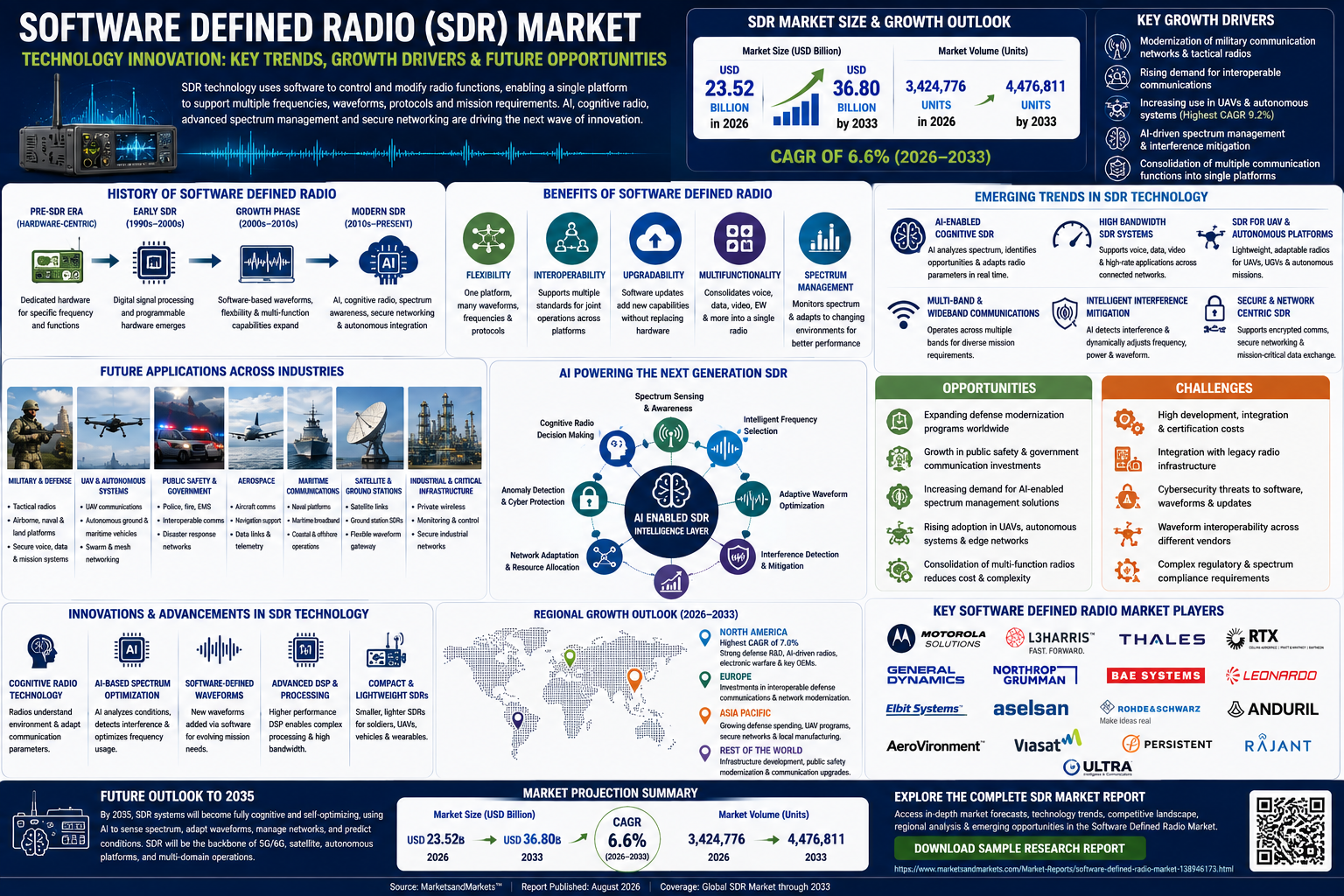
The Software Defined Radio Market is experiencing steady growth as military organizations, public safety agencies, aerospace companies, and other users modernize communication networks. According to MarketsandMarkets, the global Software Defined Radio Market size was valued at USD 23.52 billion in 2026 and is projected to reach USD 36.80 billion by 2033, growing at a CAGR of 6.6% from 2026 to 2033. In terms of volume, the market is projected to increase from 3,424,776 units in 2026 to 4,476,811 units by 2033.
The market expansion is being supported by modernization of military communication networks, increasing demand for interoperable communications, growing use of SDRs in unmanned and autonomous systems, rising adoption of AI driven spectrum management, and the need to consolidate multiple communication functions into single radio platforms.
This growth can be attributed to several important developments, including:
- Modernization of military communication networks and tactical radio infrastructure
- Growing demand for interoperable communications across defense and public safety organizations
- Increasing deployment of SDR technology in UAVs and autonomous systems
- Rising adoption of artificial intelligence for spectrum management and interference mitigation
- Increasing demand for multifunctional radio platforms that can consolidate multiple communication capabilities
Key Drivers and Factors Influencing the Future of Software Defined Radio
Several factors are shaping the future development and adoption of SDR technology.
Modernization of Military Communication Systems
Military organizations worldwide are upgrading legacy communication systems to support secure voice, data, imagery, and other information exchange requirements. SDR platforms provide the flexibility needed to support modern tactical networks while allowing communication capabilities to evolve through software.
Modern SDR systems can be deployed across soldiers, vehicles, aircraft, naval platforms, command centers, and unmanned systems. This makes them an important component of network enabled military operations.
Demand for Interoperable Communications
Communication interoperability is becoming increasingly important as military forces, government agencies, emergency responders, and coalition partners operate together. SDR platforms can support different waveforms and communication standards, helping bridge communication gaps between different systems.
Growth of UAV and Autonomous Systems
The growing deployment of unmanned aerial vehicles and autonomous systems is creating new opportunities for SDR technology. SDRs can provide flexible communication capabilities for UAVs operating across changing environments and communication networks.
MarketsandMarkets identifies UAV and autonomous systems SDR as the technology segment expected to register the highest CAGR, at 9.2% between 2026 and 2033.
Artificial Intelligence and Spectrum Management
AI is increasingly being incorporated into SDR platforms to improve spectrum awareness, frequency selection, interference detection, and communication optimization. AI enabled SDRs can analyze surrounding radio conditions and adjust operating parameters according to changing spectrum environments.
Consolidation of Communication Functions
Organizations increasingly seek to reduce the number of separate communication devices required for operations. SDR technology enables multiple communication functions to be consolidated into a common platform, helping simplify logistics, training, maintenance, and equipment management.
Emerging Trends in Software Defined Radio Technology
The future of SDR technology is being shaped by several important trends and innovations.
AI Enabled Cognitive SDR
Artificial intelligence is enabling SDR platforms to become more adaptive. Cognitive SDR systems can analyze radio environments, identify interference, evaluate available spectrum, and assist with selecting suitable communication parameters.
High Bandwidth SDR Systems
Increasing demand for voice, data, imagery, video, and other information intensive applications is encouraging development of broadband and high bandwidth SDR systems. These platforms can support larger quantities of data across increasingly connected networks.
SDR for UAV and Autonomous Platforms
Unmanned systems require flexible communication capabilities because they may operate across changing frequencies, environments, and network configurations. SDR technology allows communication functions to be modified through software, supporting the evolving requirements of autonomous platforms.
Multi Band and Wideband Communications
Modern operations increasingly require communication across multiple frequency bands. Multi band and wideband SDR systems can support diverse communication requirements while reducing the need for separate specialized radio platforms.
Intelligent Interference Mitigation
Radio environments can become congested or affected by interference. AI enabled SDR platforms can analyze signal conditions and assist with adaptive frequency selection and interference mitigation, improving communication resilience.
Opportunities and Challenges in the Software Defined Radio Market
The Software Defined Radio Market presents significant opportunities for technology providers and system integrators.
Market Expansion
Growing demand for secure and interoperable communication systems across defense, public safety, aerospace, maritime, and autonomous systems is creating opportunities for SDR manufacturers.
AI and Intelligent Spectrum Management
AI based spectrum management represents an important opportunity for SDR companies. Automated frequency selection and interference control can improve communication performance while reducing the requirement for manual spectrum management.
UAV and Autonomous System Integration
The increasing adoption of unmanned platforms creates opportunities for lightweight, compact, software configurable SDR solutions that can support reliable communications across autonomous systems.
Public Safety Communications
Police departments, fire services, emergency response organizations, and government agencies increasingly require interoperable communication systems. MarketsandMarkets identifies public safety and government systems as the dominant application segment in 2026.
However, the SDR industry also faces several challenges.
High Development and Integration Costs
SDR platforms require sophisticated hardware, software, waveforms, encryption capabilities, testing, integration, and long term maintenance. These requirements can increase development and deployment costs.
Legacy Radio Systems
Many organizations continue operating legacy and proprietary radio systems. Integrating SDR technology with existing communication infrastructure can create technical and financial challenges.
Cybersecurity Risks
Because SDR functionality relies extensively on software, protecting radio software, waveforms, firmware, and updates from cyber threats is increasingly important. Unauthorized software changes or malicious updates could compromise communication systems and operational capabilities.
Waveform Interoperability
Ensuring that the same waveform can operate effectively across SDR hardware from different manufacturers remains a significant technical challenge.
Innovations and Advancements in Software Defined Radio Technology
The future of the Software Defined Radio Market is being shaped by a broad range of technological innovations.
Cognitive Radio Technology
Cognitive radio capabilities allow SDR systems to become more aware of their operating environment. These systems can evaluate spectrum availability and support dynamic communication decisions.
AI Based Spectrum Optimization
AI can analyze spectrum conditions, detect interference, and assist SDR platforms with automatic frequency selection. This capability can improve communication performance in crowded and contested environments.
Software Based Waveform Upgrades
Software configurable waveforms allow users to introduce new communication capabilities without completely replacing radio hardware. This creates opportunities to extend equipment lifecycles and adapt platforms to evolving mission requirements.
Advanced Digital Signal Processing
Continued improvements in processing power are enabling SDR platforms to perform increasingly sophisticated signal processing functions while supporting higher bandwidth applications.
Compact SDR Platforms
Advancements in semiconductor technology and embedded processing are supporting the development of smaller and lighter SDR systems for soldiers, UAVs, autonomous vehicles, and other platforms.
Future Applications and Industries That Will Benefit From Software Defined Radio
The future of SDR technology holds significant potential across multiple industries and applications.
Military and Defense
Military organizations will remain major users of SDR technology. Tactical radios, airborne communication systems, naval platforms, land systems, and command networks can benefit from flexible and secure communication architectures.
UAV and Autonomous Systems
UAVs and autonomous platforms will increasingly integrate SDR technology to support flexible communication links, spectrum awareness, and network connectivity.
Public Safety and Government
Police, fire departments, emergency response teams, and government organizations require dependable and interoperable communication systems. SDR platforms can help different agencies communicate across diverse networks.
Aerospace
Commercial and military aircraft can use SDR platforms for flexible communication, navigation support, data exchange, and evolving communication requirements.
Maritime Communications
Naval platforms, commercial maritime systems, and autonomous maritime vehicles can benefit from SDR platforms supporting multiple frequency bands and communication protocols.
Satellites and Ground Stations
SDR technology can support satellite communications and ground station operations by providing configurable radio capabilities that can adapt to changing communication requirements.
Industrial and Critical Infrastructure
Industrial organizations and critical infrastructure operators can use SDR technologies for specialized communications, monitoring, spectrum management, and connectivity across complex operational environments.
Regional Growth Outlook for the Software Defined Radio Market
Regional demand for SDR technology is influenced by defense modernization programs, public safety investments, communication infrastructure development, and technological innovation.
North America is expected to register the highest CAGR of 7.0% between 2026 and 2033, supported by modernization of military communication networks, advanced spectrum management initiatives, electronic warfare testing, AI based radio technologies, and the presence of major SDR manufacturers.
The region's strong defense research capabilities and continued investment in secure communications are expected to support SDR adoption across military and government applications.
Asia Pacific is also positioned as an important growth region as countries invest in defense communication modernization, UAV capabilities, secure networking, and advanced electronic systems. Europe remains significant because of investments in interoperable defense communication systems and modernization of military networks.
Key Software Defined Radio Market Players
The competitive landscape includes established defense and communications companies as well as emerging SDR technology providers. MarketsandMarkets identifies Motorola Solutions, L3Harris Technologies, Thales, RTX, and General Dynamics among the major companies in the market. Other prominent participants include Northrop Grumman, BAE Systems, Leonardo, Elbit Systems, ASELSAN, Rohde & Schwarz, Anduril Industries, AeroVironment, Viasat, Persistent Systems, Rajant, Ultra Intelligence & Communications, and several specialized SDR technology companies.
These companies are focusing on secure communication systems, tactical networking, AI enabled radio technologies, software configurable waveforms, high bandwidth communication, autonomous system connectivity, and advanced spectrum management.
Conclusion: The Promising Future of Software Defined Radio Technology
The Software Defined Radio Market is entering an important phase of technological transformation as organizations seek more flexible, interoperable, secure, and intelligent communication systems. The ability to modify radio functions through software is allowing users to adapt communication platforms to changing operational requirements while reducing dependence on dedicated hardware.
Artificial intelligence, cognitive radio technology, spectrum management, UAV integration, high bandwidth communications, and advanced digital signal processing are expected to remain central to future SDR innovation. These technologies will enable radios to become more adaptive and capable of supporting increasingly complex communication environments.
The market is projected to grow from USD 23.52 billion in 2026 to USD 36.80 billion by 2033, representing a CAGR of 6.6%, while SDR unit volumes are expected to increase from 3,424,776 units to 4,476,811 units during the same period.
As military forces modernize communication networks, public safety agencies strengthen interoperability, and autonomous platforms become more widespread, Software Defined Radio technology will continue to play a critical role in the future of secure communications.
The combination of software flexibility, AI driven intelligence, multi band operation, interoperability, and continuous upgradeability makes SDR technology an important foundation for next generation communication systems across defense, public safety, aerospace, maritime, government, and industrial applications.
Discover detailed market forecasts, technology trends, competitive insights, regional analysis, and emerging opportunities in the Software Defined Radio Market through the MarketsandMarkets research report.
Download Sample Research Report for Software Defined Radio Market: https://www.marketsandmarkets.com/Market-Reports/software-defined-radio-market-138946173.html
The source report was published by MarketsandMarkets in August 2026 and covers the SDR market through 2033, including technology, application, frequency band, regional analysis, market dynamics, technological advancements, and competitive developments.
80% of the Forbes Global 2000 B2B companies rely on MarketsandMarkets to identify growth opportunities in emerging technologies and use cases that will have a positive revenue impact.
- Food Packaging Market Size Set for Strong Growth Through 2030 Amid Rising Demand for Convenience Foods
- Crop Protection Chemical Market Size, Share & Growth Forecast (2025–2030)
- Mulch Films Market: Driving Sustainable Agriculture Through Innovation
- Agricultural Adjuvants Market Analysis, Trends, and Growth Outlook (2026–2031)
- Japan Enterprise Asset Management Market Growth: AI and Smart Infrastructure Drive Demand


