

Scaling Sustainable Aviation Fuel (SAF) Industry Adoption in North America
SAF Commitments and Trends in North America
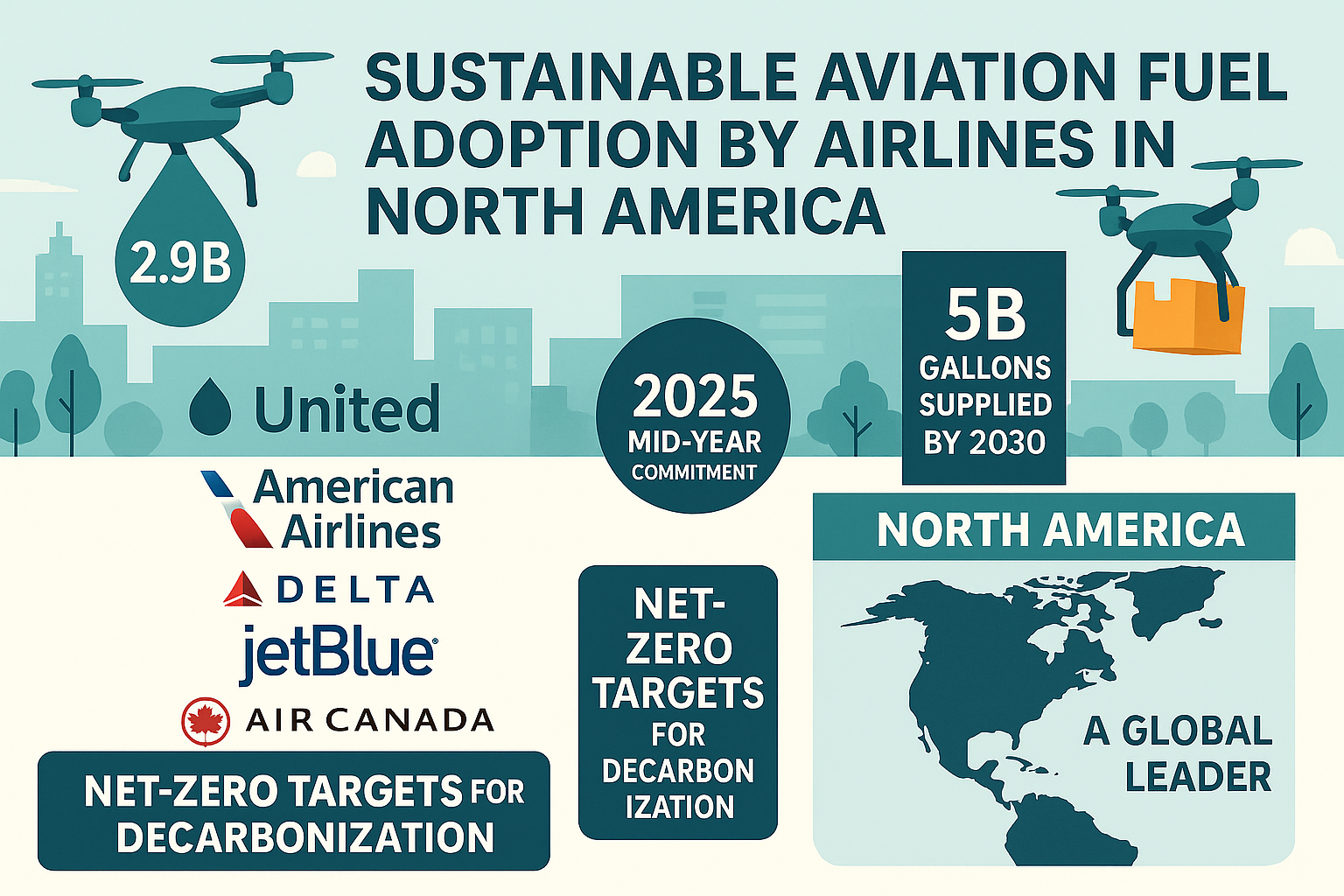
North American airlines have emerged as pioneers in the Sustainable Aviation Fuel Industry. Their leadership is visible in long-term SAF offtake agreements, early infrastructure deployment, and corporate partnerships that foster demand aggregation. As of 2025, five major carriers United Airlines, Delta Air Lines, American Airlines, Air Canada, and JetBlue have committed to substantial SAF volumes, illustrating the increasing Sustainable Aviation Fuel Market Size in the region.
United Airlines leads the charge with a total of 2.9 billion gallons in SAF commitments. Notably, a landmark 1 billion gallon agreement with Cemvita marks a shift toward synthetic fuel pathways. United plans to use 10 million gallons of SAF in 2025, tripling its 2022 volume.
Delta Air Lines has secured offtake agreements totaling 910 million gallons 525 million from Gevo and 385 million from DG Fuels targeting a 5% SAF blend by 2030.
American Airlines has inked deals worth 620 million gallons through 2030. Its partnerships with Aemetis and Gevo include annual deliveries beginning in 2024, reinforcing its strategic SAF ambitions.
Air Canada will deploy 77.6 million liters (20.5 million US gallons) of Neste SAF in 2025, representing 1% of its fuel consumption, with further growth expected under Canada’s Clean Fuel Regulations.
JetBlue, while smaller in scope, has launched a 1 million gallon per year SAF program at JFK, marking the first regular SAF supply at that major hub.
These examples reflect growing Sustainable Aviation Fuel Market Share among North American airlines.
Barriers to Scaling SAF
Despite remarkable progress, the SAF Industry faces systemic barriers that hinder broader adoption. Chief among them are cost premiums, feedstock limitations, infrastructure inadequacies, and inconsistent policy frameworks.
SAF remains significantly more expensive than conventional jet fuel often 2 to 5 times the cost. In Europe, SAF blending mandates are projected to add $1.7 billion in airline costs in 2025 alone. These price disparities reduce competitiveness, especially for carriers operating on tight margins.
Feedstock availability poses another critical challenge. Most SAF today is produced using the HEFA pathway, reliant on used cooking oil and animal fats. However, this feedstock stream is expected to plateau at 2 million tonnes by 2030. Advanced feedstocks like municipal solid waste and cellulosic biomass require intricate logistics and higher processing costs.
Infrastructure remains a bottleneck. Only 25% of North American airports are SAF-capable, and retrofitting facilities is capital intensive. The Sustainable Aviation Fuel Market cannot scale unless distribution and blending infrastructure is widely available.
Finally, regulatory fragmentation further complicates progress. The U.S. SAF Grand Challenge sets ambitious voluntary goals, but lacks federal blending mandates. Tax credits under Section 45Z expire between 2024–2027, creating long-term uncertainty. Canada’s Clean Fuel Regulations are more prescriptive, requiring 1 billion liters of SAF by 2030, but regional differences remain.
Opportunities for Acceleration
Despite these challenges, significant opportunities exist to catalyze SAF Market growth across North America.
Emerging SAF pathways, such as Power-to-Liquid (PtL) and Alcohol-to-Jet (ATJ), promise dramatic lifecycle emissions reductions. United Airlines is investing in Twelve’s CO2-to-fuel technology, which can reduce emissions by up to 90%. DG Fuels is developing timber waste-to-SAF conversion plants with 85% reduction potential.
Corporate demand aggregation is gaining traction. Programs like Eco-Skies Alliance enable cargo and logistics companies (e.g., SEKO Logistics) to co-invest in SAF, creating reliable demand pools and de-risking project financing.
Policy incentives are proving effective. California’s Low Carbon Fuel Standard (LCFS) credits and Michigan’s $1.50/gallon SAF tax credit stimulate regional production and feedstock utilization, helping to expand Sustainable Aviation Fuel Market Share.
Technological integration also supports scaling. Companies like LanzaJet are deploying modular ATJ facilities to lower capital expenditure. Digital platforms, such as SAFc-Registry powered by Chooose, streamline SAF transaction certification and traceability.
Policy and Regulatory Environment
North American policy is evolving to support the SAF Industry, but further alignment is needed to create long-term stability.
In the U.S., the SAF Grand Challenge outlines a goal of 3 billion gallons of annual SAF production by 2030, scaling to 35 billion by 2050. The Inflation Reduction Act offers Section 45Z tax credits of $1.25–$1.75/gallon, contingent on emissions reductions of over 50%.
State-level programs complement federal efforts. California’s LCFS rewards carbon intensity reductions, while Michigan offers per-gallon credits to SAF producers. However, without a federal mandate, airlines and producers still face demand uncertainty.
Canada’s Clean Fuel Regulations offer more structured targets: 1 billion liters by 2030 (approximately 10% of aviation fuel) and up to 25% by 2035. Provincial mandates and incentives further support regional development, boosting Sustainable Aviation Fuel Market Trends.
Sustainable Aviation Fuel Market, Request Pdf Brochure: https://www.marketsandmarkets.com/pdfdownloadNew.asp?id=70301163
Airline Leading Company Profiles
United Airlines: With a 2.9 billion gallon SAF commitment, United has invested in innovative platforms including Cemvita and Twelve. The airline will use 10 million gallons of SAF in 2025 and is scaling PtL facilities like AirPlant One.
Delta Air Lines: Delta’s 910 million gallon SAF offtake from Gevo and DG Fuels supports its 5% blending target by 2030. Projects focus on cellulosic feedstocks and Alcohol-to-Jet conversion.
American Airlines: With 620 million gallons committed through Aemetis and Gevo, American is exploring E-SAF pathways from CO2 via Infinium, supported by Breakthrough Energy Ventures.
Air Canada: A 20.5 million gallon SAF purchase from Neste marks a major milestone. The airline integrates SAF pipeline delivery to YVR and adheres to ISCC sustainability certifications.
JetBlue Airways: Operating the first regular JFK SAF supply through a 1 million gallon/year partnership with Valero and World Fuel Services, JetBlue also promotes corporate sustainability programs.
Strategic Recommendations
To expand the Sustainable Aviation Fuel Market Size and achieve net-zero aviation by 2050, coordinated efforts are required:
- Establish a federal blending mandate in the U.S., starting at 2% in 2025 and scaling to 10% by 2030. This would create predictable demand and incentivize private investment.
- Extend and expand tax incentives under Section 45Z and explore Contracts for Difference (CfDs) to reduce financial risk for producers.
- Invest in advanced feedstocks such as cellulosic biomass, algae, and direct air capture through grants and tax credit mechanisms.
- Fund infrastructure retrofits at major hubs to enhance SAF blending and storage capabilities.
Strengthen partnerships between airlines, SAF producers, and corporations to promote collaborative offtake agreements and boost Sustainable Aviation Fuel Market Share.
Fueling the Future of Flight
North American airlines are setting the global pace in the adoption of sustainable aviation fuel. Through bold commitments, innovative partnerships, and policy advocacy, they are building the foundation for a low-carbon aviation sector. Yet realizing the full potential of the SAF Market depends on overcoming high costs, scaling feedstock supply, harmonizing policy, and upgrading infrastructure. As these elements align, the Sustainable Aviation Fuel Industry will be poised for exponential growth, enabling aviation to meet its climate goals and reshaping the future of flight.
Related Reports:
Sustainable Aviation Fuel Market by Fuel type(Biofuel, Hydrogen, PtL, GtL), by Biofuel Conversion Pathways (HEFA, FT, ATJ, Co-processing), by biofuel blending capacity (below 30%, 30% to 50%, Above 50%), Aircraft type and Region - Global Forecast to 2030
80% of the Forbes Global 2000 B2B companies rely on MarketsandMarkets to identify growth opportunities in emerging technologies and use cases that will have a positive revenue impact.
- Food Packaging Market Size Set for Strong Growth Through 2030 Amid Rising Demand for Convenience Foods
- Crop Protection Chemical Market Size, Share & Growth Forecast (2025–2030)
- Mulch Films Market: Driving Sustainable Agriculture Through Innovation
- Agricultural Adjuvants Market Analysis, Trends, and Growth Outlook (2026–2031)
- Japan Enterprise Asset Management Market Growth: AI and Smart Infrastructure Drive Demand


