

Top 5 Growth Drivers for Hypersonic Weapons
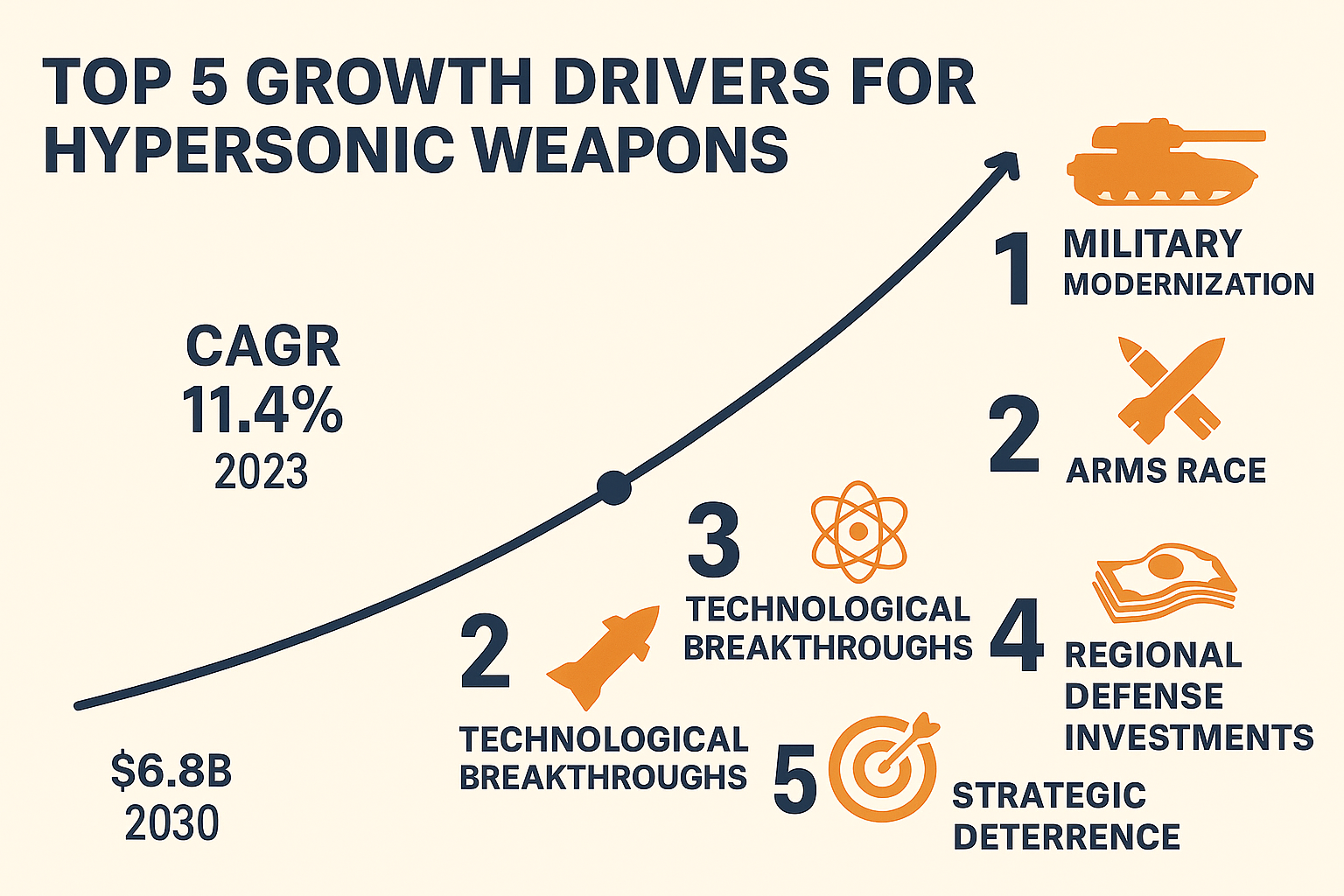
The Hypersonic Weapons Market has emerged as one of the most dynamic sectors in the global defense industry, with nations accelerating investments in technologies that promise unprecedented speed, maneuverability, and operational superiority. Valued at USD 6.8 billion in 2023, the market is projected to reach USD 14.5 billion by 2030, registering a CAGR of 11.4%. Hypersonic weapons are widely considered a revolution in modern warfare because they combine extreme speed exceeding Mach 5 with precision strike capabilities that can penetrate advanced defense systems.
As the global arms race intensifies, countries are exploring hypersonic technologies not only to safeguard national security but also to assert dominance in rapidly evolving geopolitical environments. From the United States and Russia to China and India, military powers are investing billions in research, testing, and deployment of hypersonic systems. The Hypersonic Weapons Market growth is primarily driven by five critical forces: military modernization, global arms race, technological advancements, regional defense investments, and the demand for strategic deterrence.
This blog explores the top five growth drivers for the Hypersonic Weapons Market, along with insights into opportunities, restraints, challenges, regional outlook, and the role of key players shaping this strategic industry.
Growth Driver 1: Military Modernization and Strategic Superiority
Military modernization remains the cornerstone of growth in the hypersonic weapons market. As nations upgrade their armed forces to confront next generation threats, hypersonic weapons are increasingly integrated into modernization programs. Unlike traditional ballistic missiles, hypersonic systems provide flexibility in deployment, speed, and precision, giving militaries the ability to strike high value targets within minutes.
Countries such as the United States, Russia, and China are prioritizing hypersonic development to achieve strategic deterrence. The U.S. Department of Defense has allocated nearly USD 13 billion between 2023 and 2027 for hypersonic programs, while Russia and China continue to conduct regular tests of hypersonic glide vehicles and cruise missiles.
The modernization drive is not confined to superpowers. Emerging economies like India are investing heavily in developing indigenous hypersonic technologies, recognizing their importance in regional power balances. The modernization push creates a self sustaining cycle of investment, where innovation and deployment further fuel the global hypersonic weapons market.
Growth Driver 2: Arms Race and Geopolitical Rivalries
The global defense landscape is being reshaped by a new arms race focused on hypersonic technologies. Once a single nation demonstrates operational hypersonic capability, rival powers are compelled to respond in order to avoid strategic vulnerability. This tit-for-tat dynamic is evident in the competition between the U.S. and China.
In 2021, China’s successful test of a hypersonic missile sparked widespread concern among U.S. defense officials, accelerating American investments. Similarly, Russia’s deployment of the Avangard hypersonic glide vehicle has further heightened tensions in Europe and Asia. This rivalry fuels not only technological advancements but also massive procurement contracts, pushing the Hypersonic Weapons Market forward at a rapid pace.
Geopolitical flashpoints such as the South China Sea, Taiwan Strait, and Eastern Europe amplify the urgency for hypersonic deployments. Nations view these weapons as not just offensive tools but also as psychological and political leverage in international negotiations.
Growth Driver 3: Technological Breakthroughs in Hypersonic Systems
Technological advancement is the backbone of the hypersonic weapons market. Innovations in propulsion systems, materials science, and guidance technologies have transformed hypersonic weapons from theoretical concepts into deployable systems. The development of scramjet engines enables sustained hypersonic flight, while advanced carbon composites and heat resistant alloys allow missiles to withstand extreme conditions.
Modern guidance systems now ensure unprecedented accuracy, enabling hypersonic weapons to strike mobile or hardened targets with precision. Additive manufacturing and computational simulations further enhance the development process by lowering costs and accelerating design refinements.
These innovations make hypersonic weapons not only faster but also more reliable and versatile, reinforcing their strategic value for militaries worldwide. As research continues, miniaturization and compact hypersonic designs are creating opportunities for deployment across air, land, and naval platforms.
Growth Driver 4: Expanding Regional Defense Investments in Asia Pacific
The Asia Pacific region dominates the hypersonic weapons market, driven by rising defense budgets, regional conflicts, and technological ambitions. Countries such as China, India, Japan, and Australia are pouring billions into hypersonic research and procurement.
China leads the region with multiple operational tests and rapid progress in glide vehicles and cruise missiles. India is investing in joint programs with Russia while also advancing indigenous efforts under its Defense Research and Development Organisation (DRDO). Japan has allocated nearly USD 883 million to hypersonic missile development programs through Mitsubishi Heavy Industries.
The presence of multiple regional powers in close proximity fuels competition, ensuring Asia Pacific remains the fastest growing market segment for hypersonic weapons.
Growth Driver 5: Demand for Strategic Deterrence and Precision Strike
Hypersonic weapons have become critical to maintaining strategic deterrence in modern warfare. Their ability to travel at speeds beyond Mach 5 while maneuvering unpredictably makes them nearly impossible to intercept with current missile defense systems. This capability provides militaries with a decisive edge in both offensive and defensive operations.
For strategic deterrence, hypersonic weapons serve as a visible demonstration of technological superiority. Nations equipped with hypersonic arsenals can deter adversaries from aggressive actions by creating uncertainty about response times and survivability of critical assets.
Precision strike capabilities enable hypersonic systems to target time sensitive or hardened facilities with accuracy, reducing collateral damage and enhancing operational efficiency. The combination of speed, precision, and evasion makes them indispensable for modern militaries.
Download PDF Brochure: https://www.marketsandmarkets.com/pdfdownloadNew.asp?id=99668237
Key Players in the Hypersonic Weapons Market
The hypersonic weapons market is shaped by several major defense contractors who are investing in research, development, and international collaborations to strengthen their portfolios.
Lockheed Martin Corporation (US): One of the pioneers in hypersonic development, Lockheed Martin is heavily engaged in U.S. military contracts, including programs for hypersonic glide vehicles and missiles.
Raytheon Technologies Corporation (US): Raytheon is a key player in hypersonic propulsion and guidance systems. Its recent contract with the U.S. Air Force under the HACM program demonstrates its strong role in the sector.
Northrop Grumman Corporation (US): Known for its advanced aerospace capabilities, Northrop Grumman contributes to propulsion technologies and hypersonic systems integration.
Boeing (US): Boeing is advancing its hypersonic platforms with a focus on long range strike systems and future air launched hypersonic concepts.
General Dynamics Corporation (US): The company is exploring hypersonic technologies as part of broader defense modernization initiatives.
Thales Group (UK): Thales contributes to hypersonic guidance, avionics, and communication systems, supporting interoperability and resilience.
Israel Aerospace Industries (Israel): IAI is expanding its hypersonic capabilities, focusing on regional defense applications and international collaborations.
L3Harris Technologies (US) and Leidos (US): These firms are investing in specialized technologies including sensors, command, and control systems critical for hypersonic deployment.
Together, these companies drive the competitive landscape, ensuring rapid advancements in the Hypersonic Weapons Market.
Opportunities, Restraints, and Challenges
While growth is robust, the hypersonic weapons market faces challenges such as high development costs, communication constraints during flight, and supply chain bottlenecks. Nations with limited defense budgets may find it difficult to compete, potentially widening global disparities in hypersonic capabilities.
Opportunities such as compact hypersonic weapons, cost effective manufacturing, and advanced communication networks provide promising avenues for growth. Overcoming overheating, manufacturing complexities, and testing infrastructure limitations will be key to unlocking the full potential of the hypersonic weapons industry.
The Hypersonic Weapons Market is at the forefront of modern defense innovation, transforming military strategies and global power dynamics. Driven by military modernization, geopolitical rivalries, technological breakthroughs, regional investments, and the demand for strategic deterrence, hypersonic weapons are set to redefine the future of warfare.
As investments surge and key players expand their capabilities, the industry is poised for double digit growth through 2030. While challenges remain, the race for hypersonic supremacy ensures that research, development, and deployment will accelerate, making hypersonic systems a defining feature of 21st century defense.
80% of the Forbes Global 2000 B2B companies rely on MarketsandMarkets to identify growth opportunities in emerging technologies and use cases that will have a positive revenue impact.
- Food Packaging Market Size Set for Strong Growth Through 2030 Amid Rising Demand for Convenience Foods
- Crop Protection Chemical Market Size, Share & Growth Forecast (2025–2030)
- Mulch Films Market: Driving Sustainable Agriculture Through Innovation
- Agricultural Adjuvants Market Analysis, Trends, and Growth Outlook (2026–2031)
- Japan Enterprise Asset Management Market Growth: AI and Smart Infrastructure Drive Demand


