

UAV (Drone) Avionics Technology Innovation: Key Trends, Growth Drivers and Opportunities
Introduction to UAV (Drone) Avionics Technology
In the rapidly evolving world of unmanned aerial systems, UAV (Drone) Avionics technology has emerged as a game-changing innovation, transforming the capabilities, safety, autonomy, and operational efficiency of unmanned aerial vehicles. UAV avionics encompass the electronic systems and technologies responsible for navigation, flight control, communication, surveillance, mission management, and situational awareness. These advanced systems enable drones to operate more efficiently across commercial, defense, agriculture, logistics, public safety, and other applications.
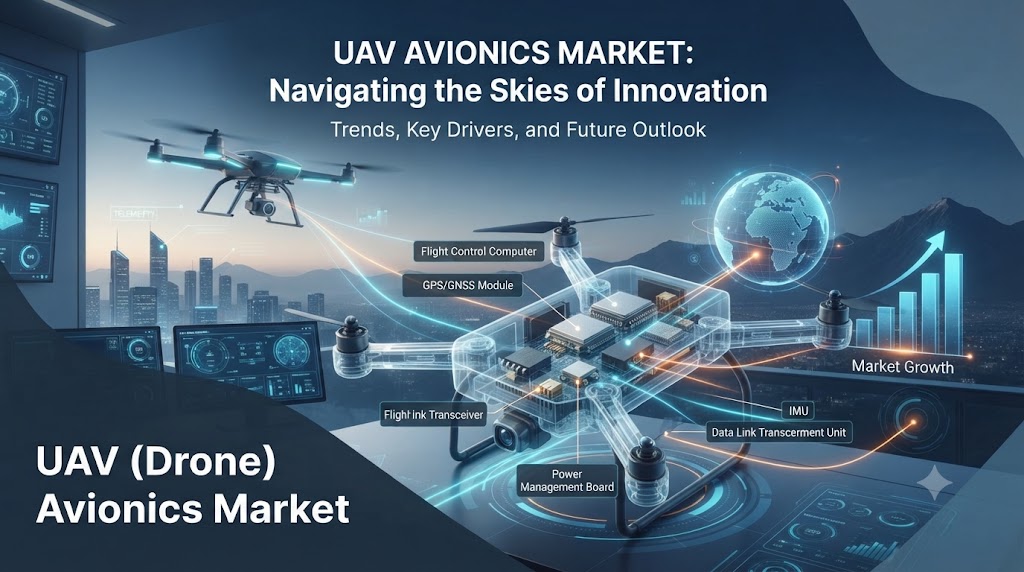
Modern UAV avionics integrate advanced flight controllers, navigation systems, inertial measurement units (IMUs), Global Navigation Satellite Systems (GNSS), communication systems, sensors, autopilot technologies, and onboard computing platforms. The integration of Artificial Intelligence (AI), machine learning, edge computing, and advanced sensing technologies is further enabling drones to perform increasingly complex missions with greater levels of autonomy. As the adoption of unmanned aerial systems continues to expand globally, the demand for sophisticated avionics solutions is increasing. Next-generation UAV avionics are enabling drones to operate in challenging environments, navigate autonomously, avoid obstacles, communicate securely, and process mission data in real time. As we explore the future of UAV (Drone) Avionics technology, we uncover a realm of exciting possibilities and transformative advancements that promise to reshape the way unmanned aerial systems operate.
History of UAV (Drone) Avionics Technology
The development of UAV avionics technology has evolved significantly alongside the advancement of unmanned aerial vehicles. Early UAV systems relied on relatively basic control systems and remote-operated communication links, with limited onboard intelligence and autonomous capabilities. As electronic components became smaller, lighter, and more powerful, UAV manufacturers began integrating sophisticated navigation, flight control, and communication systems into increasingly compact platforms. The introduction of GPS-based navigation, digital flight controllers, inertial navigation systems, and autopilot technologies significantly improved UAV stability and operational reliability.
The development of advanced sensors, satellite communication, data links, and onboard computing further expanded UAV capabilities. Modern drones can now perform autonomous takeoff and landing, waypoint navigation, obstacle detection, real-time data transmission, and complex mission operations. Today, UAV avionics represent one of the most critical technology areas within the unmanned aerial systems ecosystem. Advanced avionics architectures are enabling drones to become safer, more autonomous, connected, and capable of performing sophisticated missions across diverse environments.
Benefits of UAV (Drone) Avionics Technology
UAV (Drone) Avionics technology offers numerous advantages over conventional and manually operated aerial systems:
-
Enhanced Flight Safety: Advanced flight control, navigation, and obstacle detection systems improve UAV stability and reduce the risk of accidents during operations.
-
Improved Autonomous Operations: Modern avionics enable drones to perform complex missions with minimal human intervention, improving operational efficiency.
-
Real-Time Situational Awareness: Integrated sensors and onboard processing systems provide operators with valuable real-time information about the surrounding environment.
-
Mission Flexibility: Advanced avionics architectures allow UAVs to perform a wide range of missions, including surveillance, mapping, inspection, delivery, agriculture, and defense operations.
Current Market Size and Growth Trends of UAV (Drone) Avionics Industry
The UAV (Drone) Avionics market has witnessed significant growth as the adoption of unmanned aerial systems continues to expand across defense, commercial, and industrial applications. The increasing demand for autonomous flight, advanced navigation, secure communication, and mission-specific capabilities is driving investments in next-generation avionics technologies.
According to MarketsandMarkets, the global UAV (Drone) Avionics Market size was valued at USD 6.91 Billion in 2025 and is projected to reach USD 10.81 Billion by 2030, growing at a CAGR of 9.4% from 2025 to 2030.
This market growth can be attributed to several factors, including:
-
Increasing adoption of UAVs for commercial, defense, and industrial applications
-
Growing demand for autonomous and intelligent drone operations
-
Rising integration of advanced navigation, communication, and flight control systems
-
Increasing investments in military modernization and unmanned aerial technologies
-
Advancements in AI, sensor technologies, edge computing, and onboard data processing
As UAV applications continue to expand, advanced avionics will remain essential for improving drone safety, autonomy, connectivity, and mission performance.
Key Drivers and Factors Influencing the Future of UAV (Drone) Avionics Technology
Several key drivers and factors are shaping the future of UAV (Drone) Avionics technology:
-
Increasing UAV Adoption: The growing use of drones across defense, agriculture, logistics, surveillance, infrastructure inspection, and emergency response is driving demand for advanced avionics systems.
-
Growth of Autonomous Flight: The development of autonomous UAVs is increasing demand for advanced flight management systems, navigation technologies, obstacle avoidance, and onboard decision-making capabilities.
-
Technological Advancements: Innovations in AI, machine learning, edge computing, sensors, and high-performance processors are improving UAV avionics capabilities.
-
Growing Defense Applications: Military organizations are increasingly deploying UAVs for intelligence, surveillance, reconnaissance, communications, and other mission-critical operations, creating demand for sophisticated avionics.
-
Increasing Demand for Connected Drones: Real-time communication, cloud connectivity, and data sharing are becoming increasingly important for commercial and defense UAV operations, driving the development of advanced communication avionics.
Emerging Trends in UAV (Drone) Avionics Technology
The future of UAV (Drone) Avionics is shaped by several exciting trends and innovations:
-
AI-Enabled Autonomous Flight: Artificial intelligence and machine learning are enabling drones to make real-time decisions, recognize objects, adapt to changing environments, and perform complex autonomous missions.
-
Advanced Navigation Systems: UAVs are increasingly integrating GNSS, inertial navigation, visual navigation, and other positioning technologies to improve flight accuracy and reliability.
-
Edge Computing: Advanced onboard processors allow drones to process sensor and mission data in real time, reducing reliance on remote systems and improving response times.
-
Integrated Sense-and-Avoid Systems: Advanced sensors and avionics are enabling drones to detect and avoid obstacles, improving safety during autonomous operations.
-
Secure and Resilient Communication: Next-generation communication systems are being developed to provide reliable and secure data links between UAVs, operators, satellites, and ground control stations.
Opportunities and Challenges in the UAV (Drone) Avionics Market
As the UAV (Drone) Avionics market continues to evolve, it presents numerous opportunities for businesses and technology providers alike:
-
Market Expansion: The growing demand for UAVs across defense, logistics, agriculture, infrastructure inspection, public safety, and other industries offers significant growth opportunities for avionics manufacturers.
-
Innovation and Product Differentiation: Companies investing in advanced flight controllers, AI-powered avionics, autonomous navigation, and secure communication systems can gain a competitive advantage.
-
Integration of Autonomous Technologies: The increasing demand for autonomous drones creates opportunities for companies developing advanced avionics architectures that combine navigation, sensing, computing, and flight management.
However, the UAV (Drone) Avionics market also faces several challenges that need to be addressed:
-
Cybersecurity Risks: Connected UAV avionics systems can be exposed to cyber threats, requiring advanced cybersecurity technologies to protect flight controls, communications, and mission data.
-
Regulatory and Airspace Integration Challenges: The growing number of UAV operations requires regulatory frameworks and technologies that enable safe integration of drones into national and international airspace.
-
Size, Weight, Power, and Cost Constraints: UAV avionics must remain lightweight and energy-efficient while delivering increasingly sophisticated capabilities.
-
Communication and Navigation Vulnerabilities: Signal interference, GNSS disruptions, and communication limitations can affect UAV operations, creating a need for resilient navigation and communication systems.
Innovations and Advancements in UAV (Drone) Avionics Technology
The future of UAV (Drone) Avionics is being shaped by a multitude of innovative technologies and advancements:
-
AI-Powered Flight Management: Artificial intelligence can support autonomous route planning, real-time decision-making, and adaptive flight control.
-
Advanced Sensor Fusion: Combining data from cameras, radar, LiDAR, GNSS, IMUs, and other sensors enables UAVs to develop a more accurate understanding of their operating environment.
-
Digital Flight Control Systems: Modern digital flight control technologies improve UAV stability, maneuverability, and operational efficiency across different mission profiles.
-
Swarm Intelligence and Collaborative UAV Operations: Advanced avionics can enable multiple drones to communicate and coordinate their activities, supporting collaborative missions and complex swarm operations.
-
Integrated Avionics Architectures: Manufacturers are increasingly integrating flight control, navigation, communication, mission management, and sensor processing into unified avionics platforms, reducing system complexity and improving overall performance.
Future Applications and Industries That Will Benefit from UAV (Drone) Avionics Technology
The future of UAV (Drone) Avionics technology holds immense potential across a wide range of applications and industries:
-
Defense and Military: Advanced avionics will support UAVs used for intelligence, surveillance, reconnaissance, border monitoring, communications, and other defense missions.
-
Agriculture: Precision agriculture drones can use advanced navigation, sensors, and autonomous flight systems for crop monitoring, spraying, mapping, and field analysis.
-
Logistics and Delivery: UAV avionics will play a critical role in enabling autonomous drone delivery services for packages, medical supplies, and other goods.
-
Infrastructure Inspection: Drones equipped with advanced avionics can autonomously inspect bridges, power lines, pipelines, telecommunications infrastructure, and industrial facilities.
-
Emergency Response and Public Safety: UAVs can provide real-time aerial intelligence during natural disasters, search-and-rescue operations, firefighting, and emergency response missions.
-
Commercial and Industrial Applications: Advanced UAV avionics will support applications including aerial mapping, surveying, environmental monitoring, construction, mining, and energy infrastructure management.
Conclusion: The Promising Future of UAV (Drone) Avionics Technology
The future of UAV (Drone) Avionics technology is brimming with exciting possibilities and transformative advancements. As drones become increasingly autonomous, connected, and intelligent, advanced avionics will play a pivotal role in enabling safer and more efficient unmanned aerial operations. From AI-powered flight management and advanced sensor fusion to autonomous navigation, integrated communication systems, edge computing, and collaborative drone operations, the future of UAV avionics promises to revolutionize the way drones operate across commercial, industrial, government, and defense environments. However, realizing the full potential of UAV (Drone) Avionics will require continued research and development, addressing challenges related to cybersecurity, regulatory compliance, airspace integration, communication resilience, navigation reliability, and system costs.
Collaboration among UAV manufacturers, avionics developers, regulators, technology providers, and end users will be crucial in driving innovation and enabling the widespread adoption of advanced drone technologies. As we look ahead, one thing is certain: the future of UAV (Drone) Avionics technology is bright, and its impact will be felt across virtually every major UAV application, ushering in a new era of intelligent, autonomous, connected, and highly capable unmanned aerial systems. Discover the latest advancements and solutions in UAV (Drone) Avionics technology by exploring comprehensive market research and industry analysis. Stay ahead of emerging UAV technology trends and explore how advanced flight control, navigation, AI, sensor fusion, and communication technologies are shaping the future of unmanned aerial systems.
Download Sample Research Report for UAV (Drone) Avionics Market Future:
https://www.marketsandmarkets.com/Market-Reports/uav-drone-avionics-market-233312796.html
80% of the Forbes Global 2000 B2B companies rely on MarketsandMarkets to identify growth opportunities in emerging technologies and use cases that will have a positive revenue impact.
- Food Packaging Market Size Set for Strong Growth Through 2030 Amid Rising Demand for Convenience Foods
- Mulch Films Market: Driving Sustainable Agriculture Through Innovation
- Agricultural Adjuvants Market Analysis, Trends, and Growth Outlook (2026–2031)
- Crop Protection Chemical Market Size, Share & Growth Forecast (2025–2030)
- Japan Enterprise Asset Management Market Growth: AI and Smart Infrastructure Drive Demand


