

Electronic Warfare Investment Surges as Militaries Prepare for Spectrum-Dominated Warfare
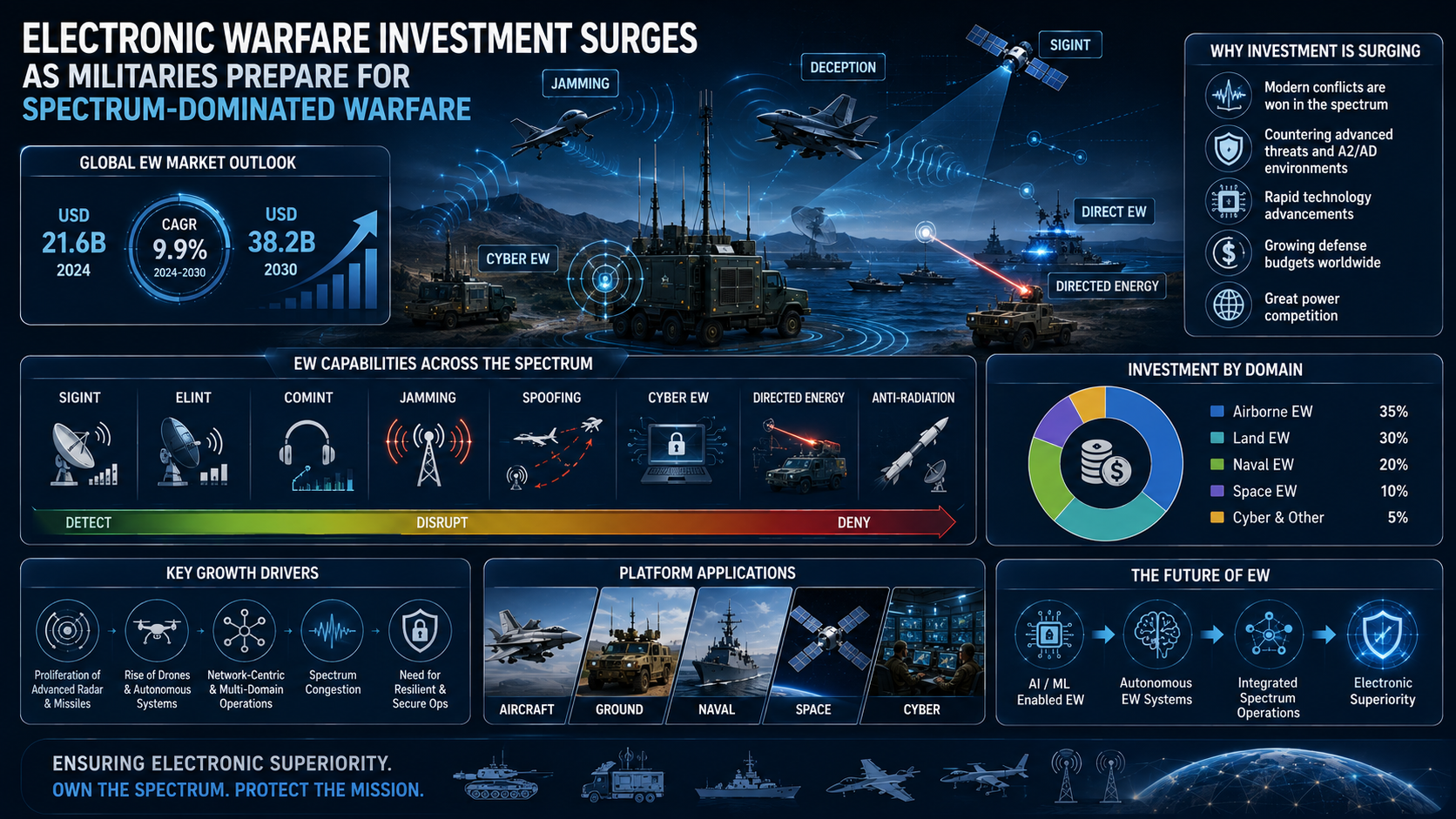
In the rapidly evolving world of defense technology, electronic warfare has emerged as a critical capability for modern military operations, transforming how armed forces detect threats, protect communications, control the electromagnetic spectrum, and maintain operational superiority. As military platforms become increasingly dependent on communication networks, radar, navigation systems, sensors, satellite links, and precision targeting technologies, the electromagnetic spectrum has become a strategically important battlespace.
Electronic warfare enables military forces to sense, exploit, protect, and influence electromagnetic signals. Its role extends from identifying hostile radar and communication emissions to protecting friendly systems from interference and supporting operations in contested electromagnetic environments. As warfare becomes increasingly network-centric and digitally connected, electronic warfare is transitioning from a specialized support capability into a core component of military modernization.
The growing focus on spectrum dominance is also encouraging defense organizations to invest in more adaptive and software-driven EW architectures. These systems are expected to combine advanced RF technologies, signal processing, artificial intelligence, machine learning, networking, and automation to respond to increasingly sophisticated electronic threats.
Evolution of electronic warfare
The evolution of electronic warfare can be traced from traditional radio-frequency interference and radar jamming systems to sophisticated, digitally controlled and networked capabilities. Earlier EW systems were generally designed to address specific communication or radar threats. Modern systems must instead operate across complex electromagnetic environments containing numerous signals, frequency bands, platforms, and rapidly changing threat characteristics.
Electronic warfare is generally organized around three complementary functions: electronic support, electronic attack, and electronic protection. Electronic support focuses on detecting, intercepting, identifying, and analyzing electromagnetic emissions. Electronic attack involves capabilities designed to disrupt, deceive, or otherwise influence adversary electronic systems. Electronic protection focuses on maintaining the availability and effectiveness of friendly electronic systems in contested environments.
The integration of these capabilities across aircraft, naval platforms, ground vehicles, satellites, UAVs, and command networks is changing the role of EW in modern military operations.
Benefits of electronic warfare
Electronic warfare technologies offer numerous strategic and operational advantages to modern armed forces:
-
Spectrum Awareness: EW systems can help military forces detect and characterize electromagnetic activity, providing valuable information about the surrounding operational environment.
-
Communications Protection: Electronic protection capabilities can help maintain reliable communications and data exchange when adversaries attempt to disrupt military networks.
-
Threat Detection: Electronic support systems can identify and analyze radar, communication, and other electromagnetic emissions to support threat awareness.
-
Operational Resilience: EW capabilities can improve the ability of military forces to operate in environments where navigation, communications, and sensing systems are subject to interference.
-
Force Multiplication: Electronic attack can complement conventional military capabilities by influencing the electronic systems supporting adversary operations.
-
Network Protection: Advanced EW capabilities can contribute to protecting increasingly connected military networks and platforms.
Current market size and growth trends of the electronic warfare industry
The global electronic warfare industry is witnessing strong growth as defense organizations increasingly recognize the importance of electromagnetic-spectrum operations. According to MarketsandMarkets, the Global Electronic Warfare (EW) Market Size was valued at USD 26.12 billion in 2025 and is projected to reach USD 40.56 billion by 2030, growing at a CAGR of 9.2% from 2026–2031, due to the increasing reliance on communication, radar, navigation, and targeting systems in contemporary military operations.
This growth reflects the increasing dependence of military forces on electronic systems and the corresponding need to protect, monitor, and control the electromagnetic spectrum.
The market is gaining momentum because of several important factors, including:
• Increasing reliance on network-centric military operations
• Growing deployment of sophisticated radar and communication systems
• Rising need for protection against electronic interference and attacks
• Modernization of military electronic warfare systems
• Increasing adoption of software-defined EW architectures
• Growing integration of EW capabilities into aircraft, naval vessels, and ground platforms
• Increasing importance of electromagnetic spectrum dominance in multi-domain operations
Key drivers and factors influencing the future of electronic warfare
Several key drivers and factors are shaping the future of electronic warfare technology and investment.
1. Increasing Dependence on the Electromagnetic Spectrum
Modern military operations rely heavily on communications, radar, satellite navigation, tactical data links, sensors, and networked command-and-control systems. This dependence creates both operational advantages and vulnerabilities.
As more military capabilities become connected, protecting access to the electromagnetic spectrum becomes increasingly important.
2. Growing Spectrum Contestation
Future battlefields are expected to involve increasingly contested electromagnetic environments. Adversaries may attempt to interfere with communications, disrupt navigation, deceive sensors, or identify electromagnetic signatures.
This is encouraging military organizations to invest in systems capable of operating in congested, contested, and rapidly changing spectrum environments.
3. Defense Modernization
Electronic warfare is increasingly being incorporated into broader defense modernization programs. New-generation fighter aircraft, warships, armored vehicles, UAVs, and command systems are being designed with sophisticated electronic capabilities.
4. Software-Defined Architectures
Software-defined EW systems can provide greater flexibility because software, algorithms, signal libraries, and processing capabilities can be updated as threats evolve.
This approach can extend system relevance and reduce dependence on fixed-function hardware.
5. Multi-Domain Operations
Modern defense strategies increasingly connect air, land, sea, space, cyber, and electromagnetic operations. EW is becoming an important cross-domain capability because electromagnetic activity influences communications, sensors, navigation, and information exchange across these domains.
Emerging trends in electronic warfare technology
The future of electronic warfare is being shaped by several major technological trends.
1. AI-Enabled Electronic Warfare
Artificial intelligence and machine learning are being explored for signal classification, threat identification, spectrum monitoring, and decision support.
AI-based systems can help analyze large quantities of electromagnetic data and identify potentially important signals more efficiently.
2. Cognitive Electronic Warfare
Cognitive EW represents a move toward adaptive systems capable of responding to changes in the electromagnetic environment.
Instead of relying exclusively on predetermined responses, cognitive approaches can use sensing and processing to support dynamic adaptation.
3. Digital Signal Processing
Advanced digital signal processing technologies are enabling EW systems to analyze increasingly complex RF environments.
High-performance processors can support real-time analysis and sophisticated signal-processing functions across multiple frequency bands.
4. Software-Defined EW
Software-defined architectures enable EW capabilities to evolve through software updates, new algorithms, and updated threat information.
This flexibility is particularly important because electromagnetic threats can change rapidly.
5. Distributed Electronic Warfare
Future EW systems are expected to become increasingly distributed. Multiple platforms can contribute electromagnetic information to a shared operational picture.
This could involve aircraft, UAVs, naval platforms, ground systems, and space assets working together as part of a broader spectrum-management architecture.
Opportunities and challenges in the electronic warfare market
As the electronic warfare industry expands, it creates opportunities across defense electronics, radar, communications, software, artificial intelligence, sensors, aerospace platforms, and military networking.
Key opportunities include:
-
AI-Based EW: The use of AI for signal identification, threat classification, and spectrum awareness creates opportunities for advanced EW software and processing technologies.
-
EW Modernization: Replacement and upgrading of legacy electronic warfare systems can generate demand across multiple military platforms.
-
Software-Defined Systems: Software-defined architectures offer opportunities for flexible EW platforms capable of receiving future capability upgrades.
-
Unmanned EW: UAVs and other unmanned platforms could increasingly support specialized electromagnetic sensing and electronic warfare missions.
-
Space-Based EW: The increasing strategic importance of space systems creates opportunities for space-based electromagnetic intelligence and spectrum awareness.
-
Integrated Sensor Networks: Combining RF sensors with radar, electro-optical, and other intelligence sources can improve electromagnetic situational awareness.
However, the electronic warfare market also faces several challenges:
-
Rapid Threat Evolution: Adversaries continuously develop new communication, radar, and electronic techniques, requiring EW systems to evolve rapidly.
-
System Complexity: Modern EW systems must process large volumes of electromagnetic information across increasingly complex environments.
-
Interoperability: EW systems need to integrate with communications, intelligence, radar, command-and-control, and other military systems.
-
Cybersecurity: Connected EW architectures create additional requirements for protecting software, networks, and data.
-
Spectrum Congestion: Growing use of the electromagnetic spectrum by military and civilian systems makes spectrum management increasingly challenging.
Innovations and advancements in electronic warfare technology
The future of electronic warfare is being shaped by innovations in sensors, processors, antennas, software, networking, and artificial intelligence.
1. Cognitive EW Systems
Cognitive EW technologies are designed to improve the ability of systems to understand changing electromagnetic conditions and adapt accordingly.
These capabilities can support faster identification of unfamiliar or changing signal patterns.
2. AI-Based Signal Processing
AI-enabled processing can help analyze large volumes of RF information and identify relevant signals.
The combination of machine learning with high-performance digital processors can support faster electromagnetic threat assessment.
3. Advanced RF Technologies
Modern RF technologies are enabling EW systems to operate across broader frequency ranges while improving sensitivity, selectivity, and processing capabilities.
These developments are important as adversary systems become increasingly sophisticated and frequency-agile.
4. Distributed Spectrum Operations
Future military networks may connect multiple EW sensors and platforms to create a distributed view of the electromagnetic environment.
Such architectures can support information sharing between different operational domains.
5. EW Integration with Unmanned Systems
Unmanned aerial and other autonomous platforms can provide additional opportunities for distributed electromagnetic sensing and specialized EW missions.
Advances in miniaturized electronics, processors, antennas, and payload technologies are supporting this development.
Future applications and industries that will benefit from electronic warfare
The future of electronic warfare holds significant potential across a broad range of defense applications.
1. Fighter Aircraft
Advanced EW suites are becoming increasingly important for modern combat aircraft. These systems can support threat detection, electromagnetic awareness, electronic protection, and electronic attack.
2. Naval Platforms
Warships depend extensively on radar and communication systems. EW capabilities can support electromagnetic intelligence, threat identification, situational awareness, and platform protection.
3. Ground Forces
Mobile ground-based EW systems can provide spectrum monitoring, electronic support, communications protection, and other capabilities closer to the tactical edge.
4. Unmanned Aerial Vehicles
UAVs can increasingly carry specialized electromagnetic sensors and EW payloads, supporting distributed sensing, communications, and other tactical functions.
5. Space Systems
Military dependence on satellites for communications, navigation, intelligence, and surveillance is increasing the importance of space-based spectrum awareness and protection.
6. Command-and-Control Networks
Modern command-and-control systems rely on secure communications and data exchange. EW technologies can contribute to the resilience and protection of these networks.
7. Multi-Domain Operations
EW will increasingly support operations across land, air, sea, space, cyber, and electromagnetic environments.
Its role is expected to expand from individual platforms toward integrated spectrum operations.
Electronic warfare investment and the rise of spectrum dominance
The surge in electronic warfare investment reflects a fundamental change in the way modern militaries approach operational superiority.
Military forces increasingly depend on electronic systems to communicate, detect threats, navigate, coordinate forces, share intelligence, and execute precision operations. Consequently, the electromagnetic spectrum has become an important operational domain.
The growing importance of spectrum dominance is driving investment across:
• Electronic support systems
• Electronic attack systems
• Electronic protection technologies
• Radar and RF sensors
• Signals intelligence
• Communications intelligence
• Spectrum monitoring
• Advanced antennas
• Digital signal processing
• AI-enabled EW software
• Cognitive EW architectures
• Distributed EW networks
These investments are helping transform electronic warfare from a specialized capability into a broader element of defense strategy and military force modernization.
Why electronic warfare is becoming a core defense investment priority
The increasing importance of EW can be directly linked to the growing digitalization of military operations.
A modern military force may depend on multiple interconnected systems for communications, navigation, surveillance, targeting, intelligence, and command and control. If these systems are disrupted, degraded, deceived, or denied, operational effectiveness can be affected.
Therefore, electronic warfare is increasingly viewed as both an offensive and defensive capability.
The objective is no longer limited to conventional radar or communications jamming. Modern EW increasingly involves understanding the electromagnetic environment, protecting friendly systems, identifying adversary emissions, managing spectrum access, and integrating electromagnetic capabilities across multiple platforms.
This is driving demand for flexible, software-defined, networked, and increasingly intelligent EW systems.
Future outlook of the electronic warfare industry
The future of electronic warfare will be shaped by the convergence of artificial intelligence, software-defined architectures, advanced RF technologies, autonomous systems, and multi-domain networking.
AI-enabled EW systems are expected to increasingly support signal analysis, classification, and threat identification. Cognitive technologies could enable systems to respond more dynamically to changing electromagnetic environments.
Software-defined architectures will also become increasingly important because they can allow military organizations to introduce new algorithms, threat libraries, and processing capabilities without completely replacing the underlying hardware.
Unmanned platforms represent another important area of development. UAVs and autonomous systems can potentially distribute electromagnetic sensing capabilities across larger areas and support networked spectrum operations.
Space-based EW is also expected to become more significant as militaries increase their dependence on satellite communications, navigation, intelligence, and surveillance.
The convergence of these technologies will contribute to the development of a more connected, adaptive, and distributed electronic warfare ecosystem.
The promising future of electronic warfare investment
The future of electronic warfare is being shaped by a fundamental shift in military operations toward increasingly connected, digital, and spectrum-dependent systems.
According to MarketsandMarkets, the Global Electronic Warfare (EW) Market Size was valued at USD 26.12 billion in 2025 and is projected to reach USD 40.56 billion by 2030, growing at a CAGR of 9.2% from 2026–2031. The market's expansion is closely associated with increasing reliance on communication, radar, navigation, and targeting systems in contemporary military operations.
From AI-enabled signal processing and cognitive EW to software-defined architectures, advanced RF technologies, distributed spectrum operations, and unmanned platforms, technological innovation is expanding the role of EW across the defense ecosystem.
As militaries prepare for increasingly spectrum-dominated warfare, electronic warfare is becoming a core defense investment priority. Future systems will need to be more adaptive, networked, software-driven, and capable of operating across complex electromagnetic environments.
The ability to sense, protect, exploit, and manage the electromagnetic spectrum will increasingly influence military effectiveness across air, land, sea, space, and multi-domain operations.
As a result, continued investment in electronic warfare technologies is expected to remain an important component of defense modernization, creating opportunities for technology developers, defense contractors, system integrators, and suppliers of advanced RF, software, AI, networking, and sensing technologies.
Discover the latest advancements, market trends, growth opportunities, and competitive developments shaping the Electronic Warfare Market.
Download Sample Research Report for Electronic Warfare Market: https://www.marketsandmarkets.com/Market-Reports/electronic-warfare-market-1301.html
80% of the Forbes Global 2000 B2B companies rely on MarketsandMarkets to identify growth opportunities in emerging technologies and use cases that will have a positive revenue impact.
- Food Packaging Market Size Set for Strong Growth Through 2030 Amid Rising Demand for Convenience Foods
- Mulch Films Market: Driving Sustainable Agriculture Through Innovation
- Agricultural Adjuvants Market Analysis, Trends, and Growth Outlook (2026–2031)
- Crop Protection Chemical Market Size, Share & Growth Forecast (2025–2030)
- Japan Enterprise Asset Management Market Growth: AI and Smart Infrastructure Drive Demand


