

Future of Wireless EV Charging: Key Trends, Technologies, Growth Drivers and Opportunities
Introduction to Wireless EV Charging Technology
The transition toward electric mobility is transforming the automotive industry, but the charging experience remains one of the most important factors influencing electric vehicle adoption. Wireless EV charging technology is emerging as an innovative solution that can make charging more convenient, automated, and integrated with future transportation infrastructure.
Unlike conventional plug-in charging, wireless EV charging transfers electrical energy from a ground-based charging system to a receiver installed on the vehicle without requiring a physical cable connection.
This technology can enable electric vehicles to charge while parked at homes, workplaces, parking facilities, fleet depots, and public transportation stations. Advanced dynamic wireless charging technologies can also enable vehicles to receive power while moving over specially equipped roadways.
As electric vehicle adoption increases, the future of wireless EV charging is expected to extend beyond convenience. It could support automated charging, autonomous vehicles, commercial fleets, public transportation, smart infrastructure, and potentially dynamic charging corridors.
What is Wireless EV Charging?
Wireless EV charging, also known as wireless power transfer (WPT) for electric vehicles, uses electromagnetic fields to transfer energy between a transmitter and a receiver.
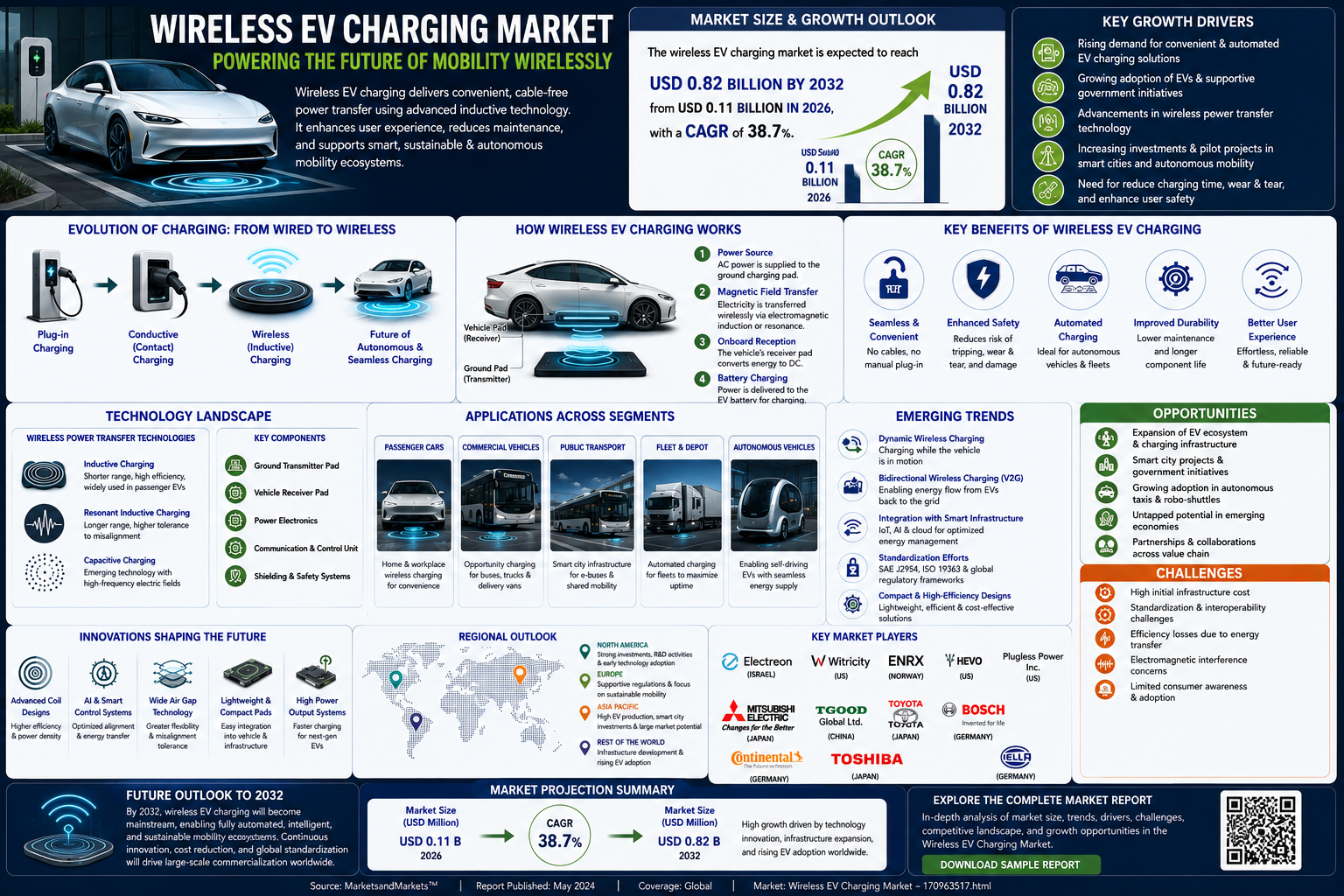
A typical wireless EV charging system consists of:
- Ground-side charging equipment
- Transmitter coil or charging pad
- Vehicle-side receiver
- Power electronics
- Communication and control systems
- Battery management system
- Grid connection
- Energy management software
When an EV is positioned above a wireless charging pad, electrical energy is transferred from the ground-side transmitter to the vehicle's receiver.
Depending on the technology and application, wireless EV charging can be designed for stationary or dynamic charging.
History and evolution of Wireless EV Charging
Wireless power transfer has been explored for decades, but the increasing adoption of electric vehicles has created a new application for the technology.
Early wireless charging systems primarily focused on demonstrating contactless energy transfer. As EV technology developed, researchers and companies began adapting wireless power transfer for higher-power automotive applications.
The technology has evolved from experimental systems to pilot deployments for passenger vehicles, buses, fleets, and other electric mobility applications.
Today, companies are working on improving charging efficiency, vehicle-to-pad alignment, interoperability, power levels, reliability, and system integration.
Benefits of Wireless EV Charging
1. Convenience
Drivers can charge an EV without manually connecting and disconnecting a charging cable.
2. Automated charging
Wireless charging can enable charging to begin automatically when the vehicle is correctly positioned over a charging pad.
3. Reduced cable dependency
Eliminating physical cables can simplify the charging experience and reduce dependence on charging connectors.
4. Improved accessibility
Wireless charging can be particularly useful for fleet operators, public transportation, and users who may find conventional plug-in charging inconvenient.
5. Better integration with autonomous vehicles
Autonomous EVs can potentially navigate to wireless charging locations, align with charging systems, and initiate charging without human intervention.
6. Fleet efficiency
For buses, taxis, delivery vehicles, and logistics fleets, automated charging can reduce charging-related downtime and support continuous vehicle operations.
7. Reduced connector wear
Because energy transfer occurs without a physical charging connector, wireless systems can reduce wear associated with repeated plugging and unplugging.
Current market size and growth of the Wireless EV Charging industry
The global Wireless EV Charging Market is experiencing rapid growth as electric vehicle adoption expands and charging infrastructure evolves.
According to MarketsandMarkets, the Wireless EV Charging Market is projected to grow from USD 0.11 billion in 2026 to USD 0.82 billion by 2032, registering a CAGR of 38.7% during the forecast period.
The market is currently transitioning from pilot-stage deployments toward early commercial adoption. Fleet operations and public transportation are among the important applications because wireless charging can reduce downtime, simplify charging operations, and improve vehicle utilization.
Residential parking, fleet depots, logistics hubs, and selected public transportation corridors are emerging as important deployment environments.
Key drivers shaping the future of Wireless EV Charging
1. Rapid growth of electric vehicles
The increasing production and adoption of BEVs is creating a larger addressable market for advanced charging technologies.
2. Demand for convenient charging
Consumers and fleet operators are increasingly looking for charging solutions that minimize manual intervention and simplify daily vehicle operations.
3. Growth of autonomous vehicles
Wireless charging is particularly compatible with autonomous vehicles because vehicles can potentially charge without requiring a person to physically connect a charging cable.
4. Fleet electrification
Electric buses, delivery vehicles, taxis, and logistics fleets can benefit from automated charging systems that reduce operational interruptions.
5. Expansion of charging infrastructure
The development of EV charging networks is creating opportunities to integrate wireless charging into residential, commercial, public, and transportation infrastructure.
6. Smart-city development
Wireless charging can become part of intelligent transportation infrastructure, particularly when integrated with connected roads, parking systems, energy management, and public transportation networks.
7. Technological improvements
Improvements in power transfer efficiency, alignment tolerance, control systems, communication, and interoperability are helping wireless charging move toward wider commercial deployment.
Emerging trends in Wireless EV Charging Technology
1. Stationary wireless charging
Stationary wireless charging is currently one of the most practical applications.
Charging pads can be installed in:
- Residential garages
- Parking spaces
- Fleet depots
- Taxi stands
- Bus stations
- Commercial facilities
- Workplace parking areas
The vehicle can charge simply by parking over the designated charging area.
2. Dynamic wireless charging
Dynamic wireless charging represents a more advanced approach in which vehicles receive electrical energy while traveling over wireless charging infrastructure installed beneath or within roadways.
This technology could potentially reduce battery-size requirements and extend driving range, although infrastructure costs, interoperability, road deployment, and efficiency remain important considerations.
Pilot projects are exploring dynamic charging for highways, public transportation systems, and electric vehicle fleets.
3. Wireless charging for autonomous vehicles
Autonomous EVs could use wireless charging to automatically replenish their batteries without requiring human intervention.
An autonomous vehicle could potentially:
- Identify a charging location
- Navigate to the charging area
- Position itself over the charging pad
- Initiate charging
- Complete charging
- Leave automatically
This combination could be particularly valuable for robotaxis, autonomous delivery vehicles, and commercial fleets.
4. Wireless charging for electric buses
Public transportation is one of the most promising applications because buses follow predictable routes and can be charged at designated locations.
Opportunity areas include:
- Bus depots
- Bus terminals
- Route-end charging
- High-frequency transit corridors
- Urban transportation networks
5. Wireless charging for commercial fleets
Logistics and delivery fleets can use wireless charging to reduce manual charging operations and potentially improve vehicle utilization.
6. Home wireless EV charging
Residential wireless charging can provide EV owners with a convenient alternative to conventional plug-in systems.
MarketsandMarkets identifies home-based wireless charging as a growing application, particularly as OEMs explore integration into passenger vehicles.
7. Integration with smart infrastructure
Wireless charging systems are increasingly being considered alongside parking management, energy management, smart grids, and connected transportation infrastructure.
Major Wireless EV Charging Technologies
Inductive Wireless Charging
Inductive charging uses electromagnetic induction between transmitter and receiver coils.
It is one of the most widely explored approaches for EV wireless charging because it can provide contactless energy transfer without physical connectors.
Magnetic Resonance Charging
Magnetic resonance enables energy transfer between resonantly coupled transmitter and receiver systems.
The technology can provide greater flexibility in positioning and is being explored for automotive and high-power charging applications.
Capacitive Wireless Charging
Capacitive wireless power transfer uses electric fields rather than conventional magnetic coupling to transfer energy.
It is being researched as an alternative approach for automotive wireless charging.
Opportunities in the Wireless EV Charging Market
Automotive OEMs
Automakers can integrate wireless charging directly into EV platforms and provide differentiated charging experiences.
Charging infrastructure providers
Companies can develop wireless charging infrastructure for homes, commercial locations, fleet depots, parking facilities, and public transportation.
Fleet operators
Fleet operators can deploy automated charging systems to reduce charging-related downtime and simplify fleet management.
Smart-city developers
Wireless charging can be incorporated into intelligent transportation systems and connected urban infrastructure.
Road infrastructure companies
Dynamic wireless charging creates potential opportunities for companies involved in roadway construction, electrification, sensors, power electronics, and infrastructure management.
Energy and utility companies
Wireless EV charging can be integrated with smart-grid systems, renewable energy, energy storage, and intelligent energy-management platforms.
Technology providers
Wireless power transfer, power electronics, communication, sensing, control, and software companies can participate across the wireless EV charging value chain.
Challenges facing Wireless EV Charging
1. High infrastructure costs
Wireless charging infrastructure can require significant investment in charging pads, power electronics, installation, grid connections, and civil infrastructure.
2. Charging efficiency
Maintaining high power-transfer efficiency while accounting for vehicle positioning, distance, environmental conditions, and system losses remains an important technical challenge.
3. Vehicle alignment
The distance and alignment between transmitter and receiver can influence charging performance.
4. Standardization and interoperability
Different vehicles and charging infrastructure need to work together reliably. Standardization is therefore essential for widespread adoption.
The industry is increasingly aligning with frameworks such as SAE J2954 to improve interoperability between vehicles and wireless charging systems.
5. Dynamic charging infrastructure
Dynamic wireless charging requires significant investment in road infrastructure and presents additional challenges related to construction, maintenance, safety, power distribution, and interoperability.
6. Consumer awareness
Wireless EV charging remains less familiar to many consumers than conventional plug-in charging, creating a need for greater awareness and education.
7. Integration with existing charging networks
Wireless systems must increasingly coexist with conventional AC and DC charging infrastructure.
Innovations accelerating the future of Wireless EV Charging
Higher-power wireless charging: Improvements in power-transfer systems can enable wireless charging for larger vehicles and commercial applications.
Improved alignment systems: Advanced sensors and communication technologies can help vehicles position themselves accurately over charging pads.
Dynamic charging roads: Electrified roadways could potentially provide energy to vehicles while they are moving.
Autonomous charging: Wireless charging can be integrated with autonomous vehicle navigation and parking systems.
Smart charging: Intelligent software can coordinate charging based on vehicle schedules, electricity prices, battery condition, and grid demand.
Bidirectional wireless charging: Future systems could potentially enable two-way energy transfer between vehicles and infrastructure.
Renewable energy integration: Wireless charging stations can be connected with solar power, energy storage, and smart-grid systems.
Standardized charging systems: Greater standardization can improve compatibility and accelerate commercial deployment.
Future applications and industries that will benefit from Wireless EV Charging
Passenger vehicles
Wireless charging can provide convenient charging for EV owners at homes, workplaces, shopping centers, and public parking facilities.
Electric buses
Public transit operators can use wireless charging at bus terminals, depots, and route endpoints.
Commercial fleets
Delivery and logistics fleets can benefit from automated charging that reduces manual intervention.
Robotaxis
Wireless charging can support autonomous robotaxi operations by enabling vehicles to recharge without requiring a human operator.
Autonomous delivery vehicles
Autonomous delivery vehicles could use wireless charging at logistics hubs and designated charging locations.
Electric trucks
High-power wireless charging could eventually support electric commercial vehicles operating on fixed routes.
Airports and industrial facilities
Wireless charging can be used in controlled environments where vehicles operate repeatedly along predictable routes.
Smart cities
Wireless charging infrastructure can become part of connected urban transportation networks.
Regional outlook for the Wireless EV Charging market
Wireless EV charging is gaining attention across major automotive and technology markets.
Europe is expected to be the largest-growing region in the Wireless EV Charging Market during the forecast period, according to MarketsandMarkets.
The European market is supported by EV adoption, sustainability initiatives, advanced transportation infrastructure, and growing interest in innovative charging technologies.
North America
The US is expected to be the largest and fastest-growing market in North America during the forecast period. Growth is supported by EV adoption, technology providers, infrastructure investments, pilot projects, and collaboration between automakers and wireless charging companies.
Asia Pacific
Asia Pacific represents an important opportunity because of its large EV manufacturing ecosystem, expanding electric mobility market, public transportation electrification, and growing investments in charging infrastructure.
Urban mobility markets
Cities worldwide are increasingly evaluating wireless charging for electric buses, fleets, and other high-utilization vehicles where automated charging can improve operational efficiency.
The future of Wireless EV Charging
The future of wireless EV charging will likely move beyond simply replacing a charging cable.
Wireless charging could become an integrated part of the vehicle and transportation ecosystem.
Imagine an electric vehicle that automatically charges while parked at home, receives short charging sessions at workplaces and shopping centers, and uses strategically deployed wireless charging infrastructure during fleet operations.
For autonomous vehicles, wireless charging could become even more important. Vehicles could automatically navigate to charging locations, position themselves, recharge, and return to service without human intervention.
Dynamic wireless charging could represent an even larger transformation by allowing electric vehicles to receive energy while moving along electrified roadways.
Although large-scale dynamic charging infrastructure remains challenging, continued technological development and pilot projects are helping evaluate its long-term potential.
Conclusion: The promising future of Wireless EV Charging Technology
Wireless EV charging is emerging as an important technology in the evolution of electric mobility.
The combination of electric vehicle adoption, autonomous driving, fleet electrification, smart infrastructure, automated charging, and advancements in wireless power transfer is creating new opportunities for the automotive and energy industries.
The global Wireless EV Charging Market is projected to grow from USD 0.11 billion in 2026 to USD 0.82 billion by 2032, at a CAGR of 38.7%, demonstrating the significant growth potential of this emerging technology.
However, achieving widespread adoption will require continued improvements in charging efficiency, vehicle alignment, interoperability, infrastructure costs, standardization, and system reliability.
As wireless charging moves from pilot projects toward early commercial deployments, fleet operators, automakers, infrastructure providers, technology companies, and cities will increasingly explore how the technology can improve the convenience and efficiency of electric mobility.
The future of EV charging may not require a plug—and wireless charging could become a critical part of the next generation of electric transportation.
Discover the latest market insights, technologies, trends, growth opportunities, and competitive developments shaping the Wireless EV Charging Market.
Download Sample Research Report for Wireless EV Charging Market Future @ https://www.marketsandmarkets.com/pdfdownloadNew.asp?id=170963517
80% of the Forbes Global 2000 B2B companies rely on MarketsandMarkets to identify growth opportunities in emerging technologies and use cases that will have a positive revenue impact.
- Food Packaging Market Size Set for Strong Growth Through 2030 Amid Rising Demand for Convenience Foods
- Crop Protection Chemical Market Size, Share & Growth Forecast (2025–2030)
- Mulch Films Market: Driving Sustainable Agriculture Through Innovation
- Agricultural Adjuvants Market Analysis, Trends, and Growth Outlook (2026–2031)
- Japan Enterprise Asset Management Market Growth: AI and Smart Infrastructure Drive Demand

