
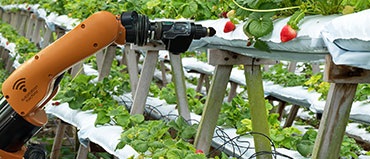
Agricultural Robots Market: Transforming the Future of Smart Farming
According to a research report “Agricultural Robots Market by Robot Type (Unmanned Aerial Vehicles, Milking Robots), Application (Harvest Management, Dairy & Livestock Management), Offering (Hardware, Software), End Use, Farming Environment, Farm Size, and Region – Global Forecast to 2030” published by MarketsandMarkets, the global agricultural robots market is estimated at USD 17.73 billion in 2025 and projected to reach USD 56.26 billion by 2030.
What is driving the growth of the agricultural robots market?
The surge in demand for automation and precision farming technologies is revolutionizing agriculture. Farmers are increasingly adopting robotics to overcome labor shortages, improve yield, and enhance operational efficiency.
Key growth drivers include:
- Integration of AI, machine learning, and IoT-enabled solutions for real-time crop monitoring.
- Rising demand for sustainable farming and resource optimization.
- Strong government support and investment in agri-tech startups worldwide.
Request Custom Data to Address your Specific Business Needs
Which segment leads in the agricultural robots market by end use?
The farm produce segment dominates the market, driven by widespread automation in planting, harvesting, and post-harvest activities.
Farmers are using robotics to:
- Boost productivity while minimizing manual effort.
- Ensure precision in weeding, irrigation, and harvesting.
- Enhance yield consistency with AI-powered monitoring and data analytics.
Major players like Deere & Company, DJI, CNH Industrial, and AGCO Corporation are actively deploying next-gen robotic systems to transform traditional farming operations.
Which farming environment segment holds the largest market share?
The outdoor farming environment holds a major share due to the heavy use of autonomous tractors, drones, and robotic harvesters in open fields.
Outdoor robots are engineered to withstand challenging weather, uneven terrains, and diverse crop types.
The growing focus on precision spraying, yield mapping, and field analytics continues to accelerate the adoption of outdoor agricultural robots globally.
Which region is leading in agricultural robot adoption?
The Asia Pacific region stands out as a major hub for agricultural robotics.
- Countries such as Japan, South Korea, and China are pioneering smart farming solutions.
- Rapid automation adoption is driven by labor shortages and the need for higher productivity.
-
Government initiatives promoting precision agriculture and sustainability further fuel market growth.
South Korea, in particular, is emerging as a leader with its strong emphasis on digital and data-driven farming ecosystems.
Who are the key players shaping the agricultural robotics market?
Prominent companies driving innovation include:
Deere & Company (US), DJI (China), CNH Industrial NV (Netherlands), AGCO Corporation (US), Delaval (Sweden), Trimble Inc. (US), Boumatic Robotic (Netherlands), Lely (Netherlands), Agjunction (US), Ageagle Aerial Systems (US), Yanmar Co. (Japan), Deepfield Robotics (Germany), Ecorobotix (Switzerland), Harvest Automation (US), Naïo Technologies (France), Robotics Plus (New Zealand), Kubota Corporation (Japan), and Monarch Tractors (US).
These agricultural robots companies are focusing on advanced sensing technologies, AI-driven analytics, and fully autonomous systems to create the next wave of intelligent farming.
What’s next for agricultural robots?
The future of farming lies in connected, autonomous, and intelligent ecosystems.
From robotic seeders to AI-powered drones, agricultural robots are redefining how food is produced. The integration of data analytics, automation, and sustainable practices will ensure that the global agricultural industry meets rising food demands while minimizing environmental impact.
80% of the Forbes Global 2000 B2B companies rely on MarketsandMarkets to identify growth opportunities in emerging technologies and use cases that will have a positive revenue impact.
- Food Packaging Market Size Set for Strong Growth Through 2030 Amid Rising Demand for Convenience Foods
- Mulch Films Market: Driving Sustainable Agriculture Through Innovation
- Agricultural Adjuvants Market Analysis, Trends, and Growth Outlook (2026–2031)
- Crop Protection Chemical Market Size, Share & Growth Forecast (2025–2030)
- Japan Enterprise Asset Management Market Growth: AI and Smart Infrastructure Drive Demand

