

Food Nanoencapsulation Market Outlook 2025–2030: Growth, Applications, and Regional Trends
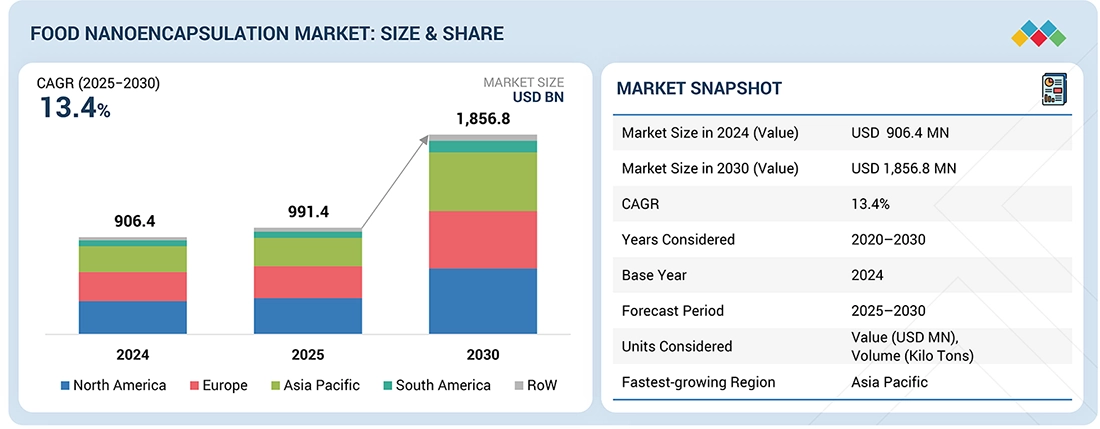
The global food nanoencapsulation market is estimated to be valued at USD 991.4 million in 2025 and is projected to reach USD 1,856.8 million by 2030, expanding at a strong CAGR of 13.4% from 2025 to 2030. This rapid growth reflects a fundamental transformation in food formulation technologies, as manufacturers increasingly adopt advanced encapsulation systems to enhance ingredient stability, bioavailability, and functional performance.
Food nanoencapsulation enables protection against heat, moisture, oxidation, and processing stress, preserving delicate bioactive compounds such as vitamins, minerals, omega-3 fatty acids, probiotics, antioxidants, and flavors. As a result, nanoencapsulation is gaining widespread acceptance across functional foods, fortified beverages, dietary supplements, infant nutrition, and clinical nutrition products, positioning it as a core enabling technology in modern food systems.
Market Drivers: Why Food Nanoencapsulation Is Accelerating
Multiple structural shifts in the food and nutrition industry are driving the adoption of nanoencapsulation:
- Rising demand for functional and preventive nutrition
- Growth in personalized nutrition and wellness-focused food products
- Increasing emphasis on clean-label stability solutions
- Need for longer shelf life and improved sensory consistency
- Demand for higher bioavailability at lower dosages
Nanoencapsulation allows food manufacturers to maintain ingredient efficacy throughout processing, storage, and consumption, while enabling controlled release mechanisms that improve nutrient absorption and product performance.
Market Size and Growth Forecast
- Market Size in 2024 (Value): USD 906.4 MN
- Market Size in 2030 (Value): USD 1,856.8 MN
- Growth Rate: CAGR of 13.4% from 2025–2030
- Years Considered: 2020–2030
- Base Year: 2024
- Forecast Period: 2025–2030
- Units Considered: Value (USD Million), Volume (Kilo Tons)
- Report Coverage: Revenue forecast, company ranking, competitive landscape, growth factors, and trends
Download PDF Brochure: https://www.marketsandmarkets.com/pdfdownloadNew.asp?id=51067411
Food Nanoencapsulation Market by Application
The application segment reflects the commercial integration of nanoencapsulation technologies across diverse food and nutrition categories:
1. Functional Foods & Dietary Products
Functional foods remain the dominant growth driver due to rising consumer interest in:
- Preventive healthcare
- Immune support
- Metabolic health
- Personalized nutrition
Nanoencapsulation enables precise release of functional ingredients in complex food matrices, ensuring process stability, storage quality, and nutrient integrity.
2. Infant & Clinical Nutrition
In infant and clinical nutrition, nanoencapsulation is valued for its ability to:
- Preserve heat- and moisture-sensitive micronutrients
- Ensure formulation uniformity
- Maintain product safety and nutrient consistency
3. Bakery, Dairy & Confectionery
In processed food categories, nanoencapsulation supports:
- Flavor protection
- Oxidation control
- Sensory stability
- Controlled release of active compounds during digestion
This application segment highlights the close linkage between nanoencapsulation adoption and the expansion of fortified, health-oriented, and convenience food products globally.
Request Sample Pages: https://www.marketsandmarkets.com/requestsampleNew.asp?id=51067411
Food Nanoencapsulation Market by Core Material (Encapsulated Ingredients)
The core material segment includes key functional ingredients integrated into nano-delivery systems:
- Vitamins
- Minerals
- Nutraceuticals
- Probiotics
- Flavoring agents
- Preservatives
- Organic acids
- Bioactive compounds
These ingredients are highly sensitive to light, heat, oxygen, and moisture, making them ideal candidates for nanoencapsulation. The technology enables:
- Improved ingredient dispersion
- Enhanced bioavailability
- Reduced ingredient degradation
- Controlled and sustained release
- Lower dosage requirements with stronger functional impact
This allows manufacturers to make health claims at lower concentrations, improve sensory consistency, and deliver targeted antimicrobial and preservative functions without compromising taste or quality.
Food Nanoencapsulation Market by Encapsulation Technique
The encapsulation technique segment represents a major area of technological innovation and competitive differentiation. Key industry focus areas include:
- Scalability and manufacturing integration
- Cost-effectiveness
- Regulatory compliance
- Food-grade material compatibility
- Clean-label formulation alignment
Advanced nano-scale delivery systems offer:
- Precise particle size control
- Optimized surface charge properties
- Tunable release profiles
- Improved solubility and dispersion
The most commercially viable techniques are those that can be integrated into existing production lines without major cost escalation, making process efficiency and performance optimization central to technology selection.
Make an Inquiry: https://www.marketsandmarkets.com/Enquiry_Before_BuyingNew.asp?id=51067411
Asia Pacific: Fastest-Growing Regional Market
The Asia Pacific region is the fastest-growing market for food nanoencapsulation globally. Growth is driven by:
- Rapid urbanization
- Rising disposable incomes
- Expanding middle-class population
- Growing nutrition awareness
- Preventive healthcare adoption
Countries such as China, India, Indonesia, and Vietnam are witnessing strong demand for:
- Fortified beverages
- Functional foods
- Dietary supplements
- Infant and toddler nutrition products
Regional food producers are investing in modern processing technologies to improve nutrient delivery, shelf life, and formulation stability. In parallel, government initiatives supporting food fortification, nutrition security, and domestic food processing capacity are accelerating market expansion.
The region’s production cost advantages, skilled labor availability, and manufacturing infrastructure position Asia Pacific as both a major consumption market and a global production hub for nanoencapsulated food ingredients.
Leading Food Nanoencapsulation Companies:
- DSM-Firmenich (Switzerland)
- International Flavors & Fragrances (IFF) (US)
- Givaudan (Switzerland)
- Kerry Group (Ireland)
- BASF SE (Germany)
- Cargill, Incorporated (US)
- Ingredion Incorporated (US)
- Tate & Lyle PLC (UK)
- Sensient Technologies (US)
- Balchem Corporation (US)
Strategic Outlook: The Future of Food Nanoencapsulation
The food nanoencapsulation market is transitioning from emerging technology to core food formulation infrastructure. Its strategic value lies in enabling:
- Functional nutrition innovation
- Clean-label product development
- Nutrient delivery optimization
- Shelf-life extension
- Product differentiation
- Health-focused branding strategies
As global demand for health-promoting, fortified, and precision-nutrition products continues to rise, food nanoencapsulation will play a defining role in shaping the next generation of advanced food systems, nutraceutical integration, and functional product design.
80% of the Forbes Global 2000 B2B companies rely on MarketsandMarkets to identify growth opportunities in emerging technologies and use cases that will have a positive revenue impact.
- Food Packaging Market Size Set for Strong Growth Through 2030 Amid Rising Demand for Convenience Foods
- Mulch Films Market: Driving Sustainable Agriculture Through Innovation
- Agricultural Adjuvants Market Analysis, Trends, and Growth Outlook (2026–2031)
- Crop Protection Chemical Market Size, Share & Growth Forecast (2025–2030)
- Japan Enterprise Asset Management Market Growth: AI and Smart Infrastructure Drive Demand

Emerging Trends and Growth Opportunities in the Food Nanoencapsulations Market
For In-depth Analysis on Food Nanoencapsulation Market
