

Soil Health Management Market Size, Share, Growth, Trends, and Forecast to 2031
The soil health management market is witnessing strong global momentum as governments, farmers, agribusinesses, and food producers increasingly prioritize sustainable agriculture and long-term soil productivity. Growing concerns regarding soil degradation, declining organic matter, nutrient depletion, and climate change are accelerating the adoption of advanced soil health solutions, including biofertilizers, biostimulants, soil amendments, soil conditioners, and specialty fertilizers.
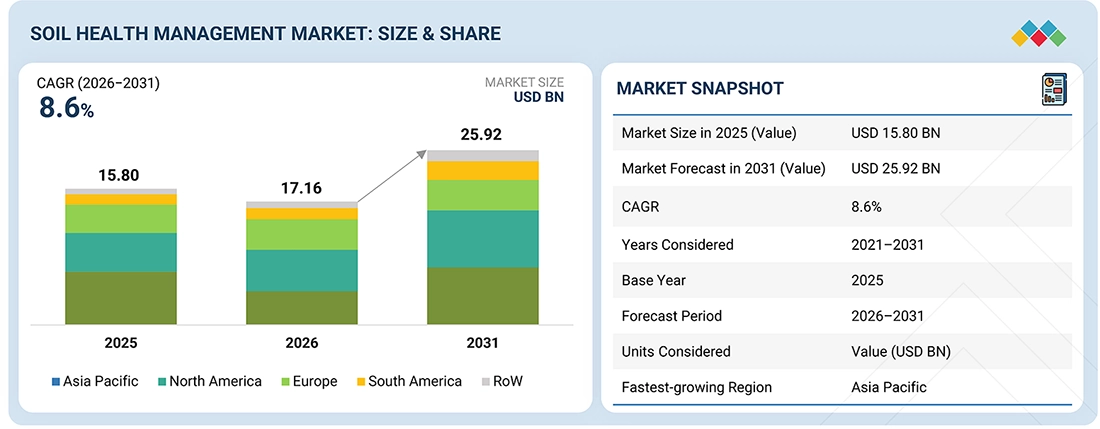
According to the latest MarketsandMarkets research, the soil health management market is estimated to be valued at USD 17.16 billion in 2026 and is projected to reach USD 25.92 billion by 2031, growing at a CAGR of 8.6% during the forecast period.
What is Driving the Soil Health Management Market?
The increasing emphasis on sustainable farming practices is one of the primary factors fueling market growth. Continuous cultivation, excessive chemical fertilizer usage, erosion, and changing climatic conditions have significantly affected soil fertility across agricultural regions. As a result, farmers are adopting integrated soil health management practices to improve crop productivity while preserving soil quality.
Additionally, rising consumer demand for organic food, supportive government initiatives promoting regenerative agriculture, and technological advancements in biological crop inputs are encouraging the widespread implementation of soil health management solutions.
Soil Health Management Market Growth Drivers
- Rising Adoption of Sustainable Agriculture: Farmers worldwide are shifting toward environmentally responsible farming techniques that maintain soil fertility, reduce chemical dependency, and improve long-term agricultural productivity.
- Increasing Demand for Biological Inputs: The growing use of biofertilizers, biostimulants, and microbial-based products is supporting healthier soils by improving nutrient availability, enhancing microbial activity, and increasing crop resilience.
- Government Support for Soil Conservation: Several governments are implementing policies, subsidies, and awareness programs that encourage sustainable nutrient management, carbon sequestration, and regenerative agricultural practices.
- Growing Food Security Concerns: With global food demand continuing to rise, improving soil productivity has become essential for achieving higher agricultural yields while protecting natural resources.
Emerging Trends Shaping the Soil Health Management Industry
Several transformative trends are shaping the future of the industry:
- Rapid adoption of regenerative agriculture practices
- Increasing integration of bio-based soil health products
- Rising use of precision agriculture technologies
- Greater emphasis on carbon farming and soil carbon sequestration
- Expansion of organic farming worldwide
- Growing investment in microbial and biological crop nutrition solutions
- Digital soil monitoring and data-driven nutrient management
These trends are helping farmers optimize resource utilization while improving crop performance and environmental sustainability.
Soil Health Management Market Opportunities
The Soil Health Management Market offers significant growth opportunities across both developed and emerging agricultural economies.
Key opportunities include:
- Expansion of organic and sustainable farming practices
- Increasing demand for bio-based crop nutrition products
- Growing investments in agricultural biotechnology
- Rising awareness regarding soil biodiversity preservation
- Development of customized soil health management solutions
- Adoption of climate-smart agricultural technologies
As agricultural stakeholders focus on improving productivity without compromising environmental health, innovative soil management products are expected to experience substantial demand.
Download PDF Brochure: https://www.marketsandmarkets.com/pdfdownloadNew.asp?id=139179355
Soil Health Management Market Segmentation
The soil health management market can be segmented by:
By Product Type
- Biofertilizers
- Biostimulants
- Soil Amendments
- Soil Conditioners
- Specialty Fertilizers
By Crop Type
- Cereals & Grains
- Fruits & Vegetables
- Oilseeds & Pulses
- Plantation Crops
- Turf & Ornamentals
- Others
By Input Source
- Bio-Based Solutions
- Chemical/Mineral-Based Solutions
By Region
- North America
- Europe
- Asia Pacific
- South America
- Rest of the World
Request Sample Pages: https://www.marketsandmarkets.com/requestsampleNew.asp?id=139179355
Soil Health Management Market Regional Analysis
North America
- North America continues to witness significant adoption of advanced soil health management technologies due to increasing investment in sustainable agriculture, precision farming, and biological crop inputs.
Europe
- Europe remains a key market, supported by stringent environmental regulations, regenerative agriculture initiatives, and increasing demand for organic food production.
Asia Pacific
- Asia Pacific is expected to experience robust growth owing to expanding agricultural activities, government support for sustainable farming, and increasing awareness of soil conservation practices in countries such as India and China.
South America
- Growing commercial agriculture and increasing adoption of biological agricultural inputs are creating favorable market opportunities across South America.
Competitive Landscape
The soil health management market is highly competitive, with leading companies focusing on product innovation, strategic partnerships, research and development, and expansion of biological product portfolios.
Leading Soil Health Management Companies
- BASF SE (Germany)
- Syngenta AG (Switzerland)
- Corteva Agriscience (United States)
- UPL Limited (India)
- Novonesis (Denmark)
- Lallemand Inc. (Canada)
- Koppert Biological Systems (Netherlands)
- Bioceres Crop Solutions (Argentina)
- Rizobacter Argentina S.A. (Argentina)
- Valagro (Italy)
- Seipasa S.A. (Spain)
- Andermatt Group AG (Switzerland)
- BioWorks Inc. (United States)
- Agrinos AS (Norway)
- The Mosaic Company (United States)
Future Outlook
The future of the Soil Health Management Market appears highly promising as sustainable agriculture becomes central to global food production strategies. Continued innovation in biological products, increasing government support for regenerative farming, and growing awareness of soil conservation will continue to drive market expansion through 2031.
The integration of precision agriculture, digital soil monitoring, and advanced microbial technologies is expected to further improve farm productivity while promoting long-term environmental sustainability.
Make an Inquiry: https://www.marketsandmarkets.com/Enquiry_Before_BuyingNew.asp?id=139179355
Frequently Asked Questions:
1. What is the current size of the Soil Health Management Market?
The Soil Health Management Market is estimated at USD 17.16 billion in 2026 and is projected to reach USD 25.92 billion by 2031, growing at a CAGR of 8.6% during the forecast period.
2. What is the projected CAGR of the Soil Health Management Market?
The global Soil Health Management Market is expected to grow at a CAGR of 8.6% from 2026 to 2031, driven by increasing adoption of sustainable farming practices and biological soil health products.
3. What factors are driving the growth of the Soil Health Management Market?
Major growth drivers include rising soil degradation, increasing demand for sustainable agriculture, expanding use of biofertilizers and biostimulants, government support for regenerative farming, and growing awareness of soil conservation.
4. What are the latest trends in the Soil Health Management Market?
Key trends include regenerative agriculture, precision farming, microbial-based soil solutions, carbon farming, digital soil monitoring, organic farming expansion, and increased use of biological crop inputs.
5. What opportunities exist in the Soil Health Management Market?
The market presents opportunities in biological soil amendments, precision agriculture technologies, organic farming, carbon sequestration initiatives, customized nutrient management solutions, and emerging agricultural economies.
6. Which regions are expected to witness significant growth in the Soil Health Management Market?
North America, Europe, and Asia Pacific are expected to experience strong growth due to government initiatives supporting sustainable agriculture, increased adoption of soil health technologies, and expanding commercial farming activities.
7. Who are the major companies operating in the Soil Health Management Market?
Leading companies include BASF SE, Syngenta AG, Corteva Agriscience, UPL Limited, Novonesis, Yara International, Nutrien Ltd., The Mosaic Company, Koppert Biological Systems, and Coromandel International Limited.
8. Why is soil health management important in modern agriculture?
Soil health management improves soil fertility, enhances nutrient availability, increases crop productivity, supports sustainable farming, reduces environmental impact, and helps maintain long-term agricultural productivity.
80% of the Forbes Global 2000 B2B companies rely on MarketsandMarkets to identify growth opportunities in emerging technologies and use cases that will have a positive revenue impact.
- Food Packaging Market Size Set for Strong Growth Through 2030 Amid Rising Demand for Convenience Foods
- Crop Protection Chemical Market Size, Share & Growth Forecast (2025–2030)
- Mulch Films Market: Driving Sustainable Agriculture Through Innovation
- Agricultural Adjuvants Market Analysis, Trends, and Growth Outlook (2026–2031)
- Japan Enterprise Asset Management Market Growth: AI and Smart Infrastructure Drive Demand

Emerging Trends and Growth Opportunities in the Soil Health Management Market
For In-depth Analysis on Soil Health Management Market
