Soil Health Management Market

Soil Health Management Market By Product Type (Biofertilizers, Biostimulants, Soil Amendments, Soil Conditioners & Specialty Fertilizers), Crop Type, Input Source (Bio-Based Solutions, Chemical/Mineral-Based Solutions), and Region - Global Forecast to 2031




OVERVIEW
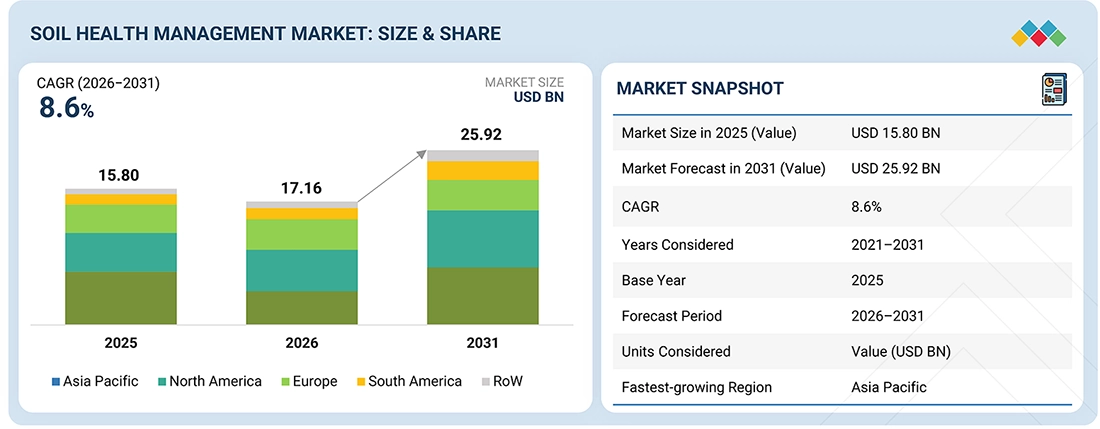
Source: Secondary Research, Interviews with Experts, MarketsandMarkets Analysis
The soil health management market is projected to reach USD 25.92 billion by 2031, up from USD 17.16 billion in 2026, at a CAGR of 8.6% from 2026 to 2031. The market is driven by growing demand to boost soil fertility, improve nutrient use efficiency, and maintain long-term agricultural output. Farmers and commercial growers are increasingly turning to biofertilizers, biostimulants, soil amendments, soil conditioners, and specialty fertilizers to address issues such as soil degradation, nutrient depletion, declining organic matter, and climate-related stress. At the same time, growers are paying closer attention to eco-friendly farming methods, regenerative agriculture programs, and how soil health affects crop resilience and yield consistency. This broader understanding is driving market expansion. Government schemes aimed at sustainable farming, along with advances in biological and specialty nutrient technologies, are accelerating adoption across regions. However, market growth can be hindered by stringent and evolving regulatory policies that vary by location. In addition, smallholder farmers in developing regions may have limited awareness, and certain advanced soil health products often cost more than standard agricultural inputs.
KEY TAKEAWAYS
-
BY REGIONAsia Pacific is projected to exhibit the highest CAGR of 11.8% during 2026-2031.
-
BY PRODUCT TYPEBy product type, the soil amendments segment is expected to dominate the soil health management market.
-
BY CROP TYPEBy crop type, the fruits & vegetables segment is projected to register a significant CAGR of 10.8% during 2026-2031.
-
BY INPUT SOURCEBy input source, the bio-based solutions segment holds a market share of more than 45%.
-
COMPETITIVE LANDSCAPE: KEY PLAYERSCompanies like BASF SE, Syngenta AG, Corteva Agriscience, and UPL Limited were identified as some of the star players in the soil health management market, given their strong market share and product footprint.
-
COMPETITIVE LANDSCAPE: STARTUPSCompanies such as Coromandel International Limited, T. Stanes & Company Limited, and Kan Biosys Pvt. Ltd. have strengthened their market presence by building a strong position in specialized niche segments, highlighting their potential for sustained growth and competitive impact.
The soil health management market is driven by growing demand for sustainable farming solutions that improve soil fertility, boost nutrient efficiency, and maintain long-term crop yields while lowering the environmental footprint. Farmers and growers are turning to soil health products because they are becoming more aware of the issues caused by soil degradation, nutrient depletion, reduced organic matter, and climate variability. It’s not just that either. The market is also gaining momentum from demand for food produced in a more responsible way, greater attention to regenerative agriculture, and continuous improvements in biofertilizers, biostimulants, soil amendments, soil conditioners, and specialty fertilizers.
TRENDS & DISRUPTIONS IMPACTING CUSTOMERS' CUSTOMERS
A key trend disrupting the soil health management market is the rapid shift toward biological and regenerative agricultural solutions. Farmers are increasingly replacing or supplementing conventional inputs with biofertilizers, microbial inoculants, biostimulants, and organic soil amendments to improve soil fertility, enhance nutrient-use efficiency, and restore soil biodiversity. Advances in soil microbiome research are enabling the development of targeted biological products that improve nutrient cycling and plant resilience. Growing interest in regenerative agriculture, carbon sequestration, and sustainable food production is accelerating the adoption of soil health products. This trend is reshaping product innovation, investment priorities, and agricultural input strategies across global farming systems.
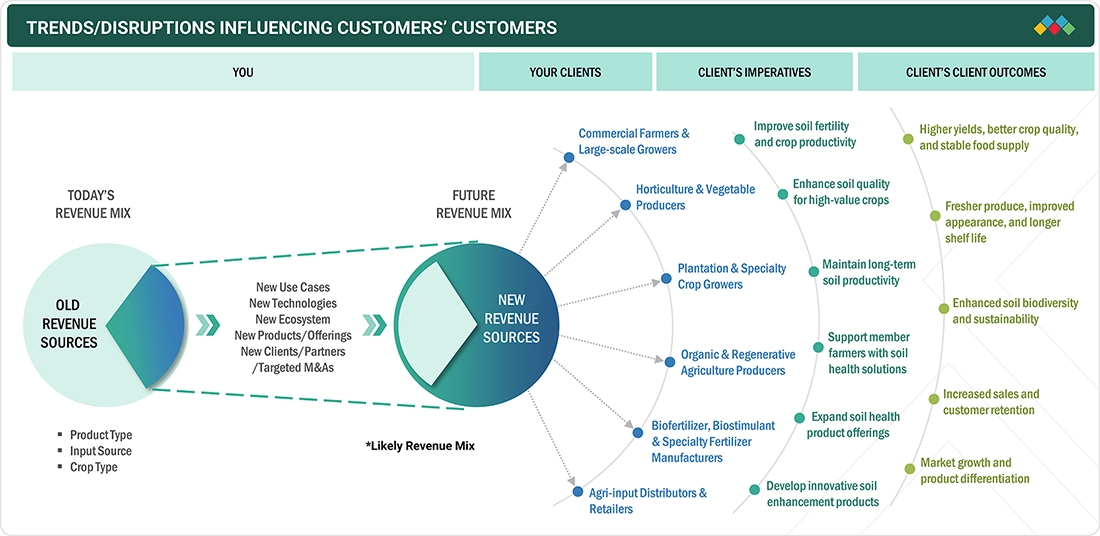
Source: Secondary Research, Interviews with Experts, MarketsandMarkets Analysis
MARKET DYNAMICS

Level
-
Increasing concerns over soil degradation and declining soil fertility

-
Growing adoption of sustainable and regenerative agriculture practices


Level
-
Limited awareness and technical knowledge among farmers in developing regions

-
Higher cost of advanced biological and specialty soil health products


Level
-
Expansion of bio-based soil health solutions and microbial technologies

-
Growing government support for sustainable agriculture and soil conservation programs


Level
-
Lack of standardized regulations and product classifications across regions

-
Variability in product performance under different soil and climatic conditions

Source: Secondary Research, Interviews with Experts, MarketsandMarkets Analysis
Driver: Increasing concerns over soil degradation and declining soil fertility
A key driver of the soil health management market is growing concern over soil degradation and declining soil fertility. Farmers are noticing nutrient depletion, soil erosion, salinization, and even the loss of organic matter, largely due to intensive farming practices, which is pushing them toward soil health products. In practice, biofertilizers, biostimulants, soil amendments, soil conditioners, and specialty fertilizers are used to help reenergize soil output by boosting nutrient availability, enhancing microbial activity, improving water retention, and supporting soil structure. And since global demand for food keeps climbing, keeping soils healthy is now kind of mandatory, not only for sustainable crop yields but also for long-term agricultural productivity.
Restraint: Limited awareness and technical knowledge among farmers in developing regions
A key restraint for the soil health management market is the limited awareness and technical knowledge among farmers in developing regions. Many growers still don’t fully understand the benefits of soil health products, so they stick to routine or conventional agricultural inputs. At the same time, limited access to extension services, on-farm field demonstrations, and agronomic coaching can block adoption of biofertilizers, biostimulants, and soil conditioners. This knowledge gap then drags down market penetration and creates noticeable disparities in adoption speeds across varied agricultural regions.
Opportunity: Expansion of bio-based soil health solutions and microbial technologies
A key opportunity for the soil health management market is the expansion of bio-based soil health solutions and microbial technologies. Advances in biotechnology, microbial formulations, and the entire biological product development pipeline are helping bring forward new solutions that boost soil fertility and improve nutrient use efficiency. At the same time, the growing desire for sustainable farming, alongside a reduced reliance on synthetic inputs, is creating favorable conditions for adoption. So, growers are increasingly turning to biofertilizers, microbial inoculants, and other biologically derived products for soil health across a broad range of cropping systems.
Challenge: Lack of standardized regulations and product classifications across regions
A key challenge for the soil health management market is the lack of standardized regulations and product classifications across regions. Regulatory expectations for biofertilizers, biostimulants, soil conditioners, and related products can vary widely from one country to the next, making things messy for makers and distributors. Registration requirements, performance proof expectations, and labeling conventions don’t align, so compliance costs rise, launches can be delayed, and global scaling becomes harder.
SOIL HEALTH MANAGEMENT MARKET: COMMERCIAL USE CASES ACROSS INDUSTRIES
| COMPANY | USE CASE DESCRIPTION | BENEFITS |
|---|---|---|
 |
Soil conditioners, specialty fertilizers, and biostimulants for cereals, oilseeds, fruits, and vegetables | Improves nutrient-use efficiency, enhances soil fertility, and supports sustainable crop production |
 |
Biological soil health solutions and microbial products for row crops and horticulture | Enhances root development, nutrient uptake, and soil microbial activity |
 |
Microbial-based soil health products and biofertilizers for broad-acre agriculture | Improves nutrient cycling, crop resilience, and soil biological function |
 |
Biofertilizers, biostimulants, and soil enhancement products for multiple crop systems | Increases soil productivity, nutrient availability, and crop performance |
Logos and trademarks shown above are the property of their respective owners. Their use here is for informational and illustrative purposes only.
MARKET ECOSYSTEM
Some of the prominent companies in this market include well-established, financially sound manufacturers of soil health management products. These companies have operated in the market for more than a decade and have diversified portfolios, the latest technologies, and excellent global sales and marketing networks. Major companies in this market include BASF SE, Syngenta AG, Corteva Agriscience, UPL Limited, Novonesis, and Koppert Biological Systems.
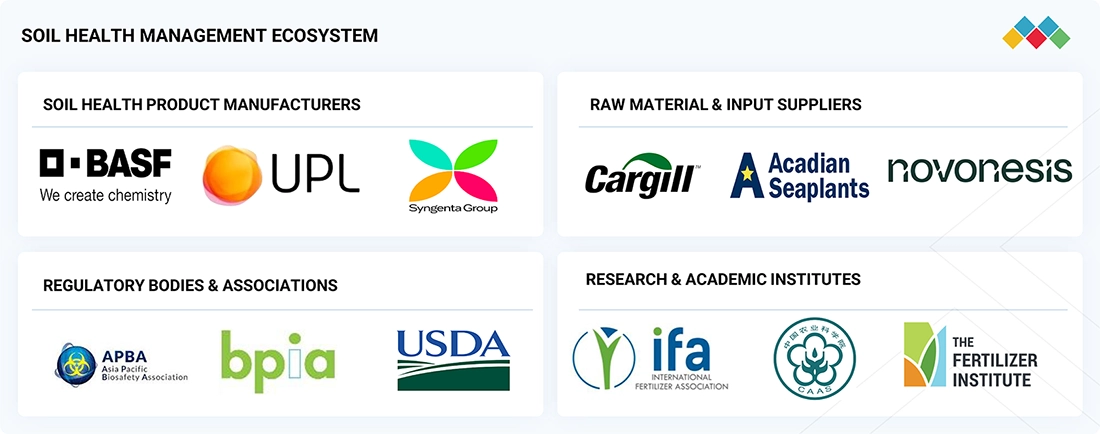
Logos and trademarks shown above are the property of their respective owners. Their use here is for informational and illustrative purposes only.
MARKET SEGMENTS
Source: Secondary Research, Interviews with Experts, MarketsandMarkets Analysis
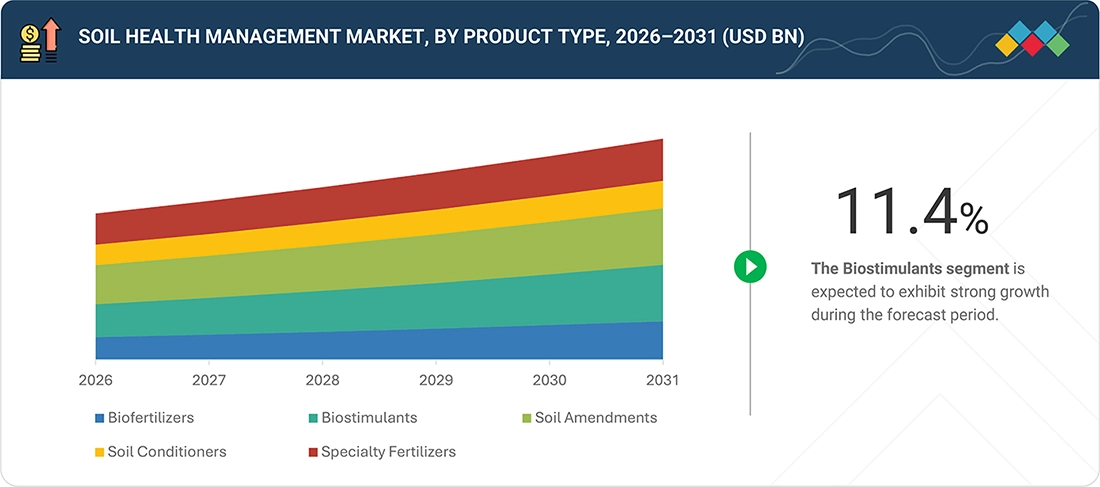
Soil Health Management Market, By Product Type
In the soil health management market, the product type segment includes biofertilizers, biostimulants, soil amendments, soil conditioners, and specialty fertilizers. Among these, soil amendments hold the largest share due to their widespread use to improve soil structure, enhance organic matter, increase water retention, and restore soil fertility across diverse agricultural systems. Products such as compost-based amendments, biochar, and organic matter enhancers are widely used to address soil degradation and declining soil productivity. Their broad applicability across cereals, oilseeds, fruits, vegetables, and plantation crops, coupled with increasing emphasis on sustainable farming practices and long-term soil health improvement, continues to support their dominant position in the market.
Soil Health Management Market, By Input Source
In the soil health management market, the input source segment comprises bio-based and chemical/mineral-based solutions. Among these, chemical/mineral-based solutions hold the largest share because of their established use in modern agriculture, immediate effectiveness, and widespread availability. Products such as specialty fertilizers, gypsum, lime, and mineral-based soil conditioners are widely adopted to correct nutrient deficiencies, improve soil chemistry, and enhance crop productivity. Their strong distribution networks, proven performance, and familiarity among farmers contribute significantly to their market leadership. While bio-based solutions are gaining traction due to sustainability concerns, chemical and mineral-based products continue to dominate because of their scalability and consistent agronomic results.
Soil Health Management Market, By Crop Type
In the Soil Health Management market, the crop type segment includes Cereals & Grains, Oilseeds & Pulses, Fruits & Vegetables, Plantation Crops, and Turf & Ornamentals. Among these, Cereals & Grains hold the largest share due to their extensive cultivation area and critical role in global food security. Major crops such as wheat, rice, maize, and barley require continuous soil fertility management to sustain productivity under intensive farming conditions. Farmers increasingly use biofertilizers, soil amendments, soil conditioners, and specialty fertilizers to improve nutrient availability, maintain soil health, and enhance crop yields. The large acreage dedicated to cereal and grain production worldwide makes this segment the largest consumer of soil health management products.
REGION
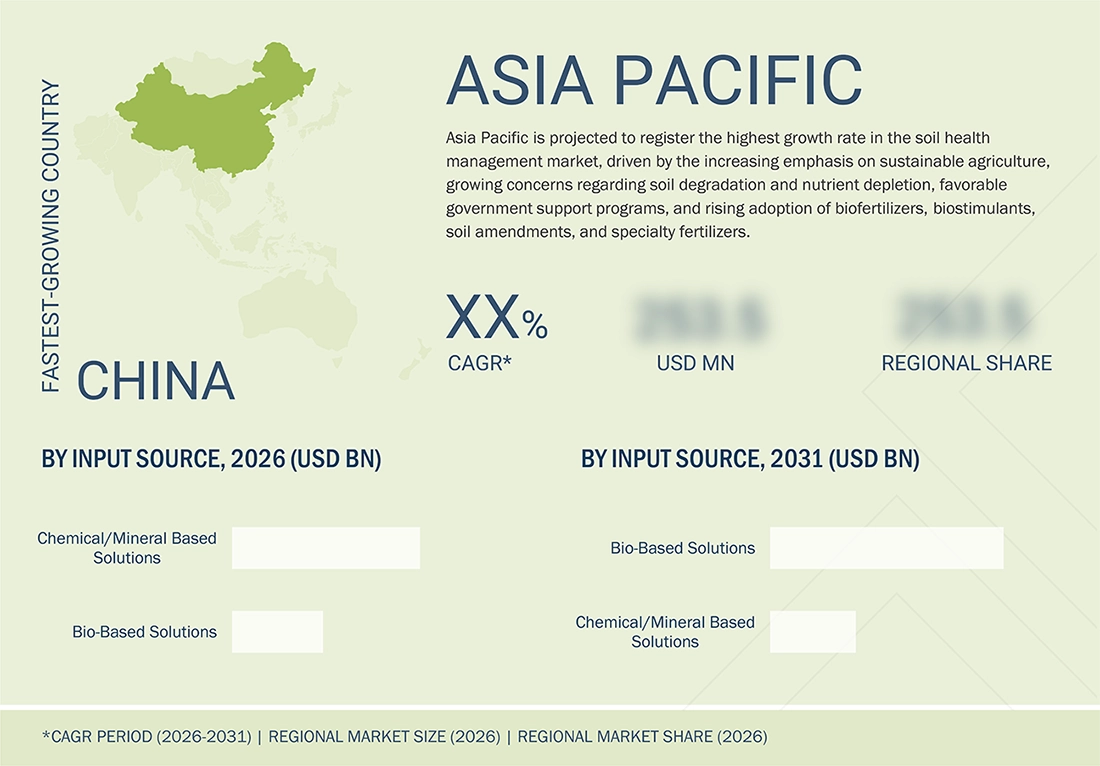
Asia Pacific to be fastest-growing region in Soil Health Management market during forecast period
Asia Pacific is expected to be the fastest-growing region in the soil health management market, driven by increasing adoption of sustainable farming practices, rising concerns about soil degradation, supportive government initiatives, and growing demand for biofertilizers, biostimulants, soil amendments, and specialty fertilizers across major agricultural economies such as China and India.
SOIL HEALTH MANAGEMENT MARKET: COMPANY EVALUATION MATRIX
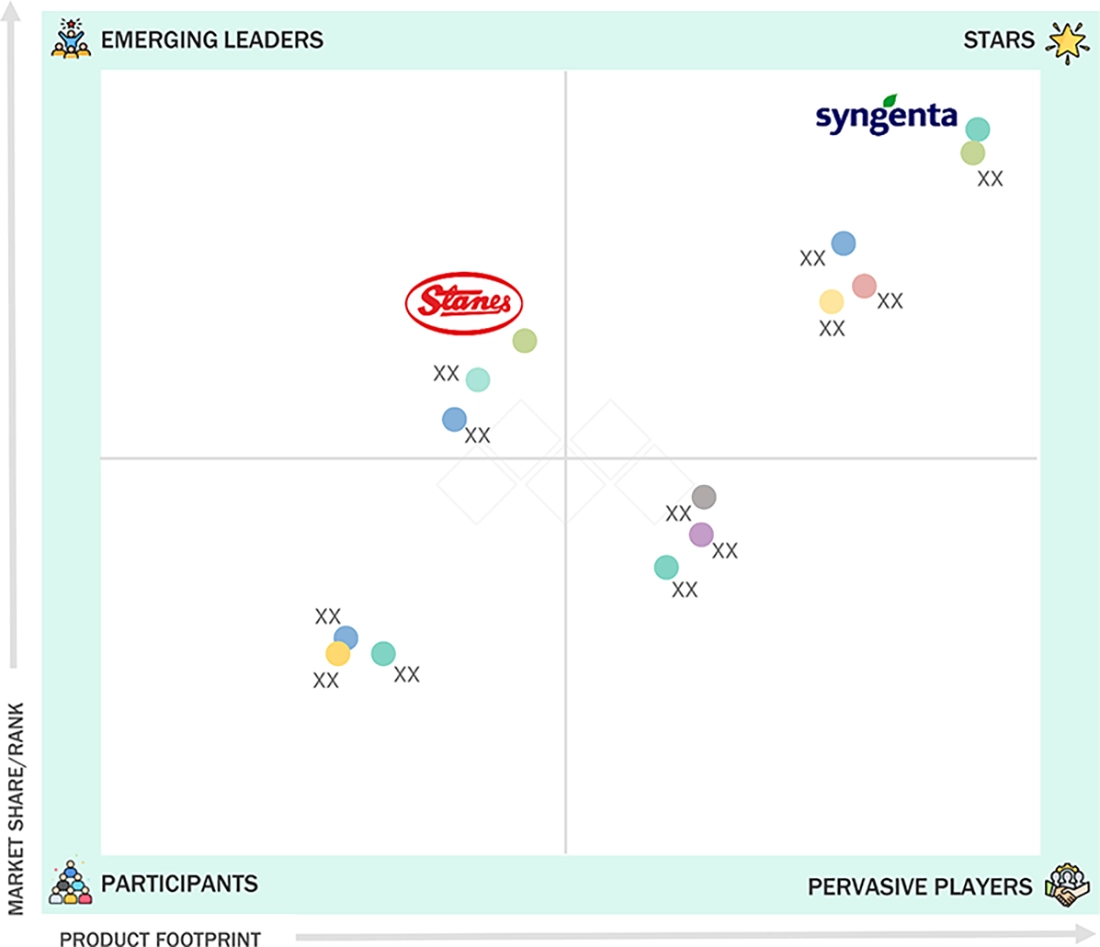
In the soil health management market matrix, Syngenta (Star) and Coretva (Star) lead the market with their comprehensive portfolio of plant health solutions, including biofertilizers, biostimulants, and specialty fertilizers that help growers improve crop resilience, yield, and sustainability outcomes. T. Stannes & Company (Emerging Leader) is emerging as a strong player by expanding its biostimulant portfolio, focusing on innovative formulations, precision application technologies, and environmental sustainability, positioning itself as a key innovator in modern crop management practices.
Source: Secondary Research, Interviews with Experts, MarketsandMarkets Analysis
KEY MARKET PLAYERS
- BASF SE (Germany)
- Syngenta AG (Switzerland)
- Corteva Agriscience (United States)
- UPL Limited (India)
- Novonesis (Denmark)
- Lallemand Inc. (Canada)
- Koppert Biological Systems (Netherlands)
- Bioceres Crop Solutions (Argentina)
- Rizobacter Argentina S.A. (Argentina)
- Valagro (Italy)
- Seipasa S.A. (Spain)
- Andermatt Group AG (Switzerland)
- BioWorks Inc. (United States)
- Agrinos AS (Norway)
- The Mosaic Company (United States)
MARKET SCOPE
| REPORT METRIC | DETAILS |
|---|---|
| Market Size in 2025 (Value) | USD 15.80 Billion |
| Market Forecast in 2031 (value) | USD 25.92 Billion |
| Growth Rate | CAGR of 8.6% during 2026-2031 |
| Years Considered | 2021-2031 |
| Base Year | 2025 |
| Forecast Period | 2026-2031 |
| Units Considered | Value (USD Million/Billion) |
| Report Coverage | Revenue forecast, company ranking, competitive landscape, growth factors, and trends |
| Segments Covered |
|
| Regions Covered | North America, Europe, Asia Pacific, South America, Rest of the World |
WHAT IS IN IT FOR YOU: SOIL HEALTH MANAGEMENT MARKET REPORT CONTENT GUIDE
DELIVERED CUSTOMIZATIONS
We have successfully delivered the following deep-dive customizations:
| CLIENT REQUEST | CUSTOMIZATION DELIVERED | VALUE ADDS |
|---|---|---|
| Soil Health Product Manufacturer |
|
|
| Agricultural Input Distributor |
|
|
| Biofertilizer & Biostimulant Company |
|
|
| Specialty Fertilizer & Soil Conditioner Manufacturer |
|
|
| Investor/Private Equity Firm |
|
|
RECENT DEVELOPMENTS
- October 2024 : Acadian Seaplants Limited and BASF formed a strategic partnership to develop innovative agricultural solutions, providing climate-resilient products that enhance crop yield and quality. Under this partnership, BASF will integrate Acadian’s advanced biostimulant technology into its comprehensive chemistry and biological portfolio, expanding its sustainable crop solutions.
- October 2024 : Elicit Plant and BASF France – Agro Division partnered for the 2024-2025 campaign to advance the development of the biostimulants, EliSun-a and EliGrain-a, targeting the sunflower and cereal markets in France.
- March 2024 : FMC Corporation announced a collaboration in Canada with Novonesis, formerly Novozymes A/S, a leader in plant biosolutions. This collaboration is part of FMC’s strategic plan to expand its biologicals platform in key markets.
Table of Contents
 Exclusive indicates content/data unique to MarketsandMarkets and not available with any competitors.
Methodology
The study involved two major approaches in estimating the current size of the soil health management market. Exhaustive secondary research was done to collect information on the market, peer, and parent markets. The next step was to validate these findings, assumptions, and sizing with industry experts across the value chain through primary research. Both top-down and bottom-up approaches were employed to estimate the complete market size. After that, market breakdown and data triangulation were used to estimate the market size of segments and subsegments.
Secondary Research
This research study involved the extensive use of secondary sources—directories and databases such as Bloomberg Businessweek and Factiva—to identify and collect information useful for a technical, market-oriented, and commercial study of the market.
In the secondary research process, various sources such as annual reports, press releases & investor presentations of companies, white papers, food journals, certified publications, articles from recognized authors, directories, and databases were referred to identify and collect information.
Secondary research was mainly used to obtain key information about the industry’s supply chain, the total pool of key players, and market classification and segmentation as per the industry trends to the bottom-most level, regional markets, and key developments from both market- and technology-oriented perspectives.
Primary Research
Extensive primary research was conducted after obtaining information regarding the soil health management market scenario through secondary research. Several primary interviews were conducted with market experts from both the demand and supply sides across major countries of North America, Europe, Asia Pacific, South America, and the Rest of the World. Primary data was collected through questionnaires, emails, and telephone interviews. The primary sources from the supply side included various industry experts, such as Chief X Officers (CXOs), Vice Presidents (VPs), Directors from business development, marketing, research, and development teams, and related key executives from distributors and key opinion leaders. Primary interviews were conducted to gather insights such as market statistics, data on revenue collected from the products and services, market breakdowns, market size estimations, market forecasting, and data triangulation. Primary research also helped in understanding the various trends related to soil health managements product type, crop type, input source, and region. Stakeholders from the demand side, such as research institutions and universities, agrochemical distributors and retailers, and food processing companies, were interviewed to understand the buyer’s perspective on the suppliers, products, and their current usage of soil health management and the outlook of their business, which will affect the overall market.
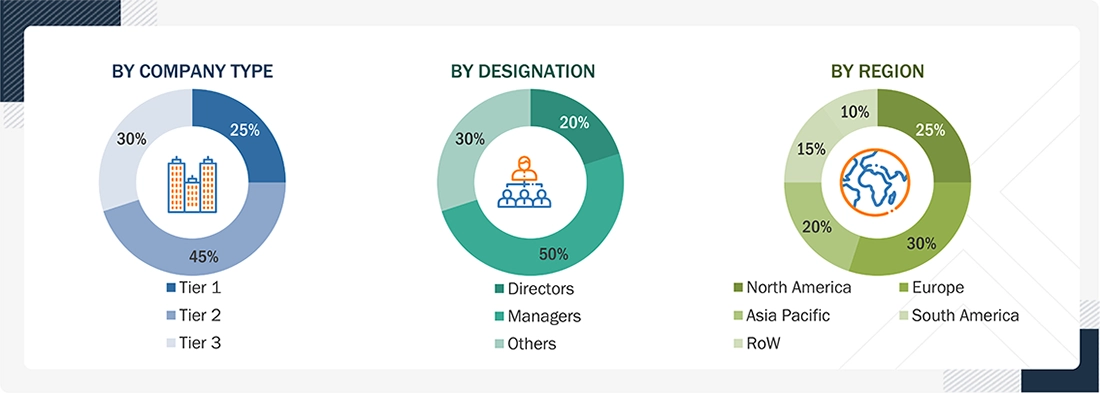
Note: The three tiers of the companies are defined based on their total revenues in 2022 or 2023, as per the availability of financial data: Tier 1: Revenue > USD 1 billion; Tier 2: USD 100 million ≤ Revenue ≤ USD 1 billion; Tier 3: Revenue < USD 100 million.
To know about the assumptions considered for the study, download the pdf brochure
|
COMPANY NAME |
DESIGNATION |
|
UPL (India) |
General Manager |
|
BASF SE (Germany) |
Sales Manager |
|
Syngenta Group (Switzerland) |
Manager |
|
Corteva Agriscience (US) |
Sales Manager |
|
Novonesis (Denmark) |
Marketing Manager |
Market Size Estimation
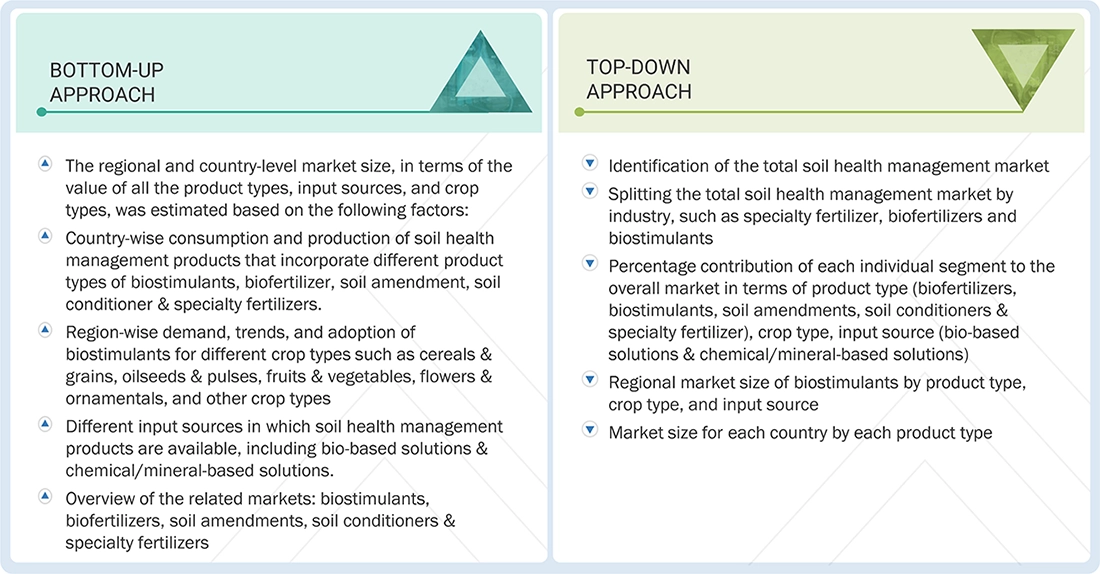
Both the top-down and bottom-up approaches were used to estimate and validate the total size of the soil health management market. These approaches were also used extensively to determine the size of various subsegments in the market. The research methodology used to estimate the market size includes the following details:
- The key players in the industry and the overall markets were identified through extensive secondary research.
- All shares, splits, and breakdowns were determined using secondary sources and verified through primary sources.
- All possible parameters that affect the market covered in this research study were accounted for, viewed in extensive detail, verified through primary research, and analyzed to obtain final quantitative and qualitative data.
- The research included the study of reports, reviews, and newsletters of top market players, along with extensive interviews for opinions from leaders, such as CEOs, directors, and marketing executives.
Data Triangulation
After arriving at the overall market size from the estimation process explained above, the total market was split into several segments and subsegments. The data triangulation and market breakdown procedures were employed, wherever applicable, to estimate the overall soil health management market and arrive at the exact statistics for all segments and subsegments. The data was triangulated by studying various factors and trends from the demand and supply sides. The market size was also validated using both the top-down and bottom-up approaches.
Market Definition
The soil health management market comprises commercial agricultural products designed to improve and maintain the physical, chemical, and biological properties of soil, thereby enhancing soil fertility, nutrient availability, microbial activity, soil structure, water retention, and overall crop productivity. The market includes biofertilizers, biostimulants, soil amendments, soil conditioners, and specialty fertilizers that are applied to agricultural soils to support sustainable crop production and long-term soil functionality.
Key Stakeholders
- International Fertilizer Association (IFA)
- The Fertilizer Institute (TFI)
- European Biostimulants Industry Council (EBIC)
- Biological Products Industry Alliance (BPIA)
- International Biocontrol Manufacturers Association (IBMA)
- International Plant Nutrition Institute (IPNI)
- United States Environmental Protection Agency (US EPA)
- Canadian Food Inspection Agency (CFIA)
- European Chemicals Agency (ECHA)
- Directorate-General for Health and Food Safety (DG SANTE)
Report Objectives
- To determine and project the size of the soil health management market with respect to the product type, input source, crop type, and region in terms of value over five years, ranging from 2026 to 2031.
- To identify the attractive opportunities in the market by determining the largest and fastest-growing segments across regions
- To provide detailed information about the key factors influencing market growth (drivers, restraints, opportunities, and challenges)
- To analyze the opportunities in the market for stakeholders and provide details of the competitive landscape for market leaders
- To analyze the micro-markets with respect to individual growth trends, prospects, and their contribution to the total market
- To identify and profile the key players in the soil health management market
- To understand the competitive landscape and identify the major growth strategies adopted by players across the key regions
Customization Options :
With the given market data, MarketsandMarkets offers customizations according to company-specific scientific needs.
The following customization options are available for the report:
Product Analysis
- Product Matrix, which gives a detailed comparison of the product portfolio of each company.
Segmental Analysis
With the given market data, MarketsandMarkets offers customizations according to company-specific scientific needs.
- Further breakdown of the Rest of Europe soil health management market into key countries.
- Further breakdown of the Rest of Asia Pacific soil health management market into key countries.
- Further breakdown of the Rest of South America soil health management market into key countries.
Product Analysis
- Detailed analyses and profiling of additional market players (up to five)


Personalize This Research
- Triangulate with your Own Data
- Get Data as per your Format and Definition
- Gain a Deeper Dive on a Specific Application, Geography, Customer or Competitor
- Any level of Personalization
Let Us Help You
- What are the Known and Unknown Adjacencies Impacting the Soil Health Management Market
- What will your New Revenue Sources be?
- Who will be your Top Customer; what will make them switch?
- Defend your Market Share or Win Competitors
- Get a Scorecard for Target Partners

Custom Market Research Services
We Will Customise The Research For You, In Case The Report Listed Above Does Not Meet With Your Requirements
Get 10% Free CustomisationTESTIMONIALS

Business Innovation Director
US Based Leading Agribusiness,
Food and Ingredients ManufacturerI highly appreciate the team's efficiency for a well conducted study that helped us clarify some blind spots in food and agricultural niche markets. Although compiling information for B2B markets is very difficult, the MnM team pulled out the task successfully. The quality of research, level of insights, and responsiveness of team were commendable.






Growth opportunities and latent adjacency in Soil Health Management Market